The BLUE PRESS JOURNAL

We aim to be a voice in the ongoing political discourse, providing both factual information and opinionated analysis, from a progressive or center-left perspective, free from the direct influence of major
established Main Street Media.

  • Why Venezuela is No Panama: U.S. Intervention Risks

    Blue Press Journal – When American policymakers reflect on the past century of interventions in Latin America, one case remains prominent in Washington’s historical narrative: Operation Just Cause, the 1989 invasion of Panama. It exemplified what many would categorize as a “successful” U.S. intervention—swift, decisive, and ostensibly judicious. Within a span of less than two weeks, the United States effectively removed General Manuel Noriega, established a compliant government led by Guillermo Endara, and largely withdrew its military presence. There was no protracted insurgency, nor any humiliating deadlock. For numerous officials in Washington, this operation represented an uncommon occasion where military force achieved the precise objectives sought by the White House.

    But Venezuela is not Panama, and any attempt to treat it as such risks a catastrophic misreading of history and geography alike.


    A Different Battlefield

    When George H.W. Bush ordered troops into Panama, the United States already had a military footprint deeply embedded in the country. The U.S. Southern Command was headquartered there. More than 10,000 American troops were stationed on the ground, with full logistical networks, airfields, and intelligence infrastructure ready to act. The operation didn’t need to project power across oceans—it was already in place. American forces quickly dismantled the Panama Defense Forces, captured Noriega, and oversaw a relatively orderly transfer of power.

    None of these conditions exist in Venezuela.

    Today, U.S. forces sit offshore—aboard the USS Gerald R. Ford and the Iwo Jima Amphibious Ready Group, impressive symbols of U.S. power, but still distant from the realities of governing a nation of nearly 28 million people. A lightning strike might remove a head of state, but it cannot occupy, stabilize, or rebuild a country with deep institutional and social fissures. The challenge is not the operation itself—it’s “the day after.”


    The Problem of What Comes Next

    In Panama, the United States could install Endara because Panama’s political elite were, by and large, aligned with Washington’s interests. The country had long functioned under U.S. influence, its economy tied to the Canal Zone, its military modest and dependent.

    Venezuela, however, has evolved under an entirely different model. The Bolivarian Armed Forces (FANB)remain cohesive and loyal to the state, not fractured and demoralized like Noriega’s forces were in 1989. Defense Minister Vladimir Padrino López has already called for “massive deployment” to resist foreign troops, and Vice President Delcy Rodríguez has vowed that the government “will not yield.” Even if Nicolás Maduro is removed, the apparatus that sustains his regime will not vanish overnight. 

    The Trump Administration faced this reality as early as 2019, when it backed opposition figure Juan Guaidó. Washington assumed that diplomatic pressure, sanctions, and a show of resolve would fracture the regime. It didn’t. The military held firm. The same dynamic is likely to repeat if the U.S. attempts to enforce regime change by force.


    Geopolitics Beyond Caracas

    There’s also the matter of global reaction. Panama’s invasion occurred at the tail end of the Cold War, when the Soviet Union was collapsing and China was not yet a global power. The world’s geopolitical center of gravity allowed the U.S. to act with relative impunity.

    Venezuela, by contrast, is a strategic partner to China, which has invested billions in its oil sector, infrastructure, and digital networks. Beijing will not view an American intervention as a regional policing operation—it will see it as a direct challenge to its influence. Russia, too, has military advisers and energy interests in Venezuela. The consequences of unilateral U.S. action ripple far beyond the Caribbean.

    Regionally, the response has been equally fraught. Mexico’s government has condemned the operation, warning that any foreign military action “seriously jeopardizes regional stability.” Other Latin American nations, still wary of U.S. interventionism, are divided or outright hostile. The vision of a hemispheric coalition supporting American leadership has not materialized.


    Legitimacy and the Law

    The Trump Administration’s refusal to clarify whether it sought congressional authorization speaks volumes. The War Powers Resolution exists precisely to prevent unilateral executive military adventures, yet Washington has seen a steady erosion of those constraints. Declaring victory from the podium is easy; governing a fractured post-conflict society is not. 

    And here lies the uncomfortable truth: whatever one thinks of Maduro’s legitimacy—and few would argue he won the July 2024 election fairly—toppling an autocrat is not the same as creating a democracy. Without a credible plan for governance, reconstruction, and reconciliation, military action risks deepening chaos rather than resolving it.


    The Mirage of “Just Cause 2.0”

    Every generation of U.S. policymakers seems to search for its own “Just Cause”—the operation that proves American power can still reshape the world for the better. But history rarely repeats so neatly. Panama was small, strategically contained, and already under Washington’s thumb. Venezuela is large, complex, and enmeshed in global rivalries that make any intervention far more perilous.

    If history offers any lesson, it is this: a quick victory on the battlefield can mask a long defeat in the years that follow. Without legitimacy, without local support, and without a plan for the day after, even the most “successful” operation risks becoming another cautionary tale.


    In the end, the question is not whether Maduro deserves to stay—by most accounts, he does not—but whether the United States, acting alone and without a clear mandate, can deliver something better. Panama’s ghost still haunts Washington, whispering promises of easy triumph. But Venezuela, in all its complexity and resistance, is poised to remind America that history is a poor template for wishful thinking.

  • Trump’s Unilateral Invasion of Venezuela Is a Constitutional Crisis

    BLUE PRESS JOURNAL – Two months ago, Donald Trump’s own Chief of Staff, Susie Wiles, said something that now sounds almost prophetic. In an interview with Vanity Fair, she made it plain: if the president “were to authorize some activity on land, then it’s war, then [we’d need] Congress.” 

    She was right — and now, Trump has done exactly what she warned against. 

    Overnight, the former president ordered U.S. forces into Venezuela, capturing its embattled leader, Nicolás Maduro, without so much as a phone call to Congress. No debate. No authorization. No transparency. Just a unilateral act of war. 

    By the reasoning of his own chief of staff — and by the plain text of the Constitution — this was illegal. Trump broke the law. He violated the Constitution. And, in doing so, he upended one of the most fundamental checks on presidential power in American history. 

    This morning, standing beside Vice President J.D. Vance, Trump confirmed what many had already suspected: the operation was not merely about so-called “narco-terrorism.” It was also about oil. “We’re securing resources that rightfully belong to the free world,” he said. In other words, the U.S. military was sent into a sovereign nation, at least in part, for profit and political theater. 


    Democrats Call It “Lawless and Dangerous”

    Democrats on Capitol Hill were quick to condemn the move. Senator Elizabeth Warren called it “a lawless and dangerous abuse of power.” Representative Alexandria Ocasio-Cortez said, “This is exactly why Congress — not one man — has the power to declare war. The framers of our Constitution saw this kind of executive overreach coming.” 

    Even Democratic moderates voiced alarm. Senator Chris Murphy warned, “If we let this stand, we’re saying any president can unilaterally start a war anywhere in the world. That’s not democracy — that’s monarchy.” 

    To Democrats, this isn’t just another Trump stunt; it’s a full-blown constitutional crisis. 


    Why This Is Unconstitutional — in Plain English

    Here’s the simple version: the Constitution divides the power to make war between Congress and the President. Article I, Section 8 gives Congress the power to declare war. The President, under Article II, can direct the military only after Congress gives authorization — or in response to a direct attack on the United States. 

    Trump did neither. Venezuela did not attack the U.S., and Congress never approved military action. 

    The War Powers Resolution of 1973 was designed to prevent exactly this kind of unilateral decision-making. It says the president can send U.S. forces into combat only if (1) Congress has declared war, (2) Congress has given specific authorization, or (3) the U.S. is under imminent threat. Even then, the law requires the president to notify Congress within 48 hours and withdraw troops after 60 days if Congress does not approve the action. 

    Trump ignored all of that. He didn’t consult Congress. He didn’t meet the conditions. He simply acted — as though the law didn’t apply to him. 


    The Bigger Danger

    By discarding both the Constitution and the War Powers Resolution, Trump has done more than violate the law — he’s set a precedent that could haunt America for decades. If the U.S. can invade a sovereign nation for oil or political gain, what moral ground do we have to criticize China for threatening Taiwan, or Russia for pushing deeper into Eastern Europe? 

    As one Democratic strategist put it, “We can’t claim to defend democracy abroad when we’re dismantling it at home.” 

    Even critics of Nicolás Maduro — and there are many — understand this. Maduro’s regime has been accused of corruption, election-rigging, and brutality. But the fact that he’s an illegitimate ruler doesn’t give the American president a blank check to break our own laws. 


    The Verdict

    Trump’s invasion of Venezuela is not just a foreign policy blunder — it’s a direct assault on the American system of government. The framers designed a balance of powers precisely to stop one person from dragging the country into war for personal or political reasons. 

    By disregarding the delicate balance of power, Trump has done far more than merely deploy troops overseas; he has fundamentally destabilized the very pillars of American democracy. The actions of Congress and the courts in curbing his authority will not only shape the outcome of this military operation but could ultimately redefine the trajectory of presidential power in the United States for generations to come.

  • A Dangerous Precedent: The U.S. Strike on Venezuela and the Capture of Nicolás Maduro

    BLUE PRESS JOURNAL (DC) – In an extraordinary and deeply troubling escalation, the United States launched a series of strikes on Venezuela last night, culminating in the capture and removal of President Nicolás Maduro. According to administration statements, Maduro was flown out of the country in what U.S. officials described as a “decisive operation.” But behind the dramatic headlines lies a disturbing question about legality, precedent, and the moral cost of such unilateral actions.

    The Trump administration’s decision to forcibly remove a sitting foreign leader without congressional authorization or clear international mandate marks one of the most audacious U.S. interventions in Latin America in decades. Not since the 1989 invasion of Panama — which ended with the seizure of Manuel Noriega — has Washington so overtly used military force to change a government in the Western Hemisphere. Then, as now, the justification was murky and the fallout unpredictable.

    The legal authority for this attack remains unclear. Reports indicate that neither the Armed Services Committees nor the broader Congress were notified in advance, an omission that starkly violates the principles of civilian oversight of the military. The War Powers Resolution exists precisely to prevent presidents from waging undeclared wars, and yet it seems to have been ignored once again.

    Beyond legalities, the moral and geopolitical implications are staggering. By unilaterally abducting a sitting president, the U.S. risks reigniting a long and painful history of interventionism in Latin America — a history that has often bred instability, resentment, and violence rather than democracy. The Venezuelan government has already called the attack an “imperialist assault,” urging citizens into the streets. Civilian and military casualties have been reported, deepening the country’s suffering at a moment when its economy and institutions are already fragile.

    President Trump’s comment that the U.S. will be “very much involved” in Venezuela’s future only compounds the concern. What does “involvement” mean in this context — occupation, trusteeship, regime installation? Whatever the answer, the precedent is perilous. If the world’s leading democracy can seize foreign leaders at will, the international order built on sovereignty and law begins to crack.

  • What Is a Cognitive Test—and Why Does Donald Trump Keep Taking Them?

    Blue Press Journal – When President Donald Trump boasts about “acing” a cognitive exam for the third straight time, it raises more questions than it answers. Cognitive tests are not intelligence contests; they’re simple screening tools doctors use to evaluate memory, attention, and problem-solving skills—often in patients showing signs of cognitive decline. So why does Trump keep taking them, and why does he feel the need to advertise the results?

    A standard cognitive test, such as the Montreal Cognitive Assessment (MoCA), might ask someone to identify animals from pictures, recall five words after a few minutes, or draw a clock showing a certain time. Scoring well doesn’t prove genius—it simply indicates that basic cognitive functions are intact. Most adults without impairment would easily “ace” it. That’s why medical experts find Trump’s repeated emphasis on his performance puzzling, even concerning.

    Trump’s latest Truth Social post, insisting that anyone running for high office should undergo a “strong, meaningful” cognitive exam, feels less like a policy suggestion and more like projection. If he’s indeed taken the test three times, it suggests that either his doctors or his team are monitoring potential issues—or that he wants to preempt speculation about his health by loudly proclaiming his mental sharpness. The bruises spotted on his hands and his occasional slurred speech have only fueled public curiosity.

    Critics argue that Trump’s obsession with “acing” a basic screening betrays insecurity rather than strength. Instead of reassuring voters, it highlights how defensive he becomes over any hint of vulnerability. After all, a healthy, confident leader doesn’t need to brag about remembering five words or drawing a clock correctly.

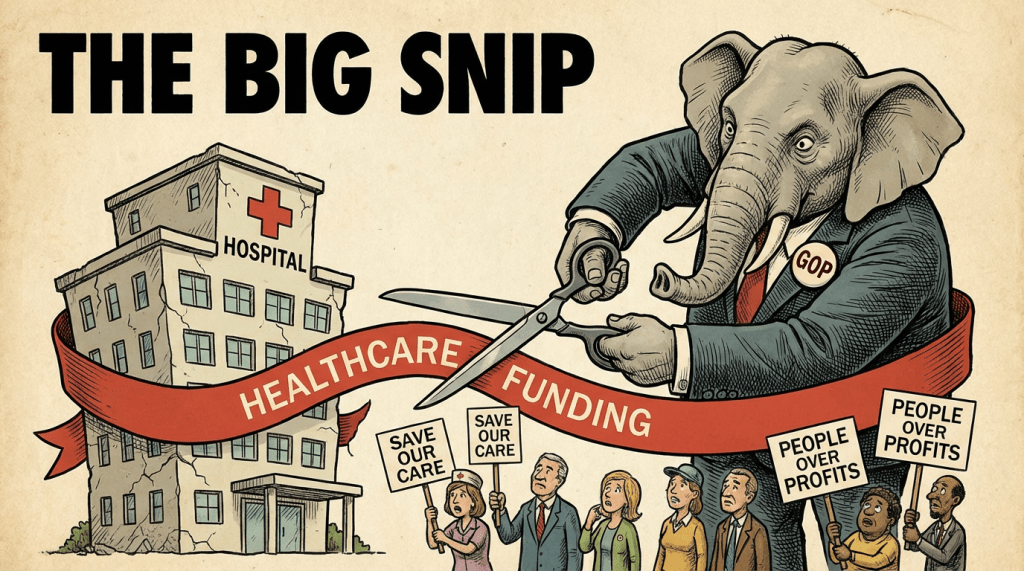
  • Rising Health Care Costs: Who’s Really to Blame – Republican’s


    Blue Press Journal – Health care costs in the United States are climbing at an alarming rate — and millions of Americans are feeling the financial strain. According to DCCC Chair Suzan DelBene (D-Wash.), the responsibility lies squarely with House Republicans. 

    DelBene points out that instead of addressing spiking health care costs with meaningful solutions, House Republicans prioritized massive tax breaks for the wealthiest Americans. Even more concerning, they blocked a floor vote that could have preserved vital health care tax credits, that expired on January 1, 2026

    For families already struggling with medical bills, the expiration of these credits could mean higher premiums, reduced access to care, and increased economic hardship. As the deadline approaches, the debate over who benefits from policy decisions — and who pays the price — is intensifying. 

    The American public is wide awake and watching! The pivotal question is whether voters will rise up in 2026 to hand control over to Democrats who steadfastly champion the interests of everyday Americans, not the wealthy elite of billionaires and millionaires.

  • Jack Smith’s Testimony and the Truth Trump Never Wanted Revealed

    BLUE PRESS JOURNAL – The latest revelations from former Special Counsel Jack Smith’s closed-door interview with the House Judiciary Committee offer a sobering reminder of how far Donald Trump and his allies were willing to go to hold onto power after losing the 2020 election. While the session was held behind closed doors, reports of what was said inside make clear why some Republican lawmakers, including Committee Chair Jim Jordan, had no interest in making the testimony public.

    Smith’s investigation—now dismissed—had sought to determine the extent of Trump’s direct involvement in efforts to overturn the election and his mishandling of classified documents after leaving the White House. What’s emerging from this new account is not just a picture of political hardball, but of a deliberate campaign built on lies that even Trump’s closest associates didn’t believe.

    One of the most striking details involves Rudy Giuliani, Trump’s personal lawyer and architect of his post-election legal strategy. Smith’s inquiry reveals Giuliani admitted he didn’t believe the conspiracy theories he promoted—and neither did Donald Trump. This confession undermines the “Stop the Steal” narrative: it was not based on genuine grievance, but a calculated deception to inflame supporters and delegitimize a lawful election.

    If Trump and Giuliani both knew their claims were false, then the entire post-election chaos—from the flood of lawsuits to the violence of January 6th—was built on a conscious lie. This undermines any argument that Trump was simply misled or acting out of misguided conviction. It paints a portrait of a leader willing to endanger democracy itself for personal gain.

    The Republicans who sought to limit public access to Smith’s testimony likely understood how damaging such revelations could be. A clear-eyed look at the evidence doesn’t just implicate Trump; it also raises uncomfortable questions about those in Congress who continue to defend him, even as the factual record grows darker.

    Trump’s defenders often dismiss these investigations as partisan witch hunts, but Smith’s work reveals a graver truth: a former president, aware of his loss, attempted to weaponize the government and his followers to maintain power. This behavior is not that of a patriot—it’s someone who views democracy as expendable.

    As more details come to light, the question is no longer whether Trump believed his own lies. It’s whether the country is prepared to hold him accountable for them.

  • Trump’s Aspirin Folly: When Ego Trumps Expertise

    Blue Press Journal – President Trump’s recent revelation that he’s doubling down on aspirin therapy to “thin” his blood has once again exposed a confusing blend of self-diagnosis and bedside intuition—and it drew swift rebuttal from experts. In an interview with the Wall Street Journal, the 79-year-old commander in chief explained, “I don’t want thick blood pouring through my heart. I want nice, thin blood pouring through my heart. Does that make sense?” 

    Dr. Jonathan Reiner, a respected cardiologist who treated former Vice President Dick Cheney, didn’t mince words when asked about Trump’s unconventional regimen on CNN’s The Lead. “That actually makes no sense,” Reiner declared. “When we use anticoagulant medications to prevent clotting, they don’t ‘thin’ the blood like changing gumbo to chicken soup. They simply reduce the chance of clot formation.” In other words, the president’s catchy metaphor has no basis in medical reality.

    Beyond the semantics, Trump’s high-dose aspirin use carries risks. The American Heart Association warns that people over 70 using aspirin to prevent a first heart attack or stroke may face more harm than benefit due to increased bleeding risk. Self-medicating at that age is a gamble with serious consequences.

    Trump, who has dismissed health concerns, favors his instincts over medical advice. At a time when cardiovascular vigilance is crucial, his cavalier attitude and reliance on pseudo-medical explanations highlight a troubling trend: expertise is overlooked when it conflicts with his gut feelings or media soundbites.

  • Big Changes Coming to Your Healthcare Costs in 2026 — And Who’s (Not) Helping You

    Health Care Premium Hike in 2026: and Republicans Refuse to Act

    Blue Press Journal – On January 1, 2026, millions of Americans will face a painful spike in health insurance premiums. This surge is directly tied to the scheduled expiration of the enhanced subsidies under the Affordable Care Act (ACA) — subsidies first expanded under the American Rescue Plan in 2021 and extended through 2025 by the Inflation Reduction Act.

    If Congress fails to extend these subsidies, health care costs will rise sharply — and the Republican Party, led by Donald Trump, has made it clear they have no intention of renewing them.


    How Much Will Premiums Rise?

    According to the Congressional Budget Office and Kaiser Family Foundation analysis, without the enhanced ACA subsidies:

    • Middle-income families (earning $50,000–$75,000/year) will see average annual premiums increase by $1,200–$2,400 per household.
    • Older enrollees in their early 60s could see premiums jump by $4,000–$6,000 annually in some states.
    • Nationally, the average premium for a benchmark silver plan could rise up to 53% for those losing subsidy eligibility.
    • The number of uninsured Americans could increase by 3–4 million in 2026 alone.

    Projected Annual Premium Increases by Income Bracket (when subsidies lapse)

    Annual Income (Family of 3)Avg. Premium Increase (National)Example State Impact
    $35,000 (150% FPL)$0–$500 (still eligible for some subsidy)CA: +$300
    $55,000 (250% FPL)+$1,800TX: +$2,200
    $85,000 (400% FPL)+$4,500FL: +$5,000
    $120,000 (550% FPL)+$6,600WY: +$7,200

    (FPL = Federal Poverty Level; figures based on KFF and CBO modeling)


    Why Enhanced ACA Subsidies Lower Premiums for Everyone

    The enhanced subsidies don’t just help those who qualify — they stabilize the entire ACA marketplace:

    1. Risk Pool Balance – More healthy people can afford coverage, which spreads risk and keeps average premiums lower for all enrollees.
    2. Market Competition – Stable enrollment encourages insurers to participate in more counties, increasing competition and slowing price hikes.
    3. Reduced Uncompensated Care – Hospitals face fewer unpaid bills, which indirectly lowers costs for insured patients.

    Without these subsidies, healthier middle-income Americans are more likely to drop coverage, leaving sicker, costlier patients in the pool — triggering a premium spiral.


    The Republican Stance and Trump’s Position

    Despite the clear evidence of harm, Republicans in Congress have opposed making the enhanced subsidies permanent. Donald Trump and GOP lawmakers have repeatedly called for dismantling the ACA framework entirely, reviving repeal rhetoric from 2017.
    Rather than offering a plan to prevent the 2026 premium spike, many Republicans have characterized the subsidies as “government handouts,” ignoring the reality that they function as a cost-control measure for the entire insured population.


    The Bottom Line

    The enhanced ACA subsidies are not just a safety net for the poor; they are a brake on runaway premiums for everyone.

    The refusal by Republican leadership and Donald Trump to extend them is, in effect, a decision to let costs soar.


  • Democratic Senators Demand Answers from Trump Adviser Susie Wiles on “Epstein File” Access

    Blue Press Journal Two senior Democratic senators have launched a formal inquiry into Susie Wiles, a top adviser to President-elect Donald Trump, over her admitted access to “the Epstein file,” raising serious questions about the handling of sensitive documents related to the Jeffrey Epstein case.

    In a letter sent to Wiles, Senate Judiciary Committee Ranking Member Dick Durbin (D-Ill.) and Sen. Sheldon Whitehouse (D-R.I.) are demanding a detailed accounting of her access to the materials, her purpose for reviewing them, and whether any information was shared with the President.

    The inquiry stems from a recent two-part Vanity Fair series featuring interviews with Trump’s inner circle, including Wiles. In her interview, Wiles mentioned reviewing materials from “the Epstein file,” a comment that has now triggered a formal request for information from Capitol Hill.

    The senators have requested Wiles’ response by January 5, asking her to address the following key points:

    • What was in the file? The senators want to know the contents of the materials Wiles reviewed. Crucially, they ask if any of the information had been presented to a grand jury, indicating their concern over the potential release of sensitive, pre-indictment, or classified information.
    • Why and when did she have access? They are seeking a timeline of her access—when it began and the schedule of her review—and the specific purpose for her reviewing such sensitive documents.
    • What was her role in the process? The senators press for details on her actions concerning the file. Did she share any of its contents with President Trump? What was her involvement in any process to review, redact, withhold, or release material from the file? And critically, were the Department of Justice or the Federal Bureau of Investigation involved in any such process?

    The Democratic senators are signaling their intent to hold the new administration accountable for the handling of sensitive government materials, drawing parallels to past controversies involving the storage and dissemination of classified information.

    The questions posed to Susie Wiles are direct and demanding. Her response will be closely watched as an early indicator of how the Trump administration will approach congressional oversight and transparency on matters of significant public interest and national security.

  • Boebert Questions Trump Veto: Is Politics Over People?

    Blue Press Journal – President Donald Trump’s recent veto of a bipartisan measure to secure clean drinking water for thousands of Colorado residents has ignited a firestorm of controversy—particularly from within his own party. Rep. Lauren Boebert, a staunch MAGA ally, is publicly questioning whether the President’s decision constitutes “political retaliation” against her.

    The bill in question, the Finish the Arkansas Valley Conduit Act, aimed to fund a critical pipeline delivering clean water to roughly 50,000 people in the Arkansas River Valley. Despite Boebert’s sponsorship and the bill’s bipartisan support, the President rejected the measure.

    While Boebert has consistently championed Trump’s “America First” agenda, she recently broke ranks over the administration’s handling of the Jeffrey Epstein files. The Congresswoman has been vocal in demanding full transparency regarding the late child predator, who once referred to Trump as his “closest friend.”

    In a statement released on X, Boebert expressed her dismay: “I sincerely hope this veto has nothing to do with political retaliation for calling out corruption and demanding accountability.” She emphasized that the American people deserve leadership that prioritizes essential needs over partisan squabbles.

    This clash highlights a rare fracture in the Republican front. As constituents in Colorado await access to clean water, the situation raises uncomfortable questions about the cost of dissent and whether the White House is prioritizing personal grievances over the public good. For Boebert, the veto serves as a stark reminder that even loyal allies can find themselves at odds with the President when seeking accountability.