The BLUE PRESS JOURNAL

We aim to be a voice in the ongoing political discourse, providing both factual information and opinionated analysis, from a progressive or center-left perspective, free from the direct influence of major
established Main Street Media.

  • Trump’s Taxpayer-Funded Political Ads: Unethical, Illegal, and Unacceptable

    Unethical, Illegal, and Unacceptable Misuse of Public Funds

    by Winston Wendell

    The Trump administration has crossed another bridge on its way to complete disaster by publicly displaying a campaign ad that utilizes taxpayer funds. The video, taken from Trump’s 2024 campaign, includes his usual insults at “villains” and “institutions.” This is not only shameful but illegal and ethically wrong.
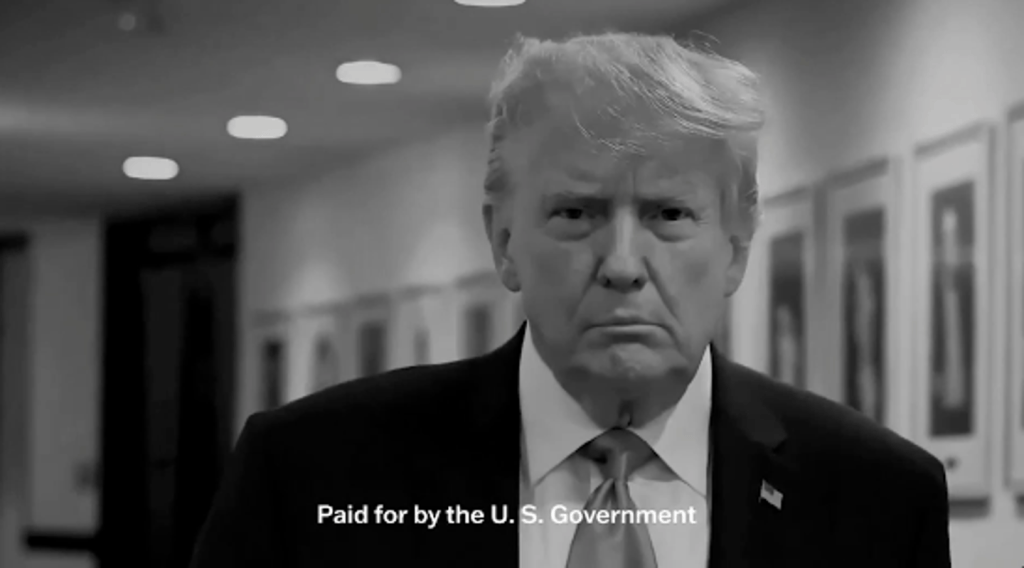
    According to the Hatch Act, federal employees cannot engage in any politics while on duty and misusing federal resources. Additionally, the Anti-Lobbying Act and appropriations acts state that it is illegal to use federal funds for “publicity or propaganda” for a candidate. In other words, Trump has officially been purchasing attack ads with taxpayer’s money.

    This is an utterly unethical and completely corrupt practice, fueled by Trump’s vindictiveness and thirst for attention. The money paid by citizens for defense, roads, or public healthcare gets wasted on ad campaigns for political purposes. This public relations operation will damage the reputation of the government and the office of the president.

    Such an unethical and corrupt action demonstrates Trump’s contempt for the rule of law and democratic norms in general. According to CREW, this latest scandal further illustrates the harm that can be done when the government engages in the kind of behavior. The Government Accountability Office already warned about the illegality of these actions. The President of the United States is not an executive for a private company. They should not turn their apparatus into a propaganda machine for their own electoral gain.
  • Trump’s Unprecedented Assault on the Press: White‑House Bans, FCC Threats, and Billion‑Dollar Lawsuits Explained

    A first‑person look at the administration’s wave of bans, lawsuits, and intimidation tactics that aim to silence the media.

    by Winston Wendell

    I have observed the Trump administration’s efforts to censor the news media carefully throughout the year, and I believe that the current situation may be the most extreme in recent times. Last week, Trump prohibited CNN, MSNBC and Politico from entering the White House, which caused a press boycott, with Fox News announcing the cancellation of all coverage, and other outlets refusing to print photographs of the president. The president’s Monday ribbon-cutting ceremony did not have its audio available to the public.

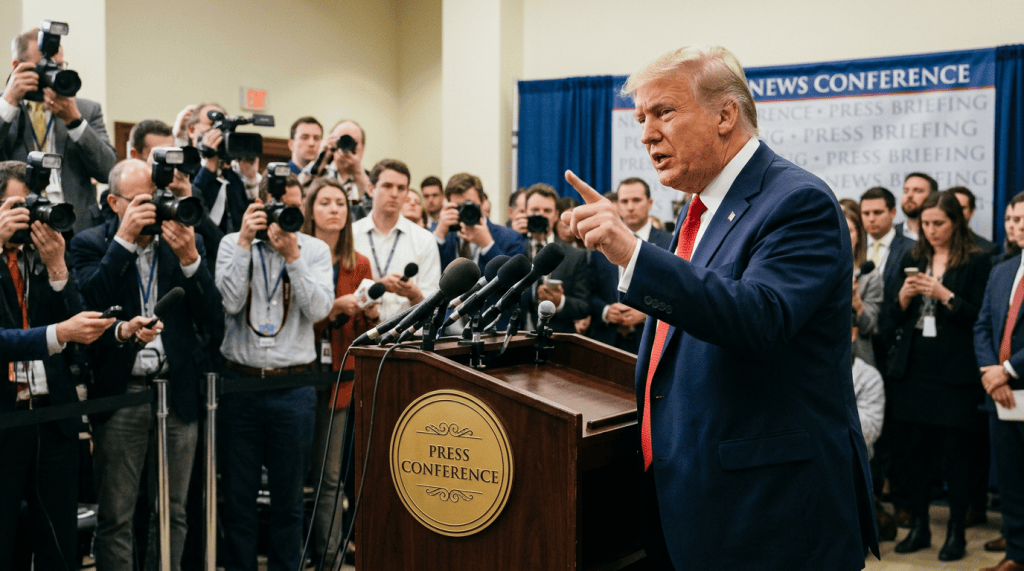
    Donald Trump speaking at a press conference surrounded by journalists

    President Trump has a history of attacking journalists who criticize him, and using the Federal Communications Commission to threaten broadcasters who air unfavorable news. In April, after ABC late-night host Jimmy Kimmel joked about the president’s wife, the head of the FCC, Brendan Carr, a Trump loyalist, ordered an investigation into all of ABC’s broadcasting licenses. ABC filed a lawsuit against the FCC, claiming that it was retaliating for Kimmel’s comments.

    He has also targeted individual female journalists with insults. I am sure many people were surprised when, after Kaitlin Collins of CNN was awarded the White House Correspondents’ Dinner honor, the president tweeted a computer-generated video of himself tossing the young woman into a dumpster.

    Phone records of New York Times reporters were sought by Trump through a subpoena, but the president later withdrew the request. The FTC is investigating Media Matters for America, which was previously named in a defamation lawsuit by the president. Most notable are the numerous multi-billion-pound libel lawsuits that Trump has initiated against the Wall Street Journal and the BBC, among others, seeking $10  billion, The New York Times for $15  billion and $10  billion respectively in damages, both of which were dismissed as “megaphone cases.” A judge even stated that he filed the lawsuit to deflect negative news coverage.

    Despite the ongoing ban, press freedom is flourishing in the United States. While the recent boycott was a frightening reminder of what could happen to America’s news outlets, it was also a brilliant publicity stunt for the companies that participated. As I watch the drama unfold, I am trying to determine whether it will affect news outlets’ ability to report objectively on the president, or if the president’s disinformation efforts will ultimately harm him.

  • CNN, MS NOW, and Politico Request Emergency Hearing as Journalists Blocked Despite Court Order

    10:35am EST

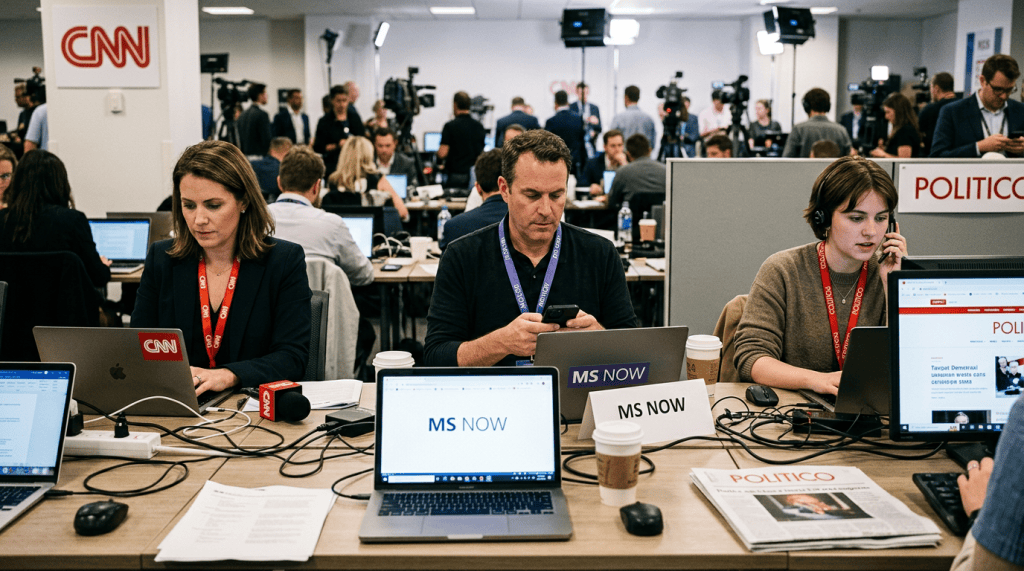
    WASHINGTON( Blue Press Journal) — CNN, MS NOW and Politico have filed for an emergency hearing on Thursday morning, accusing the Trump administration of blatantly defying a court order to allow their journalists into the White House.

    Busy newsroom with CNN, Politico, and MS NOW branding

    The networks say that reporters were again blocked from entering the White House on Thursday, even though a judge ruled last week that they should be given back their White House press credentials.

    The networks’ lawyers say they tried to contact the Justice Department this morning and ask them about the issue, but were ignored.

    Counsel for Plaintiffs reached out to counsel for Defendants this morning and requested to call the Court together. Counsel for Defendants has not responded. Defendants have already repeatedly violated the Court’s Order. Plaintiffs respectfully request that the Court set a hearing by videoconference or teleconference this morning, as soon as possible.

    The White House has not responded to the emergency request, but the latest standoff happened when journalists from all three networks were blocked from entering the White House this morning, with only one CNN producer allowed in. The networks are asking in their request to the Court why exactly one CNN producer was allowed in, but others not.

    The networks are accusing the White House of willfully defying the court’s order to allow their journalists back in the White House. Last week, the White House began banning reporters from the White House, which publishers said was a First Amendment problem. However, a judge sided with the publishers, requiring the White House to reinstate CNN, MS NOW and Politico’s White House press credentials. The networks are now accusing the Trump administration of ignoring the court. It remains unclear if the administration would actually ignore the court, or if the networks are just being overly cautious.

    The networks are requesting that the administration comply with the court’s order, and are seeking to get immediate answers as to the statuses of their White House correspondents.

    The White House and the Justice Department have not commented publicly about the morning’s events or the networks’ request for an emergency hearing.

    Will update the story as events change.

  • MS NOW Reporter Barred From White House, Joins CNN and Politico in Access Dispute

    Washington, D.C., Sept. 24 — A federal judge’s order to restore White House press credentials for three news outlets has been ignored, as MSNBC correspondent  Laura Barron‑Lopez was denied entry on Thursday, mirroring recent turn‑aways of CNN and Politico journalists.

    Update: 10:20am est.

    A reporter for the online outlet MS NOW was turned away from the White House press entrance on Thursday, bringing the media outlet into a growing dispute over access that already includes correspondents from CNN and Politico.

    Laura Barron‑Lopez, a senior reporter for the news outlet, said she arrived at the Press Briefing building, swiped her badge at the security checkpoint and watched the indicator turn red before being stopped by a uniformed security guard.

    “I got as far as the press pass security hut, swiped my badge, and the light started flashing red,” Barron‑Lopez told reporters after the incident. “The guard told me I could not proceed and escorted me off the premises.”

    Her experience mirrors that of a CNN reporter and a Politico correspondent, both of whom were denied entry his morning under the same circumstances.

    MS NOW, CNN and Politico have scheduled a joint press conference for Thursday afternoon to discuss the broader implications of the White House’s security procedures on media freedom.

    Fediverse reactions
  • Politico Reporter Denied White House Access Despite Federal Court Order, Outlet Says

    UPDATE: 8:45am

    Tensions between the White House and the press corps escalated significantly on Thursday as Politico reported that one of its journalists was denied entry to the White House grounds. The incident occurred despite a federal judge’s order issued earlier that day mandating that the Trump administration restore access to several barred news organizations.

    According to Politico, the unnamed reporter not only had their access blocked but also had their physical press credentials confiscated by security personnel.

    The incident marks a critical flashpoint in the ongoing legal and political battle over press freedom, credentialing, and the constitutional rights of journalists covering the executive branch.

  • CNN Staffers Still Facing White House Entry Barriers Despite Court Ruling

    Published: 09/24/2026. 8:20am est

    Despite a recent court ruling blocking the administration’s ban on specific news outlets, some CNN journalists are still reporting difficulties gaining access to the White House complex.

    The ongoing confusion highlights a disjointed enforcement of security protocols following legal battles over press credentials for reporters from CNN, MS NOW, and Politico.

    The Incident at the Gates

    The challenges came to light this morning when CNN journalist Betsy Klein was blocked from entering the White House grounds. According to reports, Klein presented both her driver’s license and official press ID to U.S. Secret Service agents at the checkpoint.

    Despite providing standard identification—and even showing agents a digital copy of the judge’s ruling that temporarily halted the press ban—Klein was denied entry. Agents instructed her to contact the White House press office for further clarification rather than granting her access.

    The situation appeared inconsistent on the ground. Just moments after Klein was turned away, a CNN producer was permitted to enter the White House. However, the inconsistency continued when a CNN photojournalist attempting to enter shortly after was also barred, despite the producer’s successful entry.

    A “Fluid” Situation Awaiting Clarification

    Describing the morning’s events as “fluid,” Klein and other affected media personnel are currently awaiting formal guidance and clarification from the White House press office regarding how security personnel are operationalizing the recent court decision.

    Legal experts note that while court rulings can quickly alter official policy, the operational trickle-down to frontline security staff can sometimes experience logistical delays or mixed messaging.

    As this is a developing story, updates will be provided as the White House press office and legal teams respond to the ongoing access disputes.

    Fediverse reactions
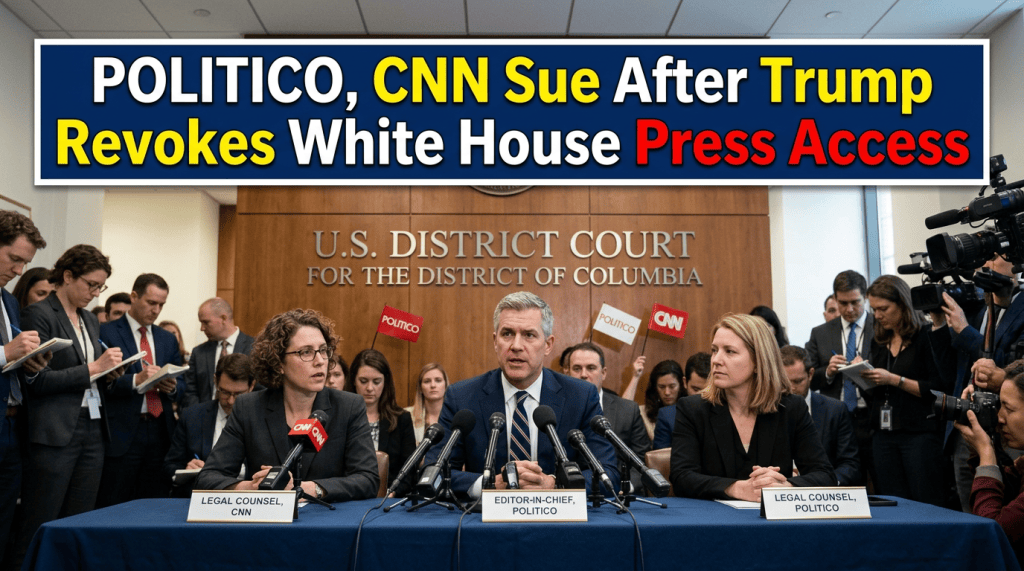
  • POLITICO, CNN Sue After Trump Revokes White House Press Access

    The Trump administration wants a court order letting the executive branch decide who receives White House press credentials, and it is challenging a long-standing legal precedent that protects journalists covering the West Wing.

    Headline reads “POLITICO, CNN Sue After Trump Revokes White House Press Access”; U.S. District Court for the District of Columbia hearing with legal counsel for CNN, POLITICO editor-in-chief, and legal counsel for POLITICO.

    In a brief filed late Tuesday, the Justice Department said barring POLITICO, CNN and MS NOW from the White House complex was justified by how those outlets had reported on sensitive information.

    The administration told the courts that the president believed the plaintiffs had failed basic journalistic standards by revealing classified details and national security matters.

    Responding to an emergency injunction from the three media companies seeking immediate restoration of access, the government brief cited articles from each outlet about the conflict with Iran, US military reserve levels and a leak investigation into FBI Director Kash Patel. It also objected to POLITICO’s release of a Secret Service document originally given to Senate Republicans to help build a new presidential ballroom.

    The DOJ brief also included copies of letters supposedly sent to the organisations that day explaining the credential revocations and setting a Friday deadline for a response.

    But the documents had no signatures or letterhead and never explicitly said any cited example in the articles contained classified information. Several examples were also largely unrelated to national security; the letter to POLITICO objected to an article about internal tensions at a Texas Republican convention.

    Government attorneys conceded the retroactive letters do not meet the standard set by Sherrill v. Knight, a 49-year-old D.C. Circuit ruling holding that the state cannot arbitrarily exclude specific news organisations from White House press facilities based on its perceived coverage.

    Instead, the Justice Department is formally asking the courts to overturn the Sherrill precedent, dismantling the legal framework that ensures equal press access. The administration instead wants wider use of a different ruling from last year suggesting the president has discretion to restrict entry to high-security parts of the White House grounds, such as the Oval Office.

    POLITICO, CNN and MS NOW sued on Monday, arguing that revoking their press passes violates the First Amendment. They have also asked for a temporary restraining order forcing the administration to restore their credentials while the case is heard.

    U.S. District Judge Timothy Kelly, appointed by Trump, has set a hearing for Wednesday afternoon.

    Fediverse reactions
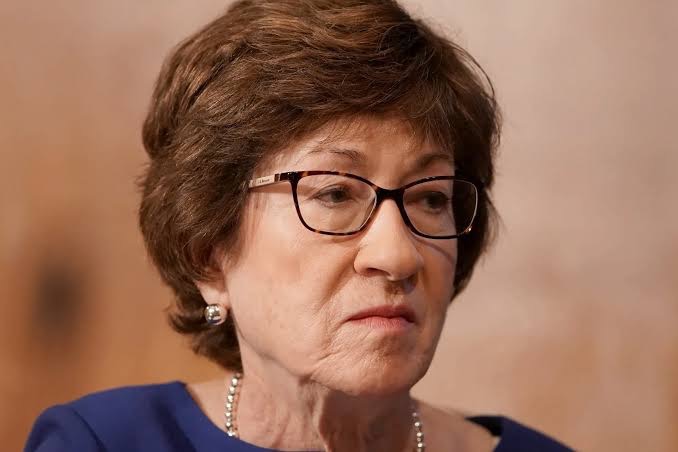
  • Explosive ProPublica Report Ties Sen. Susan Collins to Alleged Pay-to-Play Scandal in Maine Senate Race

    A new ProPublica report details a potentially explosive source of controversy in the re-election bid of Sen. Susan Collins (R-Maine) , shifting Democratic criticism of the senator away from her legislative voting record and towards allegations of significant political corruption.

    The report follows up on an investigative trail beginning with Martin Kao, the former CEO of defense contractor Navatek, a Hawaii-based company. At the time of the 2022 campaign finance indictment, Kao was cooperating with federal authorities and met with Scott Reed, who headed a super PAC that had been associated with Collins. Kao allegedly offered to provide a $500,000 donation to the super PAC, which would have circumvented contributions from government contractors to get around bans on donations from government contractors in order to secure dozens of millions of federal naval contracts for Navatek. Reed supposedly assured Kao that the senator would be aware of where the money came from, and internal emails later suggested that Collins was committed to obtaining $32 million in contracts.

    FBI agents had investigated the possibility of a bribery investigation connected to these allegations, but the probe died out after the new election cycle began, and federal law enforcement purges, particularly those orchestrated by the Trump administration, that undermined public corruption investigations. An FBI spokesperson said that the bureau ultimately found nothing implicating Collins or her campaign.

    Collins’ office and campaign have strongly rebutted the allegations, describing Kao’s statements as “outlandish” and noting that the campaign was never a target of FBI investigation, cooperating fully with authorities.

    Despite these denials, the report threatens to derail the final weeks of the Maine Senate race, with Collins’ Democratic rival, Troy Jackson, quickly capitalizing on the story, claiming the allegations represented “corruption of the highest order” and calling for full transparency, which is sure to be a major issue for voters ahead of election day.

  • Belarus Potash Debacle: Trump’s “Massive Deal” Proves to be a Hot Air

    by Winston Wendell

    In a surprising development, Belarussian President Alexander Lukashenko refuted the reports of a major potash deal between the US and Belarus. Lukashenko asserted that there were no such volumes of potash for sale to make such a deal, despite Trump’s insistence that a significant discount on Belarusian potash would benefit the American farmers.

    President Trump announced the deal on his social media platform called Truth Social, claiming that the US is “working on a massive Deal with respect to the purchase of Potash from Belarus” at a price lower than the current Canadian rate. However, President Lukashenko of Belarus spoiled the deal by telling Trump that all of their available potash has already been ordered and that they do not have any for sale.

    Trump’s long-running dispute between Canada and the United States has upended the potash market and has had a clear outcome: American farmers supply has decreased and costs have increased. Canada is the world’s largest producer of potash, and about 53% of its output is exported to the United States. Overall, roughly 80% of the potash used on American farms comes from Canada, while Belarus supplies only about 2%.

    As the dust is settling on the Belarus potash debacle, it is hard to say with a degree of certainty whether Trump was being truthful about the purported deal or he was just engaging in some self-promotion from the outset. The American farmers are left scratching their heads in bewilderment over the actual state of affairs with respect to their fertilizers. The bottom line is Trump is solely to blame for the critical shortage!

  • Trump’s Iran‑War Folly and the GOP’s Midterm Maneuvering: Why Voters Should Avoid the Party of Big Oil

    by Winston Wendell

    President Donald Trump has intensified economic pressure on Iran with new sanctions and blockades, claiming it will strengthen the United States. Instead, record diesel prices are fueling backlash from farm and energy interests, pushing Republican lawmakers from rural states to consider a diesel export ban that cuts against his own policy.

    Mr. Trump’s war with Iran has reduced Iranian oil exports and triggered a blockade of the Strait of Hormuz, creating a shortage in European and Asian markets. With diesel demand still high, prices have hit record levels, hammering the agricultural sector and driving up the cost of goods and services. As the 2026 midterm elections approach, Republicans risk losing farm voters who blame the President and his party for surging inflation.

    Many Republicans in Congress refuse to budge because they rely on big oil money from companies like Exxon and Chevron, which profit when diesel prices soar. Their lobbying power drowns out farmers who are being squeezed by high fuel costs. This GOP loyalty to oil giants over rural voters exposes a blatant hypocrisy that could cost them crucial farm‑state electoral support.

    Critics say the President’s Iran policy is less about security and more about staging a confrontation with Tehran to distract voters. They argue his hardline moves have failed to explain to voters why Iran was a looming threat, but a political tactic to distract from stubbornly high prices for everyday goods and services because of this tariffs.

    For farmers and American’s, it means that prices of commodities and services are about to rise again. The President’s and Republican’s current course of action will be detrimental for the country, we need change!

    Fediverse reactions