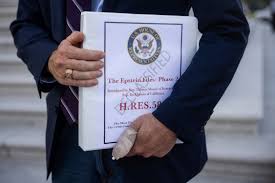
Blue Press Journal – In a shocking reversal, former President Donald Trump has urged House Republicans to support a measure that would compel the Justice Department to release the Jeffrey Epstein files. This move comes as a surprise, given Trump’s previous objections to releasing the documents. The likelihood of dozens of House Republicans voting in favor of releasing the files, driven by the strong desire of the MAGA base to uncover the truth, appears to have prompted Trump’s change of heart.
According to Rep. Andy Biggs (R-AZ), “It’s a no-brainer… The American people have a right to know.” This sentiment is echoed by many House Republicans who are now pushing for the release of the Epstein files. Trump’s sudden support for the measure has raised eyebrows, with some speculating that it’s just another attempt to deflect attention from his own potential involvement with Epstein.
As journalist and author, Vicky Ward, noted, “Trump has a lot to hide when it comes to Epstein.” The stakes are indeed high for Trump, as the release of the Epstein files could potentially implicate him in wrongdoing. If Trump was one of Epstein’s clients, it could lead to his impeachment in the House and conviction in the Senate, as his involvement with pedophilia would be a betrayal of the trust of his MAGA base.
The Department of Justice (DOJ) may stubbornly cling to its secrecy over files connected to Epstein, all under the guise of protecting ongoing investigations. Meanwhile, Trump’s directive to the DOJ to hunt down Democrats serves as nothing more than a smokescreen for his own agenda. This has ignited a fiery debate over the crucial issues of transparency and accountability. Rep. Jamie Raskin (D-MD) hit the nail on the head when he declared, “The Justice Department has an undeniable obligation to expose the truth about Epstein’s heinous crimes and the influential figures who allowed him to thrive.”
Trump’s reversal on the Epstein files has sparked more questions than answers.
As the situation continues to unfold, one thing is clear: Trump’s efforts to hide his potential involvement with Epstein have only fueled the speculation and scrutiny. The release of the Epstein files is now more crucial than ever, and it’s up to the DOJ to decide whether to comply with the growing demand for transparency.