The BLUE PRESS JOURNAL
We aim to be a voice in the ongoing political discourse, providing both factual information and opinionated analysis, from a progressive or center-left perspective, free from the direct influence of major
established Main Street Media.
-
Trump’s False Patriotism: His Grand Parade Satruday

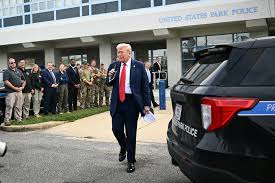
On Saturday, the nation is slated to witness a grand military parade featuring nearly 6,600 soldiers, 150 military vehicles, and a range of aircraft. Estimated to cost between $25 million and $45 million – a figure likely understating the total impact – this event is presented as a celebration of the United States Army’s 250th anniversary, coincidentally falling on President Donald Trump’s 79th birthday.
Yet, this planned spectacle is a departure from the norm. Contrary to popular imagination, the U.S. military does not typically conduct large-scale public parades. Those public events that do occur, such as Fleet Week or ceremonial displays, are usually recruitment-focused and deliberately nonpolitical. True military parades on this scale are reserved for moments of national triumph, occasions like the celebrations following the victories in 1946 or 1991, designed to honor those who fought and won major wars. This parade lacks any such victory to celebrate.
The absence of a traditional justification, coupled with the substantial expense, points to a different purpose. President Trump, who has often praised authoritarian figures, appears to be leveraging this display of military power to enhance his “tough-guy” persona at home and project strength abroad.
This politicization of the military is deeply problematic, threatening the institution’s apolitical standing and its loyalty to the Constitution. While presidents naturally interact with and represent the military, President Trump’s use of it to validate harsh partisan positions crosses a critical line, fueling concerns that he seeks personal allegiance over fidelity to the Constitution.
Adding a layer of controversy, this effort to use the military for political gain comes from a figure who reportedly took significant steps to avoid military service himself. According to testimony from his former lawyer, President Trump admitted to inventing a medical reason to evade the Vietnam draft, stating he “wasn’t going to Vietnam.” This stark contrast between alleged personal draft avoidance and the public deployment of military symbols for political purposes raises questions about the sincerity of the patriotism on display, suggesting it may be artificial and politically motivated.
-
Federal Judges Block Trump’s Election Changes

President Trump’s executive order of March 25, aiming to alter federal election rules, has suffered significant legal setbacks. The order had attempted to mandate that officials require documentary proof of citizenship for voter registration, accept only mailed ballots received by Election Day, and condition federal election grant funding on states adhering to this deadline. Critics contended the directive “usurps the States’ constitutional power and seeks to amend election law by fiat.”
Adding to an earlier ruling by a federal judge in Washington, D.C. that blocked parts of the order – specifically the proof-of-citizenship requirement for the federal voter registration form – a federal judge in Massachusetts has now also blocked the president’s broader attempt to overhaul elections.
In Friday’s order, Judge Denise J. Casper of the U.S. District Court in Massachusetts stated that the challenging states had a likelihood of success in their legal arguments. “The Constitution does not grant the President any specific powers over elections,” Judge Casper wrote.
Among its provisions, the executive order would have forced states to exclude mail-in or absentee ballots received after Election Day. This directly contradicted the current practice in 18 states and Puerto Rico, which allows ballots to be accepted after Election Day if postmarked by that date, according to the National Conference of State Legislatures. Furthermore, the order threatened states’ federal funding if they did not comply with this strict deadline.
-
Indivisible And Partners Announce ‘NO KINGS’ Nationwide Day of Defiance on Flag Day, During Trump’s Birthday Parade

Indivisible and a coalition of pro-democracy partner organizationsannounced the NO KINGS Nationwide Day of Defiance on Flag Day (June 14). The actions are set to take place during Donald Trump’s military parade in Washington, D.C., on June 14. Instead of allowing this military parade to be the center of gravity, activists will make action everywhere else the story of America that day.
Alongside local organizers, partners, and leaders from across the pro-democracy and pro-worker movements, activists across the country will come together for marches, rallies, and demonstrations to reject corrupt, authoritarian politics in the United States.
This mobilization is inspired by the success of Hands Off! and May Day and is intended to once again motivate actions in towns and cities in every state in the country. Over 100 events have already been registered all over the country, and more will be added here.
As the mobilization’s organizers announced on the website NoKings.org:
-
Newsom Lays Bare Trump’s Authoritarian Threat
California Gov. Gavin Newsom on Tuesday warned Americans in a televised address that the country is witnessing the initial phases of American democracy’s slide toward authoritarianism with the president’s deployment of the military to respond to peaceful protests in Los Angeles.
-
Los Angeles Police Chief Debunks Trump’s National Guard Narrative

Donald Trump’s assertion that Los Angeles required National Guard support is patently false. In reality, Los Angeles Police Chief Jim McDonnell emphasized that the protests were nowhere near the level that would necessitate deploying troops.
During a visit to the Kennedy Center to attend a performance of “Les Misérables”, Trump made the unsubstantiated claim, “If we weren’t there, if we didn’t bring in the National Guard and the Marines, you would probably have a city that was burning to the ground.” He further distorted the facts by suggesting that Police Chief McDonnell had acknowledged the necessity of their presence. However, McDonnell swiftly countered Trump’s false assertion, stating, “No, we were not in a position to request the National Guard. We’re nowhere near a level where we would be reaching out to the governor for National Guard at this stage.”
It is abundantly clear that Trump concocted a false narrative to justify the deployment of federal troops in Los Angeles. The very purpose of these troops is shrouded in ambiguity, sparking serious doubts about the legitimacy of their presence. The authorization for National Guard troops and Marines to temporarily detain civilians stands on shaky legal ground, as they are typically barred from law enforcement duties unless the president invokes the Insurrection Act. By recklessly sending unnecessary federal troops to Los Angeles without the city’s consent, Trump has ignited a constitutional crisis that demands rigorous examination!
-
Military Deployment in LA: Trump’s Authoritarian Move Exposed!

The Trump administration’s brazen move to federalize the California National Guard, deploying them to suppress protests against ICE detentions in Los Angeles without any request from the state’s governor, illustrates a chilling power grab. This reckless decision comes despite local law enforcement’s reassurances that the situation was well in hand, revealing a disturbing intersection of Trump’s authoritarian tendencies and his campaign’s most alarming promises.
The decision by the Pentagon to activate 700 Marines from the Marine Corps Air Ground Combat Center in Twentynine Palms, California, to accompany the 4,000 federalized National Guard troops in occupying sections of Los Angeles represents a significant commitment to deploying military forces within the United States. This action aligns with Trump’s ongoing declarations throughout the 2024 campaign cycle regarding his intention to utilize military personnel to suppress civil unrest.
Trump, the mastermind behind the 2020 coup attempt and the instigator of a deadly insurrection at the Capitol, now has the audacity to claim that protesters in Los Angeles are staging an insurrection. This display of military might is nothing but a calculated move to flex his muscles and stifle dissent—an alarming tactic to reclaim control and intimidate those who dare oppose him.
Like a quintessential bully, Trump reveals his cowardice at every turn. Humiliated by powerful adversaries—China, Harvard, and the federal courts—he has resorted to waging war on the most vulnerable among us, specifically targeting a progressive state like California, where the overwhelming majority stand firmly against him.
The deployment of the military to Los Angeles comes at a time when state and local officials have deemed it unnecessary. This manufactured crisis is a product of Trump’s creation, and the presence of federally controlled troops on American streets is a historically ominous sign of social crisis.
The Trump administration has waged a ruthless campaign to punish Democratic cities and states, a vendetta that was brewing long before he even stepped back into office. A shocking expose from November revealed that Trump and his inner circle were deep in discussions about mercilessly cutting federal funding to defiant cities like Chicago—bold bastions of resilience that have dared to stand up against his heartless deportation agenda.
Trump and his cohorts are fervently seeking to unleash chaos and bloodshed on our streets. On Truth Social, Trump proclaimed, “Looking really bad in L.A…. BRING IN THE TROOPS!!!” The events over the weekend have gifted Trump a golden opportunity to attack a blue state, fabricate a dramatic spectacle in its largest city, and dangerously blur the boundaries between a constitutional president and a would-be monarch.
-
Dictator Trump: Patriotic Americans Must Stand for the Constution

Over the weekend, President Trump ordered the deployment of thousands of National Guard troops to Los Angeles in an effort to suppress protests against his aggressive and unlawful mass deportation campaign. This decision ignited a clash with California’s state government, which neither requested the military assistance nor supported the deployment.
The largely peaceful protests in Los Angeles against the Trump administration’s deportation policies have now entered their fourth day, but the response to them is generating significant controversy. Specifically, the decision to potentially deploy up to 2,000 troops under federal control to the streets of LA has drawn sharp criticism, particularly from former top military figures. They argue that this move constitutes a violation of the military’s long-held commitment to remain separate from domestic politics, except in the most extreme and justifiable circumstances.
California Governor Gavin Newsom, a Democrat, announced his intention to sue Trump, labeling the president a “dictator” who is deliberately “fanning the flames” of tension and potential violence in Los Angeles. Newsom also highlighted the broader implications of the June 7 memorandum Trump signed, emphasizing that its reach extends beyond California.
The memorandum, titled Department of Defense Security for the Protection of Department of Homeland Security Functions, grants Pentagon Secretary Pete Hegseth the authority to “employ any other members of the regular Armed Forces as necessary to augment and support the protection of Federal functions and property in any number determined appropriate in his discretion.” This marks an unprecedented assertion of federal military power across the nation.
The core concern is the perceived politicization of the armed forces. Critics argue that deploying troops against the wishes of the state’s governor, and in the absence of a clear and genuine civil emergency, appears to be a politically motivated action by the Trump administration. This has triggered alarm within military circles, where the ideal of remaining apolitical is deeply ingrained. As one source noted, the deployment “seems like a political forcing – a forced use of the military by Trump because he can.”
Recognizing the profound and far-reaching consequences of Trump’s actions, courageous demonstrators across the United States—from Portland, Maine, to the vibrant streets of Houston, Texas, and the resilient heart of Salt Lake City, Utah—rallied with unyielding solidarity alongside the brave protesters in California who are courageously facing military repression.
Governor Newsom underscored the illegality and immorality of commandeering a state’s National Guard without the governor’s consent, and he confirmed plans to file a lawsuit against the president on Monday in response to the extraordinary deployment.
Trump himself has previously made no secret of his willingness to utilize the military for domestic purposes. During his reelection campaign last year, he repeatedly told supporters that, if re-elected, he would deploy the armed forces against what he termed “the enemy within.” This history further fuels the perception that the troop deployment is not a response to a genuine emergency, but rather an attempt to use the military to suppress dissent and further a political agenda.
Trump’s use of force and intimidation tactics reflects authoritarian tendencies, signaling a constitutional crisis in the United States.
-
KILL the BILL

Elon Musk has gone beyond merely labeling the bill a “disgusting abomination”; he has made it clear that he intends to actively oppose it.
The former White House advisor has intensified his criticism of the large Republican bill that proposes significant tax cuts and Medicaid reductions, urging Americans to contact their lawmakers and oppose the legislation. While Musk’s reasons differ from those of Democrats, both sides share a common goal: to avoid increasing the national debt further. Historically, Republican presidents have contributed slightly more to the national debt per term than their Democratic counterparts, according to inflation-adjusted data from the U.S. Treasury Department and the Bureau of Labor Statistics dating back to 1913. Notably, President Trump is the largest contributor, having added an estimated $7.1 trillion to the national debt during his first term from 2016 to 2020.
This legislation is intended to represent the full scope of President Donald Trump’s domestic policy agenda for a his second term, making Musk’s strong opposition—just one week after stepping down as a senior adviser to the president—particularly noteworthy.
The Republican bill combines over $4 trillion in tax cuts and new spending with less than $2 trillion in cuts to Medicaid and other social programs, resulting in a net deficit increase of $2.4 trillion, according to the Congressional Budget Office. The tax cuts predominantly benefit the wealthy and corporations, which some argue are not paying their fair share.
On Wednesday, Musk posted, “A new spending bill should be drafted that doesn’t massively grow the deficit and increase the debt ceiling by 5 TRILLION DOLLARS.”
Musk is asking the public to trust someone who can land rockets vertically and develop self-driving cars more than the Republican lawmakers who passed this bill by a single vote under pressure from Trump and wealthy interests.
Now, the question remains whether the Republican-controlled Senate will stand firm or yield to Trump and his affluent allies.