We aim to be a voice in the ongoing political discourse, providing both factual information and opinionated analysis, from a progressive or center-left perspective, free from the direct influence of major established Main Street Media.
President Trump’s declining approval ratings should be a cause for concern for the Republican Party, particularly as they push forward with a budget that prioritizes tax cuts for the wealthy. Recent polling data, such as the June 16th Reuters/Ipsos poll showing Trump’s approval at 42%, reveals a significant erosion of public support. This decline is particularly evident in key areas: his immigration policies have seen a drop in approval from 47% in May to 44%, while a majority (52%) disapprove of his handling of the economy and foreign policy. These figures suggest widespread dissatisfaction with the President’s overall policy agenda.
Further fueling public unease is the perception of conflicts of interest. A substantial 62% of Americans express worry about the potential influence of the President’s personal wealth on his political decisions. This concern is likely exacerbated by Trump’s recent actions, such as his brinkmanship regarding potential military conflict in the Middle East between Iran and Israel. This aggressive posture, while perhaps consistent with his campaign rhetoric, seems to have generated a sense of buyer’s remorse among some voters. The combination of falling approval ratings and growing concerns about conflicts of interest presents a significant challenge to the Republican Party as they navigate the current political landscape.
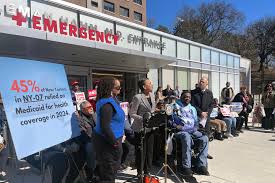
We often hear claims that the GOP Medicaid cuts will not impact hardworking average Americans. However, this simply isn’t true. During a recent visit, Senator Gillibrand warned about the proposed Medicaid cuts threatening a hospital in Saranac Lake, a small community in New York State. These cuts could result in 1.5 million New Yorkers losing their health insurance coverage by 2034.
New York’s 21st Congressional District, one of the largest in the Eastern United States, is under the dubious leadership of Congresswoman Elise Stefanik, a staunch MAGA Trump supporter who shockingly voted for a bill that’s set to ruin her own district. As if that weren’t enough, she’s now eyeing the Governor’s mansion in New York. This ambiguous ambition has healthcare professionals shaking their heads in disbelief, loudly warning that the proposed federal budget cuts will decimate Medicaid coverage for countless New Yorkers.
Clearly, the GOP is relentlessly crafting a smokescreen of misinformation to conceal their true agenda: prioritizing tax breaks for billionaires and millionaires while neglecting the urgent needs of average rural Americans.
Homeland Security Secretary Kristi Noem seems to be treating the Department of Homeland Security (DHS) budget like a party fund, already blowing it by about $1 billion—who knew there was so much cash for glitter? Must be all those costumes she wears. And if that wasn’t enough, she’s eyeing a $40 million plane for her personal joyrides! Meanwhile, Immigration and Customs Enforcement (ICE) is deporting individuals slower than a turtle on vacation compared to last year under President Joe Biden—yet this juicy tidbit is hardly ever mentioned by FOX News, probably because it doesn’t fit their favorite storybook plot.
Noem’s spending on ICE appears to surpass authorized amounts by roughly a billion dollars, which raises serious legal concerns regarding the misuse of funds.
President Donald Trump, meanwhile, is like the kid in class who blames everyone else for his messy desk instead of cleaning up his own act. You know the type—“Whine, whine, it’s not my fault!” During one of his riveting speeches at the G7 summit in Canada, he took aim at “Democrat-run cities” and his predecessor, showcasing his unique ability to miss the point entirely. When he’s not perfecting his golf swing, Trump loves to scribble on executive orders—sometimes with the same level of comprehension as a toddler drawing on the walls—or unleashes fiery speeches that could ignite a campfire. Plus, he’s got a knack for turning his presidential perch into a personal cash register, always looking for a way to cash in!
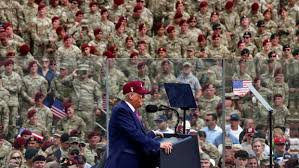
Recent internal communications from the 82nd Airborne Division reveal a carefully orchestrated effort to shape the narrative around President Trump’s recent visit. Documents indicate that soldiers were selectively chosen to appear behind Trump based on their political affiliations and physical characteristics. The men chosen to stand behind him during the event were predominantly male. Their enthusiastic laughter and applause during Trump’s partisan speech marked a startling and uncommon moment where military personnel publicly engaged in overt political partisanship.
One source disclosed a message to troops indicating that those who held opposing political views to the current administration and preferred not to be present should discuss with leadership to not attend. This situation unfolded at Fort Bragg, North Carolina, showcasing a stark departure from the usual presidential visit, which is typically characterized by decorum and neutrality. Instead, Trump delivered a speech filled with partisan rhetoric, drawing boisterous responses from soldiers behind him, thereby blurring the critical line between military duty and political engagement.
Trump has taken partisanship further than any prior president, treating gatherings with troops as campaign events and openly criticizing his rivals. Retired Army Lt. Gen. Russel Honore, renowned for his role in coordinating military aid during Hurricane Katrina, labeled the speech “inappropriate,” asserting he had never witnessed anything like it during his 37 years of service.
With military presence in LA and directives from the President aimed at political military initiatives, it is essential for Americans to recognize the gravity of this situation. The military’s involvement in such overtly partisan activities poses a significant threat to our constitutional principles, marking a dangerous departure from the ideals of neutrality and professionalism that have long defined our armed forces.
Atlanta’s 5,000-capacity “No Kings” rally quickly reached its limit, with thousands more demonstrators outside the barrier in front of the state Capitol and a handful of counter-protesters leaving before the rally finished.
On Saturday evening, the capital of the United States will take on an appearance reminiscent of North Korea’s Pyongyang, China’s Beijing, and Russia’s Red Square, featuring tanks and missile launchers parading through the streets. This spectacle—a $45 million “birthday gift” to himself, funded by taxpayers—highlights a troubling trend in American politics.
The U.S. military is designed to remain apolitical, standing apart from politics and the whims of elected officials. This principle is what sets America apart from other nations and contributes to its greatness.
Kentucky Republican Senator Rand Paul expressed skepticism about the parade’s symbolism, telling HuffPost, “I don’t really think the symbolism of tanks and missiles is really what we’re all about. If you ask me about a military parade, the first images that come to mind are of the Soviet Union and North Korea.”
Interestingly, this monumental event aligns with the 250th birthday of the U.S. Army, overshadowing Donald Trump’s own 79th birthday. Isn’t it ironic how the mainstream media has made such a fuss over Biden’s age at 81, while we often overlook that Trump is just 79? Let’s not ignore the math here.
Although both the Navy and the Marines also celebrate significant anniversaries this year, there has been no discussion of organizing lavish $45 million events for them. This raises questions about why only Trump’s birthday seems to warrant such extravagant recognition.
The military parade appears to promote an authoritarian display of power, further emphasized by the unnecessary deployment of U.S. troops to police American streets, as confirmed by the Los Angeles police chief.
Historically, the United States has held very few military parades, the last occurring in 1991 during George H.W. Bush’s presidency, after American forces pushed Iraqi dictator Saddam Hussein out of Kuwait—an event justifying a celebration of military success.
Despite Trump’s frequent proclamations of support for the armed forces, his history reveals a stark disregard for military service and its values. He evaded the Vietnam War draft, citing “bone spurs,” with a doctor who was a family friend providing the diagnosis. Moreover, during his presidential campaign in 2015, Trump insulted Arizona Senator John McCain—an esteemed veteran who endured nearly six years of imprisonment and torture—by claiming he was not a hero simply because he was captured, stating he preferred those who avoided capture. Reports from his former chief of staff indicate that Trump referred to fallen military members as “suckers” and “losers,” demonstrating a clear lack of respect for their sacrifices.
Trump also broke the long-standing tradition of a commander-in-chief personally shaking hands with every graduating cadet at a military academy, leaving West Point immediately after his speech to return to his golf resort in New Jersey. In contrast, Joe Biden devoted time to congratulating each graduate last year, spending 70 minutes with them—reflecting a commitment to honoring military service that Trump failed to show during his tenure, even when he had participated in similar ceremonies in the past.
As we witness this parade today, it’s crucial to honor the Army’s 250 years of service to our nation and celebrate the values they embody—principles that Trump himself seems to overlook or misunderstand.
On Saturday, the nation is slated to witness a grand military parade featuring nearly 6,600 soldiers, 150 military vehicles, and a range of aircraft. Estimated to cost between $25 million and $45 million – a figure likely understating the total impact – this event is presented as a celebration of the United States Army’s 250th anniversary, coincidentally falling on President Donald Trump’s 79th birthday.
Yet, this planned spectacle is a departure from the norm. Contrary to popular imagination, the U.S. military does not typically conduct large-scale public parades. Those public events that do occur, such as Fleet Week or ceremonial displays, are usually recruitment-focused and deliberately nonpolitical. True military parades on this scale are reserved for moments of national triumph, occasions like the celebrations following the victories in 1946 or 1991, designed to honor those who fought and won major wars. This parade lacks any such victory to celebrate.
The absence of a traditional justification, coupled with the substantial expense, points to a different purpose. President Trump, who has often praised authoritarian figures, appears to be leveraging this display of military power to enhance his “tough-guy” persona at home and project strength abroad.
This politicization of the military is deeply problematic, threatening the institution’s apolitical standing and its loyalty to the Constitution. While presidents naturally interact with and represent the military, President Trump’s use of it to validate harsh partisan positions crosses a critical line, fueling concerns that he seeks personal allegiance over fidelity to the Constitution.
Adding a layer of controversy, this effort to use the military for political gain comes from a figure who reportedly took significant steps to avoid military service himself. According to testimony from his former lawyer, President Trump admitted to inventing a medical reason to evade the Vietnam draft, stating he “wasn’t going to Vietnam.” This stark contrast between alleged personal draft avoidance and the public deployment of military symbols for political purposes raises questions about the sincerity of the patriotism on display, suggesting it may be artificial and politically motivated.
President Trump’s executive order of March 25, aiming to alter federal election rules, has suffered significant legal setbacks. The order had attempted to mandate that officials require documentary proof of citizenship for voter registration, accept only mailed ballots received by Election Day, and condition federal election grant funding on states adhering to this deadline. Critics contended the directive “usurps the States’ constitutional power and seeks to amend election law by fiat.”
Adding to an earlier ruling by a federal judge in Washington, D.C. that blocked parts of the order – specifically the proof-of-citizenship requirement for the federal voter registration form – a federal judge in Massachusetts has now also blocked the president’s broader attempt to overhaul elections.
Among its provisions, the executive order would have forced states to exclude mail-in or absentee ballots received after Election Day. This directly contradicted the current practice in 18 states and Puerto Rico, which allows ballots to be accepted after Election Day if postmarked by that date, according to the National Conference of State Legislatures. Furthermore, the order threatened states’ federal funding if they did not comply with this strict deadline.