The BLUE PRESS JOURNAL

We aim to be a voice in the ongoing political discourse, providing both factual information and opinionated analysis, from a progressive or center-left perspective, free from the direct influence of major
established Main Street Media.

  • End of Week Notes: Republican Polices Pose Danger to US Economy

    As Republicans engaged in negotiations this week over a tax bill projected to add trillions to federal deficits, the long-term costs associated with financing the national debt surged. The U.S. government is poised to issue a significant volume of debt causing the bond market to be cautious directly affecting interest rates we pay on our debt. 

    A report in The New York Post, retailers are likely to raise prices in the coming weeks as a direct consequence of President Donald Trump’s tariffs. Apple’s stock took a hit after Trump threatened to impose a 25% tariff on its products unless the company relocates iPhone manufacturing to the United States. The retail sector is warning President Trump that they cannot absorb the costs of these tariffs indefinitely, and price increases are imminent.

    U.S. stock markets experienced declines on Friday following Trump’s announcement of potential 50% tariffs on the European Union, which could take effect in just over a week. The S&P 500 index fell by 0.8% in morning trading, positioning it for its worst week in the past seven. The Dow Jones Industrial Average dropped 276 points, or 0.7%, by 10:25 a.m. Eastern Time, while the Nasdaq composite index decreased by 1%.

    Trump made his tariff threat public before the U.S. stock market opened, stating on his Truth Social platform that trade negotiations with the European Union “were going nowhere” and that the “straight 50%” tariffs would be implemented on June 1. The European Union represents one of the United States’ largest trading partners. Markets have historically reacted negatively to abrupt policy shifts. 

    In the bond market, Treasury yields fluctuated before ultimately declining. The yield on the 10-year Treasury note eased to 4.51% from 4.54% late Thursday. Earlier in the week, yields had been rising, partly due to concerns that Washington’s tax-cutting efforts could exacerbate the

  • House Republicans’ Reckless Bill: A Threat to Everyday Americans

    The so-called “big, beautiful bill” is a stark and alarming proposal that pairs devastating cuts to food assistance and health insurance for low-income Americans with extravagant tax breaks for the wealthy elite. This is not the behavior of traditional conservatives; rather, the Republican majority is acting like revolutionaries, intent on dismantling the established order with reckless haste, all while the nation remains blissfully unaware of the seismic shifts taking place.

    The Congressional Budget Office has yet to assess the full impact of this bill, leaving us in the dark about how many millions of Americans will be stripped of their health insurance or how many trillions the deficit will swell as a result. Cutting taxes for the affluent is already a deeply unpopular move, and slashing Medicaid—an essential lifeline for countless families—is even more so. This is precisely why House Republicans are not boldly championing the bill’s true consequences; instead, they are resorting to obfuscation, pretending that their convoluted work requirements will not result in the very disenfranchisement they are engineering. These requirements are designed to ensnare vulnerable recipients in a web of bureaucratic red tape, effectively pushing them off the program—an outcome they are counting on to generate the savings they seek.

    This bill does not merely threaten to spike the deficit; it prioritizes enriching lawyers and CEOs over the well-being of everyday Americans, including fast-food workers and ride-share drivers. House Republicans have chosen to advance a measure that offers lavish tax cuts for the wealthy while ruthlessly slashing benefits for the poor and middle class, all while jeopardizing the economic health of our nation. 

    The consequences of this legislation are poised to be nothing short of catastrophic! It appears that Republicans are indifferent, as their leaders stubbornly cling to the very policies championed by Donald Trump!

  • Impact of GOP Budget Bill on U.S. Debt: A $3.8 Trillion Concern

    The recent passage of the Republican budget bill vote, passed under cover of a late night vote, has raised significant concerns about the future of U.S. debt levels, with several analyses suggesting a troubling trajectory. Over the next decade, this GOP bill could potentially cost the nation a staggering $3.8 trillion, as highlighted in a report earlier this month by the Joint Committee on Taxation. This report meticulously examined the implications of the proposed tax measures in comparison to spending cuts.

    Wall Street is already feeling the tremors of these risks. On Friday, Moody’s Ratings downgraded the nation’s debt, citing the likelihood that the new bill could add an alarming $4 trillion to the federal primary deficit—excluding interest payments—over the next ten years. Economists and policy experts alike warn that this surge in debt could ultimately constrain federal spending, as the U.S. would likely face escalating interest payments. Such a scenario could jeopardize funding for essential programs like Social Security, which is already under strain as baby boomers reach retirement age. Additionally, it could hinder investments in critical infrastructure initiatives that are vital for stimulating economic growth.

    While the bill does propose some spending cuts, recent analyses indicate that these reductions are insufficient to counterbalance the extensive tax breaks. The nonpartisan Bipartisan Policy Center estimated in a May 14 analysis that the tax cuts would amount to a staggering $7.7 trillion over the next decade, while the proposed spending cuts would only offset $3.9 trillion during the same period. This results in a significant shortfall of $3.8 trillion—an arithmetic reality that prompted Moody’s to downgrade its rating on U.S. debt from the highest tier of Aaa to Aa1.

    Moreover, the implications of the proposed GOP bill raise significant concerns for the lowest-income Americans. According to a May 19 analysis from the Penn Wharton Budget Model, a research group at the University of Pennsylvania that evaluates the fiscal impact of public policies, the bottom 20% of earners—despite potential savings from tax cuts—will face a $1,035 reduction in 2026 when the cuts to Medicaid and other programs are taken into account, affecting middle class earners.

    Just remember, Trump has sent a wave of bankruptcy crashing through several of his businesses, and now, against all odds, MAGA has handed over the country’s checkbook to him. God help us all!

  • The One Big, Ugly Bill

    On Thursday morning, the House of Representatives narrowly passed a bill with a vote of 215 to 214. In a stunning display of unity, all Democrats and two brave Republicans stood against it, while one Republican opted for the ever-mysterious “present” vote.

    Dubbed the “One Big Beautiful Bill Act,” this legislative masterpiece combines a staggering $1 trillion in cuts to federal health and food programs with nearly $4 trillion in tax cuts, primarily benefiting billionaires with just crumbs for the middle class. Who needs health insurance anyway? After all, the Congressional Budget Office has estimated that these spending cuts could leave around 8 million Americans without health coverage, primarily due to the slashing of Medicaid. But hey, who’s counting?

    The Congressional Budget Office also chimed in this week, warning that the legislation would significantly reduce resources for lower-income households, thanks to its generous cuts to Medicaid and the Supplemental Nutrition Assistance Program and raise the national debt!  

    “This is one big, ugly bill that House Republicans are trying to jam down the throats of the American people, under the cover of darkness,” declared House Democratic leader Hakeem Jeffries (N.Y.) in a passionate speech just before the vote. “This legislation will not make life better for the American people.” 

  • Supreme Court Slams Door on Trump Administration

    The Supreme Court has made it abundantly clear that it is fed up with the Trump administration’s blatant disregard for its orders in cases involving the Alien Enemies Act. In a decisive ruling concerning a group of Venezuelan detainees who were at imminent risk of being sent to a notorious prison in El Salvador, the Court took a strong stand against the administration’s actions.

    In an eight-page unsigned opinion, with Justices Samuel Alito and Clarence Thomas dissenting, the Court emphatically rejected the administration’s practice of providing these detainees with a mere 24 hours’ notice before their removal. The ruling not only condemned the administration’s misuse of the Alien Enemies Act to expedite the removal of Venezuelan and Salvadoran immigrants with minimal due process, but it also implicitly accused the administration of dishonesty.

    Evidence presented in the case indicates that, on the afternoon of April 18, the government was actively preparing to remove detainees under the Alien Enemies Act—transporting them from their detention facility to an airport, only to return them later. The Court noted, “Had the detainees been removed from the United States to the custody of a foreign sovereign on April 19, the Government may have argued, as it has previously argued, that no U.S. court had jurisdiction to order relief.”

    The Court’s ruling underscores the administration’s attempts to deny due process to detained immigrants by offering only the most rudimentary notice of removal. This strategy is further undermined by their efforts to eliminate any possibility of due process altogether by sending these individuals to a foreign prison. The Court’s assertion that these detainees face “indefinite detention” highlights the severity of the situation; no one held at CECOT has ever seen a day in court, and the only known prisoner to have stepped outside its walls is a chilling testament to the lack of justice.

    It is evident that the Supreme Court is deeply appalled by the administration’s blatant attempt to circumvent due process. This ruling is a resounding testament to the enduring significance of the US Constitution, and it is imperative that Trump adhere to its principles with unwavering commitment.

  • MAGA’s Outrage: Comey’s Post Much to Do About Nothing

    ‘8647’ doesn’t mean what Trump voters say it means

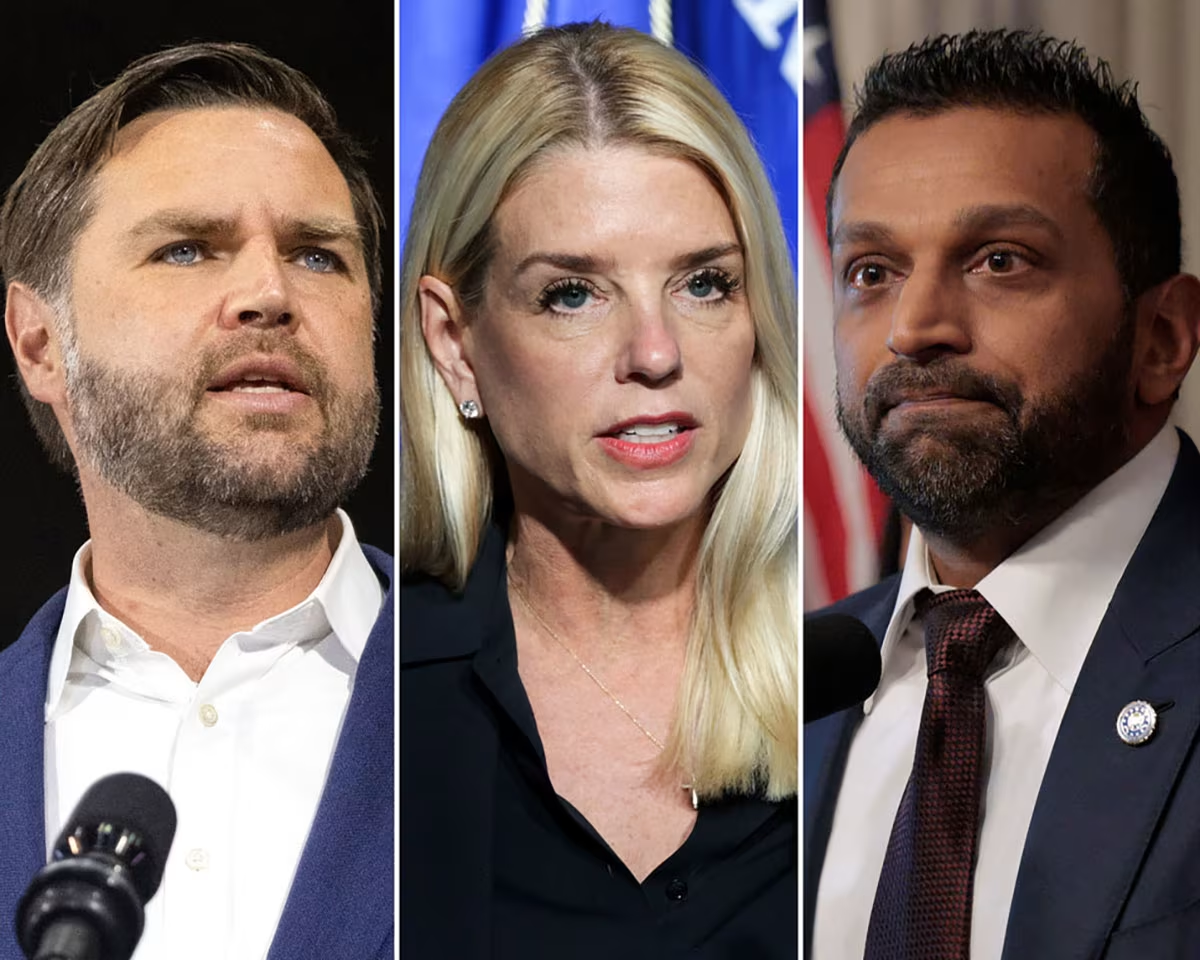
    Homeland Security Secretary Kristi Noem, FBI Director Kash Patel, and other far-right MAGA Republicans are demanding an investigation into former FBI Director James Comey, all sparked by an Instagram post featuring seashells in the sand that formed the numbers 8647. But hold on—what about Donald Trump’s video from March 30, 2024, which prominently displayed an image of President Joe Biden in the back of a pickup truck? Where was the MAGA outcry then?

    This video represents yet another instance of Trump employing dark and violent imagery in his campaign messaging, showcasing his penchant for inflammatory rhetoric. The slang term “eight-six” means to remove or eject, and let’s not forget that Donald Trump is the 47th president of the United States. In a post on May 15 on X (formerly Twitter), Noem accused Comey of promoting violence against Trump. However, critics are quick to remind her that “eight-six” does not inherently carry a violent connotation. In the restaurant industry, for instance, when workers say they need to “eight-six” an order, it simply means to cancel it. Similarly, a bar might “eighty-six” a customer who has had too much to drink.

    Liberal firebrand and former MSNBC host Keith Olbermann responded to Noem’s tweet with a scathing remark: “Listen, you lying witch, he didn’t call for assassinating anyone. Since you murdered your daughter’s dog, maybe you ought to shut up about this.”

    The Guardian’s Edward Helmore notes that the number 86 has also been used by Republicans advocating for the impeachment of Joe Biden. For example, t-shirts sold on Amazon emblazoned with “8646” signal a call to impeach Biden, the 46th president. Some liberals are accusing the right of deliberately misinterpreting Comey’s intent to score political points.

  • Donald Trump, the self-proclaimed “business genius,” is Steering us into a Dumpster Fire

    Moody’s has changed its outlook on the U.S. from “stable” to “negative.

    Donald Trump proudly touts himself as a great businessman, despite a track record marred by bankruptcies and failed ventures. I mean, how does one even manage to bankrupt a casino? They have house rules designed to ensure profitability! Yet, somehow, Trump managed to pull it off.

    In a recent turn of events, Moody’s downgraded the United States’ credit rating from “Aaa” to “Aa1.” This downgrade follows a shift in the outlook for the U.S. sovereign in 2023, driven by a widening fiscal deficit and soaring interest payments. Meanwhile, the Republican-controlled Congress, under Trump’s influence, is embroiled in debates over tax and spending plans that could further deepen the nation’s fiscal abyss.

    The combination of tariffs and spending cuts proposed by Trump and his Republican allies—alongside Elon Musk’s so-called Department of Government Efficiency—has revealed a concerning lack of awareness regarding the risks associated with Trump’s policies. If left unchecked, these could very well trigger a bond market rout.

    Moody’s downgrade should serve as a wake-up call for Trump and Congressional Republicans to abandon their reckless pursuit of deficit-busting tax giveaways. Trump is actively urging lawmakers to extend the 2017 tax cuts for billionaires—his crowning legislative achievement during his first term. Nonpartisan analysts warn that this move could add trillions to the federal government’s already staggering $36.2 trillion debt.

    Moody’s has indicated that the fiscal proposals currently under consideration by Republicans are unlikely to result in a sustained, multi-year reduction in deficits. They estimate that the federal debt burden could soar to approximately 134% of GDP by 2035, up from 98% in 2024.

    Investors rely on credit ratings to gauge the risk profile of companies and governments when raising funds in debt capital markets. Generally speaking, the lower a borrower’s rating, the higher their financing costs.

    So, there you have it: Donald Trump, the self-proclaimed “business genius,” is steering the good ol’ U.S. of A. straight into a corporate dumpster fire—like a casino that forgot to deal the cards!

  • Elise Stefanik’s Political Future in New York

    On Thursday, Axios reported that former President Donald Trump is maneuvering to clear the GOP primary field in New York, positioning Rep. Elise Stefanik for a gubernatorial run. This comes on the heels of Trump’s abrupt decision to withdraw Stefanik’s nomination for U.S. ambassador to the United Nations, a move that left House Republicans grappling with their precarious majority. In a surprising twist, Trump nominated former national security adviser Mike Waltz—infamous for his role in the “Signalgate” scandal—to fill the coveted position and its luxurious residence.

    Stefanik hails from a cozy little nook in northern New York, a place so safe it makes Fort Knox look like a target range! While the rest of New York leans toward the moderate to liberal side of the voting spectrum, her attempts to sell her MAGA policies downstate might be as successful as trying to sell ice to Eskimos—especially in a region where voting republican is as rare as a snowstorm in July!

    Stefanik may believe that the recent rightward shift in certain parts of New York could provide her with a viable path to victory. However, the political landscape is fraught with challenges. Democrats have been achieving a series of unexpected victories since November, and the 2026 elections are poised to be particularly daunting for Republicans across the nation. Adding to her difficulties, history is not on her side; New York has not elected a Republican governor in over two decades.

    After diligently climbing the ranks of the House GOP, Stefanik now finds herself sidelined. Meanwhile, Trump has demonstrated a willingness to treat his allies as disposable tools. Just ask his former Cabinet members—loyalty in the MAGA world is expected, but rarely rewarded.

    Stefanik tied her political fortunes to Trump, hoping that this alliance would propel her to power and prestige. Instead, she faces a precarious gubernatorial bid in a predominantly blue state, a demotion in Congress, and a front-row seat to the slow unraveling of her party’s machinery. 

  • Another Misguided GOP Proposal: The Economic Consequences of SNAP Cuts

    A recent proposal from the Republican Party, which advanced through the House Agriculture Committee on Wednesday, threatens to undermine the Supplemental Nutrition Assistance Program (SNAP) and its vital role in supporting families, farmers, and state budgets. At the heart of this measure is a plan to require states to contribute a percentage of the funding for food aid provided under SNAP. 

    Currently, the federal government fully funds SNAP benefits, while states cover approximately half of the program’s administrative costs.

    Under the proposed legislation, states would be mandated to pay between 5% and 25% of the cost of SNAP food aid, contingent upon their payment error rates. Additionally, states would be responsible for 75% of the program’s administrative expenses immediately.

    The implications of these changes are profound. Every dollar allocated in SNAP benefits generates up to $1.50 in local economic activity, supporting thousands of jobs. According to the National Grocers Association, the leading trade organization for the independent grocery sector, SNAP funding sustains approximately 388,000 jobs, contributes over $20 billion in direct wages, and generates billions in state and federal revenue.

    The ripple effects of these proposed cuts would extend across multiple sectors, adversely affecting families, farmers, grocers, local governments, and overall community economies. This legislation represents a misguided attempt to significantly reduce access to essential food assistance and discourage enrollment in a program that is crucial for many Americans.

  • Trump’s Empty Promises on Drug Price Cuts

    Donald Trump’s executive order demanding a reduction in prescription drug prices is about as impactful as a wet paper towel—utterly useless. He boldly claims he will slash prices by 30 to 80 percent, yet the order itself is nothing more than a collection of empty promises. It’s almost charming how he seems to believe he has the authority to make such sweeping changes when, in reality, he does not.

    It’s as if the president is orbiting in one universe while the rest of us are stuck in another, discussing a reality that simply doesn’t exist. Take Britain, for instance, where they have a national health insurance system that negotiates with pharmaceutical companies on behalf of the entire country. They present a united front, saying, “Here’s what we’re willing to pay,” which effectively diminishes the drug companies’ bargaining power and leads to lower prices.

    In contrast, the United States operates under a fragmented system, where no single entity has the clout to challenge the pharmaceutical giants.

    So, while Trump’s grandstanding may sound impressive, it’s clear that without a cohesive strategy, his executive order is little more than a theatrical performance—entertaining, perhaps, but ultimately devoid of substance.