We aim to be a voice in the ongoing political discourse, providing both factual information and opinionated analysis, from a progressive or center-left perspective, free from the direct influence of major established Main Street Media.
President Donald Trump has asserted that America has entered upon a new “Golden Age.” This is a far cry from the reality we see on the ground today, where over one hundred thousand jobs have been lost in just the past two months. Gas prices are skyrocketing, and groceries are costing a record amount.
Yet another consequence of the Trump administration’s disastrous war with Iran is that we are facing unprecedented deficits and soaring gas prices. More concerning still, the military’s most vital missiles for the defense of America’s allies and military installations in the Middle East are nearly depleted.
The Washington Post recently reported that the Pentagon’s stores of precision guided missiles and large diameter rockets needed for its most sophisticated missile-defense systems are nearly depleted after more than five months of relentless strikes on Iran. This leaves the president with only limited options regarding renewed attacks on the Islamic Republic.
At the same time, however, Reuters looked at this issue from a different angle, citing security analysts for the statement that the U.S. would be unable to respond adequately to a Chinese attack on Taiwan or other regional provocations if they were to occur, given the current levels of defense readiness. This development is exceptionally concerning given the heightened tensions with China at the moment, and it is not reassuring that the U.S. has so few options available in the event of a large-scale attack on any of its allies.
If Trump decides to continue with his campaign of airstrikes against Iran, the limited number of precision-guided weapons in the Pentagon’s inventory poses a potentially dangerous dilemma for the President. Reuters added that the U.S. is already down to just eight THAAD missiles and thirteen Patriot missiles, having burned through nearly 80% of THAAD and 50% of Patriot since the beginning of hostilities with Iran.
Despite the urgent need, defense officials estimate it will take several years before America’s missile inventory will be back to where it was before the war with Iran began, even if the defense-contracting companies ramp up their production rates to maximum.
It all boils down to the President himself, who, with his unilateral declaration of war on Iran, has placed the U.S. in an exceptionally perilous position both at home and abroad. Neither the American public nor our allies wanted this, and it is clear that Trump thought through the economic impact of his decision much too little. By launching this kind of reckless campaign, he has undermined both the economic and national security of the United States.
President Trump and the military establishment are learning that the campaign to strike Iran has been an expensive affair with diminishing returns and that the President’s political capital may be quickly running out.
In a tight presidential election year, Iran appears to have the best hand at the table. According to a number of media reports, Tehran has calculated that it already has the most to gain from whatever confrontation may unfold – and believes it may soon have reason to stop playing the game.
At this stage, the war may prove to be too costly, too long and too unpopular to achieve its political aims.
War Chest is Empty
The President’s options are being severely limited by the growing realization that the Pentagon is running low on long-range precision-guided munitions.
While the President’s press secretary has quickly dismissed such reports as false, the costs of war are nevertheless proving to be very real.
The Iranians know that time is not on America’s side and they have little doubt that eventually, even the most bellicose elements in Washington will come to realize the same thing.
At the Gas Pump
Meanwhile, back on American soil, the President’s economic policies are taking their toll: after another month of heightened hostilities, the national average for a gallon of gasoline now exceeds $4 and voters are not happy.
For the GOP, this is especially bad news, since it is the party that has benefited most from the recession and the voters who feel the effects of a tightening economy are likely to remain leery about any further adventures abroad.
With the midterms looming, voters are already starting to think about their options and higher prices at the pump are unlikely to help Trump’s chances.
Approval Ratings Plummet
According to a survey conducted last month by YouGov, Trump’s overall job approval rating has plunged to a shocking 34 percent – the lowest it has ever been, according to this pollster.
When it comes to the war, his numbers were even worse: according to a recent Associated Press-NORC survey, only 28 percent of voters approved of the job he has done in handling the crisis.
A president engaged in an unpopular war, with an economy that is still struggling under the weight of inflation, is likely to have an exceptionally difficult time during the electoral cycle.
Looking For An Exit Strategy
According to a recent report by the Wall Street Journal , Trump has already started considering ways to cut his losses and end his involvement in the crisis. In this scenario, Trump has apparently proposed to declare victory if and when Iranian forces open up the Strait of Hormuz for commercial traffic to resume.
However, this “win” scenario does not appear to include limiting Iran’s nuclear capabilities, the original goal of the campaign which, ironically, no longer seems desirable to its initiators.
In effect, if Trump were to declare victory, he would have to do so even as he leaves in place the very policies that continue to threaten America’s national security.
The lesson to be learned from his campaign of aggression against Iran appears to be that endless wars of decision have an unfortunate habit of making even the most well-intentioned politicians look like fools.
Gas prices, his own party, the polls, and the military budget are all combining to put unprecedented pressure on the President and he is beginning to feel it. Tehran certainly realizes it, and so does the GOP, which is already looking for ways to spin a hasty withdrawal as a presidential triumph.
I have always been interested in theater, but there are not many people who could describe Senator Susan Collins’s art as political theater so convincingly. Her most recent performance regarding the confirmation hearings of Todd Blanche, Trump’s former attorney, perfectly illustrates the art of rebellion.
When Senator Lisa Murkowski announced her opposition to the confirmation in the Senate, I felt delighted, believing that a real GOP rebellion had occurred. Soon after her announcement, Senator Collins followed suit, adding fuel to the idea that GOP senators had staged a magnificent show of disapproval against Trump’s choice for the position. However, my political nose began to itch as the next statements began pouring in. After all, it was none other than Senator Bill Cassidy who revealed his support for Blanche’s confirmation. The curtain quickly dropped, exposing the lack of real GOP opposition to Trump’s nomination.
To my surprise, Cassidy defended Blanche’s confirmation with nothing more than a good enough excuse for his “no” vote. After all, who has not criticized Blanche’s record before? At a time when the majority of Senate Republicans have voiced concerns about Todd Blanche’s confirmation, his “not perfect,” yet ultimately tolerable voting record, is a good enough excuse for a limited “rebellion” against Trump’s nominee.
I believe that the most crucial detail regarding Collins’s performance involves the “rebellion.” In this respect, I can understand Chris Hayes’s unease when Collins announced her “no” vote on Blanche’s confirmation because, shortly thereafter, he realized that the required votes for passage had already been secured. In fact, according to Susan Collins Watch, a website monitoring Collins’s voting record, her “no” vote has failed to stop a single nominee in her 29-year Senate career. To me, it seemed that Collins’s “rebellion” against Trump’s choice was yet another well-orchestrated play designed to mislead Collins’s constituents.
Moreover, I was quick to recall the events of 2018 involving Collins’s confirmation of Brett Kavanaugh. She was confident in stating that her vote for Kavanaugh’s confirmation did not undermine abortion rights or Roe v. Wade, yet her promise rang hollow four years later when her “yes” vote secured Kavanaugh’s confirmation. As such, I do believe that Collins has demonstrated a pattern of behavior suggesting that she rarely votes “no” when her “no” vote cannot change anything.
Collins’s “carefully crafted image as a bipartisan gatekeeper” begins to fade, her constituents must ask themselves what really matters when casting a “no” vote against a presidential nominee for the Supreme Court. Collins’s performance in voting for Kavanaugh’s nomination and subsequently defending her decision as one of “reasoned pragmatism” appears to suggest that “no” votes do not come easy for Collins. In fact, for Collins, it seems that they only occur when they fail to accomplish anything.
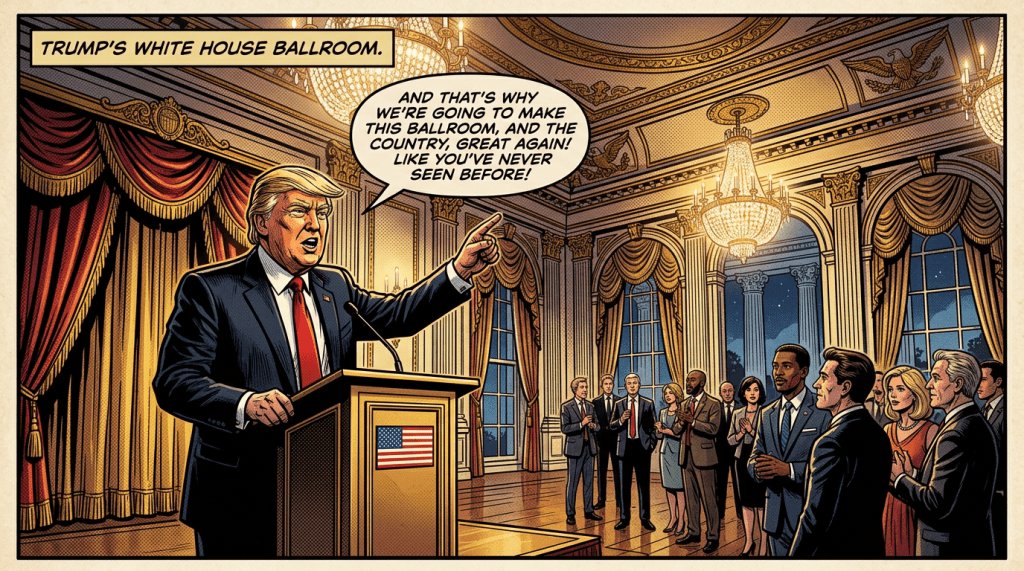
WASHINGTON – A federal appeals court has paused construction on President Donald Trump’s budgeted 400 million-dollar project of the White House ballroom. The court ruled that building the ballroom should be immediately stopped from proceeding with any jobs “above ground”, including features the government claims are necessary security measures.
.
On Friday, a 2-1 panel of the D.C. Circuit Court of Appeals ruled to uphold a preliminary injunction against the President. The National Trust for Historic Preservation, an organization that protects buildings, filed the injunction in December 2025 after the administration began demolition of the East Wing to make way for a 90,000 square foot subterranean ballroom not approved by Congress.
Patricia Millett’s and Bradley Garcia’s opinions, in which they ruled in favor of preservation, were joined by judges who were appointed by President Barack Obama and Joe Biden. They stated that the Constitution does not permit presidential edicts to dictate the use of federal resources.
They continued, “whether a large ballroom should be built…is a decision for Congress, not the President” due to the fact that the Constitution grants spending authority over the federal assets to lawmakers, not the executive branch, despite the security reasons cited by the administration.
However, the decision to halt the work was only made official for two weeks in order to allow the Trump administration to appeal to the U.S. Supreme Court.
Neomi Rao, who was nominated by President Trump, filed a dissenting opinion in response to the majority’s ruling. She stated that the injunction which stopped the work was an act of judicial activism.
“By stepping in and taking control over something as monumental as the White House, the district court engaged in judicial activism,” she wrote. “Courts shouldn’t be running building projects”
The administration’s original plan was to decommission the East Wing while keeping the West Wing as a separate unit. However, the White House Complex’s budget requires funding beyond the president’s official salary so the administration argued that the entire wing be demolished to make way for the expansion of the subterranean chamber.
Furthermore, the administration claims that the ballroom project is part of larger security upgrades to the complex.
President Trump expressed dissatisfaction with the decision in his Truth Social page. He stated that the ruling was “politically motivated and completely illegal.” He argued that not completing the ballroom project endangered future presidents, staff, diplomats, and the general public.
The two-week pause in the construction of the ballroom project means that the future of the project depends on whether or not Trump’s emergency appeal to the Supreme Court is granted.
For years, I studied the relationship between information and society. But the latest policy changes in Washington are deeply troubling. This week, the Federal Communications Commission, in a 2-1 vote, overturned a key media ownership rule protecting the diversity of viewpoints in our news and entertainment. This decision, which has been made by a Republican majority, allows bigger corporations to acquire a significantly greater share of local news.
If this is to be achieved, local news outlets will no longer be truly local. As someone who has fought for years for a better environment for local news to survive, I believe this development to be an existential threat to it. This is why I am raising this alarm bell about the end of local news.
What Just Happened? (The 39 Percent Cap Was Lifted)
For more than two decades, companies have been restricted to 39 percent of all television households as a result of a certain law. It was designed to prevent a single entity from dominating the news and information space.
The chairman of the FCC, Brendan Carr, a Trump appointee, argued that this decision was made to “restore fairness” to the system, giving local news a better chance to compete with big tech conglomerates.
Many, however, do not share this point of view. During the debate in the FCC, democrat commissioner Anna Gomez said, “This is not local broadcasting; it is Big Media muscling in to replace Big Tech as the gatekeeper – neither of which is in the public interest.”
Who Wins from This?
In this tug of war, there are always winners and losers, but the main beneficiaries of this policy shift were already predicted by its supporters. With this FCC decision, Nexstar, for example, will be able to merge with Tegna, so that around 80 percent of all households in the USA will receive their local news from one company. Such concentration of power in one media holding threatens the diversity of views in society.
Another media conglomerate that wins from this is Sinclair Broadcasting Group. This company has a reputation for forcing “must run” news stories on its affiliated local TV stations, so that the news coming out of them reflects a particular point of view selected by the company’s bosses. With the repeal of the 39 percent rule, Sinclair will be able to disseminate its political narratives even more widely through dozens of local news outlets.
Not Entirely Legal either (Challenges to the FCC Decision are Being Considered)
In addition to being “unfair,” this FCC decision may also be illegal. This is what the court in Washington will have to decide in one of the lawsuits challenging the new FCC rules. This case, brought by the media watchdog group Free Press, claims that Brendan Carr does not have the authority to repeal the 39 percent rule.
According to the complaint, the FCC’s move violates the Communications Act of 2004, which was adopted by a decision of Congress. Moreover, this law prevented the FCC from overturning the 39 percent cap unless Congress voted to repeal it. According to Matt Wood of Free Press, Carr’s initiative is an attempt to help Trump allies grab local news markets by any means.
How Does This Affect the Local News?
The importance of this decision for the future of local news can’t be overestimated. When a large national media company buys a popular local news outlet, it rarely means that it will begin to provide more comprehensive coverage of local events. Such mergers usually lead to the opposite: cuts in the number of local news shows, journalists’ salaries, and much more remote management decisions.
In other words, the audience will have less information about what is happening around them and about their region in general, since coverage of local events will be controlled by people who speak for themselves. John Bergmayer of Public Knowledge said, “News consolidation leads to less local news, fewer journalists, and more top-down management.”
The FCC as an Agency that Makes Politically Motivated Decisions
Perhaps the most annoying aspect of all this is that the FCC itself seems to serve primarily as an instrument for advancing the policy preferences of the current administration.
By promoting his candidates to the post of FCC chairman, Trump has ensured that the FCC will be willing to loosen regulations whenever they see fit. This week, commissioner Brendan Carr, for example, accused ABC and CBS of “anti-conservative bias” in the coverage of certain news. In essence, it is a call for these federal networks to change their narratives in favor of the Trump administration. By politicizing the FCC, Trump has turned it into an auxiliary instrument for pursuing his policy in Congress.
From my point of view
This decision to repeal the 39 percent rule is another step toward greater corporate control of the news, which is why I am raising this alarm bell about the end of local news. This is because it allows companies to buy more local news outlets and cover fewer local issues than before. In addition, the coverage of news will be subject to the control and management of officials from these companies, which will have an even greater impact on the polarization of opinions in society.
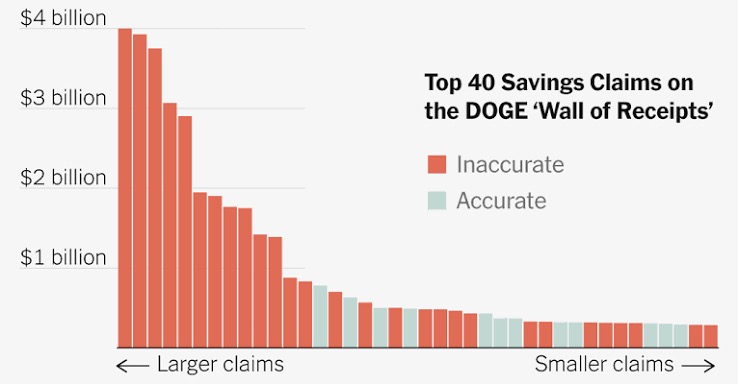
According to a report released on Thursday, the Department of Government Efficiency, better known as DOGE, led by Elon Musk himself, was making up figures about the amount of money it was saving the country. The report was requested by Democratic senators Gary Peters of Michigan and Richard Blumenthal of Connecticut and was conducted by the Government Accountability Office.
DOGE was found to have used “misleading practices” when it came to canceled leases and active government contracts. Additionally, the audit found that the department provided insufficient evidence for the methods used in 96 percent of the canceled grants.
The Department of Government Efficiency was also found to have failed to follow their own formulas when it came to calculating figures for canceled leases and contracts, and in the cases where they did follow their formulas, they either missed out on the details or did not disclose them when they should have. When they did follow their own procedures, the Government Accountability Office found that they overlooked the complexities of government contracts, including liabilities and penalties that come with breaking a contract before the due date.
“The report shows that the Trump administration’s cost-saving mission was conducted in a misleading fashion, achieving little apart from putting at risk taxpayer data and key programs,” said Senator Peters.
“President Trump and his allies in the Senate and House have been using DOGE as a fig leaf to hide tax-cut giveaways to the wealthy and large corporations while pretending to save the deficit,” said Senator Blumenthal.
Many people have responded to the report, including Jessica Tillipman, associate dean of the GWU School of Law, who specializes in government procurement. Tillipman cited several errors she found on the social media accounts of DOGE, one of which being a claim that the department had saved $28 million reduction in expenditures for an Air Force agreement, whereas the actual financial relief amounted to roughly $600,000 from a canceled lease. “That figure doesn’t account for the present value of future lease payments, which would reduce the supposed $3.7 million savings,” Tillipman said.
“DOGE’s fiscal wins were mostly fictional,” write Reason editor-in-chief Eric Boehm, who covered the story for the libertarian magazine. “According to a new report from the Government Accountability Office, the Trump administration’s claims about savings from slashing federal spending were often based on faulty math.”
“DOGE may soon start spending more taxpayer money, but at least the government watchdogs are forcing Musk’s agency to be more open about how it spends our money when it comes to cutting back federal services,” concluded Senator Blumenthal.
How Trump’s “Bold” Moves Turned a Working Iran Deal Into a Self-Inflicted Crisis
by Winston Wendell
Wars don’t always begin with explosions. Sometimes you lose before a single shot—when your rivals grow stronger, your network of allies weakens, and your own choices hurt more than help. That’s what happened after Trump tore up the Iran nuclear deal, the JCPOA, and started his so-called “maximum pressure” campaign. Looking back now, it’s clear: all that posturing did more harm than good.
Let’s break down how we got here—how the tough talk just made things messier, gas prices spiked, markets stumbled, and even America’s best friends started doubting us.
Grandstanding Isn’t the Same as Getting Results
Trump loved making a scene. He’d throw out fiery tweets, trash the Iran deal at every rally, and promise something “better.” He called the JCPOA weak, claiming it caved to Tehran and left America empty-handed.
But reality didn’t match the rhetoric. The facts were plain: the JCPOA was working. Iran cut its enriched uranium stockpile by 98%, dismantled thousands of centrifuges, and opened up its nuclear sites to unprecedented inspections from the IAEA. The deal put hard limits in place.
Still, the Trump administration never came up with a better alternative. All “maximum pressure” really meant was punishing sanctions, hoping Iran would fold and come crawling back. Of course, that didn’t happen. Instead, Iran held its ground, which is pretty much what history teaches us about relying on pressure without a backup plan.
Walking Away From Progress
The Decision
In May 2018, Trump yanked America out of the JCPOA and hit Iran with sanctions again. I remember thinking: why break something that’s actually working? The real answer wasn’t about better policy. It was politics.
Immediate Fallout
Iran didn’t just shrug and take it. They cranked up uranium enrichment, ignoring the deal’s strict limits. Suddenly, the path to building a bomb got a lot shorter.
Diplomatic ties started unraveling. The negotiating group shrank, with the U.S. out and Europe struggling to shield Iran from American sanctions. Everyone’s bargaining power sagged without U.S. support.
America’s allies noticed. When one country tears up a major deal, trust dries up fast. It’s not easy earning that back.
Leaving the JCPOA handed Iran a whole new set of advantages: the freedom to enrich more uranium, the chance to play the victim, and a divided bunch of opponents.
The Economic Domino Effect: Oil, Markets, Wallets
Oil Prices Spike
Sanctions knocked 2–3 million barrels of Iranian oil a day off the world market. Saudi Arabia and Russia tried to cover the slack, but oil prices still jumped from $70 a barrel to nearly $85 in a few months.
We felt it, our weekly gas bill jumped about 15%. Drivers everywhere noticed, along with businesses shipping goods or running trucks.
Markets Wobble
Investors hate not knowing what’s next. Trump’s moves spread uncertainty all over:
Stock markets bounced around, especially for energy companies and businesses with a Middle East footprint. Countries like India, China, and South Korea scrambled to find new oil suppliers. Their budgets felt the hit and so did the cost of goods at home.
These numbers weren’t just for headlines. Groceries cost more, energy bills crept up, and even retirement savings got dinged if they were tied to the markets. Decisions in Washington rippled straight to regular people.
Leaving Allies Out to Dry
Europe on the Spot
Europe tried to save the JCPOA with a workaround, INSTEX, but without U.S. backing, European companies ran for cover. I remember German and French leaders sounding pretty frustrated, caught between supporting the deal and avoiding U.S. penalties.
Asia’s Dilemma
Japan and South Korea got a few short-term waivers to keep buying Iranian oil. But every few months, diplomats scrambled to figure out what Washington would do next. It was exhausting for everyone involved.
Trust Gets Shaky
When the rules keep changing, allies grow suspicious. NATO wasn’t thrilled. Neither were old partners, watching America toss aside another agreement. Doubt crept into military exercises, intelligence sharing, and every future negotiation. And that kind of mistrust is hard to reverse.
Why “Maximum Pressure” Missed the Mark
The biggest mistake? Betting it all on sanctions without leaving room for real negotiation. Iran’s leaders just doubled down, ramped up their nuclear work, and kept stirring up trouble in the region. More pressure just meant less cooperation, not more.
So what did the U.S. get? A dead inspection program, an Iran with more nuclear options, shaky world markets, and cooler alliances all around. Everyday Americans ended up paying for it.
Honestly, a smarter move would’ve been to stick with JCPOA inspections and use them as leverage to fix the deal’s flaws on missiles, on regional actions. Not trashing the whole thing.
Lessons for Next Time
Here’s what I take away:
If something’s working, don’t destroy it, improve it. Check if it’s actually hitting its goals, then build on that. Sanctions only work if there’s an exit. Just squeezing harder makes the other side push back.
Stay tight with partners. America’s strongest when its friends trust and cooperate. Go it alone, and you end up isolated and less effective.
When Showmanship Wins, Everyone Pays
I watched the fallout from one attention-grabbing decision echo all the way from the UN to my local pump. Trump’s bold moves made for good TV but wrecked progress and ordinary people picked up the bill.
The Iran deal wasn’t perfect, but it did the job. Scrapping it gave Iran new momentum, touched off economic pain, strained alliances, and made life harder for regular folks.
If we want to avoid repeating this, we need to stick with what works, trust the facts, and focus on steady, smart partnerships. Real strength isn’t just about big talk. It’s about reliable leadership that others (and the world) can count on.
If this breakdown made sense to you, pass it on or subscribe for more straight-shooting analysis on politics, economics, and global security.
Every time I look at Washington, D.C., I can’t help but shake my head at the tricks politicians pull. But this PROMISE Act sitting on my desk? That’s next-level. It’s political cynicism at its finest, and I won’t stay quiet about it—Americans deserve better than to have their most basic safety net tampered with behind closed doors.
Let’s talk about what’s really in this bill, because it’s wild.
The PROMISE Act hands control to four unelected members of the Social Security Advisory Board. They’d have just one month to come up with a fifty-year plan to fund Social Security. If they agree on something, Congress has to hold an immediate vote—right after an election, when we’re in that gray “lame-duck” zone before new members are sworn in. If the panel can’t agree? Then any single member of Congress can throw their own plan straight onto the House floor—no committees, no amendments, no real debate, nothing.
Stop and think about that. They want to fundamentally change Social Security—the backbone for millions of retirees, people with disabilities, and survivors—at a moment when politicians who are leaving office have nothing to lose. They’re basically insulated from any backlash.
For me and for millions of folks working hard everyday, that’s the exact opposite of democracy.
And who’s behind this? A “bipartisan” group of senators: Bill Cassidy, Dick Durbin, Thom Tillis, Tim Kaine, John Cornyn, Angus King, and Alan Armstrong. Now look closer: five out of these seven are either retiring or already lost their next election. They don’t have to answer to anybody. They won’t stand behind cuts or a higher retirement age. They can just pull the trigger and walk away, leaving the rest of us to deal with the fallout.
I’m not the only one calling this out. Advocacy groups are furious, as they should be. The AARP fired off a letter to Cassidy and Durbin, ripping them for trying to rush these changes without real public input. Max Richtman, he runs the National Committee to Preserve Social Security and Medicare—put it bluntly: lawmakers who aren’t facing another election have no business messing with people’s earned benefits. That’s basic accountability.
Now, I’m not denying there’s a real problem. The Social Security Board of Trustees said back in June: if Congress does nothing, the trust funds only cover 78% of promised benefits starting in 2032. We need to fix that.
But the folks pushing the PROMISE Act want to fix it on the backs of ordinary workers—with cuts, stingier cost-of-living raises, or hiking the retirement age.
There’s a straightforward, fair solution that doesn’t hurt seniors or vulnerable people. The proposal is simple: make the wealthiest pay what regular folks already do. If you make more than $250,000, you’d pay payroll taxes on every dollar, just like everybody else.
This isn’t just about keeping Social Security alive for 75 years—it’s about making it stronger. The plan actually increases yearly benefits by $2,400 for people. And voters agree. Eight out of ten support this, according to a Data for Progress poll.
Still, Senate Republicans blocked my bill. Why? Because protecting the ultra-wealthy from paying taxes is practically a team sport in Washington.
My message the whole Democratic Party: draw a bright line, no raising the retirement age, no benefit cuts, no watered-down cost-of-living hikes, no privatization, and no backroom deals in the
I’ve watched the Democratic Party twist itself in knots for years, but lately, it feels like it’s finally unraveled. All of a sudden, “democratic socialists” have found their way to the center stage, and honestly, the party seems to be forgetting what most people need—folks who just want life to make sense, not another uphill battle. Democratic socialism isn’t a fresh spin on old values—it runs straight into the wall of what middle-class Americans care about.
Anyone I know isn’t hoping for higher taxes or a government takeover in the middle of the night. They’re busy paying the mortgage, keeping the fridge stocked, checking if their kids’ schools are safe, and crossing their fingers there’s enough left over for a rainy day. Ask them about fairness, and they’ll tell you it’s about working hard and earning what you get. Nobody’s asking for the government to hand everything out or bog down the economy with wild experiments.
Take the Green New Deal. Climate change matters—a lot. But come on, does anyone believe the middle class can foot a trillion-dollar bill and pay more for energy without breaking a sweat? We’re the ones stuck paying the price. They’re shaky ideas that pile even more pressure onto teachers, nurses, business owners, and workers—the same people already feeling squeezed by shrinking paychecks and pricier groceries.
Party leaders keep saying there’s space for everyone, banking on far-left proposals to keep younger voters hopeful and the donation machine humming. But all this does is turn radical ideas into “normal,” and most families don’t buy it. Look at Darializa Avila Chevalier’s win in NYC’s 15th district—she ran on a 70% wealth tax and a federal jobs guarantee for everyone. Activists might celebrate, but regular folks aiming to buy a house, start a business, or pick a school for their kids look at that and think, “No thanks.” Her win doesn’t mean America wants to go far left. It’s a red flag that the party is veering toward policies that hike costs, kill investment, and stick even more power in the government’s hands—the last thing the middle class needs.
What I wish is for the Democratic Party to stick to common sense, back up small businesses, and deliver real help: affordable childcare, decent job training, safer streets. Democratic socialism misses all that. If we’re being real, it’s just an idealistic, top-down plan that swaps practical answers for risky promises—and guts what makes the Democratic Party strong. If this direction keeps up, it’s the middle class left holding the mess. We know the Republican Party and Trump clearly not for the American middle Class. Let’s be honest: this isn’t some bold new path for Democrats. It’s just a turn away from what built and keeps the American middle class alive.
Every time we stop for gas and see the price creeping past four bucks a gallon, it stings—it’s a blunt reminder of how much harder life’s gotten for regular folks. Meanwhile, the oil giants? They’re swimming in profits. Costs for everything else just keep rising. Families are stretched to the breaking point, but big oil corporations are basically making out like bandits, especially now with all the chaos in Iran.
Let’s just say it straight: after President Trump launched that military strike—something a lot of legal experts straight-up call illegal—fuel prices shot up worldwide. The oil companies jumped at the chance. In just the first quarter of 2026, ExxonMobil and Chevron pulled in $26.5 billion combined. And it’s not just here in the States. Shell and TotalEnergies are raking it in overseas, too.
These numbers tell the story. ExxonMobil pulled in $14.5 billion, and a big chunk—$9.4 billion—got funneled right to their shareholders through stock buybacks and dividends. Chevron? They just had their best quarter in six years, pocketing $12 billion.
It’s a pileup of cash at the top, while people everywhere are barely scraping by. A fresh Harris survey says 95% of Americans see the country stuck in a full-blown affordability crisis, with gas and groceries eating up most of their paychecks.
And honestly, people aren’t just sitting quietly. A group of Democratic senators is calling out the oil giants for padding their profits while families get slammed by high prices. Things only got more heated after President Trump flat-out said his administration isn’t planning to help with the fallout from the war.
Environmental groups and consumer advocates aren’t backing down, either. The Sierra Club and others are pushing Congress to tax these massive profits so that some of the money actually ends up in the hands of people who need it. Critics say oil execs are cozying up to the White House, fighting off new clean energy projects—stuff that could eventually give folks some breathing room.
The bottom line: every time we stop at the pump, it’s a cold reminder—the oil industry keeps cashing in off global crises, while everyone else is just scrambling to hang on.