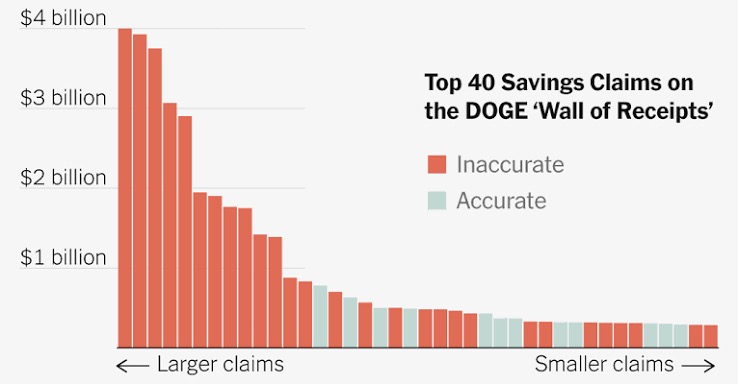
According to a report released on Thursday, the Department of Government Efficiency, better known as DOGE, led by Elon Musk himself, was making up figures about the amount of money it was saving the country. The report was requested by Democratic senators Gary Peters of Michigan and Richard Blumenthal of Connecticut and was conducted by the Government Accountability Office.
DOGE was found to have used “misleading practices” when it came to canceled leases and active government contracts. Additionally, the audit found that the department provided insufficient evidence for the methods used in 96 percent of the canceled grants.
The Department of Government Efficiency was also found to have failed to follow their own formulas when it came to calculating figures for canceled leases and contracts, and in the cases where they did follow their formulas, they either missed out on the details or did not disclose them when they should have. When they did follow their own procedures, the Government Accountability Office found that they overlooked the complexities of government contracts, including liabilities and penalties that come with breaking a contract before the due date.
“The report shows that the Trump administration’s cost-saving mission was conducted in a misleading fashion, achieving little apart from putting at risk taxpayer data and key programs,” said Senator Peters.
“President Trump and his allies in the Senate and House have been using DOGE as a fig leaf to hide tax-cut giveaways to the wealthy and large corporations while pretending to save the deficit,” said Senator Blumenthal.
Many people have responded to the report, including Jessica Tillipman, associate dean of the GWU School of Law, who specializes in government procurement. Tillipman cited several errors she found on the social media accounts of DOGE, one of which being a claim that the department had saved $28 million reduction in expenditures for an Air Force agreement, whereas the actual financial relief amounted to roughly $600,000 from a canceled lease. “That figure doesn’t account for the present value of future lease payments, which would reduce the supposed $3.7 million savings,” Tillipman said.
“DOGE’s fiscal wins were mostly fictional,” write Reason editor-in-chief Eric Boehm, who covered the story for the libertarian magazine. “According to a new report from the Government Accountability Office, the Trump administration’s claims about savings from slashing federal spending were often based on faulty math.”
“DOGE may soon start spending more taxpayer money, but at least the government watchdogs are forcing Musk’s agency to be more open about how it spends our money when it comes to cutting back federal services,” concluded Senator Blumenthal.
How Trump’s “Bold” Moves Turned a Working Iran Deal Into a Self-Inflicted Crisis
by Winston Wendell
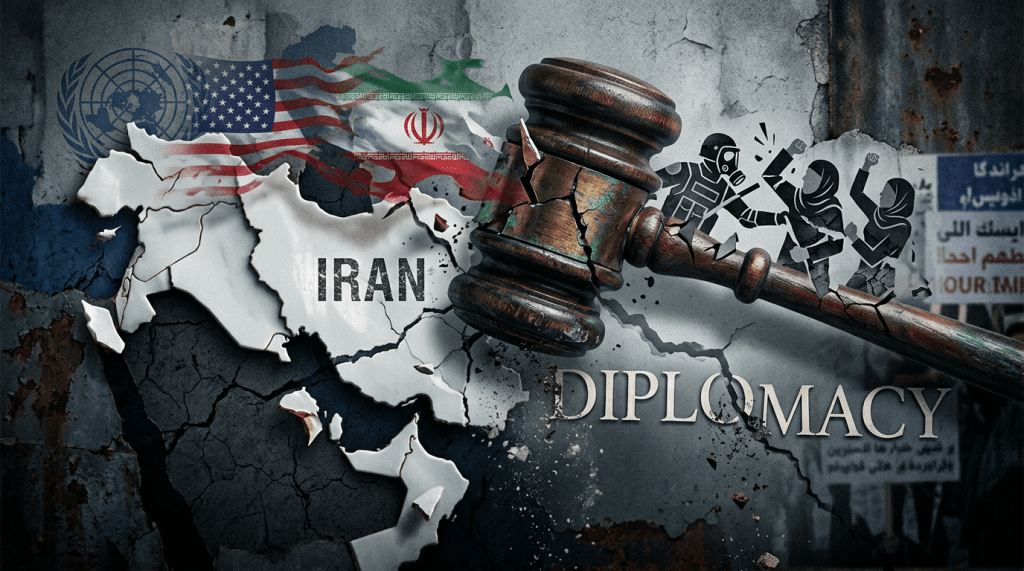
Wars don’t always begin with explosions. Sometimes you lose before a single shot—when your rivals grow stronger, your network of allies weakens, and your own choices hurt more than help. That’s what happened after Trump tore up the Iran nuclear deal, the JCPOA, and started his so-called “maximum pressure” campaign. Looking back now, it’s clear: all that posturing did more harm than good.
Let’s break down how we got here—how the tough talk just made things messier, gas prices spiked, markets stumbled, and even America’s best friends started doubting us.
Grandstanding Isn’t the Same as Getting Results
Trump loved making a scene. He’d throw out fiery tweets, trash the Iran deal at every rally, and promise something “better.” He called the JCPOA weak, claiming it caved to Tehran and left America empty-handed.
But reality didn’t match the rhetoric. The facts were plain: the JCPOA was working. Iran cut its enriched uranium stockpile by 98%, dismantled thousands of centrifuges, and opened up its nuclear sites to unprecedented inspections from the IAEA. The deal put hard limits in place.
Still, the Trump administration never came up with a better alternative. All “maximum pressure” really meant was punishing sanctions, hoping Iran would fold and come crawling back. Of course, that didn’t happen. Instead, Iran held its ground, which is pretty much what history teaches us about relying on pressure without a backup plan.
Walking Away From Progress
The Decision
In May 2018, Trump yanked America out of the JCPOA and hit Iran with sanctions again. I remember thinking: why break something that’s actually working? The real answer wasn’t about better policy. It was politics.
Immediate Fallout
Iran didn’t just shrug and take it. They cranked up uranium enrichment, ignoring the deal’s strict limits. Suddenly, the path to building a bomb got a lot shorter.
Diplomatic ties started unraveling. The negotiating group shrank, with the U.S. out and Europe struggling to shield Iran from American sanctions. Everyone’s bargaining power sagged without U.S. support.
America’s allies noticed. When one country tears up a major deal, trust dries up fast. It’s not easy earning that back.
Leaving the JCPOA handed Iran a whole new set of advantages: the freedom to enrich more uranium, the chance to play the victim, and a divided bunch of opponents.
The Economic Domino Effect: Oil, Markets, Wallets
Oil Prices Spike
Sanctions knocked 2–3 million barrels of Iranian oil a day off the world market. Saudi Arabia and Russia tried to cover the slack, but oil prices still jumped from $70 a barrel to nearly $85 in a few months.
We felt it, our weekly gas bill jumped about 15%. Drivers everywhere noticed, along with businesses shipping goods or running trucks.
Markets Wobble
Investors hate not knowing what’s next. Trump’s moves spread uncertainty all over:
Stock markets bounced around, especially for energy companies and businesses with a Middle East footprint. Countries like India, China, and South Korea scrambled to find new oil suppliers. Their budgets felt the hit and so did the cost of goods at home.
These numbers weren’t just for headlines. Groceries cost more, energy bills crept up, and even retirement savings got dinged if they were tied to the markets. Decisions in Washington rippled straight to regular people.
Leaving Allies Out to Dry
Europe on the Spot
Europe tried to save the JCPOA with a workaround, INSTEX, but without U.S. backing, European companies ran for cover. I remember German and French leaders sounding pretty frustrated, caught between supporting the deal and avoiding U.S. penalties.
Asia’s Dilemma
Japan and South Korea got a few short-term waivers to keep buying Iranian oil. But every few months, diplomats scrambled to figure out what Washington would do next. It was exhausting for everyone involved.
Trust Gets Shaky
When the rules keep changing, allies grow suspicious. NATO wasn’t thrilled. Neither were old partners, watching America toss aside another agreement. Doubt crept into military exercises, intelligence sharing, and every future negotiation. And that kind of mistrust is hard to reverse.
Why “Maximum Pressure” Missed the Mark
The biggest mistake? Betting it all on sanctions without leaving room for real negotiation. Iran’s leaders just doubled down, ramped up their nuclear work, and kept stirring up trouble in the region. More pressure just meant less cooperation, not more.
So what did the U.S. get? A dead inspection program, an Iran with more nuclear options, shaky world markets, and cooler alliances all around. Everyday Americans ended up paying for it.
Honestly, a smarter move would’ve been to stick with JCPOA inspections and use them as leverage to fix the deal’s flaws on missiles, on regional actions. Not trashing the whole thing.
Lessons for Next Time
Here’s what I take away:
If something’s working, don’t destroy it, improve it. Check if it’s actually hitting its goals, then build on that. Sanctions only work if there’s an exit. Just squeezing harder makes the other side push back.
Stay tight with partners. America’s strongest when its friends trust and cooperate. Go it alone, and you end up isolated and less effective.
When Showmanship Wins, Everyone Pays
I watched the fallout from one attention-grabbing decision echo all the way from the UN to my local pump. Trump’s bold moves made for good TV but wrecked progress and ordinary people picked up the bill.
The Iran deal wasn’t perfect, but it did the job. Scrapping it gave Iran new momentum, touched off economic pain, strained alliances, and made life harder for regular folks.
If we want to avoid repeating this, we need to stick with what works, trust the facts, and focus on steady, smart partnerships. Real strength isn’t just about big talk. It’s about reliable leadership that others (and the world) can count on.
If this breakdown made sense to you, pass it on or subscribe for more straight-shooting analysis on politics, economics, and global security.
President Barack Obama defended the Joint Comprehensive Plan of Action (JCPOA) with a blunt warning: “The choice we face is ultimately between diplomacy or some form of war.”
Now, years later, I watch that warning turn painfully real. When Donald Trump pulled the United States out of a nuclear deal that had kept Tehran’s nuclear ambitions in check, his administration threw the country into a disaster of its own making.
On the military front, this war’s a failure from every angle. Targeted strikes came and went, and the Iranian government endures, now with even tougher hardliners from the Islamic Revolutionary Guard Corps in charge. Iran still holds most of its missile stock, its mobile launchers, its underground bunkers. Drone and missile factories keep running. Worst of all, Tehran’s grip on the Strait of Hormuz—is even tighter. Those photos of commercial ships stuck near Larak Island say it all. Washington’s shortsighted choices gave our adversaries control of some of the world’s most important economic lifelines.
The cost? It’s staggering, both in dollars and lives. We burned through about $25 billion at the start, and the spending hasn’t stopped. At home, Americans feel it everywhere, gas prices, groceries, you name it. But it’s the human cost that hurts most. U.S. service members have died, and hundreds cope with wounds they’ll never shake, all for a conflict with no clear end, no real transparency, and not a word of congressional approval. Like millions of others, I feel deep frustration. This is a war with no purpose, no strategy, and no exit.
Trump’s aggressive reversal left America boxed in with terrible options. If Washington caves to Tehran—giving up huge sums of money or control over the Strait of Hormuz—we abandon the basic principle of free maritime navigation. Global commerce depends on that. An emboldened Iranian regime, flush with cash, will just buy new air defenses, load up on missiles, and use the Strait for leverage as long as it wants.
No one wins here. There’s only the bitter fallout of a war we never needed, a conflict that put America’s security at risk, bled our economy, and left the world less stable than ever.
American politics doesn’t usually give you a transformation as sharp, or as revealing as Lindsey Graham’s. Watching him shift in Washington has become almost surreal. The man bends with the wind, sure, but the cost of that flexibility has been his integrity.
Just look at his record. Over the years, Graham has mostly acted like his main goal is just to hang on to his seat. He went from bashing Trump at every turn to openly praising him. If you need a case study in plain old political opportunism, this is it.
Remember the 2016 Republican primaries? Graham didn’t pull any punches. He called Trump a “race-baiting, xenophobic, religious bigot.” He sounded like someone who actually believed what he was saying. Then, almost instantly, once Trump became the nominee, Graham dropped the act and threw in his lot with Trump. That wasn’t some sudden epiphany, it was survival mode, pure calculation.
The shift was impossible to miss during the Brett Kavanaugh hearings in 2018. After Dr. Christine Blasey Ford’s testimony, the Senate was in chaos. Graham could have played the role of the rational adult in the room, but he didn’t. He went full throttle with a fiery defense of Kavanaugh, turning the hearings into political theater. In doing so, he shored up his spot in Trump’s camp, tossing aside the usual committee rules for a shot at the spotlight.
Fast forward to 2020, and Graham’s credibility took another hit. After Justice Ruth Bader Ginsburg died, the same man who’d argued in 2016 that Supreme Court picks should wait until after the election did an immediate about-face. He fast-tracked Amy Coney Barrett’s nomination, just weeks before voters went to the polls. It wasn’t just a flip-flop, it was proof that his stated principles didn’t mean much when power was at stake.
So, when does a politician stop serving the public and start just playing the angles? With Graham, it was obvious: keeping his place at the table matters more than sticking to his beliefs. He changed course whenever it suited him, and yes, it’s helped him stay in power, but at the expense of his credibility.
Graham’s story serves as a cautionary tale. When individuals abandon their convictions to maintain relevance, they risk losing the very respect that initially earned them admiration. Politicians who remain apolitical will eventually succumb to any political pressure. Moreover, if you support someone whose principles fluctuate with the political climate, what can you truly rely on during challenging times?
In the wake of his passing, it is customary for Washington to offer a eulogy extolling his virtues. While he was undoubtedly a remarkable individual when collaborating with John McCain, it is imperative that we draw lessons from his tenure in office. Was his primary motivation the nation and the Constitution, or was it driven by political gain and the pursuit of power?
I’ve been watching the Maine Senate race with this weird combination of fascination and dread, and after a while, you just can’t keep quiet about the slow-motion disaster that might hand Susan Collins another term. Everybody knows that seat matters—a single Republican win could lock in their Senate majority, which means control over Supreme Court appointments for years to come. It’s no exaggeration to say this race feels like a vote on the country’s future.
Thing is, it’s not just the big stakes—the whole race has been utter chaos. Out of nowhere, Morris Katz, this young New Yorker best known for splashy viral videos with John Fetterman, parachutes into Maine. He brings along his firm, The Fight Agency, and decides to build a “man of the people” candidate from scratch for the Democrats. That’s how Graham Platner shows up—a guy who, on the surface, seems to tick every box for working-class appeal. Thanks to Katz’s flashy campaign launch, Platner’s poll numbers shot up almost overnight.
But they cut corners to make it happen. Instead of running the usual, thorough background checks (the stuff that keeps campaigns from blowing up), Katz just grabbed a quick-and-dirty memo from some boutique outfit and called it a day. That left them exposed. Sure enough, it didn’t take long for a stack of explicit texts and an ugly online past to surface—stuff anyone should’ve spotted. Once the scandals broke (with everything from domestic trouble to abuse claims in the mix), Platner’s team tried circling the wagons and blaming “coastal elites.” All that stonewalling just made things uglier.
And don’t let the Democratic leadership off the hook. Chuck Schumer brought his signature top-down style—pushing Governor Janet Mills to be the party’s favorite. Then, just as Platner started getting traction, Mills backed out and left the party stuck trying to rally around a candidate who was already a liability. Now, as the general election creeps closer, the Democrats are left with a nominee who’s unraveling in front of everyone.
It’s honestly a joke—the very consultants and leaders who were supposed to guard the party’s chances are the ones who blew it up. If Collins wins, well, the consequences for the Supreme Court are enormous. With Justices Alito and Thomas likely to retire soon, a Republican majority could stack the Court with even more hard-right judges—locking in their decisions for a generation.
What gets under my skin is the arrogance that started all this. Katz, the Hollywood kid, treated picking a candidate like casting for a movie—another part for Manhattan insiders to play. Schumer, with all his experience, doubled down on party machinery, and it ended up backfiring. They both forgot the basics: voters actually want real people, some honesty, and accountability.
Now, Maine Democrats are scrambling to put the pieces back together at the last possible moment. I can’t shake the feeling that the fallout is going to stick with us long after the voting wraps up. If Collins keeps her seat because of these screwups, the consequences will show up at the Supreme Court for years. That’s the warning: when you skip the unglamorous hard work and any sense of humility, even the sharpest political team can implode from its own hype.
I’ve watched the Democratic Party stretch to build a bigger tent, always talking up diversity and inclusion, but never at the expense of democratic values or national security. Lately, though, I can’t ignore it any longer: there’s a limit to what the party can tolerate. Some statements and associations just go too far, drifting out to the fringes, even slipping into anti-American territory. After Darializa Avila Chevalier won the 2026 primary in New York’s 13th District, it’s clear she shouldn’t just slide into Congress. The party needs to act, now, before she’s elevated as a new face of the Democratic Party.
The warnings started early. On October 8, 2023, right after Hamas attacked Israel, Avila Chevalier joined a pro-Palestinian protest in Times Square. Protest is a right, sure. But the timing and the setting sent a message that struck many as flat-out hostile toward a close U.S. ally. Critics jumped on the moment, calling it “tone-deaf,” and it’s haunted her ever since, fueling a steady campaign controversy.
Look no further than her social media history. In 2019, Avila Chevalier posted, “I wiped my hand on an American flag instead of a napkin.” Far from a throwaway joke, this was a calculated insult to a symbol that service members have died defending. She followed that up during the 2020 election by trashing her own party’s nominee, calling Joe Biden a “rapist” and “war criminal,” and calling the U.S. a “f**king disgrace.”
Now, she claims she has “matured” since then. But a sudden change of heart doesn’t erase the record, especially for someone in their 30s. You simply cannot publicly mock the flag and then pretend to share the values of mainstream Democrats.
Her suggestion to unite the Dominican Republic and Haiti went over terribly. She claimed that if the island had never split, it could have been one unified nation.
People immediately warned her to back off. Why? Because the Dominican Republic fought hard for its independence from Haiti. Bringing up a “unified island” triggers deep, historic fears for Dominican voters who are fiercely protective of their sovereignty.
Instead of clearing the air, she completely dodged the question during a Spanish radio interview. Bailing on the conversation only made her look guilty, leaving voters more suspicious than ever.
The issues don’t stop there. Her policies lean further left than even the most progressive lines. She calls herself a “prison abolitionist,” but when asked whether convicted murderers should go to prison, she dodged the question. She told the New York Editorial Board she’d “rather focus on fixing the systemic root causes of violence.” That isn’t leadership—it signals she’d rather excuse violent crime than enforce the law.
Then there’s her 2022 tweet about Ukraine. She accused the United States of “bullying Russia ever since the Cold War ended,” like Russia’s full-scale invasion of another country didn’t even matter. Even after fierce criticism, her response was tepid at best barely acknowledging Ukraine’s plight, still demanding a diplomatic “solution” that would reward Russian aggression.
The Democratic Party can’t afford to repeat the GOP’s mistake of coddling voices on the fringe until they wreck the party’s credibility. Too much is at stake now: our reputation, trust from voters, and national security. Party leadership has to show where the line is, and not seat Avila Chevalier as a Democrat. It’s time to say stop—to refuse to keep anyone who opposes the nation’s defining principles, or else risk handing our opponents a win and losing the voters we’re supposed to stand up for.
The Democratic Party history is to support progress, inclusion, and upholding the law. Darializa Avila Chevalier’s record shows she doesn’t share those values. I’m calling on party leaders: take a stand, reject her candidacy, and keep the party rooted in the values that have always sustained American democracy.
Washington: 6/25/2026– In Wolford v. Lopez (2026), the U.S. Supreme Court struck down a Hawaii law that stopped licensed individuals from carrying firearms on private property open to the public unless the owner gave explicit permission. Justice Samuel Alito, writing for the majority, said the statute violated the Second and Fourteenth Amendments because it placed too heavy a burden on the right to carry firearms for self-defense.
This law turned the usual common-law rule on its head. Normally, anyone—including legal gun carriers—can enter public-facing businesses unless the owner says otherwise. Hawaii’s law reversed that, demanding affirmative consent before someone could enter with a firearm. The Court said this change made everyday errands legally risky for permit holders and restricted routine activities.
Using the test from New York State Rifle & Pistol Assn. v. Bruen (2022), the Justices decided the law plainly restricted conduct protected by the Second Amendment. They dismissed Hawaii’s historical arguments, noting that past laws covered hunting or trespassing and didn’t resemble modern limitations on carrying firearms in public.
Justice Alito stressed that geography doesn’t change constitutional rights. He wrote, “merely local attitudes can neither shrink nor inflate the meaning of fundamental Bill of Rights guarantees.” He also wrote that Hawaii’s method “severely hampers the ability of law-abiding citizen[s] to exercise” the right to self-defense.
Broader Impact Across States
This decision goes beyond Hawaii. The opinion points out that states like California, New York, New Jersey, and Maryland have similar laws, making gun carriers get explicit permission before entering private property open to the public. Since the Court said Hawaii’s approach was unconstitutional, those states’ laws are now at risk of being challenged. The decision doesn’t wipe those laws off the books automatically, but it sets a clear precedent that lower courts will probably follow when looking at similar restrictions.
There were strong dissents. Justice Kagan argued that there were enough historical analogues to support Hawaii’s law, and Justice Ketanji Brown Jackson saw the case as mainly about property rights, not gun rights.
All in all, the Court doubled down on a broad view of the Second Amendment and made it harder for states to limit carrying firearms in everyday public-facing places.
France feels different this week, quiet, maybe a bit somber. A decade of upended traditions is ending not with a bang, but a sigh. Take Donald Trump: he’s at his sixth G7, but the old swagger is gone. Back in 2017, you couldn’t miss him: loud, insistent, pulling everyone’s attention his way. Now? He looks worn down. Age hangs on him, the kind you can’t hide, no matter how much makeup you skip. At 80, the relentless drive isn’t there anymore. He seems smaller, almost faded, and it’s obvious the world isn’t watching him like it used to.
His “big moment” in France—a supposed landmark deal with Iran—barely turned heads. Sure, there’s talk of a $300 billion economic boost for Tehran, lifting oil sanctions, and calling for a ceasefire. On paper, that sounds ambitious, a shot at lasting peace. But in reality, it just seems like an exhausted attempt to end a mess that’s sapped America’s cash and reputation. Benjamin Netanyahu already brushed it off. This isn’t bold diplomacy; it’s almost a repeat of Trump’s old routine, only without the drama.
The contrast with Trump’s early G7 days is jarring. 2018, 2019—he showed up chomping at the bit. He demanded Russia’s return to the fold, gave NATO leaders lectures about money, even tried to turn the meetings into commercials for his hotels. That relentless energy, gone now. There’s a distant air about him. Ukraine barely comes up, and when it does, he sounds tired, going through the motions. The other G7 leaders feel the shift. They don’t count on the US for guidance the way they used to. They’re making their own plans for Kyiv, building their own safety nets.
Everyone sees this drop in US influence. Pete Hegseth’s offhand remarks about the D-Day legacy still sting on this side of the Atlantic, and Europe’s leaders seem more focused than ever on going their own way. Waiting for Washington? Not anymore, they’re tired of the mood swings.
Even the summit trappings fell flat. The German Chancellor handed Trump a soccer jersey. He barely cracked a smile, just mumbled thanks. At Versailles, standing in the hall of mirrors, gold everywhere, he looked a little more comfortable. Maybe it was all that gleaming reminder of power. For a second, you could almost believe he belonged.
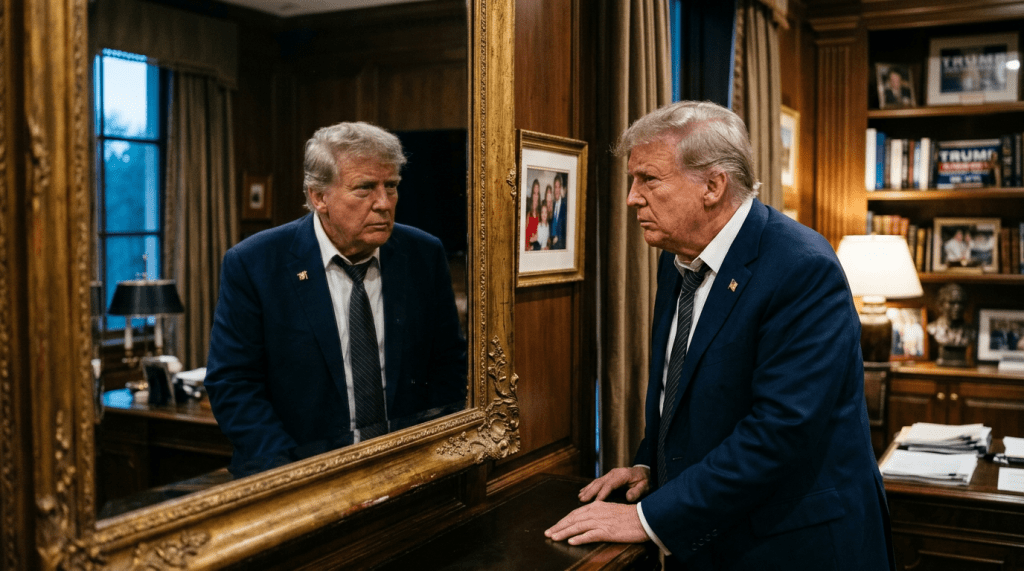
When it’s time to head home, Trump isn’t the “great negotiator” he set out to be. There’s no big legacy, no Nobel Prize, none of the things he once seemed sure he’d win. What’s left is an uncertain scene, with his spot in world affairs slipping away. Maybe, back in Washington, he’ll dream up another grand project—a hall of mirrors just for him. That’d fit. In these final days, it’s like he can’t look anywhere but at his own reflection. His aging reflection.
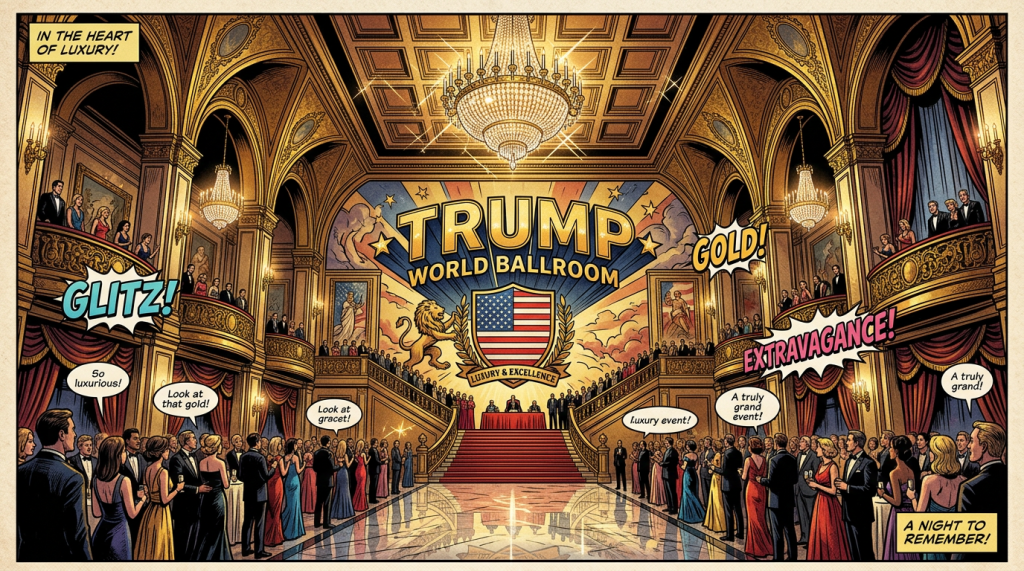
Donald Trump always called himself the king of making deals, a real budget hawk who’d slash government waste wherever he found it. But when you start looking closely at the ballooning costs of his White House ballroom project, a whole different story starts to surface. Instead of thrift, you see broken promises, some pretty clever budget gymnastics, and a jaw-dropping bill of $300 million dumped straight onto the American people.
At first, the ballroom was supposed to be a $200 million renovation, all paid for by private donors. That promise didn’t last. Now it’s ballooned to a bloated $600 million construction saga. Even worse, the whole idea of “private funding” just fell apart. An investigation from The Washington Postfound that taxpayers are now picking up about half the tab, even though Trump kept insisting otherwise.
Clark Construction, the company handling this massive overhaul, spelled out exactly how things got off track. This project isn’t just a fancy party room anymore, they’ve expanded it to include full demolition of part of the East Wing, plus a high-security underground bunker. Sure, presidents need security. But nobody’s been upfront about where the money’s really coming from, and that’s got critics riled up.
Look at the numbers. Project summaries from March lay it all out: the Secret Service is kicking in $155 million; the White House Military Office, another $149 million. They’re even pulling $3 million from the Executive Residence budget. Instead of just calling this what it is, spending on a luxury ballroom, they’re labeling everything as “security upgrades.” Outlets like The New York Times keep pointing out this move; it’s classic Trump-era accounting.
The $400 million gap between what was promised and where things stand now says a lot. This is an administration, Donald Trump, that loved grand promises, but flopped on fiscal responsibility. By burying construction costs inside military and Secret Service budgets, they’ve hidden just how expensive this ballroom actually is.
So as the total skyrockets, everyday Americans are left utterly bewildered. How on earth did a project billed as “privately funded” morph into a public bill? For a president who claimed to be the champion of cutting government fat, this outrageous $600 million ballroom is shaping up to be the poster child for the very wastage and irresponsibility he vowed to eradicate.
You can’t ignore the buzz about the new US-Iran agreement, even if it feels a bit early for celebration. As the deal comes into view, it honestly looks like a birthday present for President Trump though what’s inside is still a mystery, hidden under layers of wrapping.
Trump did what he always does best: he grabbed his phone and blasted the news all over social media, saying the naval blockades were over and ships would soon pass through the Strait of Hormuz again. His post on Sunday—”Let the oil flow!”—put his classic, upbeat spin on things, painting this diplomatic move as the dawn of a more stable region.
But let’s be real, that kind of hype is just Trump’s style. He likes to sound strong and ahead of the curve. Still, in international politics, the stakes are high. The press release is nice, Main Street media loves it, but what really matters is what’s written in the deal, the tricky details lawyers and diplomats obsess over.
Supposedly, the agreement puts limits on how far Iran can push its nuclear program. Vice-President JD Vance says he’s absolutely sure those tough checks are in place to stop Tehran from getting nuclear weapons. President Obama’s 2015 agreement with Iran permanently banned from pursuing a nuclear weapon, so why did Trump pull out of that agreement? Looks like we are just at the same place we were in 2015, but millions of dollars of wasted munitions and hundreds of lives lost.
Even so, big questions linger. It’s still not clear how much uranium Iran can enrich or what’s going to happen to the enriched uranium they already have. Officials say these knotty technical points are on hold for sixty days, during the ceasefire, and will be discussed later. So people are understandably cautious.
Looking back, US-Iran relations have always been a bit of a guessing game, no matter how optimistic Washington gets. Iran’s Supreme National Security Council made it clear: before anything is final, both countries need to prove they’ll actually stick to the deal.
On the ground, energy experts aren’t convinced oil shipments will get back to normal instantly. The Strait of Hormuz is still risky, littered with mines and tangled up by supply chain problems. So, any promise of smooth sailing and stability feels pretty shaky.
And there’s always the wildcard. Israel’s unpredictable actions are well known. Trump told the Wall Street Journal that he actually scolded Prime Minister Benjamin Netanyahu over those recent strikes in Lebanon, warning that such moves could blow up this fragile peace. Whether the agreement can survive future Israeli actions or if Iran hits back, is anyone’s guess.
Back home, the administration is facing massive pressure to bring down rising energy costs. Vice-President Vance promised the public prices would drop soon, which, if it happens, would give folks some relief and help the White House win back some goodwill.
At the end of the day, this weekend’s agreement just brings things close to what they were before, except now Iran has influence over the Strait of Hormuz. We still don’t know if the deal can hold together both Trump’s economic plans and his political interests. The next few months will reveal if this administration can actually keep things steady.

 Blue Press Journal