Tag: Personal Finance

  • Inside the PROMISE Act: The Behind-Closed-Doors Deal Targeting American Safety Nets

    by Winston Wendell

    Social Security in Danger

    Every time I look at Washington, D.C., I can’t help but shake my head at the tricks politicians pull. But this PROMISE Act sitting on my desk? That’s next-level. It’s political cynicism at its finest, and I won’t stay quiet about it—Americans deserve better than to have their most basic safety net tampered with behind closed doors.
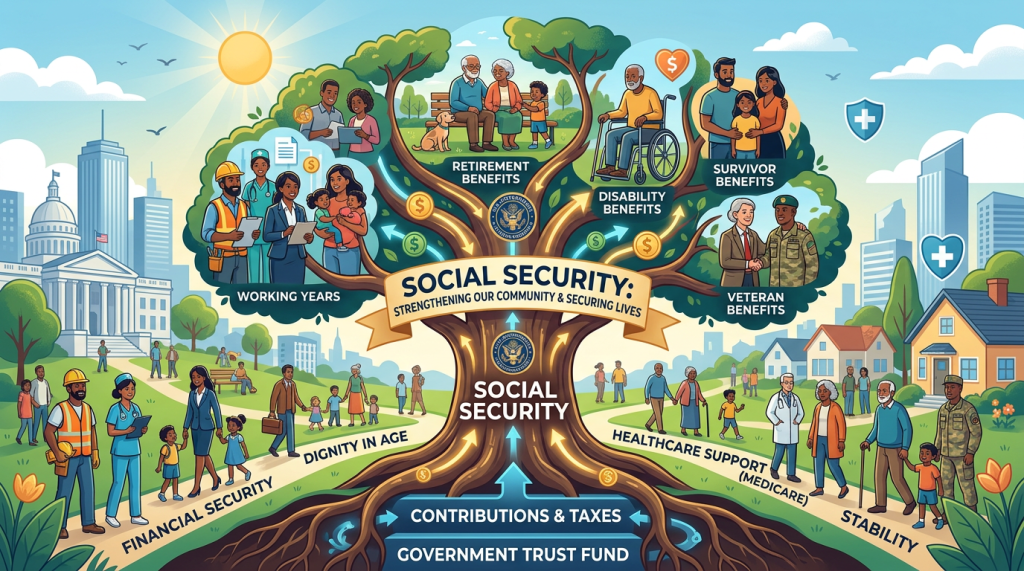
    Illustration of a Social Security tree depicting working years, retirement, disability, survivor and veteran benefits, and healthcare support

    Let’s talk about what’s really in this bill, because it’s wild.

    The PROMISE Act hands control to four unelected members of the Social Security Advisory Board. They’d have just one month to come up with a fifty-year plan to fund Social Security. If they agree on something, Congress has to hold an immediate vote—right after an election, when we’re in that gray “lame-duck” zone before new members are sworn in. If the panel can’t agree? Then any single member of Congress can throw their own plan straight onto the House floor—no committees, no amendments, no real debate, nothing.

    Stop and think about that. They want to fundamentally change Social Security—the backbone for millions of retirees, people with disabilities, and survivors—at a moment when politicians who are leaving office have nothing to lose. They’re basically insulated from any backlash.

    For me and for millions of folks working hard everyday, that’s the exact opposite of democracy.

    And who’s behind this? A “bipartisan” group of senators: Bill Cassidy, Dick Durbin, Thom Tillis, Tim Kaine, John Cornyn, Angus King, and Alan Armstrong. Now look closer: five out of these seven are either retiring or already lost their next election. They don’t have to answer to anybody. They won’t stand behind cuts or a higher retirement age. They can just pull the trigger and walk away, leaving the rest of us to deal with the fallout.

    I’m not the only one calling this out. Advocacy groups are furious, as they should be. The AARP fired off a letter to Cassidy and Durbin, ripping them for trying to rush these changes without real public input. Max Richtman, he runs the National Committee to Preserve Social Security and Medicare—put it bluntly: lawmakers who aren’t facing another election have no business messing with people’s earned benefits. That’s basic accountability.

    Now, I’m not denying there’s a real problem. The Social Security Board of Trustees said back in June: if Congress does nothing, the trust funds only cover 78% of promised benefits starting in 2032. We need to fix that.

    But the folks pushing the PROMISE Act want to fix it on the backs of ordinary workers—with cuts, stingier cost-of-living raises, or hiking the retirement age.

    There’s a straightforward, fair solution that doesn’t hurt seniors or vulnerable people. The proposal is simple: make the wealthiest pay what regular folks already do. If you make more than $250,000, you’d pay payroll taxes on every dollar, just like everybody else.

    This isn’t just about keeping Social Security alive for 75 years—it’s about making it stronger. The plan actually increases yearly benefits by $2,400 for people. And voters agree. Eight out of ten support this, according to a Data for Progress poll.

    Still, Senate Republicans blocked my bill. Why? Because protecting the ultra-wealthy from paying taxes is practically a team sport in Washington.

    My message the whole Democratic Party: draw a bright line, no raising the retirement age, no benefit cuts, no watered-down cost-of-living hikes, no privatization, and no backroom deals in the

  • The Hidden Tax: How Global Conflict is Quietly Draining Our Bank Accounts

    Editorial

    Man in denim jacket refueling black car with gas pump at gas station

    Blue Press Journal – I was standing at the pump this Sunday morning, watching the numbers tick upward on the digital display, and I couldn’t help but feel that familiar, sinking pit in my stomach. Like millions of Americans, I’m constantly balancing the household budget, but lately, that balance feels more like a tightrope walk. 

    With tensions escalating in the Middle East—specifically the war with Iran, which many experts claim was unnecessary, have caused the global oil markets to spike. When crude prices jump in response to the war in Iran, the ripple effect isn’t just felt at the pump; it’s felt at the grocery store, the pharmacy, and every single time we make a decision about our daily commute.

    The Immediate Pain at the Pump

    Energy markets are inherently reactive. According to the U.S. Energy Information Administration (EIA), even a minor disruption in supply chains or a mere risk will cause a push to national averages. When gas prices spike, they act as a “hidden tax” on every American worker.

    Mark Zandi, Chief Economist at Moody’s Analytics, and other economic analysts, have pointed to the regressive nature of high energy prices, noting that they act as a hidden tax that disproportionately impacts low- and middle-income households. When you spend a larger percentage of your income on fuel, you have significantly less discretionary capital left for housing, food, or savings.

    The “Follow-On” Cost: Our Grocery Bill

    What many of us don’t immediately account for is the logistical cost of getting goods to market. Almost everything we buy—from fresh produce in California to electronics in New York—traveled on a truck or train to get to our shelves. As diesel prices climb alongside gasoline, those transportation costs are passed directly to the consumer.

    Consider a hypothetical breakdown of how these costs impact our monthly spending:

    Expenditure CategoryEstimated Weekly Impact of High Gas Prices
    Commuting+$15 – $25 per week
    Grocery/Food Staples+$10 – $20 per week (transportation surcharges)
    Family Activities+$10 – $15 per week (sports/errands)
    Total Estimated Hit$35 – $60 per week

    Tough Choices for Our American Families

    For the average family, an extra $50 a week isn’t just “pocket change.” It’s the difference between a savings account contribution and a credit card balance. I’ve found myself cutting back on non-essential trips, consolidating errands to save on mileage, and—regrettably—choosing generic brands at the grocery store to offset the rising cost of “transported” goods.

    We are entering a season of adaptation. Americans are experts at tightening their belts, but it’s becoming increasingly difficult to find more “slack” in the rope under the Trump administration. We are choosing between the kid’s soccer tournament and an extra trip to the grocery store; we are opting for home-cooked meals over dining out; and we are delaying major purchases while we wait for the economic and political smoke to clear.

    Our Bottom Line

    As of today, analysts from sources like Bloomberg and The Wall Street Journal suggest that while the U.S. is more energy-independent than it was a decade ago, we are still beholden to the global price of oil. Until stability returns to the Middle East, volatility will remain the “new normal.”

    For those of us at the pump this weekend, my advice is simple: track your expenses, prioritize your essential travel, and keep a close watch on your budget. We may not be able to control the price of a barrel of oil or the war in Iran, but we can manage how we navigate the political choices at home. It’s clear the Trump administration has made bad choices so let’s not compound them with ours. The midterms should be where we make a clear choice for change.