Tag: wealth inequality

  • One Year Later: The One Big Beautiful Bill’s Devastating Toll on America’s Working Class

    Donald Trump signing tax cuts and jobs bill in Oval Office with speech bubble saying tax cuts are here

    A closer look at how landmark legislation signed by President Trump has enriched the wealthy while leaving millions of vulnerable Americans behind

    by Winston Wendell

    When President Trump signed the “One Big Beautiful Bill Act” last year, his fans cheered for sweeping change. And they sort of got it—just not for everyone. If you’re in one of America’s wealthiest families, you’re probably thrilled. For most people, though, it’s a different story.

    I’ve been following this law since day one, and every new report just confirms what a lot of folks feared. Defend America Action laid out the numbers for Common Dreams, and it’s pretty clear: the richest are cashing in, while working-class Americans are stuck on the sidelines.

    The numbers tell their own story, and—wow. The Institute on Taxation and Economic Policy says the richest 1% will get $117 billion in tax breaks by 2026, which averages out to about $66,000 per wealthy household. Meanwhile, if you add up all the tax breaks for the bottom 60% of earners, their total doesn’t even match what one rich person gets. And with prices creeping up and surprise fees stacking on, a whole lot of working families are actually worse off.

    Nobody’s really surprised. Critics just call it the same old playbook: benefits for corporations and the ultra-rich, scraps (if that) for everyone else.

    But it’s not just about paychecks. Healthcare’s taken a beating, too. The law chopped more than $1 trillion from Medicaid and the Affordable Care Act. We’re already feeling it—a year later, Medicaid enrollment has dropped by 3.8 million people. Experts predict 15 million could lose coverage by 2034.

    The Affordable Care Act marketplace is a mess. Premiums have more than doubled. One out of every five people on ACA plans has already dropped coverage. If you’re buying insurance yourself, you’ll shell out over a third more than before. More than 8 million folks have lost health insurance so far, and it’s not slowing down.

    It’s not just about national numbers, either. Take Nevada—about 100,000 people there could lose Medicaid coverage. That’s 22,000 in one congressional district alone.

    Then there’s food assistance. The bill ripped $187 billion from SNAP, the program that helps people buy food. Four million people—kids and seniors included—have already lost that support, and the hurdles to keep benefits are higher than ever. Young adults are getting hit especially hard. They’re losing food help even though steady jobs are still tough to find.

    Clean energy took a major blow, too. When Congress gutted clean energy tax credits, hundreds of projects vanished. That cost around 140,000 jobs and scared off $69 billion in investment. Now consumers are facing an extra $92 billion in energy bills, and dirty, expensive energy is all that’s left for many.

    Electric vehicles? Same story. Killing off the $7,500 EV tax credit tanked sales. So, people stick with less efficient cars that cost more to run—especially with gas prices climbing, thanks in part to foreign policy headaches.

    Jared Bernstein—a former White House adviser—didn’t sugarcoat it: ditching clean energy isn’t just about falling behind, it’s about giving that lead away to China. “This isn’t China just eating our lunch. This is us serving our lunch to them,” he said.

    People see what’s happening, and they’re not buying the spin. Just a few months after the bill passed, 55% disapproved, and only 31% were on board. Not much has shifted—today, just a third support it.

    Rep. Dina Titus from Nevada put it straight: “They’re always up for cutting programs. They call it fraud, waste, and abuse, but it’s not. It’s benefits people needed.”

    With the midterms coming, it’s tough to hide the fallout. The law really did change America, just like they promised—but not for the better, and definitely not for most of us.
    Fediverse Reactions
  • A National Milestone, For All the Wrong Reasons: How GOP Fiscal Recklessness Pushed Our Debt Past a Grim Threshold

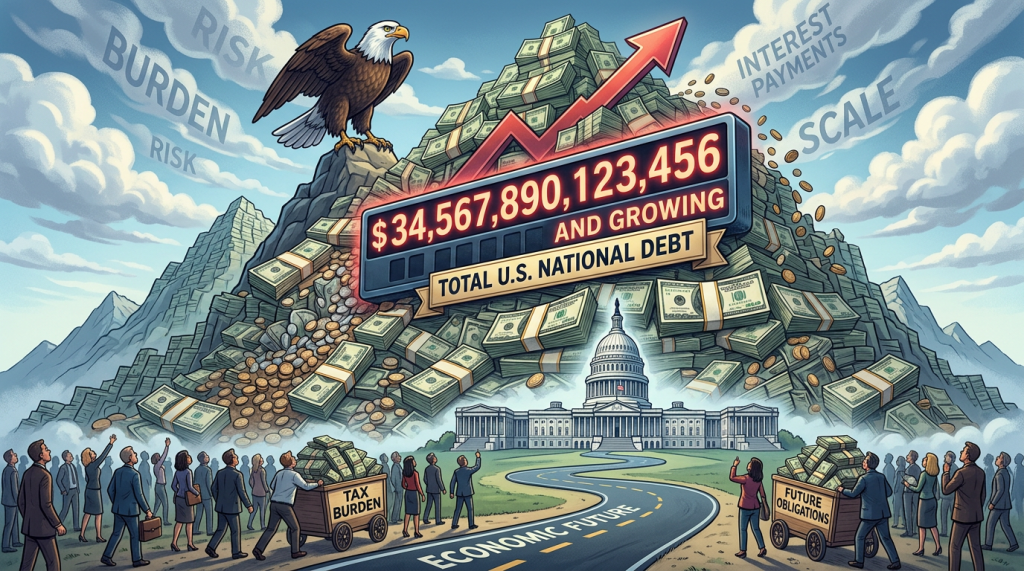
    U.S. national debt counter with $34,567,890,123,456 above Capitol building and people carrying tax burden and future obligations

    by Winston Wendell

    I’ve covered the messy space where politics and economics meet for years, and honestly, fiscal benchmarks usually come and go without much press coverage. This week’s news hits differently and it’s troubling, to say the least. The latest government numbers show that, for the first time since the aftermath of World War II, our national debt has officially blown past 100% of the country’s Gross Domestic Product. The debt now sits at $31.265 trillion, just nudging past our GDP of $31.216 trillion.

    Sure, it sounds like a dry statistic that the average American would find unimportant. But look beneath the surface, and you’ll find a story about deep fiscal irresponsibility, a story that traces straight back to choices made by the Donald Tump’s administration and the current Republican Party.

    It has not always been this way, two Democrats actually balanced the budget. President Bill Clinton balanced the federal budget, achieving consecutive budget surpluses between fiscal years 1998 and 2001 and President Lyndon B. Johnson achieved a balanced budget in 1969.

    Let’s not kid ourselves: This didn’t happen suddenly, and it didn’t happen by chance. Every recent administration has added to the debt, but one deliberate shift in policy put us on fast-forward. I point directly to the Republican 2017 Tax Cuts and Jobs Act. This was the centerpiece of Trump’s economic playbook. It sold itself as a “middle-class miracle,” but honestly, it was a massive giveaway to the wealthy where the average American saw little longterm advantage.

    The Center for American Progress, a non-partisan think tank, crunched the numbers on the law. They found that the top 1 percent got an average tax cut of $61,090, while the bottom 80 percent saw about $870. We were told growth would explode and pay for everything. That didn’t happen. The Congressional Budget Office backs that up, showing the law pumped the deficit and added about $1.9 trillion to national debt over ten years. Now we’re staring at the fallout and it’s clear what caused this.

    And circumstances are on the brink of worsening dramatically. The “Big Beautiful Bill” of 2025, the darling of Republican Congressional leaders and Trump’s staunch backers, threatens to deepen our deficit yet again, pushing through reckless tax cuts for corporations and the wealthy elite. This initiative disregards fiscal responsibility; it paves a perilous path toward financial disaster. In essence, it’s a lavish tax giveaway to the affluent, leaving the hardworking American taxpayer to bear the brunt of the costs.

    There’s another piece we can’t ignore: the cost of war. Trump’s reckless and unconstitutional conflict with Iran on shaky intelligence opened a new financial black hole. The Associated Press covered the mounting costs: Pentagon estimates put price tag for military operations in the Persian Gulf at over $1 billion a month on borrowed money, supporting a war that didn’t have to happen. These figures are backed up by recent congressional hearings.

    The Wall Street Journal points out that these massive deficits aren’t going away anytime soon. But they leave out, like most major news media, the real reason: revenue took a hit from tax cuts favoring the wealthy, while spending spiked everywhere except where it would actually help the middle class.

    That headline number of 100.2% isn’t just a statistic—it’s judgment. It stands as proof of a political mindset that threw fiscal responsibility out the window, favoring the rich and fueling pointless, expensive adventures overseas. Now, the bill for years of parties thrown for millionaires and billionaires has landed and the rest of us are left to pay it.

  • The Big Beautiful Bill Tax Giveaway: How Billionaires Pay Lower Rates Than Workers While Social Security Faces Insolvency

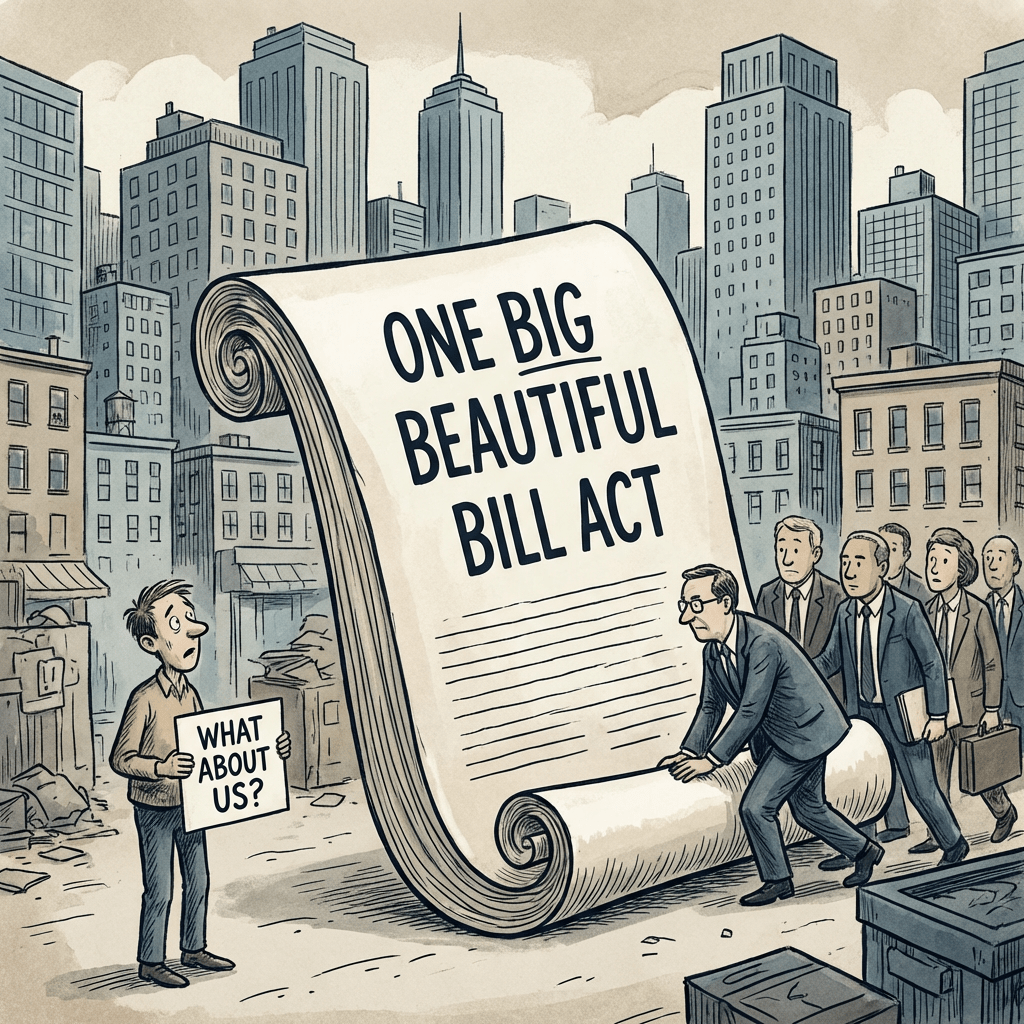
    Giant 'ONE BIG BEAUTIFUL BILL ACT' scroll rolls toward a man holding 'WHAT ABOUT US?' sign.

    Blue Press Journal – The Republican-passed One Big Beautiful Bill Act—championed by Donald Trump and GOP leadership—represents one of the largest tax giveaways to the ultra-wealthy in modern American history. While working families face stagnant wages and rising costs, multiple independent analyses using IRS data confirm a stark reality: America’s billionaires and richest households often pay lower effective tax rates than the average teacher, nurse, or construction worker.

    The discrepancy stems from systemic favoritism toward wealth over work. Because much of billionaire income derives from unrealized capital gains rather than taxable wages, the ultra-rich exploit structural loopholes that the Big Beautiful Bill expands rather than closes. Independent economic analyses suggest that equalizing effective tax rates—ensuring billionaires pay roughly what middle-class workers contribute—could generate between $500 billion and $1 trillion annually in new revenue.

    Instead, current trajectory is fiscally catastrophic. As of late 2025, U.S. national debt exceeds $38 trillion, driven significantly by Trump-era and GOP tax cuts favoring millionaires and billionaires. The debt grows by over $2 trillion per year, with nearly $1 trillion consumed annually by interest payments alone—crowding out investments in infrastructure, healthcare, and elder security.

    Simultaneously, Social Security faces an imminent solvency crisis. According to the Social Security Administration (ssa.gov), the trust fund faces depletion between 2032–2034, triggering automatic benefit cuts of 20–28% unless Congress intervenes [^1^][^2^]. While Social Security’s 75-year funding gap remains smaller than the national debt, relatively modest revenue increases—derived from billionaire wealth taxes—could delay or prevent these devastating cuts.

    However, current law limits Social Security financing to payroll taxes. Redirecting wealth-based taxes to the trust fund would need congressional action for modification—a feasible yet politically blocked solution by lawmakers who approved the Big Beautiful Bill giveaways.

    Sources: [^1^]: Social Security Administration. “Status of the Social Security and Medicare Programs.” ssa.gov. [^2^]: Newsweek. “Social Security Benefit Cuts Projected Timeline.” newsweek.com. [^3^]: WGME. “Social Security Trust Fund Shortfall Analysis.” wgme.com.