Tag: election security

  • The Fulton County Raid: A Blueprint for Election Interference in 2026?

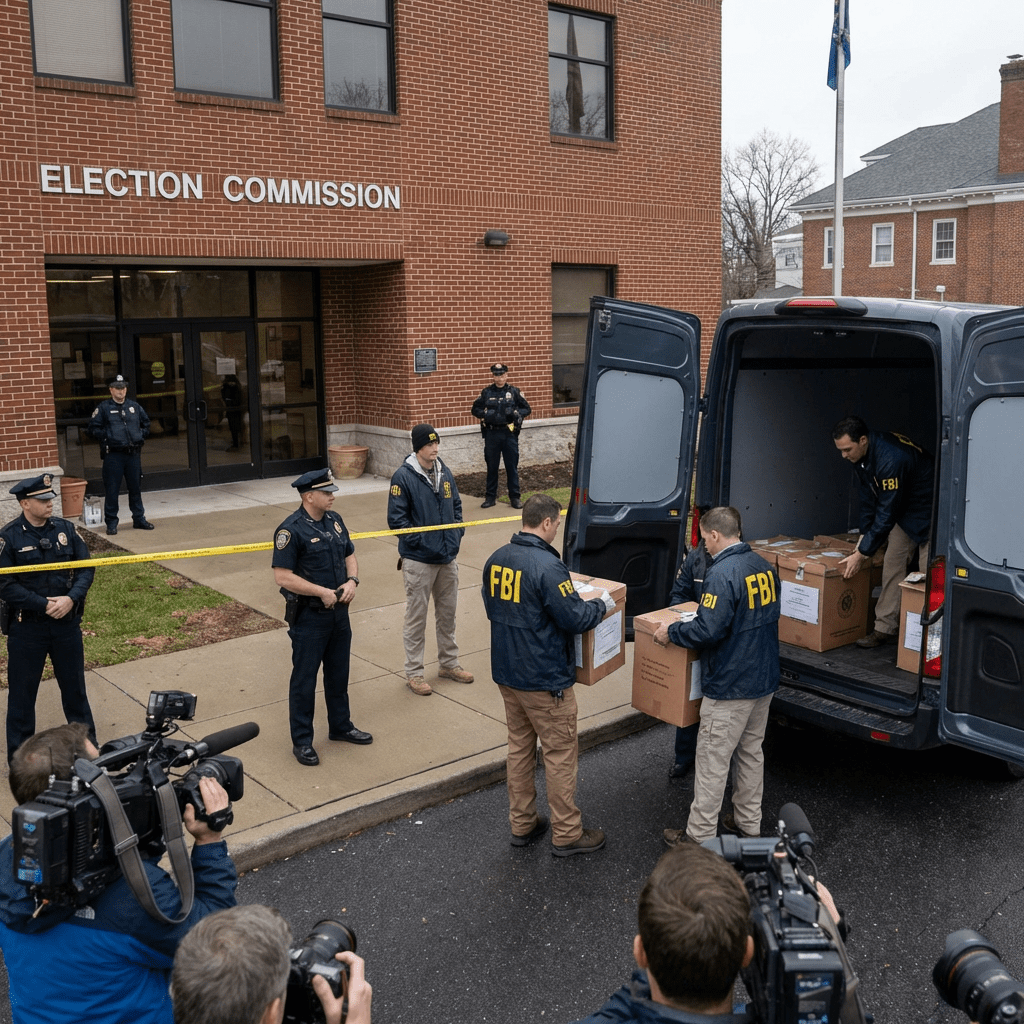
    FBI agents load boxes from an Election Commission building into a van under police watch.

    Blue Press JournalThe 2026 Department of Justice raid on a Fulton County, Georgia election office, seizing ballots and machinery, was a watershed moment. While framed as an investigation into the 2020 election, legal experts and election officials nationwide interpreted it as a dangerous escalation and a potential dress rehearsal for future electoral disruption.

    Election law scholar Richard Hasen of UCLA Law warned in Slate that the action appeared less about the past and more like a “test run for messing with election administrators” in upcoming contests. This aligns with a persistent pattern of baseless election fraud claims being used to justify unprecedented federal overreach into state-run elections.

    The prospect of similar ballot seizures during or after the 2026 midterms raises profound legal and constitutional alarms. As the Brennan Center for Justice’s Wendy Weiser stated, such actions would be “wildly illegal,” requiring judicial warrants or subpoenas that are meant to serve as a check on power. However, the legally questionable Fulton County warrant, now itself being challenged in court for its “Material Omissions and Misstatements,” demonstrates how these safeguards can be exploited.

    In response, Democratic secretaries of state are not standing idle. Officials in states like Colorado and Minnesota have publicly outlined their preparations to immediately challenge any federal interference in the courts. “We’ve been preparing for this event and many other scenarios of federal disruption,” Colorado’s Jena Griswold noted, underscoring the heightened state of alert.

    A potential legal defense may ironically come from a recent Supreme Court decisionBost v. Illinois State Board of Elections. As analyzed by SCOTUSblog, this ruling could provide candidates standing to sue in advance to prevent actions—like seizing ballots—that threaten a “fair process and an accurate result,” offering a new tool to preempt interference before it occurs.

    While the administration seeks to expand its electoral power, a coalition of state officials, legal experts, and judicial checks stands as a barrier to these efforts in 2026.

  • Why the Republican “SAVE Act” Threatens American Voters – Costly, Undemocratic, and Discriminatory

    Clear ballot box filled with papers, wrapped in heavy metal chains and secured with a padlock.

    Blue Press Journal – The Republican‑backed “Secure American Voter Eligibility (SAVE) Act,” championed by President Donald Trump’s allies, proposes that every voter present a passport or an original birth certificate to cast a ballot. While the bill is marketed as a safeguard against fraud, the reality is far more troubling: it would impose prohibitive costs, undermine constitutional authority, and disproportionately disenfranchise women, low‑income workers, and minority communities.

    A Financial Burden No Voter Can Afford

    A standard U.S. passport now costs $165 for an adult, plus an additional $35 for expedited service (U.S. Department of State, 2024). For many Americans, especially those earning the federal minimum wage of $7.25 per hour, this fee represents a full day’s wages. The SAVE Act’s requirement for a passport would also force voters to navigate a complex application process that can take weeks—time many cannot spare from multiple jobs or childcare duties.

    Equally daunting is the demand for an original birth certificate. In many states, obtaining a certified copy costs $10‑$30 and can take up to six weeks, according to the National Center for Health Statistics. For a single mother working two jobs, the combined expense and delay could effectively strip her of the right to vote in a single‑day election.

    Constitutional Overreach

    The U.S. Constitution explicitly reserves the conduct of elections to the states (Art. I, § 4). By imposing a uniform federal identification requirement, the SAVE Act usurps state authority and creates a single, nationwide voting rule that many states have already deemed unnecessary. Legal scholars from Harvard Law School have warned that “federal ID mandates risk violating the Elections Clause by overriding state‑crafted eligibility standards” (Harvard Law Review, 2023).

    Targeting Women and Married‑Status Voters

    Women, especially those who are married, are uniquely vulnerable. Many married couples share a single birth‑certificate file, and some states issue a “marriage certificate” rather than an individual birth record for privacy reasons. Requiring an original birth certificate therefore forces women to navigate a bureaucratic maze that can delay or prevent voting. 

    Dr. Maria Lopez, a political scientist at the University of California, Berkeley, told The New York Times: “The SAVE Act would create a gendered barrier. Women who are caretakers often lack the time and resources to procure these documents, effectively silencing a significant portion of the electorate.” (NYT, April 2024).

    Voices From the Ground

    Local activists echo these concerns. Johnathan Reed, director of the voter‑rights group Fair Elections Now, testified before the Senate Judiciary Committee: “Our data shows that 23 % of low‑income voters have never held a passport, and 15 % cannot readily obtain a certified birth certificate. This bill would lock them out of democracy.” (Senate Hearing Transcript, June 2024).

    Similarly, Emily Watkins, a single mother of three from Ohio, told ABC News: “I work nights at a factory and mornings at a daycare. Paying $165 for a passport just to vote is impossible. The SAVE Act would tell me my voice doesn’t matter.” (ABC News, May 2024).

    A Trump‑Era Power Play

    Critics argue the legislation is less about fraud and more about political power. Donald Trump’s 2022 campaign rally in Iowa featured the slogan “Secure the Vote, Save the Nation,” a thinly veiled appeal to a voter‑suppression strategy that has haunted his administration. Political analysts from The Washington Postnote that “the SAVE Act aligns with Trump’s broader effort to reshape the electorate in favor of the GOP, regardless of constitutional limits.” (Washington Post, July 2024).

    The SAVE Act is an expensive, unconstitutional, and discriminatory roadblock that threatens to silence millions of Americans—particularly women, low‑income workers, and minority voters. Rather than protecting elections, it weaponizes bureaucratic hurdles to tilt the democratic process in favor of a single party. As the nation heads toward the 2026 elections, safeguarding universal suffrage must remain a priority, not a political pawn.

  • Unprecedented Federal Raids and Election Conspiracy Theories Undermine Democratic Trust

    A new federal raid on Georgia’s Fulton County offices, linked to debunked election fraud claims, has intensified concerns about political interference and the erosion of democratic norms.

    Blue Press Journal – In January 2026, a controversial report by the Election Oversight Group (EOG) reignited baseless allegations of fraud in Georgia’s 2020 presidential election, claiming “irregularities” in Fulton County’s ballot counts. Just weeks later, FBI agents executed a high-profile raid, seizing 700 boxes of election records from the county’s offices. This unprecedented action has sparked a firestorm of speculation about broader attempts to destabilize U.S. electoral processes, with critics warning of a dangerous pattern of executive overreach. 

    The EOG, a self-proclaimed watchdog group, has a history of peddling conspiracy theories that were previously cited in former President Trump’s legal battles. According to The Political Machine (TPM), the group’s 2026 report, released on January 6th—symbolically mirroring the Capitol attack—was shared with Trump’s legal team. The report’s findings, which include debunked claims about “unsigned ballots,” were amplified by Trump allies, including 2024 campaign spokesperson Liz Harrington, who promoted the allegations on social media platforms. 

    The raid aligns with a growing strategy within the Trump administration to challenge state election outcomes, despite overwhelming legal and electoral confirmations of Georgia’s 2020 results. Independent recounts, overseen by Republican officials, and judicial rulings have consistently dismissed fraud claims due to a lack of credible evidence. Yet, figures like EOG associate Kevin Moncla, who reportedly discussed the report with U.S. Attorney Thomas Albus, continue to push the narrative, framing their efforts as a mission to “protect election integrity.” 

    The Department of Justice (DOJ), now led by Attorney General Pam Bondi, has embraced this agenda, with Albus overseeing the Fulton County operation. This has raised alarms among constitutional scholars and civil liberties groups, who argue that such actions risk politicizing federal agencies and eroding public trust in democratic institutions. “When law enforcement tools are weaponized to service a partisan agenda, the very foundations of democracy are threatened,” warned Dr. Maria Delgado, a political scientist at Harvard University. 

    White House officials, including Director of National Intelligence Tulsi Gabbard, have defended the raids as necessary to “secure America’s elections.” However, critics highlight the absence of transparency and the disproportionate focus on blue states. Former attorney general Eric Holder, in an op-ed for The Washington Post, condemned the move as an “attack on legitimate election procedures” that could normalize authoritarian tactics. 

    Notably, far-right figures like Alex Jones and Stewart Rhodes have celebrated the raid, further entrenching a climate of distrust. Rhodes, founder of the Oath Keepers, praised Gabbard’s involvement during a recent InfoWars broadcast, framing the operation as a “battle for America’s soul.” Such rhetoric, absent factual grounding, risks polarizing the electorate and legitimizing fringe theories. 

    As the administration intensifies its fervent campaign for “election reform,” experts passionately implore vigilance against the insidious creep of anti-democratic practices. “History is littered with regimes that have wielded such pretexts to stifle dissent and manipulate outcomes,” passionately cautioned political commentator David Cole in The New York Times. The upcoming months will be a crucible that tests whether the U.S. will staunchly defend the integrity of its democratic process—or fall prey to the seductive, yet treacherous, allure of conspiracy-laden governance.