Washington, D.C., Sept. 24 — A federal judge’s order to restore White House press credentials for three news outlets has been ignored, as MSNBC correspondent Laura Barron‑Lopez was denied entry on Thursday, mirroring recent turn‑aways of CNN and Politico journalists.
Update: 10:20am est.
A reporter for the online outlet MS NOW was turned away from the White House press entrance on Thursday, bringing the media outlet into a growing dispute over access that already includes correspondents from CNN and Politico.
Laura Barron‑Lopez, a senior reporter for the news outlet, said she arrived at the Press Briefing building, swiped her badge at the security checkpoint and watched the indicator turn red before being stopped by a uniformed security guard.
“I got as far as the press pass security hut, swiped my badge, and the light started flashing red,” Barron‑Lopez told reporters after the incident. “The guard told me I could not proceed and escorted me off the premises.”
Her experience mirrors that of a CNN reporter and a Politico correspondent, both of whom were denied entry his morning under the same circumstances.
MS NOW, CNN and Politico have scheduled a joint press conference for Thursday afternoon to discuss the broader implications of the White House’s security procedures on media freedom.
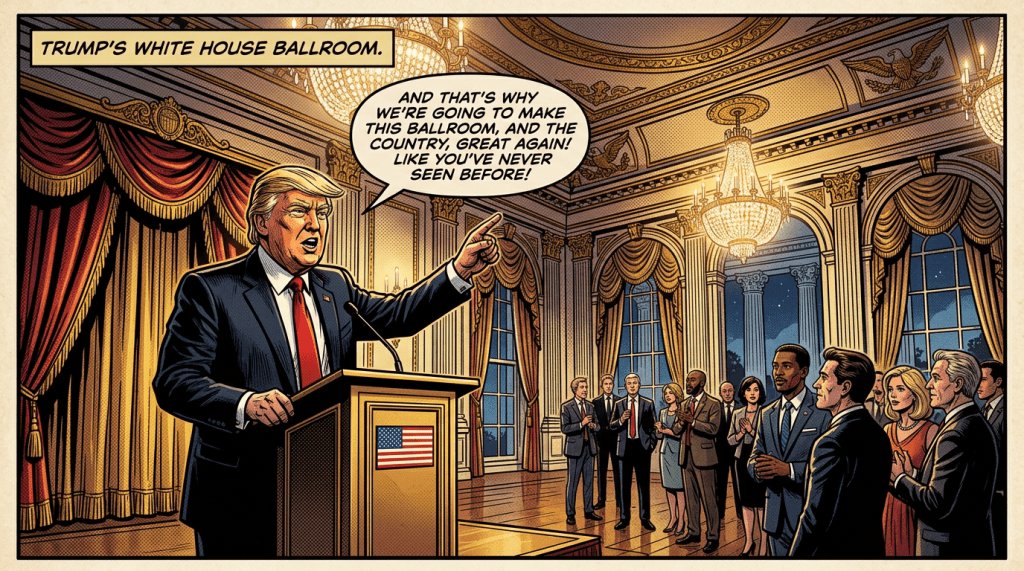
WASHINGTON – A federal appeals court has paused construction on President Donald Trump’s budgeted 400 million-dollar project of the White House ballroom. The court ruled that building the ballroom should be immediately stopped from proceeding with any jobs “above ground”, including features the government claims are necessary security measures.
.
On Friday, a 2-1 panel of the D.C. Circuit Court of Appeals ruled to uphold a preliminary injunction against the President. The National Trust for Historic Preservation, an organization that protects buildings, filed the injunction in December 2025 after the administration began demolition of the East Wing to make way for a 90,000 square foot subterranean ballroom not approved by Congress.
Patricia Millett’s and Bradley Garcia’s opinions, in which they ruled in favor of preservation, were joined by judges who were appointed by President Barack Obama and Joe Biden. They stated that the Constitution does not permit presidential edicts to dictate the use of federal resources.
They continued, “whether a large ballroom should be built…is a decision for Congress, not the President” due to the fact that the Constitution grants spending authority over the federal assets to lawmakers, not the executive branch, despite the security reasons cited by the administration.
However, the decision to halt the work was only made official for two weeks in order to allow the Trump administration to appeal to the U.S. Supreme Court.
Neomi Rao, who was nominated by President Trump, filed a dissenting opinion in response to the majority’s ruling. She stated that the injunction which stopped the work was an act of judicial activism.
“By stepping in and taking control over something as monumental as the White House, the district court engaged in judicial activism,” she wrote. “Courts shouldn’t be running building projects”
The administration’s original plan was to decommission the East Wing while keeping the West Wing as a separate unit. However, the White House Complex’s budget requires funding beyond the president’s official salary so the administration argued that the entire wing be demolished to make way for the expansion of the subterranean chamber.
Furthermore, the administration claims that the ballroom project is part of larger security upgrades to the complex.
President Trump expressed dissatisfaction with the decision in his Truth Social page. He stated that the ruling was “politically motivated and completely illegal.” He argued that not completing the ballroom project endangered future presidents, staff, diplomats, and the general public.
The two-week pause in the construction of the ballroom project means that the future of the project depends on whether or not Trump’s emergency appeal to the Supreme Court is granted.
When I think about why this country even has a Supreme Court, the idea was always pretty simple: it was supposed to be shielded from political chaos, a steady hand making sure the Constitution actually means something for everyone. But look at the Court now. It’s hard to pretend it’s still neutral or above the fray. Honestly, it feels like the Court has become just another powerful political tool, a super-legislature pushing its own narrow agenda and ignoring what most Americans actually want.
The root of the problem, in my eyes, starts with how the Senate works. The way our system’s set up gives a handful of small states way too much sway, letting a group of senators who only speak for a small slice of Americans pack the Court with justices who mostly seem chosen for their loyalty to right-wing causes. That’s not what justice is supposed to look like. It’s politics, plain and simple.
There’s no real mystery about what’s happening anymore, the facts are right there for anyone who cares to look. I find it shocking that some justices still hold their seats while serious accusations swirl around them: secret gifts, obvious conflicts of interest, all swept under the rug. If a judge pulled stunts like that in any other American court, they’d be out or forced to step aside in a heartbeat. But these justices keep making decisions that shape the lives of millions, leaving people to wonder if “equal justice under law” means anything at all.
The clearest sign to me that things have gone off the rails is how the Court keeps chipping away at voting rights. Just look at Louisiana v. Callais. That decision isn’t some technical fix, t’s the biggest attack on Black political power since Reconstruction. By gutting what’s left of the Voting Rights Act, the Court is opening the door for states to erase Black-majority districts. We’re watching a whole new wave of voter suppression sweep across the South from Alabama to Georgia, that threatens to wipe out decades of progress.
I’ve also seen the justices twist the law to fit whatever side they’re on. They’ll lean hard on something like the “independent state legislature theory” whenever it advances the conservative cause but then drop it once it becomes a problem. When the law’s just another tool for one side to win, the court stops being a check on power and just become another weapon in the political fight.
A democracy can’t survive if the last line of defense has already been captured. I still think there’s a way back. When the political moment arrives, we’ve got to put real Supreme Court reform on the table, expanding and setting term limits to fix this imbalance. The law has to reflect the full diversity of America, not just enshrine one group’s vision at everyone else’s expense.
People deserve a Supreme Court that stands apart from politics, not one leading the charge into the partisan trenches. Right now, we’re at a breaking point; either we rebuild trust in the Court, or we watch the roots of our democracy keep crumbling. This moment calls for real urgency.
Sen. Mark Kelly’s Lawsuit Against Pentagon Marks Historic Defense of First Amendment and Legislative Independence
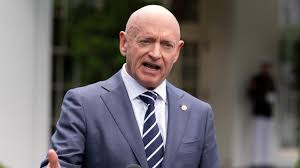
Blue Press Journal – In a bold move underscoring the importance of constitutional protections for lawmakers, Senator Mark Kelly (D-AZ) filed a federal civil lawsuit Monday against the Pentagon, Secretary of Defense Pete Hegseth, the U.S. Navy Department, and Navy Secretary John Phelan. The suit alleges that the Trump administration’s decision to cut Kelly’s military retirement pay—following his participation in a video message to U.S. troops—constitutes an unprecedented attack on legislative independence and the First Amendment.
Kelly’s complaint, filed in U.S. District Court in Washington, argues that the government’s actions “trample on protections the Constitution singles out as essential to legislative independence.” His legal team points out that never in American history has the Executive Branch sought to impose military sanctions on a sitting Member of Congress for engaging in political speech disfavored by those in power.
“The First Amendment forbids the government and its officials from punishing disfavored expression or retaliating against protected speech,” the lawsuit asserts. “That prohibition applies with particular force to legislators speaking on matters of public policy.”
Historical Precedent and Constitutional Stakes
Kelly’s case touches a nerve in the ongoing debate over separation of powers and free speech. The framers of the Constitution designed the Speech or Debate Clause in Article I, Section 6 to ensure legislative independence, shielding lawmakers from intimidation or retaliation by the executive branch. Past disputes—such as United States v. Johnson (1966), where the Supreme Court protected a congressman’s speeches from executive interference—have reaffirmed that principle.
Similarly, cases involving retaliation against political expression—like the landmark New York Times Co. v. United States (1971), which defended the right to publish the Pentagon Papers—reinforce that government actors cannot suppress speech simply because it is inconvenient or critical. Kelly’s lawsuit echoes these foundational rulings, framing the Pentagon’s move as not only punitive but corrosive to the core democratic values of checks and balances.
Why This Matters
Kelly, a former Navy combat pilot and astronaut, has dedicated his career to public service. His military retirement pay is not merely a personal benefit—it symbolizes the nation’s recognition of that service. Punishing him for participating in a video for troops sets a dangerous precedent, risking a chilling effect on lawmakers who speak out on military or national security issues.
At a time when political polarization threatens institutional trust, Kelly’s stand represents more than a personal legal battle—it’s a defense of constitutional freedoms that protect all Americans. If the executive branch can wield military benefits as a political weapon against sitting senators, the independence of Congress itself is at stake.
Kelly’s lawsuit is not just about his pay—it’s about preserving the voice of legislators in matters of public concern. In standing up to the Pentagon, he’s standing up for the principles that have kept American democracy resilient for over two centuries.
Blue Press Journal: In a shocking and widely condemned move, U.S. Senator John Cornyn (R-TX) has asked the FBI to arrest Democratic state legislators who fled Texas to prevent the passage of a congressional map that would likely give the GOP a significant advantage in the U.S. House of Representatives.
Constitutional law experts have slammed Cornyn’s request as “entirely unhinged” and “unconstitutional.” According to Robert Kreis, a legal expert, “They have not committed a crime. They are not fugitives. There’s no offense against the United States.” Kreis added that Cornyn’s request is an egregious example of a politician seeking to use federal power to silence and intimidate his opponents.
The proposed congressional map, which is rooted in the Trump administration’s policies, aims to reshape district lines in a way that would dismantle districts with Black and Latino majorities. The move is widely seen as a naked attempt to suppress minority voting power and entrench Republican dominance in the state.
Cornyn’s request has sparked outrage among civil rights advocates and Democrats, who argue that it represents a blatant abuse of power and a threat to the democratic process. “This is a chilling example of a senator using his office to intimidate and silence his opponents,” said one Democratic legislator. “It’s a clear attempt to undermine the rule of law and the principles of democracy.”