Tag: economic policy

  • The Double Standard at the Gas Pump: When Politics Hides Responsibility

    by Winston Wendell

    Every time you fill up your car, the hit to your wallet reminds you just how tough things are right now. But for a lot of Americans, it’s not just the price that stings, it’s the silence from Republican leaders. Republicans just say it’s a price we have to pay for an unwanted and unneeded war with Iran.

    Back in 2024, the message was loud and clear: high gas prices were blamed on the Biden administration. Candidate Donald Trump and Congressional Republicans jumped at every chance, blasting gas prices as a disaster for the middle class. Fast forward to 2026, gas is even pricier, as of today over $4.50 a gallon but where is the Republican uproar? It’s disappeared. Where’s the flood of angry tweets and the emergency congressional hearings now?

    Honestly, the geopolitical nightmare unleashed by Trump’s reckless war with Iran is the main culprit behind soaring gas prices. His poorly thought-out conflict has sent global oil prices spiraling into disarray. Yet, under GOP leadership, there’s a deafening silence. Accountability? It’s vanished without a trace. It’s just like the proverb of the three wise monkeys, see no evil, hear no evil, speak no evil. It appears the Republican Party has embraced that proverb wholeheartedly.

    That’s not leadership. It’s plain old political showmanship that does nothing to help Americans. When you place party before country it does nothing to help Americans.

    So the next time you find yourself trapped at the pump, challenge yourself: should accountability really waver just because there’s a shift in the White House?

  • A National Milestone, For All the Wrong Reasons: How GOP Fiscal Recklessness Pushed Our Debt Past a Grim Threshold

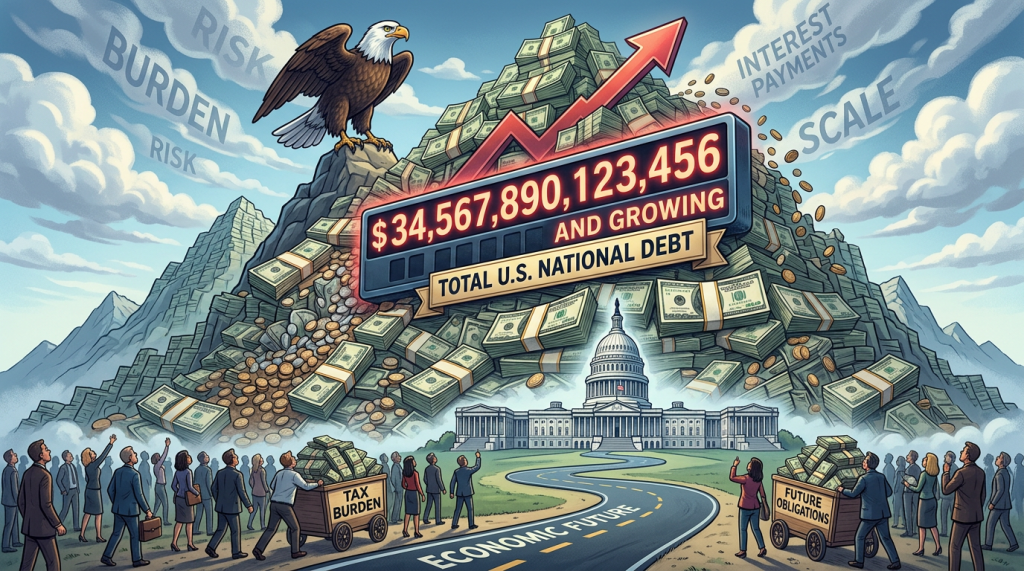
    U.S. national debt counter with $34,567,890,123,456 above Capitol building and people carrying tax burden and future obligations

    by Winston Wendell

    I’ve covered the messy space where politics and economics meet for years, and honestly, fiscal benchmarks usually come and go without much press coverage. This week’s news hits differently and it’s troubling, to say the least. The latest government numbers show that, for the first time since the aftermath of World War II, our national debt has officially blown past 100% of the country’s Gross Domestic Product. The debt now sits at $31.265 trillion, just nudging past our GDP of $31.216 trillion.

    Sure, it sounds like a dry statistic that the average American would find unimportant. But look beneath the surface, and you’ll find a story about deep fiscal irresponsibility, a story that traces straight back to choices made by the Donald Tump’s administration and the current Republican Party.

    It has not always been this way, two Democrats actually balanced the budget. President Bill Clinton balanced the federal budget, achieving consecutive budget surpluses between fiscal years 1998 and 2001 and President Lyndon B. Johnson achieved a balanced budget in 1969.

    Let’s not kid ourselves: This didn’t happen suddenly, and it didn’t happen by chance. Every recent administration has added to the debt, but one deliberate shift in policy put us on fast-forward. I point directly to the Republican 2017 Tax Cuts and Jobs Act. This was the centerpiece of Trump’s economic playbook. It sold itself as a “middle-class miracle,” but honestly, it was a massive giveaway to the wealthy where the average American saw little longterm advantage.

    The Center for American Progress, a non-partisan think tank, crunched the numbers on the law. They found that the top 1 percent got an average tax cut of $61,090, while the bottom 80 percent saw about $870. We were told growth would explode and pay for everything. That didn’t happen. The Congressional Budget Office backs that up, showing the law pumped the deficit and added about $1.9 trillion to national debt over ten years. Now we’re staring at the fallout and it’s clear what caused this.

    And circumstances are on the brink of worsening dramatically. The “Big Beautiful Bill” of 2025, the darling of Republican Congressional leaders and Trump’s staunch backers, threatens to deepen our deficit yet again, pushing through reckless tax cuts for corporations and the wealthy elite. This initiative disregards fiscal responsibility; it paves a perilous path toward financial disaster. In essence, it’s a lavish tax giveaway to the affluent, leaving the hardworking American taxpayer to bear the brunt of the costs.

    There’s another piece we can’t ignore: the cost of war. Trump’s reckless and unconstitutional conflict with Iran on shaky intelligence opened a new financial black hole. The Associated Press covered the mounting costs: Pentagon estimates put price tag for military operations in the Persian Gulf at over $1 billion a month on borrowed money, supporting a war that didn’t have to happen. These figures are backed up by recent congressional hearings.

    The Wall Street Journal points out that these massive deficits aren’t going away anytime soon. But they leave out, like most major news media, the real reason: revenue took a hit from tax cuts favoring the wealthy, while spending spiked everywhere except where it would actually help the middle class.

    That headline number of 100.2% isn’t just a statistic—it’s judgment. It stands as proof of a political mindset that threw fiscal responsibility out the window, favoring the rich and fueling pointless, expensive adventures overseas. Now, the bill for years of parties thrown for millionaires and billionaires has landed and the rest of us are left to pay it.

  • Trump’s Iran Conflict Fuels Highest Wholesale Inflation in Three Years

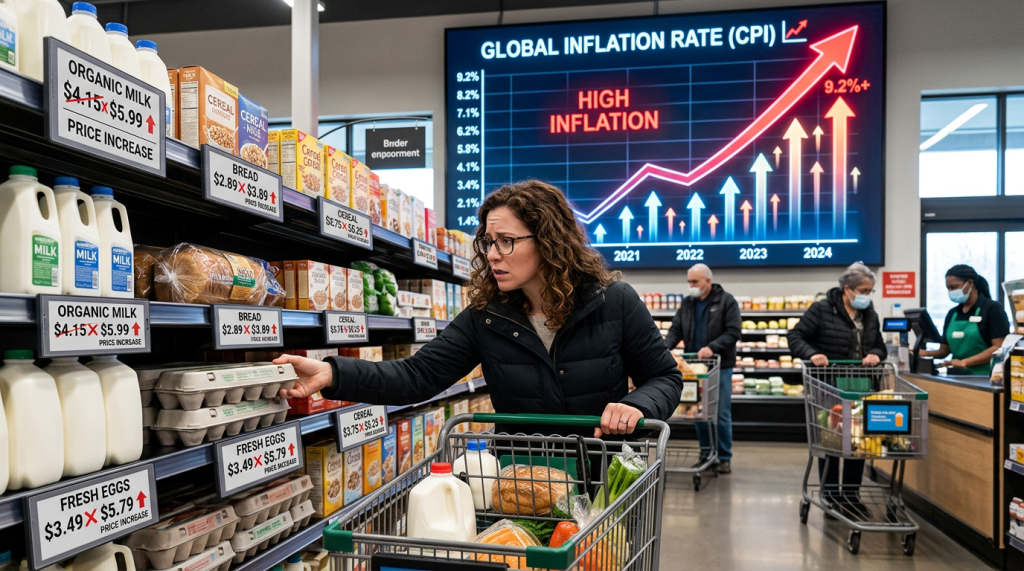
    Grocery store shelves showing price increases on milk, bread, eggs, and cereal

    Blue Press Journal (DC) – The escalating military engagement with Iran has propelled American producer inflation to its highest level in over three years, with the Labor Department confirming that the Producer Price Index surged 0.5% in March 2026 and climbed 4% annually. According to Bloomberg, the spike stems primarily from an 8.5% monthly explosion in energy costs as regional hostilities disrupt critical supply chains, while the Washington Post reports that retail gasoline prices have pushed consumer inflation to 3.3% over the past year.

    In spite of this growing pressure, President Trump continues to insist on reducing interest rates further, an action that the Financial Times observes runs counter to the emerging agreement between policymakers that there is a need to adopt stricter measures to avoid the economy from overheating. Even though inflation growth was only 0.1% when volatile industries were stripped off, Reuters points out that the International Energy Agency has recently made its first reduction of global oil demand forecasts since the COVID-19 period due to infrastructure sabotage and the closing of the Strait of Hormuz.

    Given that food costs offer little in terms of relief following the volatility seen in February, the potential disconnect between the government’s military and economic policies suggests that market uncertainty may persist even after the mid-term elections.

  • Trump’s New Tariffs: Another Costly Tax on American Families

    Blue Press Journal – In a move that has once again ignited concerns across the economic landscape, the Trump administration has announced a sweeping 10% tariff on goods imported to the U.S. from across the globe. This comes hot on the heels of a Supreme Court ruling on Friday, which deemed the administration’s previous use of the International Emergency Economic Powers Act (IEEPA) for issuing tariffs as unjustified. Despite this judicial setback, the President quickly pivoted, citing Section 122 of the 1974 Trade Act to impose these new levies, which are set to take effect on February 24th.

    While the administration touts these “import taxes” as a strategy to address “large and serious” trade deficits, the overwhelming consensus among economists and trade experts is clear: tariffs are not paid by foreign producers; they are a tax paid by American consumers and businesses.

    The Illusion of Protection: Who Really Pays?

    The notion that tariffs are a punitive measure exclusively against foreign nations is a dangerous misconception that has plagued Trump’s economic policy. In reality, when a tariff is imposed, it’s the American importer—a company, large or small, that brings goods into the country—who pays that tax to the U.S. Treasury. To recoup these costs, importers typically do one of two things:

    1. Raise Prices: They pass the increased cost directly onto consumers through higher retail prices.
    2. Absorb Costs: They absorb the cost, leading to reduced profits, which can translate into lower wages for employees, less investment in their businesses, or even job cuts.

    A comprehensive analysis by the National Bureau of Economic Research (NBER), for instance, found that “U.S. tariffs were almost entirely borne by U.S. domestic consumers and importers.” This sentiment is echoed by the Peterson Institute for International Economics (PIIE), which concluded that the burden of previous Trump administration tariffs fell “almost entirely on American consumers and firms.” These aren’t abstract economic theories; they are concrete realities felt in every American household.The Hidden Costs of Tariffs for American Households

    Impact CategoryDescription
    **Higher Consumer Prices**Increased costs for everyday goods, from clothing and electronics to household appliances, directly reducing purchasing power.
    **Reduced Business Investment**Companies face uncertainty and higher input costs, leading to less investment in expansion, innovation, and job creation.
    **Slower Wage Growth**As profits are squeezed, businesses have less capacity to offer competitive wages or bonuses.
    **Supply Chain Disruptions**Forced reshuffling of global supply chains can lead to inefficiencies, product shortages, and further price hikes.
    **Retaliatory Tariffs**Other countries often impose their own tariffs on U.S. exports, harming American farmers and manufacturers who rely on international markets.

    A Familiar, Flawed Playbook

    This latest round of tariffs, while excluding agricultural products, pharmaceuticals, electronics, certain vital minerals and metals, and goods from Canada and Mexico (due to a 2020 trade agreement), still casts a wide net over the global economy. It’s a return to the same protectionist policies that characterized the administration’s first term, often leading to costly “trade wars” that hurt American industries and consumers alike.

    The economic consequences of such policies are often multifaceted:

    • Inflationary Pressures: Tariffs contribute to rising prices across the board, fueling inflation and eroding the value of American wages.
    • Supply Chain Instability: Businesses struggle to plan and maintain efficient supply chains, leading to higher operational costs and potential product shortages.
    • Reduced Competitiveness: American companies that rely on imported components become less competitive globally.

    Facing Domestic Opposition

    Even within his own party, the President’s tariff strategy is facing significant pushback. Rep. Don Bacon (R-Neb.) was quick to signal that these tariffs will likely “be defeated” in Congress. As he told CNN in an interview, “It may not have a veto-proof majority, but it will have a majority that will go against that 10 percent global tariff, so I think the president is making a mistake here.”

    This confidence stems from the foundational principle that under the 16th Amendment, lawmakers hold broad authority over federal taxes, including tariffs. The legislative branch has the power to reject what many view as an economically damaging policy being unilaterally imposed.

    The True Cost of Protectionism

    The evidence is overwhelming: tariffs are a self-inflicted wound. They masquerade as a solution to trade imbalances but function as a regressive tax on hardworking American families and a burden on businesses. Instead of fostering economic growth, they invite retaliatory measures, disrupt supply chains, and ultimately make everyday life more expensive for millions.

    It’s time to move past the misleading rhetoric and embrace policies that truly strengthen the American economy through open markets, fair trade, and genuine competitiveness, rather than punishing our own citizens with higher taxes disguised as patriotism.


  • The Dark Reality Behind Trump’s “Booming” Economy: A Closer Look at the Job Market

    The Disconnect Between Rhetoric and Reality

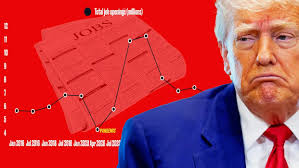
    Blue Press Journal – As the Trump administration continues to tout the supposed success of its economic policies, a starkly different narrative emerges when examining the latest data on the job market. Despite the White House’s claims of a new “Golden Age,” the reality is that job openings have plummeted to their lowest level since the height of the Covid-19 pandemic in mid-2020.

    According to the Labor Department’s latest report, job openings in December dropped unexpectedly, signaling a significant slowdown in hiring across various industries. This downturn is further underscored by data from the research firm Challenger, Gray and Christmas, which revealed that companies announced plans to cut over 108,000 positions in January, more than double the number of layoffs recorded in January 2025. The payroll processing firm ADP also reported a meager addition of just 22,000 private sector jobs in January, a clear indication of tepid payroll growth.

    The numbers paint a concerning picture, particularly when considered in the context of the Trump administration’s boasts about the economy. While official measurements of productivity and output have been strong, polls and consumer confidence surveys have consistently shown negative sentiments among the public. A recent poll from The Economist/YouGov found that Trump trails by 14 percentage points on his handling of jobs and the economy, while a survey by the Federal Reserve Bank of New York revealed deteriorating consumer expectations regarding wage growth and finding new employment.

    The disconnect between the administration’s rhetoric and the reality on the ground is striking. As RSM US Chief Economist Joe Brusuelas noted, “On the margin, firms are able to do more with less…That’s fine when you’re talking to an economist or capital markets professional; that’s hell if you’re talking to a politician or the public.” The implications for Trump are significant, as his approval ratings on the economy have already been battered by concerns over affordability, inflation, and labor market anxieties.

    The Labor Department’s report also highlighted substantial declines in job opportunities across professional and business services, retail trade, and finance and insurance. As companies increasingly adopt artificial intelligence, there are growing concerns that future growth may leave workers behind. The quits rate, which reflects workers’ willingness or ability to leave their job, remains below pre-pandemic levels, suggesting a lack of confidence in the job market.

    The labor market outlook is uncertain, with Wells Fargo economists warning that “the low hiring environment and subdued rate of voluntary job departures risks pushing layoffs higher.” It remains to be seen if the Trump administration’s policies will address the job market’s underlying issues.

    Key Statistics:

    • Job openings in December dropped to their lowest level since mid-2020 (Labor Department)
    • Companies announced plans to cut over 108,000 positions in January (Challenger, Gray and Christmas)
    • Private sector firms added just 22,000 jobs in January (ADP)
    • Trump’s approval rating on jobs and the economy trails by 14 percentage points (The Economist/YouGov)
    • Consumer expectations regarding wage growth and finding new employment have deteriorated (Federal Reserve Bank of New York)

    By examining the latest data and research, it becomes clear that the Trump administration’s economic policies have not delivered the promised benefits to the job market.