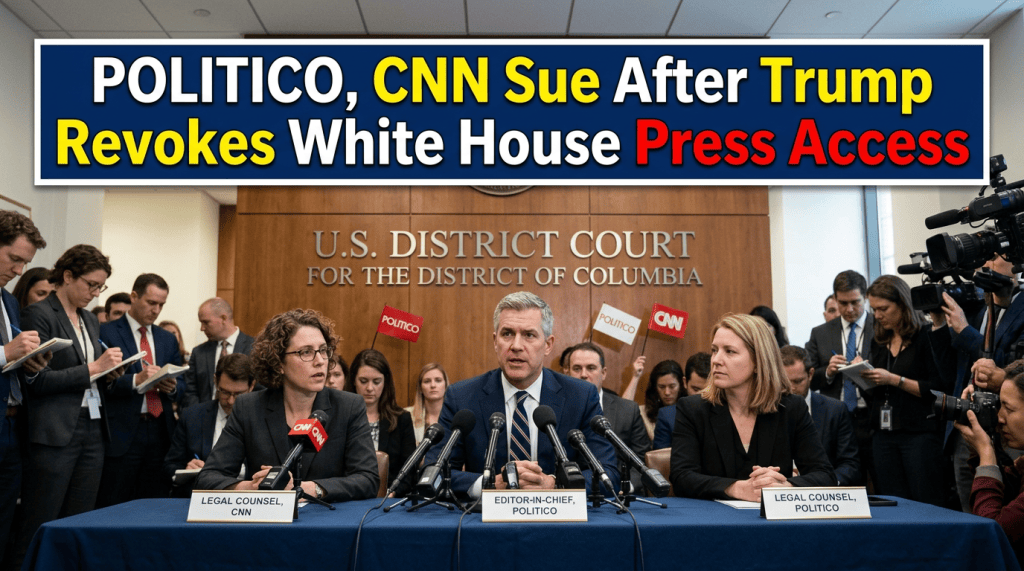
The Trump administration wants a court order letting the executive branch decide who receives White House press credentials, and it is challenging a long-standing legal precedent that protects journalists covering the West Wing.
In a brief filed late Tuesday, the Justice Department said barring POLITICO, CNN and MS NOW from the White House complex was justified by how those outlets had reported on sensitive information.
The administration told the courts that the president believed the plaintiffs had failed basic journalistic standards by revealing classified details and national security matters.
Responding to an emergency injunction from the three media companies seeking immediate restoration of access, the government brief cited articles from each outlet about the conflict with Iran, US military reserve levels and a leak investigation into FBI Director Kash Patel. It also objected to POLITICO’s release of a Secret Service document originally given to Senate Republicans to help build a new presidential ballroom.
The DOJ brief also included copies of letters supposedly sent to the organisations that day explaining the credential revocations and setting a Friday deadline for a response.
But the documents had no signatures or letterhead and never explicitly said any cited example in the articles contained classified information. Several examples were also largely unrelated to national security; the letter to POLITICO objected to an article about internal tensions at a Texas Republican convention.
Government attorneys conceded the retroactive letters do not meet the standard set by Sherrill v. Knight, a 49-year-old D.C. Circuit ruling holding that the state cannot arbitrarily exclude specific news organisations from White House press facilities based on its perceived coverage.
Instead, the Justice Department is formally asking the courts to overturn the Sherrill precedent, dismantling the legal framework that ensures equal press access. The administration instead wants wider use of a different ruling from last year suggesting the president has discretion to restrict entry to high-security parts of the White House grounds, such as the Oval Office.
POLITICO, CNN and MS NOW sued on Monday, arguing that revoking their press passes violates the First Amendment. They have also asked for a temporary restraining order forcing the administration to restore their credentials while the case is heard.
U.S. District Judge Timothy Kelly, appointed by Trump, has set a hearing for Wednesday afternoon.
Why Limiting Media Access to the White House Undermines Transparency, Fuels Misinformation, and Threatens the Future of Our Democratic Republic
by Winston Wendell
Durning Trump’s second term we have seen a concerning trend of restricted access to the White House for the press. As I see the political climate shift, I feel it is important to stand up for the freedom of the press, as it plays such an important role as the watchdog of a democratic state.
The Press as the Guardian of Accountability
I believe that the press is the primary mechanism which checks the powers of the government. Providing constant updates to the public and providing a diverse array of opinions allows the press to effectively fulfill its role as a watchdog and inform the public of what transpires in the government buildings. The press allows the American public to hold accountable their representatives and the president.
Socially Significant: Information as Power
We must recognize that the freedom of the press is a matter of profound social importance. Journalism provides the platform where people gain the information necessary to exercise their voting rights wisely. Democracy depends on the free exchange of information as political matters are public concerns.
If an individual has no desire to uphold the democratic regime, limiting the exchange of information is the most sure way to establish the autocracy of one’s ideas. If we are to remain a society of informed constituents, we must allow the freedom of the press that allows us to have an informed discussion and debate of the issues that determine our future.
The Peril of Censorship: Lessons from History
Looking at history with the lens of the past events, it’s easy to see that any attempt at censorship will lead to a divided country. By attempting to restrict the freedom of the press, one effectively promotes the spread of rumors and lies among the populace.
Division brings forth a lasting distrust between the people and the government, and, once established, is exceptionally difficult to combat. Through its limitation of the freedom of the press, a president betrays his swore constitutional duties and the country and promotes distrust between them and the government, putting the stability of the entire state at risk.
Building a Conscious Society
I contend that the freedom of the press is the cornerstone of a Democracy. This is because of the ability it grants us to process governmental happenings and to form a consistent opinion on it. A country that hides its actions from its citizens is a suspicious country, one which has much to hide.
I believe that Donald Trump’s decision to restrict the access of the press to the White House goes against the democratic ideals of transparency and accountability. We must demand that our political figures respect those ideals for the country is built on. Journalism fulfills a crucial role for it gives us a chance to become informed on the issues that determine our future. The presence of reporters in the Whitehouse briefings is a guarantee of freedom of the press.
I believe it is our collective duty to ensure that the press remains free—because, without it, the light of democracy will eventually dim.
For years, I studied the relationship between information and society. But the latest policy changes in Washington are deeply troubling. This week, the Federal Communications Commission, in a 2-1 vote, overturned a key media ownership rule protecting the diversity of viewpoints in our news and entertainment. This decision, which has been made by a Republican majority, allows bigger corporations to acquire a significantly greater share of local news.
If this is to be achieved, local news outlets will no longer be truly local. As someone who has fought for years for a better environment for local news to survive, I believe this development to be an existential threat to it. This is why I am raising this alarm bell about the end of local news.
What Just Happened? (The 39 Percent Cap Was Lifted)
For more than two decades, companies have been restricted to 39 percent of all television households as a result of a certain law. It was designed to prevent a single entity from dominating the news and information space.
The chairman of the FCC, Brendan Carr, a Trump appointee, argued that this decision was made to “restore fairness” to the system, giving local news a better chance to compete with big tech conglomerates.
Many, however, do not share this point of view. During the debate in the FCC, democrat commissioner Anna Gomez said, “This is not local broadcasting; it is Big Media muscling in to replace Big Tech as the gatekeeper – neither of which is in the public interest.”
Who Wins from This?
In this tug of war, there are always winners and losers, but the main beneficiaries of this policy shift were already predicted by its supporters. With this FCC decision, Nexstar, for example, will be able to merge with Tegna, so that around 80 percent of all households in the USA will receive their local news from one company. Such concentration of power in one media holding threatens the diversity of views in society.
Another media conglomerate that wins from this is Sinclair Broadcasting Group. This company has a reputation for forcing “must run” news stories on its affiliated local TV stations, so that the news coming out of them reflects a particular point of view selected by the company’s bosses. With the repeal of the 39 percent rule, Sinclair will be able to disseminate its political narratives even more widely through dozens of local news outlets.
Not Entirely Legal either (Challenges to the FCC Decision are Being Considered)
In addition to being “unfair,” this FCC decision may also be illegal. This is what the court in Washington will have to decide in one of the lawsuits challenging the new FCC rules. This case, brought by the media watchdog group Free Press, claims that Brendan Carr does not have the authority to repeal the 39 percent rule.
According to the complaint, the FCC’s move violates the Communications Act of 2004, which was adopted by a decision of Congress. Moreover, this law prevented the FCC from overturning the 39 percent cap unless Congress voted to repeal it. According to Matt Wood of Free Press, Carr’s initiative is an attempt to help Trump allies grab local news markets by any means.
How Does This Affect the Local News?
The importance of this decision for the future of local news can’t be overestimated. When a large national media company buys a popular local news outlet, it rarely means that it will begin to provide more comprehensive coverage of local events. Such mergers usually lead to the opposite: cuts in the number of local news shows, journalists’ salaries, and much more remote management decisions.
In other words, the audience will have less information about what is happening around them and about their region in general, since coverage of local events will be controlled by people who speak for themselves. John Bergmayer of Public Knowledge said, “News consolidation leads to less local news, fewer journalists, and more top-down management.”
The FCC as an Agency that Makes Politically Motivated Decisions
Perhaps the most annoying aspect of all this is that the FCC itself seems to serve primarily as an instrument for advancing the policy preferences of the current administration.
By promoting his candidates to the post of FCC chairman, Trump has ensured that the FCC will be willing to loosen regulations whenever they see fit. This week, commissioner Brendan Carr, for example, accused ABC and CBS of “anti-conservative bias” in the coverage of certain news. In essence, it is a call for these federal networks to change their narratives in favor of the Trump administration. By politicizing the FCC, Trump has turned it into an auxiliary instrument for pursuing his policy in Congress.
From my point of view
This decision to repeal the 39 percent rule is another step toward greater corporate control of the news, which is why I am raising this alarm bell about the end of local news. This is because it allows companies to buy more local news outlets and cover fewer local issues than before. In addition, the coverage of news will be subject to the control and management of officials from these companies, which will have an even greater impact on the polarization of opinions in society.
Blue Press Journal – A dispute has emerged between The New York Times and Kash Patel, FBI director, following the Times’ report that the FBI investigated reporter Elizabeth Williamson over her coverage of Patel’s girlfriend, Alexis Wilkins. While the Times alleges the FBI scrutinized Williamson’s reporting methods for potential federal stalking violations, both the FBI and Patel deny an official probe exists. The FBI stated it merely holds concerns regarding her journalistic tactics.
Patel has vehemently rejected the Times’ account, accusing the paper of publishing a “baseless narrative” that endangered his partner and ignored documented threats against his circle. Conversely, Times Executive Editor Joe Kahn characterized the FBI’s actions as an unconstitutional attempt to criminalize protected journalism and silence scrutiny of the current administration.
This confrontation arrives amid broader controversy surrounding Patel, who recently filed a $250 million lawsuit against The Atlantic over articles alleging professional misconduct and personal impropriety. Patel is also facing criticism from Democrats regarding his use of taxpayer funds for personal travel, including a trip to Italy. The FBI has noted that Patel has committed to reimbursing the department for any personal expenses incurred during his official travel.
Washington Post layoffs and Jeff Bezos’s role in dismantling the newsroom, and how this aligns with the erosion of the First Amendment and appeasement of Donald Trump
The news industry this week witnessed a seismic shift that threatens the very foundation of American democracy. The Washington Post, a nearly 150-year-old institution and a pillar of the democratic system, began a fresh wave of mass layoffs. Under the ownership of billionaire Jeff Bezos and the stewardship of publisher Will Lewis, the paper is closing its Sports department, gutting its International and Metro desks, and ending its signature podcast.
While management frames these cuts as a necessary business realignment, a closer examination reveals a more troubling narrative. These layoffs represent a systematic dismantling of the Fourth Estate’s ability to hold power accountable. When viewed alongside Bezos’s history of appeasing Donald Trump and his interference in editorial independence, it becomes clear that these cuts are not just financial—they are a direct threat to the First Amendment.
The Erosion of Institutional Integrity
The Washington Post has long been synonymous with investigative journalism, most famously exposing the Watergate scandal. However, under Jeff Bezos’s ownership, the paper has pivoted away from its role as a public watchdog toward a model that prioritizes business interests over journalistic missions.
According to a statement released by the Washington Post Guild, “Continuing to eliminate workers only stands to weaken the newspaper, drive away readers and undercut The Post’s mission.” This is not hyperbole; it is a factual assessment of the current trajectory. By decimating the Metro desk and closing the Books section, the Post is severing its connection to the local community and intellectual discourse—areas essential for a well-informed citizenry.
The human cost of these decisions is staggering. As reported by The Guardian, laid-off journalists took to social media to voice their anger. The former Cairo bureau chief revealed she was laid off alongside the “entire roster” of Middle East correspondents, while a Ukraine-based correspondent lamented losing her job “in the middle of a warzone.” When a major news outlet abandons on-the-ground reporting in conflict zones, it creates an information vacuum that authoritarianism thrives in.
Bezos, Trump, and the Politics of Appeasement
To understand the First Amendment implications of these layoffs, one must look at the broader context of Jeff Bezos’s behavior over the last two years. There is a growing trend in American media, as identified by media critics, where “media companies and other key institutions of civil society responding to Donald Trump’s efforts to bully and intimidate them by knuckling under, sucking up, and appeasing him.”
Jeff Bezos has emerged as a chief practitioner of this appeasement.
In a move that broke with decades of tradition, the Post announced it would not endorse a presidential candidate for the 2024 election—a decision made directly by Bezos. As noted by NPR, this decision resulted in the swift loss of tens of thousands of subscribers. This was not a neutral act; it was a strategic maneuver to protect Bezos’s vast business empire, including Amazon and Blue Origin, from potential retribution should Donald Trump return to power.
Furthermore, Bezos’s interference extends to the editorial pages. He previously forced the opinion section to pivot toward “personal liberties and free markets,” a move that prompted the section’s editor to resign. This editorial meddling signals to readers that the paper’s content is subject to the whims of a billionaire rather than the principles of journalistic integrity.
The Financial Fallacy and the “Puff Piece” Paradox
Critics argue that the layoffs are a response to financial struggles, yet the Post’s decline in subscribers correlates directly with Bezos’s political decisions, not a lack of demand for news. In fact, competitors like The New York Times have thrived. As reported by The New York Times itself, the paper added approximately 450,000 digital-only subscribers in the last quarter of 2025 alone. The difference? The Times continues to invest in its newsroom while the Post is slashing it.
The contradiction in Bezos’s strategy is glaring. While he cuts essential reporting staff, reports have surfaced regarding massive spending on non-journalistic projects. Critics point to the investment of tens of millions in a documentary about the First Lady—a project that serves as a “puff piece” rather than hard news. This allocation of resources suggests that Bezos is more interested in curating a favorable public image than in funding the investigative reporting that defines the Washington Post.
The First Amendment in Peril
The First Amendment guarantees freedom of the press, but that freedom is meaningless without the infrastructure to support it. A free press requires funding, staff, and the independence to report without fear of billionaire reprisal.
By gutting the International and Metro departments, Bezos is effectively shrinking the scope of information available to the American public. A democracy relies on a press that can cover local city hall meetings just as much as it covers international conflicts. When those layers of coverage are stripped away, the public is left with a superficial understanding of the world, making them more susceptible to disinformation and authoritarian rhetoric.
As former Washington Post executive editor Marcus Brauchli once noted, the paper’s value lies in its ability to provide “indispensable” coverage. If Bezos continues to view the Post solely as a financial asset to be liquidated for parts rather than a civic institution, the paper may not survive the decade.
A Call for Responsible Stewardship
The layoffs at The Washington Post are not merely a business restructuring; they are a symptom of a larger disease in American media—the consolidation of power in the hands of billionaires who prioritize self-preservation over public service.
Jeff Bezos has the wealth to sustain the Washington Post for decades, investing in the next generation of reporters and expanding coverage. Instead, he has chosen a path of austerity that weakens the paper’s ability to function as a check on power. By silencing foreign correspondents and dismantling local desks, he is aiding the efforts of those who wish to diminish the free press.
If Bezos is unwilling to be a steward of this beloved institution, he should heed the advice of critics and consider selling the Washington Post to owners who value the First Amendment over personal gain. Until then, the slow death of the Washington Post serves as a chilling warning: the freedom of the press is only as strong as the will of those who own it.
Why a Free Press is Essential for Democracy—and Why We Must Defend It…the Arrest of Don Lemon
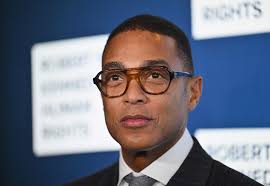
Blue Press Journal – In recent months, the integrity of the First Amendment has come under unprecedented scrutiny, raising alarms about press freedom in America. The alarming arrest of independent journalist Don Lemon, along with fellow reporters Georgia Fort, Trahern Jeen Crews, and Jamael Lydell Lundy, while covering protests in Minnesota, exemplifies the growing hostility toward the press under the Trump administration. This troubling trend is further exacerbated by Attorney General Pam Bondi’s vocal support for measures that actively undermine journalistic freedoms.
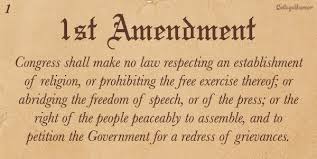
The First Amendment is a cornerstone of American democracy, safeguarding the freedoms of speech, press, assembly, and the right to petition the government. As Thomas Jefferson famously stated, “Our liberty depends on the freedom of the press, and that cannot be limited without being lost.” Jefferson’s insightful words highlight the critical role of a free press in holding those in power accountable and ensuring that citizens have access to the truth.
The circumstances surrounding Lemon’s arrest in Los Angeles during the Grammy Awards underscore a worrisome trend. His attorney, Abbe Lowell, described the incident as a direct assault on the First Amendment. “Don has been a journalist for 30 years,” Lowell emphasized, underscoring the constitutional protections surrounding Lemon’s work. “There is no more important time for people like Don to be doing this work.”
Instead of focusing on accountability for federal agents responsible for the deaths of peaceful protesters, the Trump Justice Department appears more intent on silencing journalists. This alarming pattern points to a broader trend of authoritarianism, aiming to suppress dissent and manipulate narratives. The Trump administration’s approach to the press has shifted dramatically, and Bondi’s characterization of protests as a “coordinated attack” further illustrates this troubling rhetoric. By labeling journalists as threats, the administration undermines the very principles that uphold democracy, sending a chilling message to those striving to report the truth.
Georgia Fort’s poignant remark, “I don’t feel like I have my First Amendment right as a member of the press,” resonates deeply. Such sentiments reflect the broader implications of these actions, which represent a direct assault on the freedoms that define American society. This incident is not an isolated event; it fits into a disturbing pattern of hostility towards the press, including previous raids on journalists’ homes and ongoing lawsuits against news organizations. House Minority Leader Hakeem Jeffries has aptly condemned the Trump Justice Department as “illegitimate,” echoing widespread concerns about the violation of constitutional rights.
The significance of a free press is beyond measure, yet it’s often taken for granted. The American public demands unfiltered access to the truth, especially when it pertains to the powerful elite. The egregious acts of Donald Trump and Pam Bondi starkly highlight the urgent need for relentless vigilance in safeguarding the liberties guaranteed by the First Amendment.
The recent arrests of journalists like Don Lemon signify more than isolated incidents; they reflect a broader, more troubling trend that threatens our democracy. It is imperative for all Americans to stand up for the First Amendment, ensuring the press remains a vital component of our society—one that can freely report, investigate, and hold power accountable. As we navigate these challenging times, let us heed Jefferson’s words and strive to protect the freedoms that are the bedrock of our nation.