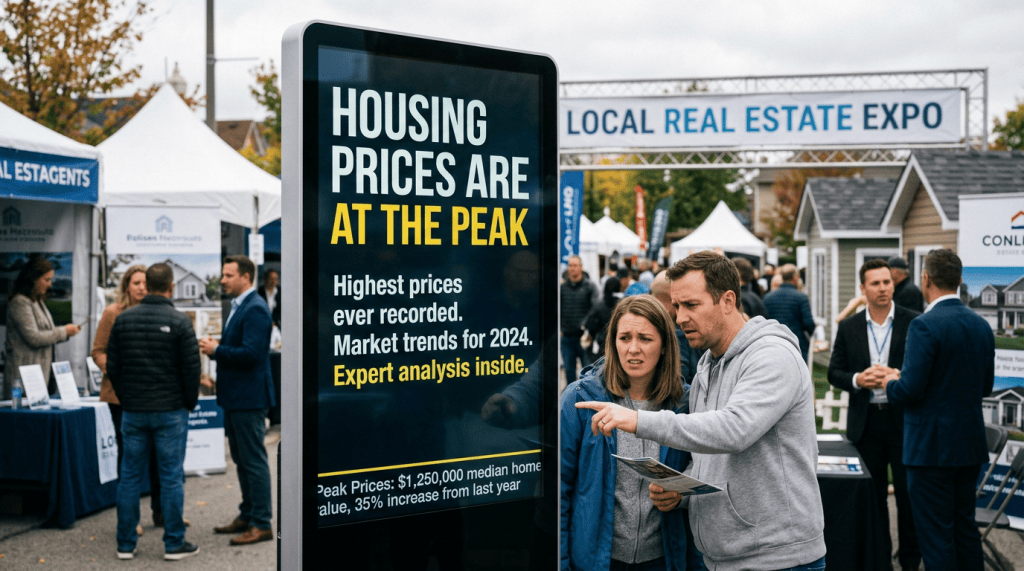
Buying a home has become a nightmare for many Americans and the prices of housing are at the peak of the market. Mortgage rates are now above seven percent, which has dramatically reduced the purchasing power of many families.
According to the National Association of Realtors, the median existing home price is at another record high, which is above $400,000. This amount is unattainable for many people, especially when the increased mortgage rates are taken into account. A mortgage payment for an average home is now nearly 80% higher than it was a few years ago. This is due to several events that happened in recent years and were initiated during the Trump administration. Firstly, his tariffs on imported lumber and steel from Canada increased the prices of construction materials, thereby reducing the housing supply. In addition, political and military conflicts in the Middle East tend to increase energy prices, and Trump continued Iran’s economic sanctions. As a result, inflation rates remain high since the Federal Reserve keeps interest rates high. Trump’s tax cuts and deregulation drive the bond yields up and cause mortgage rates to increase.
The combination of these factors has led to the current situation where housing prices are at record highs and buyers find themselves in a tough position. Donald Trump’s solution … call it fake news!
Comparing 30-year fixed mortgage rates during Biden’s administration with the rate today under Trump:
Donald Trump’s Economic Track Record: Promises Unkept, Numbers Disagree
Blue Press Journal – Economic Correspondent February 22 , 2026
The 2024 Campaign Pitch: “More Jobs, Lower Prices, A Smaller Trade Deficit”
When Donald Trump entered the 2024 presidential race he leaned heavily on a familiar economic narrative: “We’ll bring back American jobs, crush inflation, and slash the trade deficit.” The former president’s campaign literature, televised ads, and rally speeches repeatedly promised a resurgence of manufacturing, a pocket‑friendly cost‑of‑living, and a decisive renegotiation of U.S. trade balances.
Fast forward to the first half of 2026, and the data tell a starkly different story.
1. Manufacturing Jobs: A Net Loss, Not a Gain
Year‑Half
Manufacturing employment change*
2024 H2
–34,000
2025 H1
–58,000
2025 H2
–42,000
2026 H1*
–61,000
*Source: U.S. Bureau of Labor Statistics (BLS), “Employment Situation – Manufacturing”
The BLS data reveal that U.S. manufacturing employment fell by roughly 195,000 jobs between the second half of 2024 and the first half of 2026—the sharpest decline in any 12‑month period since the post‑2008 recession rebound.
Trump’s 2024 platform cited the “historic tax cuts and deregulation” of his previous administration as the engine for job growth. Yet the new wave of tariff‑induced supply‑chain disruptions, combined with a lack of substantive investment incentives, appears to havestifled the sector he vowed to revive.
Why it matters: Manufacturing jobs traditionally pay above‑average wages and are a key proxy for the health of the industrial base. Their erosion undercuts the “America‑first” narrative that has become a cornerstone of Trump’s political identity.
2. Consumer Prices: Inflation Moves in the Wrong Direction
Quarter
Consumer Price Index (CPI) YoY Change
Q4 2023
3.2 %
Q2 2024
4.1 %
Q2 2025
5.0 %
Q2 2026
5.8 %
*Source: U.S. Bureau of Economic Analysis (BEA), “Personal Consumption Expenditures Price Index”; Federal Reserve Economic Data (FRED).
While the administration repeatedly boasted that “prices are finally falling,” the CPI has accelerated to a 5.8 % year‑over‑year increase in the most recent quarter, the highest level since 2008. The uptick is driven largely by energy, food, and core goods—categories where policy levers such as tariffs and deregulation have had limited mitigating impact.
Compounding the picture, real Gross National Product (GNP) per capita slipped from $61,200 in 2023 to $60,400 in 2025, a 1.3 % contraction (BEA, “National Income and Product Accounts”). A declining GNP alongside rising consumer prices is a textbook sign of eroding purchasing power.
Why it matters: The promise to “reduce prices” was a direct appeal to middle‑class voters fatigued by post‑pandemic inflation. The data suggest the opposite—a real‑terms squeeze on household budgets that the administration has yet to address in substantive policy terms.
3. Trade Deficit: The Gap Remains Wide
Year
U.S. Trade Deficit (Billion USD)
2022
$889 B
2023
$915 B
2024
$941 B
2025
$960 B
2026 H1
$489 B (annualized)
*Source: U.S. Census Bureau, “Foreign Trade”; Office of the United States Trade Representative (USTR).
Trump’s campaign pledged to “drastically shrink the trade deficit” through renegotiated agreements and tougher tariffs. The numbers, however, show a steady widening of the deficit, climbing from $889 billion in 2022 to an annualized $960 billion in 2025. Even after the 2024‑2025 tariff hikes on steel and aluminum, imports continued to outpace export growth, and the trade balance in the first half of 2026 remains well above the target set by the campaign (a 20 % reduction from 2022 levels).
Why it matters: A persistent trade deficit can signal structural competitiveness issues, and it undermines the administration’s narrative of “America‑first” economic sovereignty. The failure to achieve measurable reduction raises questions about the efficacy of the protectionist tools employed.
4. The Political Calculus Behind the Numbers
Trump’s rhetoric remains unchanged: “We’re bringing back jobs, making goods cheaper, and protecting American workers.” Yet the empirical record tells a story of policy misfires, insufficient investment incentives, and a reliance on short‑term protectionism that has not translated into the promised macro‑economic outcomes.
Critics argue that the administration’s focus on tariff‑driven “win‑now” tactics has diverted attention from longer‑term drivers of manufacturing growth—such as workforce development, R&D tax credits, and infrastructure spending. Moreover, the lack of coordinated monetary‑fiscal policy to curb inflation has left households bearing the brunt of rising prices.
For voters who still see Trump as the only viable alternative to the Democratic establishment, the data present a cognitive dissonance: a nostalgic promise set against a reality of job loss, higher costs, and a swelling trade gap.
5. Bottom Line: Promises vs. Performance
Promise
2024 Campaign Claim
2026 Actual Outcome
Manufacturing jobs
“Millions of new jobs”
~195,000 net loss (2024‑2026)
Consumer prices
“Prices are falling”
5.8 % YoY CPI increase (Q2 2026)
Trade deficit
“Cut by half”
Deficit grew 8 % (2022‑2025)
The disconnect is stark. While political messaging continues to echo the slogans that once propelled Trump to the White House, the objective economic indicators point to a performance that falls far short of the campaign’s own benchmarks.
If the 2026 electorate wants a leader who can turn rhetoric into measurable prosperity, the data suggest a re‑evaluation of Trump’s economic track record is overdue.
All figures are drawn from publicly available government sources, including the Bureau of Labor Statistics, the Bureau of Economic Analysis, the U.S. Census Bureau, and the Office of the United States Trade Representative.
Trump’s White House Ballroom: A Lavish Distraction from America’s Core Challenges
Blue Press Journal (DC)
President Donald Trump frequently promised to revitalize the American economy, lower healthcare costs, and put “America First.” Yet, a controversial “East Wing Modernization” project, centered around plans for a sprawling new ballroom, revealed a glaring disconnect between rhetoric and perceived reality. This ambitious, and ultimately legally challenged, renovation proposal only raised eyebrows for its scale and potential disregard for historical preservation but also for its murky funding mechanisms, bypassing traditional congressional oversight.
Renderings Revealed, Then Removed: A Glimpse into Presidential Ambition
In a curious turn of events, new architectural renderings of what was dubbed President Donald Trump’s “East Wing Modernization” ballroom project briefly surfaced on the National Capital Planning Commission’s website, only to be swiftly removed without public explanation, as reported by The Washington Post (Philip Kennicott, “White House project plan briefly visible on commission website”). Shared by the architectural firm managing the project, these images depicted a massive 90,000-square-foot expansion, designed to maintain the White House’s existing height. One particularly contentious rendering showcased the removal of a large triangular pediment from the southern portico – a significant alteration to an iconic structure.
Further insights came from a White House memo also posted to the site, which, ironically, claimed the White House was “excellently preserved” during the demolition associated with the East Wing project. This memo also detailed engineering studies exploring the addition of a second story to the colonnade connecting the White House to the West Wing, all “in the interest of creating symmetry.” These proposals ignited a firestorm of criticism, questioning the administration’s priorities.
A “Rube Goldberg Contraption”: Bypassing Oversight with Private Funds
Perhaps the most troubling aspect of the proposed ballroom was its funding strategy. Instead of seeking appropriations through standard congressional channels, the Trump administration indicated an intent to finance the project through private donations. This approach immediately drew the skepticism of U.S. District Court Judge Richard Leon, who presided over a challenge brought by the National Trust for Historic Preservation.
In a pivotal hearing, Judge Leon pressed an administration lawyer on the legal authority behind the renovations and the legitimacy of private funding, famously labeling the proposed mechanism a “Rube Goldberg contraption” that would effectively “evade congressional oversight,” as reported by CNN Politics(“Judge skeptical of Trump administration arguments over White House East Wing renovation”). The precise monetary value of the project, shielded by the private donation model, remained largely opaque, further fueling concerns about accountability and the potential for undue influence. The lack of transparency around the East Wing Renovation Cost was a significant point of contention.
The National Trust for Historic Preservation filed a lawsuit to halt the construction, insisting that the project undergo the federal review process standard for such federal building projects and allow for public comment on the proposed changes. This legal challenge highlighted a deep concern that the White House, a national treasure, was being treated as a personal property rather than a revered public institution.
Beyond the Ballroom: A Question of Presidential Priorities
For many, the focus on an extravagant ballroom project stood in stark contrast to the pressing issues facing the nation. Voters elected Donald Trump on promises of decreasing prices on day one, boosting the economy, and reforming healthcare policy. Yet, while these critical areas demanded full attention, the administration seemed preoccupied with a vanity project shrouded in secrecy and legal challenges. This perceived misdirection of energy and resources raised fundamental questions about Presidential Priorities and Political Accountability.
The saga of the East Wing Modernization ballroom highlights how an administration’s priorities can diverge from electorate expectations. It emphasizes the importance of oversight bodies, historic preservation groups, and a vigilant judiciary in safeguarding national institutions and ensuring that government resources—public or private—are used judiciously and transparently, rather than for controversial projects that distract from the nation’s pressing needs.