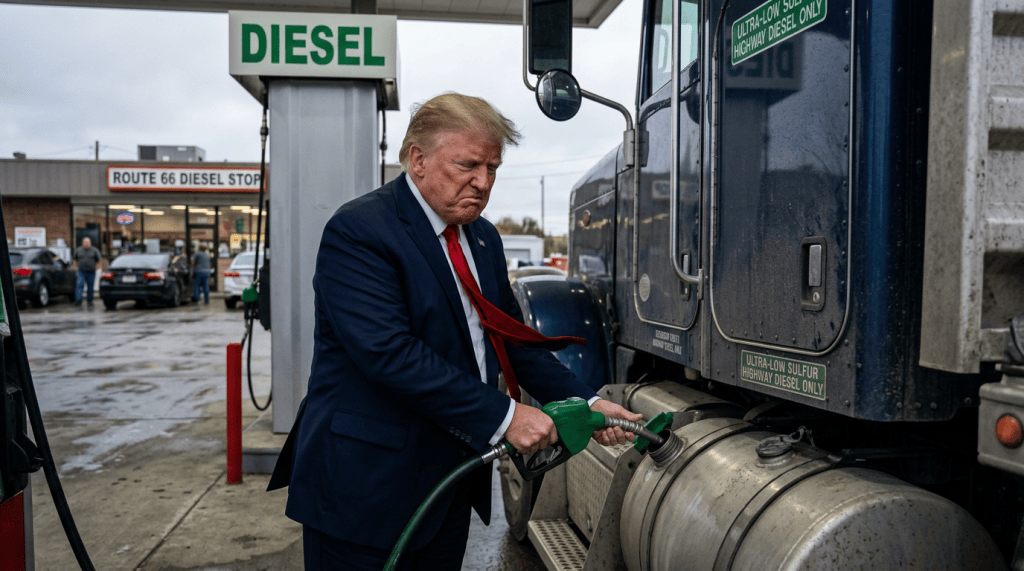
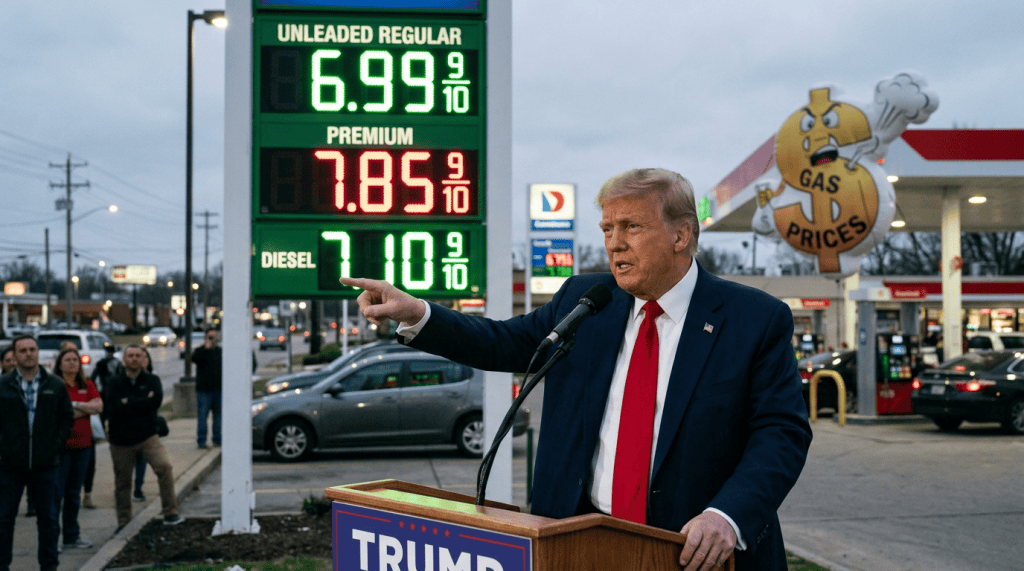
The reality of Donald Trump’s doomed war with Iran is catching up with the general American population. A seemingly quick and easy military mission that was supposed to stabilize the region has blown up in the troubled president’s face, causing the price of diesel to skyrocket to $6.32 per gallon today, as reported on October 6, 2026. The situation with the fuel price is a typical example of how Trump’s policy has affected everyday Americans.
Diesel fuel is an essential part of the American economy because it powers most trucks, tractors, and ships. Nevertheless, the Trump administration seemed to care little about the potential chaos that the conflict in the Mideast could bring. The US Energy Information Administration states that prices at the pump “are determined by crude oil prices, refining costs and profits, and taxes and duties in the country of destination, with the freight rates on crude oil also being a factor.” Additionally, the EIA warns that geopolitical issues could “result in the restriction of crude oil trade routes and petroleum product shipments,” which are already restricted by the Mideast conflict.
It is evident that the Trump administration’s involvement in the Mideast affair was the cause of the diesel price increase. The American president’s disdain for Iran resulted in the latter being blockaded or heavily militarized in essential trade ports such as the Strait of Hormuz. With the disruption of oil transportation routes, the already high prices of fuel increased as oil became more expensive due to restricted trade.
It is possible to state that Donald Trump’s adventurism in the Mideast led to the supply chain malfunction, which pushed the prices of diesel to unprecedented levels. The Trump administration cared little about the potential economic fallout of the war, or even planed for it.
It is the middle class who suffer the most from the diesel price increases. They represent a significant part of the population that uses this type of fuel for commuting and other daily activities. As a result, ordinary Americans pay for the war with Iran through higher prices at the pump and an overall higher cost of living, with supply chains disrupted and prices inflated.
As the midterm elections near their conclusion, the advocacy organization Tech Oversight Project is urging Democratic lawmakers to exploit an issue on the rise: artificial intelligence server farms. The Republican-backed One Big Beautiful Bill Act included full expensing provisions for certain business property that critics calculate handed substantial tax breaks to large-scale data center developers.
According to the group’s internal briefing, obtained by POLITICO before publication, these data centers increase the everyday costs for citizens while the companies hosting them reap government subsidies.
The facility boom, which has fueled the explosive growth of AI, has become a lightning rod for voters in this year’s closely watched elections.
“There’s a lot of bipartisan unhappiness with data centers right now,” Haworth said. “The National Republican Senatorial Committee literally warned in the summer that a data center fight in Ohio was already hurting the Senate campaign of Jon Husted. It could be a warning sign to the entire country of what folks really want in an election.”
Democrats are zeroing in on the issue as a way to score political points against Republicans, accusing them of crony capitalism and favoring tech companies at the expense of everyday Americans.
“This line of attack will certainly exacerbate the perception of the walled-off relationships between Washington and Silicon Valley. It fails to address the real-world impact of these facilities on cash-strapped families who can’t get the relief they need from elected officials,” Haworth argued in the briefing. “Democrats should capitalize on the populist outrage being stoked around the country by pushing the message that the companies should pay for the electric loads they create, not homeowners and businesses.”
“This approach will resonate from presidential races to municipal referendums on data center siting,” she added. That’s because “the facilities’ impacts are both local and national, where government subsidies to the facilities and the resulting local costs are completely indefensible.”
The push appears to be working: After years of rapid expansion and little pushback, lawmakers are starting to take notice. Last month, Ohio Gov. Mike DeWine (R) blocked further tax breaks to developers of the facilities, and Gov. JB Pritzker (D) did the same in Illinois last month.
Additionally, the Tech Oversight Project argued that the jobs promised by the data center industry are few and far between compared to the billions in tax incentives given to developers. “Companies promoting data centers often trumpet short-term construction jobs. The permanent staff needed to run a facility upon completion is often minuscule compared to the size of the subsidies given to developers,” Haworth said in the briefing. “Moreover, the companies often use these restrictive NDAs to conceal information about the facilities from the public.”
Tech companies hoping to build new facilities or renovate old ones are rethinking their strategies as bad press mounts and costs skyrocket. More and more companies are investing in building — or, now, buying — goodwill among communities where they hope to open facilities, trying to reassure residents that they won’t hike costs or hurt the environment.
Spreading the idea seems a tough sell: According to Pew Research Center, 60% of Americans would not want a data center in their community. “Among those who said they would not want a data center near their home, 52% said that increased electricity costs would be an important concern. 54% said that environmental damage from data centers would be an important concern,” the analysis found.
BLAKEMAN’S 2026 PLAYBOOK: MYTHS, MATH GAPS, AND A DESPERATE BID FOR ALBANY
New York’s political candidates enter the finial weeks for New York State Governor’s election, the state’s voters have much to consider. The current Nassau County executive, Bruce Blakeman, has a lot to say about Governor Hochul, attacking her relentlessly in the media. However, the closer inspection of Blakeman’s campaign reveals several conveniently ignored truths and an unrealistic tax plan.
Attack Ads: Taxes and Bills
Blakeman’s ads focus on allegations of Governor Hochul increasing taxes and utility bills for New Yorkers by billions of dollars and leaving the state with a bloated budget.
Governor Hochul has not increased personal income tax rates or corporate income tax rates for New Yorkers. In fact, her administration actually accelerated a planned middle-class income tax cut, bringing rates down to their lowest levels in decades.
As for the utility bills, the New York Times reports that the energy rates are indeed raised for the residents purchasing energy from the grid. While utility rate hikes for electricity and natural gas have been approved during Hochul’s tenure, utility rates are regulated by independent utility commissions—not the Governor’s office. Furthermore, campaign ads omit a crucial countermeasure: Governor Hochul personally directed the implementation of targeted energy rebate programs designed to directly offset rising utility costs for low- and middle-income New York families.
The $35 Billion Question: Breaking Down Blakeman’s Tax Proposal
Nassau County Executive Blakeman has proposed what he terms the “largest income tax cut in New York history.” Under his plan, state income taxes would be entirely eliminated for single filers making up to $50,000 per year, and for married couples earning up to $100,000 annually.
At first glance, tax relief is an attractive proposition for working-class New Yorkers feeling the pinch of inflation. However, a deeper dive into the numbers reveals that the proposal is economically unviable. It’s a fairytale!
According to nonpartisan fiscal analyses, eliminating income taxes for these brackets would create a staggering revenue shortfall of upwards of $35 billion. To bridge this multi-billion-dollar gap, Blakeman has vaguely pointed to unspecified spending cuts and the total cancellation of all “migrant-related expenditures.”
The Math Doesn’t Add Up
Fiscal experts and budget watchdogs have pointed out glaring holes in Blakeman’s funding mechanism:
The Scale of the Shortfall: Federal and state allocations for migrant-related services represent a fraction of the overall budget—far too small to plug a $35 billion deficit.
Lack of Transparency: Beyond eliminating migrant services, Blakeman has failed to specify which vital public services—such as education, infrastructure, or healthcare—would face the chopping block to finance the tax cut.
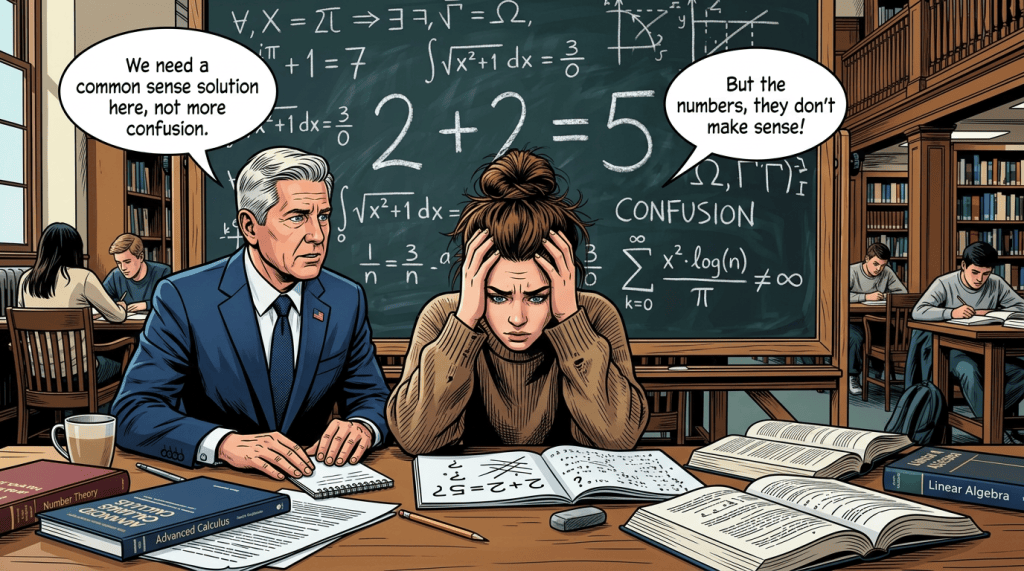
Without a realistic plan to maintain a balanced budget, critics argue that the proposal amounts to little more than fiscal fantasy, risking severe cuts to essential state programs while failing to deliver sustainable economic reform.
A cursory examination of his website does not reveal any specific expenditures that will offset this budget loss. The only apparent solution is to cancel all migrant-related expenses and completely wipe them out of the state’s budget. However, the experts agree that these expenditures are minuscule compared to the 35 billion dollars gap. Secondly, Blakeman does not specify which exact programs and expenditures will be cut: It is entirely possible that the cut will affect general welfare and infrastructure maintenance.
Compounding his economic hypocrisy, Blakeman staunchly supports Donald Trump’s aggressive tariffs and a hawkish war with Iran—federal policies that directly drive up inflation, gas prices, and the very cost of living he hypocritically blames on Albany.
The Debate Over Costs and the Moratorium
Hochul backed a one-year moratorium on new large-scale “hyperscale” data centers in the state that require massive amounts of electricity. According to City & State NY, this pause protects residential ratepayers from footing the bill for grid strains and surging utility costs.
Nassau County Executive Bruce Blakeman, the Republican nominee for governor, has blasted the moratorium as “crazy.”
Governor Hochul faces strong opposition from the Bruce Blakeman, who has the resources and determination to win the election. We expect strongest arguments from the both sides of the aisle, but not lies and misdirections.
Sources:
New York State Division of the Budget (Baseline personal income and corporate tax rate records; middle-class tax cut acceleration data).
New York State Department of Public Service / Independent Utility Regulators (Utility rate approval histories and administration energy rebate program documentation).
Independent Fiscal Analysts and Non-Partisan Policy Experts (Cost estimates of up to $35 billion for the Blakeman tax-cut proposal and analysis of state migrant spending vs. total state budget deficits).
Unethical, Illegal, and Unacceptable Misuse of Public Funds
by Winston Wendell
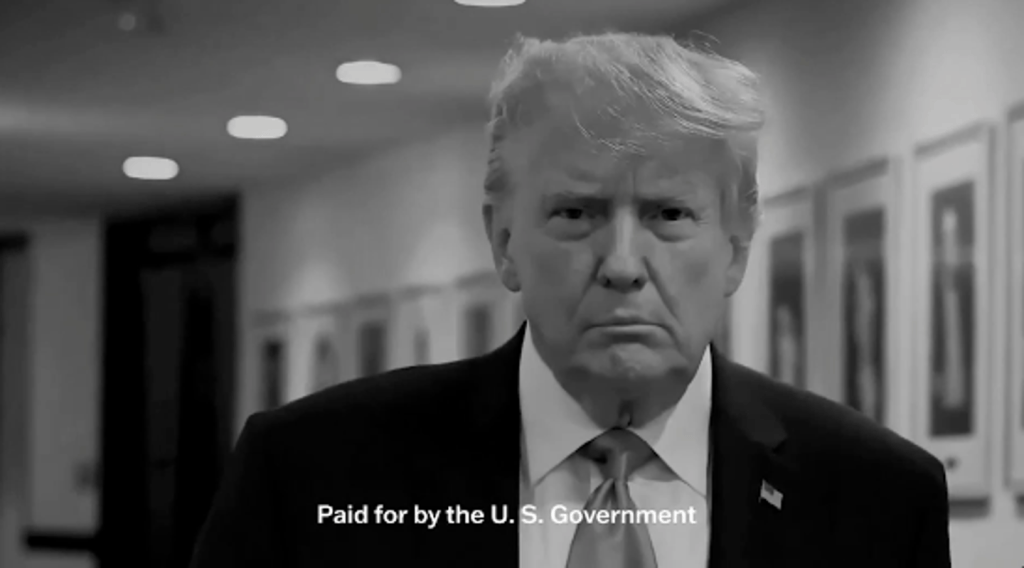
The Trump administration has crossed another bridge on its way to complete disaster by publicly displaying a campaign ad that utilizes taxpayer funds. The video, taken from Trump’s 2024 campaign, includes his usual insults at “villains” and “institutions.” This is not only shameful but illegal and ethically wrong.
According to the Hatch Act, federal employees cannot engage in any politics while on duty and misusing federal resources. Additionally, the Anti-Lobbying Act and appropriations acts state that it is illegal to use federal funds for “publicity or propaganda” for a candidate. In other words, Trump has officially been purchasing attack ads with taxpayer’s money.
This is an utterly unethical and completely corrupt practice, fueled by Trump’s vindictiveness and thirst for attention. The money paid by citizens for defense, roads, or public healthcare gets wasted on ad campaigns for political purposes. This public relations operation will damage the reputation of the government and the office of the president.
Such an unethical and corrupt action demonstrates Trump’s contempt for the rule of law and democratic norms in general. According to CREW, this latest scandal further illustrates the harm that can be done when the government engages in the kind of behavior. The Government Accountability Office already warned about the illegality of these actions. The President of the United States is not an executive for a private company. They should not turn their apparatus into a propaganda machine for their own electoral gain.
A new ProPublica report details a potentially explosive source of controversy in the re-election bid of Sen. Susan Collins (R-Maine) , shifting Democratic criticism of the senator away from her legislative voting record and towards allegations of significant political corruption.
The report follows up on an investigative trail beginning with Martin Kao, the former CEO of defense contractor Navatek, a Hawaii-based company. At the time of the 2022 campaign finance indictment, Kao was cooperating with federal authorities and met with Scott Reed, who headed a super PAC that had been associated with Collins. Kao allegedly offered to provide a $500,000 donation to the super PAC, which would have circumvented contributions from government contractors to get around bans on donations from government contractors in order to secure dozens of millions of federal naval contracts for Navatek. Reed supposedly assured Kao that the senator would be aware of where the money came from, and internal emails later suggested that Collins was committed to obtaining $32 million in contracts.
FBI agents had investigated the possibility of a bribery investigation connected to these allegations, but the probe died out after the new election cycle began, and federal law enforcement purges, particularly those orchestrated by the Trump administration, that undermined public corruption investigations. An FBI spokesperson said that the bureau ultimately found nothing implicating Collins or her campaign.
Collins’ office and campaign have strongly rebutted the allegations, describing Kao’s statements as “outlandish” and noting that the campaign was never a target of FBI investigation, cooperating fully with authorities.
Despite these denials, the report threatens to derail the final weeks of the Maine Senate race, with Collins’ Democratic rival, Troy Jackson, quickly capitalizing on the story, claiming the allegations represented “corruption of the highest order” and calling for full transparency, which is sure to be a major issue for voters ahead of election day.
President Donald Trump has intensified economic pressure on Iran with new sanctions and blockades, claiming it will strengthen the United States. Instead, record diesel prices are fueling backlash from farm and energy interests, pushing Republican lawmakers from rural states to consider a diesel export ban that cuts against his own policy.
Mr. Trump’s war with Iran has reduced Iranian oil exports and triggered a blockade of the Strait of Hormuz, creating a shortage in European and Asian markets. With diesel demand still high, prices have hit record levels, hammering the agricultural sector and driving up the cost of goods and services. As the 2026 midterm elections approach, Republicans risk losing farm voters who blame the President and his party for surging inflation.
Many Republicans in Congress refuse to budge because they rely on big oil money from companies like Exxon and Chevron, which profit when diesel prices soar. Their lobbying power drowns out farmers who are being squeezed by high fuel costs. This GOP loyalty to oil giants over rural voters exposes a blatant hypocrisy that could cost them crucial farm‑state electoral support.
Critics say the President’s Iran policy is less about security and more about staging a confrontation with Tehran to distract voters. They argue his hardline moves have failed to explain to voters why Iran was a looming threat, but a political tactic to distract from stubbornly high prices for everyday goods and services because of this tariffs.
For farmers and American’s, it means that prices of commodities and services are about to rise again. The President’s and Republican’s current course of action will be detrimental for the country, we need change!
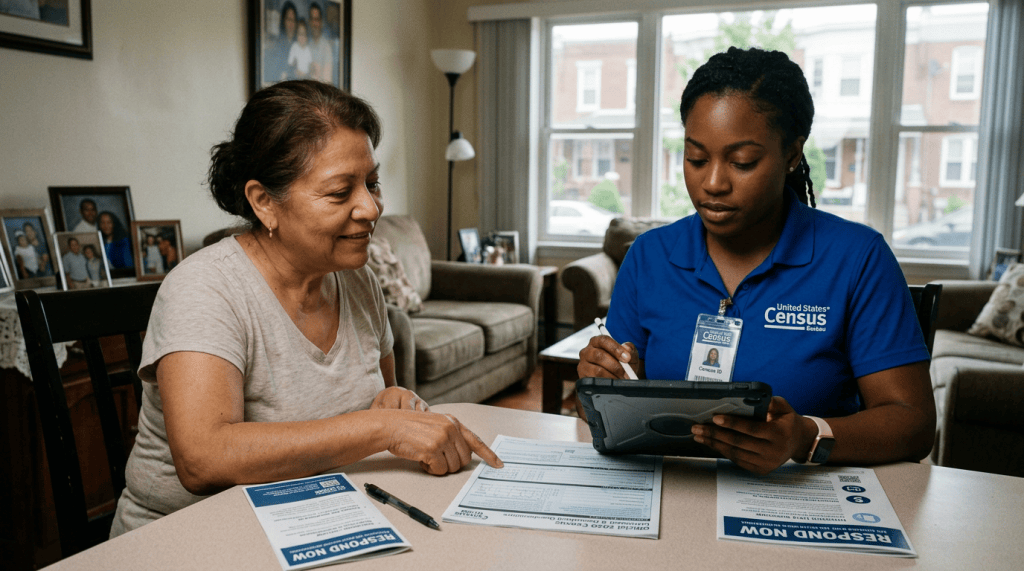
When I first read about the changes to the 2030 census proposed by the Trump administration, I knew it would make national headlines and turn into a political scandal. The provisions under consideration would exclude millions of people from being counted, change the funding formula, and favor redistricting that benefits Republicans.
I want to discuss what the changes mean and explain why they have caused such a stir in Washington, DC.
The Substance of the 2030 Census Changes
The provisions that the Trump administration wants to see in the 2030 census report are of a radical nature. Here are some key changes that the government wants to make:
Redefining “usual residence” as the place of “primary physical presence” during the year of the census. The administration would use income-tax filings and W-2 tax forms to determine a person’s “primary physical presence”
Excluding undocumented immigrants and legal residents who do not have residency on April 1, 2030, from the count. The 2020 census count included all foreigners, legal and illegal. The reasoning behind this provision is that it is an unconstitutional interpretation of “whole number of persons”
Removing questions on race, ethnicity, and sexual orientation. The rationale is that it is outside the constitutional powers of the federal government to collect this information.
To justify excluding non-citizens from the count, the administration has interpreted “whole number of persons” to mean “inhabitants” that have a “qualified” relationship with the political system. It is worth noting that many of these policies have been advocated by President Trump and the Heritage Foundation in Project 2025, a document outlining policies that a Republican administration would implement through executive orders.
Reaction to the Trump Census Proposal
Not surprisingly, the proposals have been met with derision and outright condemnation from Democrats and civil libertarians.
The argument that only “qualified” persons should be counted is an assault on the equal sovereignty of every American citizen that goes against the spirit and intent of the Constitution.
Letitia James, the attorney general of New York, called the proposals “a radical revision of the US Census” and said that she was considering taking legal action to block the changes because of their “unpatriotic” nature.
In the past, Ms. James has successfully sued to block similar changes to the census, and she will undoubtedly take similar actions in the future. Ms. James stated, “The Constitution says what the Constitution says. Every person who is present in the United States should be counted, period,”
Mr. Roberts of the Center for American Progress reacted to the proposal by saying that it was “a blatant attack on our democracy and a means to gerrymander our way to victory at the expense of minorities and public policy.”
Mr. Roberts added that he expected litigation to challenge the new changes and that the Court would eventually rule on whether the changes were constitutional or not.
He concluded, “Congress is the only body that can decide if this change is appropriate or not. Nevertheless, the public will have thirty days to respond to the request for comments and express their opinions on the issue.”
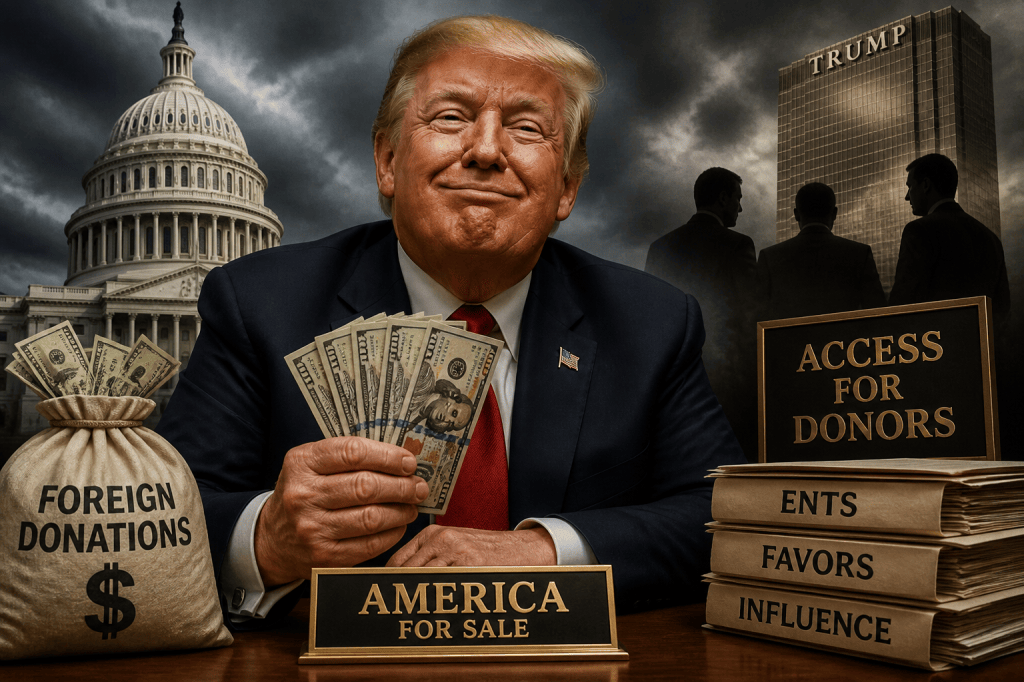
September 8, 2026 – According to a survey conducted by the Navigator Research Project, an influential Democratic poll, 60% of voters believe that Mr. Trump exacerbates corruption in the nation’s capital, while only 40% believe that he helps to eradicate it. This is a dramatic reversal of the opinion of Trump’s first campaign, which promised to “drain the swamp” and purge Washington of its corruption and special interests.
This figure represents a significant shift from the beginning of his presidential campaign, when Navigator registered only a 2 percent difference between those who thought Trump was a “source of corruption” and those who thought he would “help to eradicate it.”
“Trump has had a major shift in how people are viewing him in relation to corruption. A growing number of people see him as a source of corruption,” Ms. Tang said. “This trend was evident across different voter segments.”
Nevertheless, this is a change that has been building for sometime, prompted by recent disclosures regarding his family’s crypto enterprises, his acceptance of a new jet from the Qatari royal family, and his latest business endeavor, Truth Social, which includes a paywall. Democrats have long struggled to depict Trump as anything other than a self-seeking billionaire willing to sacrifice the government for his own gain. Nevertheless, it has proven to be a slippery slope for the anti-Trump forces.
The timing is significant because Navigator found that one-third of all voters and 40% of independents identified battling corruption as one of their top five issues. It does not take precedence over healthcare or inflation, which are of greater concern to voters, but it does rank above immigration, housing, and crime.
Most voters have a generally negative perception of corruption. By a wide margin, approximately one-third (33%) of voters and 40% of independents claim to believe that “virtually all” or “most” politicians are corrupt. This perception is consistent with recent polls that have found a record-high 89% of Americans believe there is rampant corruption in the federal government.
When asked to choose between the major political parties, respondents had a more negative opinion of the Republican Party, especially when it came to Trump. When asked whether they believed “Trump and the GOP are more corrupt or that Democrats are more corrupt,” 51% answered yes to the former and 32% to the latter. On the other hand, when Trump was not mentioned, 46% felt that the GOP was more corrupt than the Democrats, and 34% felt the same about the Democrats.
How a Needless Conflict Is Crushing American Family Budgets
By Winston Wendell
Gas prices in America have once again reached a breaking point. For many families, the prospect of filling up their cars is an unbearable prospect. Energy prices directly impact the global economy, and its repercussions are being felt by ordinary families. As an essential good, increases in its price effectively act as a tax on all other goods and services.
The devastating impact of this development is felt most strongly by middle-class families. Yet, what many people fail to understand is that this crisis is a direct result of an avoidable conflict engineered by Donald Trump.
During the 2024 election campaign, US president Donald Trump courted working-class voters by promising to ease the rising costs of living. Voters were promised that a Trump administration would be good for the economy and energy prices would plummet. Many were drawn to his populist rhetoric and pledged their vote to the former president, hoping that he would deliver on his promises.
They delivered their votes, but not much else.
With little provocation, the President decided to embark on a geopolitical and military adventure in Iran. By fueling a senseless war, Trump pushed global oil prices to a record high, devastating families that trusted him to restore stability to the economy.
This development is an unforgivable betrayal of the middle-class voters that placed their trust in him. Ordinary Americans that believed in his populism are now faced with the ugly reality of Trump’s presidency. With every visit to a gas station and a grocery store, they are reminded that their president is responsible for their financial struggles.
These people know that they were misled and their trust betrayed. They understand that the America First rhetoric masked Trump’s recklessness and irresponsibility as a leader.
For the American middle class, there is no justice. For everyone else, there is at least some form of redemption.
During the 2024 campaign, commentators, economists, and analysts warned of the potential economic ramifications of Trump’s presidency. They spoke of skyrocketing energy prices and a possible inflation crisis. Throughout the election race, they were dismissed as irresponsible and unworthy of attention.
Now, as the damage is being tallied, these commentators can finally take a deep breath and say: “we told you so”.
American families deserve better leadership than what they have been offered during the 2024 campaign. They deserve better than a foreign policy fueled by ego and a domestic policy of perpetual war and division.
The price for Trump’s vanity and incompetence will be paid in higher gas prices and unbearable costs of living. It is only fitting that those that promoted this vision of America, MAGA, are held accountable. Voters must understand that a vote for a Trump and Republicans are a vote for higher taxes and budget deficits. The electorate needs to hold the president and his Republican Party enablers in Congress responsible for the manufactured crisis at home and abroad.
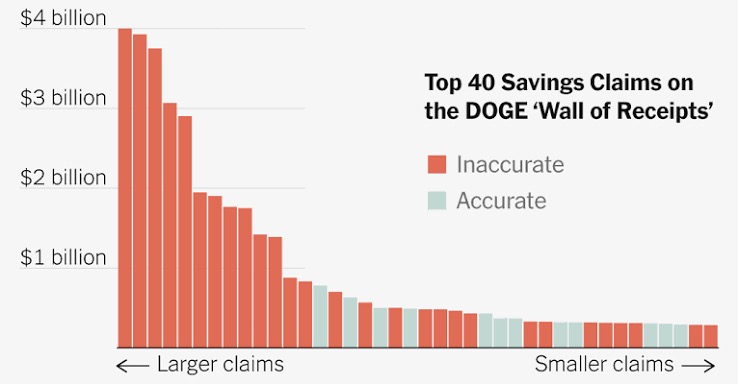
According to a report released on Thursday, the Department of Government Efficiency, better known as DOGE, led by Elon Musk himself, was making up figures about the amount of money it was saving the country. The report was requested by Democratic senators Gary Peters of Michigan and Richard Blumenthal of Connecticut and was conducted by the Government Accountability Office.
DOGE was found to have used “misleading practices” when it came to canceled leases and active government contracts. Additionally, the audit found that the department provided insufficient evidence for the methods used in 96 percent of the canceled grants.
The Department of Government Efficiency was also found to have failed to follow their own formulas when it came to calculating figures for canceled leases and contracts, and in the cases where they did follow their formulas, they either missed out on the details or did not disclose them when they should have. When they did follow their own procedures, the Government Accountability Office found that they overlooked the complexities of government contracts, including liabilities and penalties that come with breaking a contract before the due date.
“The report shows that the Trump administration’s cost-saving mission was conducted in a misleading fashion, achieving little apart from putting at risk taxpayer data and key programs,” said Senator Peters.
“President Trump and his allies in the Senate and House have been using DOGE as a fig leaf to hide tax-cut giveaways to the wealthy and large corporations while pretending to save the deficit,” said Senator Blumenthal.
Many people have responded to the report, including Jessica Tillipman, associate dean of the GWU School of Law, who specializes in government procurement. Tillipman cited several errors she found on the social media accounts of DOGE, one of which being a claim that the department had saved $28 million reduction in expenditures for an Air Force agreement, whereas the actual financial relief amounted to roughly $600,000 from a canceled lease. “That figure doesn’t account for the present value of future lease payments, which would reduce the supposed $3.7 million savings,” Tillipman said.
“DOGE’s fiscal wins were mostly fictional,” write Reason editor-in-chief Eric Boehm, who covered the story for the libertarian magazine. “According to a new report from the Government Accountability Office, the Trump administration’s claims about savings from slashing federal spending were often based on faulty math.”
“DOGE may soon start spending more taxpayer money, but at least the government watchdogs are forcing Musk’s agency to be more open about how it spends our money when it comes to cutting back federal services,” concluded Senator Blumenthal.