
Tag: DHS

  • Federal Judge Blocks Trump Administration’s Attempt to Restrict Lawmakers’ Surprise Visits to Immigration Facilities

    Blue Press Journal

    WASHINGTON — A federal judge has once again ruled against the Trump administration’s efforts to restrict congressional oversight of immigration detention centers, finding that the policy likely violates existing federal law ensuring lawmakers’ access to those facilities. 

    U.S. District Judge Jia Cobb, appointed by President Biden, issued the decision Monday, halting a Department of Homeland Security (DHS) directive that would have required members of Congress to provide seven days’ notice before conducting visits to Immigration and Customs Enforcement (ICE) centers. The rule, reinstated last month by DHS Secretary Kristi Noem, applied to facilities funded under the so-called “Big Beautiful Bill,” a Republican-backed spending package enacted last summer that omitted a long-standing access provision. 

    This ruling marks the second time Judge Cobb has sided with a group of Democratic lawmakers who filed suit to preserve their ability to conduct unannounced inspections. In December, Cobb previously found that the Trump administration violated a congressional “rider” attached to DHS’s annual appropriations bill — a provision guaranteeing lawmakers the right to visit detention sites without advance notice. 

    In her latest opinion, Cobb criticized the administration’s argument that it could feasibly separate funding streams to determine which facilities were covered by the rider and which were not. “Defendants’ declarant provides almost no details or specifics as to how DHS and ICE would accomplish this task in the face of the practical challenges raised by Plaintiffs,” Cobb wrote. 

    Legal experts note that the decision reaffirms Congress’s constitutional oversight powers and underscores the judiciary’s role in upholding legislative intent. The ruling effectively prevents DHS from enforcing the notice requirement while the lawsuit proceeds. 


    Understanding Appropriations Riders and Congressional Oversight

    Appropriations riders are provisions in spending bills that direct or limit the use of federal funds. Congress has often used these riders to oversee executive agencies, particularly in sensitive areas like immigration enforcement, environmental regulation, and defense spending.

    According to the Congressional Research Service, riders have been used since the early 20th century to ensure compliance with congressional mandates, such as requiring public reporting on detainee conditions and restricting the transfer of Guantánamo Bay prisoners.

    Judge Cobb’s ruling reinforces that these riders carry the force of law and cannot be sidestepped by administrative reinterpretation or selective funding designations.
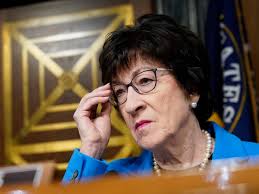

  • Senator Susan Collins: A Call for Accountability and Change

    It’s time for Senator Collins to Go!

    Blue Press Journal – Senator Susan Collins finds herself at a critical crossroads, navigating the tumultuous waters of immigration policy while the Trump administration’s aggressive tactics continue to dominate the national discourse. As the chair of the Senate Appropriations Committee, Collins faces immense pressure to take a definitive stance against the actions of Immigration and Customs Enforcement (ICE) and the Department of Homeland Security (DHS). The recent tragic killing of Alex Pretti in Minnesota at the hands of federal agents has intensified scrutiny on her leadership, raising the question: Is it time for Collins to go?

    A Complicated Relationship with Trump’s Policies

    Collins has made headlines for her attempts to salvage a funding package amid a looming government shutdown, yet her reluctance to confront Trump’s immigration enforcement is troubling. While she acknowledges the need for better oversight of DHS, she has not advocated for reforms to protect Mainers from ICE’s aggressive tactics. Her comments about the lack of rationale for many ICE agents in Maine seem hollow against her inaction regarding the Trump administration’s policies.

    Collins stated, “I urged [Secretary of Homeland Security Kristi Noem] to pause this surge of enforcement,” but mere words are inadequate when lives are at stake. The Maine Democratic Party has rightly accused her of “choosing Donald Trump over the people of Maine,” highlighting the disconnect between her rhetoric and the reality facing her constituents (Maine Democratic Party).

    The Political Fallout

    As Collins seeks a sixth term in the Senate, her political calculus appears driven more by electoral concerns than by a commitment to justice. With challengers like Governor Janet Mills opposing Trump’s immigration policies, Collins’s lack of a hard stance could jeopardize her future. Mills declared, “We will not be intimidated. We will not be silenced,” reflecting discontent among voters neglected by Collins’s complacency (Mills 2026).

    Moreover, Congressional Democrats are increasingly vocal about the need to rein in ICE. Senator Chris Van Hollen of Maryland has pointed out, “All you have to do is look at what’s happening in Minnesota, look at what’s happening in Maine,” emphasizing that the deployment of DHS agents is a clear justification for reevaluating funding packages (Van Hollen, 2026. Collins’s inaction on these critical issues not only reflects poorly on her leadership but also raises doubts about her ability to represent the interests of Mainers effectively.

    The Urgent Need for Change

    With the political landscape shifting and the consequences of inaction becoming more apparent, it is time for Senator Collins to reevaluate her position. The Maine electorate deserves a representative who will prioritize their safety and well-being over partisan politics. Collins’s current trajectory suggests a reluctance to break from the status quo, which is insufficient for a state grappling with the ramifications of aggressive immigration enforcement.

    In light of recent events and the call for accountability, it is clear: Senator Susan Collins must go. The people of Maine deserve a leader who stands against the injustices of ICE and DHS, ensuring their voices are heard and rights protected. It is time for Collins to take a stand or step aside for new leadership that truly represents her constituents.

    As the appropriations process unfolds and the specter of another government shutdown looms, Collins has a choice to make. Will she finally take a hard line against the Trump administration’s immigration policies, or will she continue to be swept along by the tide of political expediency? The time for action is now, and the people of Maine are watching.