by Winston Wendell
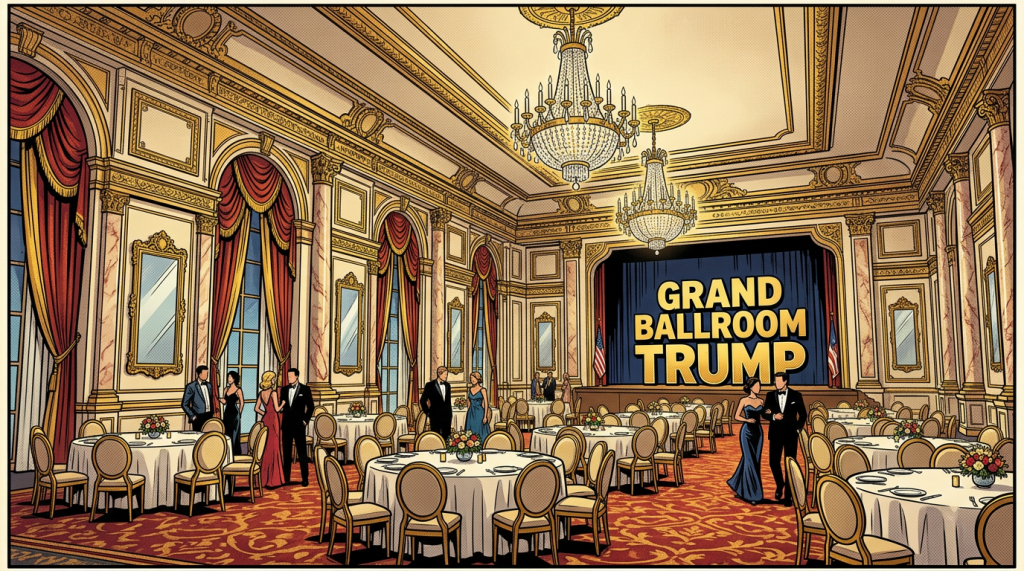
I’ve been closely monitoring political scandals for quite sometime, but let me tell you, nothing has highlighted the chasm between campaign promises and reality like this outrageous White House ballroom debacle involving Donald Trump. It all began as a so-called privately funded renovation, an ambitious yet dubious plan to dismantle the west wing and build a grand ballroom. Now, it has exploded into a staggering billion-dollar bill funded by taxpayers, mired in evasions and skyrocketing costs, while Republicans in Congress sit idly by.
It’s not just the price tag, which let’s face it, is jaw-dropping for a single room. What really stands out is the sheer disregard for public accountability. When Trump rolled out the plan to tear down part of the East Wing and build a fancy ballroom, he promised no federal money would be used. Corporate sponsors and private donors would foot the bill not taxpayers. This wasn’t an accident it was carefully staged to let him chase his luxury dream without being accused of wasteful spending the very thing he’d spent so much time railing against.
That promise fell apart on Monday night. Senator Chuck Grassley revealed that the Republican budget earmarked $1 billion for the ballroom. What was supposed to run $200 million and be paid for by private donations is now a full on federal takeover. Now very penny will come from taxpayers. It’s a giant flip: the president looked the public in the eye, made a promise, and then his Republican friends in Congress did the exact opposite.
It’s not just the dollars that bug me, though. The deafening silence from Republicans is almost as bad. Not one Republican senator or representative has spoken out against this shift even though it flies in the face of everything the party says it believes. They ran on cutting government waste and giving power back to the people. Now, they’re quietly signing off on a billion-dollar ballroom most Americans don’t even want. Take the numbers: a Washington Post poll found just 28 percent support for the project, while 56 percent oppose it. Even Republican voters aren’t buying in. If a president can’t get majority support from his own base on a signature project, something’s seriously broken.
Let’s talk about the cost hike. This thing started at $200 million and suddenly needs $1 billion, a fivefold jump that just doesn’t add up. The official explanation is “security features” like bulletproof windows, reinforced walls, drone detectors. Sure, security’s important, but those upgrades aren’t worth a billion bucks. And if $600 million for security was included before, where’s the detailed accounting? All we get are vague promises and a blank check. Normally, big projects handled by private companies have competitive bidding, contracts, and audits. Here, there’s barely any oversight rules that apply to everyday government spending seem to vanish when the president’s interests are on the line. The Republican congress just lines up behind this stupid idea without questions or oversight.
The timing couldn’t be worse, either. While Trump obsesses over floor layouts, marbel and gold trimming, the middle class is struggling. Buying a house? Nearly impossible. Health insurance? Premiums keep climbing. Groceries? More expensive every week. And at the pump, four bucks a gallon is the new normal with the price increasing everyday. Daniel Pfeiffer, who worked for Obama, nailed it when he said Trump’s priorities are “fiddling while Rome burns.” It sounds cliché, but honestly, it fits the moment.
Internationally, the situation is even messier. Tensions with Iran are driving up gas prices, and Americans are caught in the fallout. All of this lands squarely on working families with already tight budgets. Against that backdrop, asking taxpayers to pay for a presidential ballroom shows either a total disconnect or a flat-out abandonment of priorities. He campaigned on America first, but it sure looks like Donald Trump first!
This ballroom won’t make us safer. It won’t bring down gas prices. It won’t fix healthcare or help anyone who’s struggling at the kitchen table. It’s just another monument to one man’s comfort and ego. The absolute lack of pushback from congressional Republicans shows they’re willing to drop their supposed principles to stay loyal to party over country.
So, when exactly did we start accepting this nonsense? The chaos in the ballroom isn’t merely a display of government waste or political posturing; it hints at something far more concerning. It seems that accountability is just a choice for those in power, while duty has been sacrificed on the altar of convenience. A thousand people can throw a party in that ballroom, yet it appears that not a single principal managed to survive the festivities.

 Blue Press Journal