Tag: Trump economy

  • The Dark Reality Behind Trump’s “Booming” Economy: A Closer Look at the Job Market

    The Disconnect Between Rhetoric and Reality

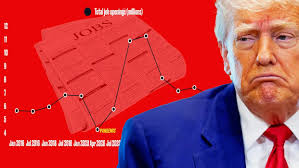
    Blue Press Journal – As the Trump administration continues to tout the supposed success of its economic policies, a starkly different narrative emerges when examining the latest data on the job market. Despite the White House’s claims of a new “Golden Age,” the reality is that job openings have plummeted to their lowest level since the height of the Covid-19 pandemic in mid-2020.

    According to the Labor Department’s latest report, job openings in December dropped unexpectedly, signaling a significant slowdown in hiring across various industries. This downturn is further underscored by data from the research firm Challenger, Gray and Christmas, which revealed that companies announced plans to cut over 108,000 positions in January, more than double the number of layoffs recorded in January 2025. The payroll processing firm ADP also reported a meager addition of just 22,000 private sector jobs in January, a clear indication of tepid payroll growth.

    The numbers paint a concerning picture, particularly when considered in the context of the Trump administration’s boasts about the economy. While official measurements of productivity and output have been strong, polls and consumer confidence surveys have consistently shown negative sentiments among the public. A recent poll from The Economist/YouGov found that Trump trails by 14 percentage points on his handling of jobs and the economy, while a survey by the Federal Reserve Bank of New York revealed deteriorating consumer expectations regarding wage growth and finding new employment.

    The disconnect between the administration’s rhetoric and the reality on the ground is striking. As RSM US Chief Economist Joe Brusuelas noted, “On the margin, firms are able to do more with less…That’s fine when you’re talking to an economist or capital markets professional; that’s hell if you’re talking to a politician or the public.” The implications for Trump are significant, as his approval ratings on the economy have already been battered by concerns over affordability, inflation, and labor market anxieties.

    The Labor Department’s report also highlighted substantial declines in job opportunities across professional and business services, retail trade, and finance and insurance. As companies increasingly adopt artificial intelligence, there are growing concerns that future growth may leave workers behind. The quits rate, which reflects workers’ willingness or ability to leave their job, remains below pre-pandemic levels, suggesting a lack of confidence in the job market.

    The labor market outlook is uncertain, with Wells Fargo economists warning that “the low hiring environment and subdued rate of voluntary job departures risks pushing layoffs higher.” It remains to be seen if the Trump administration’s policies will address the job market’s underlying issues.

    Key Statistics:

    • Job openings in December dropped to their lowest level since mid-2020 (Labor Department)
    • Companies announced plans to cut over 108,000 positions in January (Challenger, Gray and Christmas)
    • Private sector firms added just 22,000 jobs in January (ADP)
    • Trump’s approval rating on jobs and the economy trails by 14 percentage points (The Economist/YouGov)
    • Consumer expectations regarding wage growth and finding new employment have deteriorated (Federal Reserve Bank of New York)

    By examining the latest data and research, it becomes clear that the Trump administration’s economic policies have not delivered the promised benefits to the job market.

  • Trump’s Tariff Threat Against Canada: Bad Economics, Worse for American Consumers

    President Trump’s latest 100% tariff threat against Canada will hurt American consumers, damage U.S. industries, and strain vital trade relationships. Learn why Trump’s trade war is bad economics and worse policy.


    Blue Press Journal – President Donald Trump’s recent threat Satruday to impose a 100% tariff on Canadian imports has sent shockwaves through North American trade circles. The move, aimed at punishing Canada for its newly negotiated trade concessions with China, reflects the same protectionist instincts that have defined Trump’s economic agenda since his first term. But beyond the political theater, tariffs like these come with a steep price — one paid directly by American consumers, businesses, and workers.


    The Canada-China Trade Context

    Earlier this month, Canadian Prime Minister Mark Carney announced a deal with China to lower tariffs on Chinese electric vehicles in exchange for reduced import taxes on Canadian agricultural products. While Canada maintains no free-trade agreement with China, the arrangement was crafted to support Canadian farmers and diversify trade relationships amid global tensions.

    Trump initially praised the deal, but quickly reversed course, accusing Canada of becoming a “drop-off port” for Chinese goods destined for the U.S. His retaliation? Threatening a 100% import tax on Canadian goods if Ottawa proceeds — a move that would affect everything from steel to agricultural products to critical minerals.


    Why Tariffs Hurt Americans More Than They Help

    Tariffs are often sold to voters as a way to protect domestic industries, but the reality is that tariffs operate as a hidden tax on U.S. consumers. When the U.S. imposes tariffs, importers pay higher costs, which are then passed along to businesses and consumers in the form of higher prices.

    According to a 2019 study by the Federal Reserve Bank of New York, U.S. tariffs during the Trump administration’s first trade war with China led to $1.4 billion in additional costs per month for American consumers. Similarly, research from the Peterson Institute for International Economics found that the average U.S. household paid $800 more per year due to tariff-driven price increases.

    For context:

    • Canada is the largest export destination for 36 U.S. states.
    • Nearly $2.7 billion USD in goods and services cross the Canada-U.S. border daily.
    • Canada supplies 60% of U.S. crude oil imports and 85% of U.S. electricity imports.
    • It is also a key supplier of steel, aluminum, uranium, and critical minerals essential for the auto industry, defense and technology.

    Imposing a 100% tariff on these imports would cause instant price spikes in energy, manufacturing, and consumer goods — directly hitting U.S. households and industries.


    Economic Fallout of Trump’s Tariff Threat

    If enacted, Trump’s proposed tariffs would:

    1. Raise Costs for Energy and Manufacturing – U.S. industries dependent on Canadian oil, electricity, and metals would face supply shortages and higher costs.
    2. Damage Cross-Border Supply Chains – The deeply integrated Canada-U.S. manufacturing sector, especially in automotive and aerospace, would be disrupted.
    3. Invite Retaliation from Canada – Ottawa could respond with its own tariffs on U.S. exports, hurting American farmers, particularly in states that rely on agricultural trade with Canada.
    4. Undermine NATO and Western Alliances – Trump’s antagonistic stance toward Canada, paired with his push to acquire Greenland and social media provocations, risks alienating a key ally.

    Political Theater vs. Economic Reality

    Trump’s rhetoric — including calling Carney “Governor Carney” and posting altered maps showing Canada as part of U.S. territory — may play well to a certain political base. But such antics undermine serious diplomatic relationships and erode trust among allies.

    Carney’s speech at the World Economic Forum in Davos, urging “middle powers” to unite against coercive tactics by great powers, clearly struck a nerve with Trump. As Carney’s popularity rises on the world stage, Trump’s trade threats appear less about protecting American workers and more about retaliating against political rivals.


    The Consumer’s Perspective

    For the average American, tariffs mean:

    • Higher grocery bills (due to increased costs on Canadian agricultural imports).
    • More expensive cars and electronics (Canadian manufacturing is a key part of U.S. supply chains).
    • Higher energy costs (Canadian oil, electricity, and uranium are essential to U.S. energy security).

    In short: Tariffs punish consumers first, industries second, and political rivals last.


    So What Does it Mean

    President Trump’s threat of a 100% tariff on Canadian goods is more than a diplomatic provocation — it’s an economic self-inflicted wound. Canada is one of America’s most important trading partners, and disrupting that relationship will raise prices, strain industries, and weaken alliances. 

    If history is any guide, Trump’s tariffs will not force Canada to change course with China. Instead, they will drive up costs for American families, hurt U.S. competitiveness, and isolate the United States in a world where cooperation — not coercion — is the key to economic success.


  • Trump’s Economic Policies Are Costing American Families Thousands – The Numbers Don’t Lie

    In Response to todays Trump News Conference

    Blue Press Journal – While former President Donald Trump made headlines with bizarre distractions like his public musings about buying Greenland, the real story for American households was happening in their wallets. A new congressional analysis reveals that under Trump’s leadership, U.S. families faced sharp increases in the cost of living, directly tied to his economic agenda and trade strategies. 

    According to a recent report from the Joint Economic Committee (JEC), the average U.S. household paid $1,625 more in 2025 for everyday essentials. These rising costs were not random — they were the result of Trump’s tariffs, housing market pressures, and broader economic mismanagement (Joint Economic Committee, 2025). 

    The Real Impact: Higher Prices for Housing, Transportation, and Groceries

    Breaking down the numbers, the JEC found that housing expenses rose by an average of $323 per family, transportation costs climbed by $241, and grocery bills surged across the country. For residents of states like Alaska, Connecticut, Massachusetts, and New York, the hit was even harder — more than $2,000 in additional annual costs. 

    The cause? Trump’s tariff-heavy trade policy, which he claimed would punish foreign exporters but in practice acted as a hidden tax on American consumers. Independent economic analyses, including research from the Center for American Progress, confirm that U.S. businesses and families bore nearly the entire cost of these tariffs (CAP, 2025). 

    The Inflation Reality Check

    Trump has repeatedly boasted that he “ended inflation” and claimed prices are falling. The data tells a different story. In December 2025, inflation was still running at 2.7% year-over-year, with prices continuing to climb month to month (CNN Fact Check). For working families, this meant that paychecks stretched less, and basic necessities became more expensive — despite the White House’s rosy rhetoric. 

    Economic Uncertainty Hurts Families

    Economists warn that tariffs not only raise consumer prices but also create uncertainty for businesses, slowing investment and job growth. This uncertainty compounds the financial strain on households, particularly in industries reliant on global supply chains. 

    Senator Maggie Hassan (D-NH) criticized the administration’s “reckless” economic approach, pointing out that tariffs, higher healthcare costs, and policy unpredictability have all contributed to the squeeze on American families. 

    The Takeaway: The “Greatest Economy” Myth

    Trump’s claims of delivering “the greatest first year in history” simply don’t match the lived reality of American families. The hard truth is that his economic policies functioned as a tax on the middle class, without delivering the promised benefits.