Tag: CNN

  • MS NOW Reporter Barred From White House, Joins CNN and Politico in Access Dispute

    Washington, D.C., Sept. 24 — A federal judge’s order to restore White House press credentials for three news outlets has been ignored, as MSNBC correspondent  Laura Barron‑Lopez was denied entry on Thursday, mirroring recent turn‑aways of CNN and Politico journalists.

    Update: 10:20am est.

    A reporter for the online outlet MS NOW was turned away from the White House press entrance on Thursday, bringing the media outlet into a growing dispute over access that already includes correspondents from CNN and Politico.

    Laura Barron‑Lopez, a senior reporter for the news outlet, said she arrived at the Press Briefing building, swiped her badge at the security checkpoint and watched the indicator turn red before being stopped by a uniformed security guard.

    “I got as far as the press pass security hut, swiped my badge, and the light started flashing red,” Barron‑Lopez told reporters after the incident. “The guard told me I could not proceed and escorted me off the premises.”

    Her experience mirrors that of a CNN reporter and a Politico correspondent, both of whom were denied entry his morning under the same circumstances.

    MS NOW, CNN and Politico have scheduled a joint press conference for Thursday afternoon to discuss the broader implications of the White House’s security procedures on media freedom.

    Fediverse Reactions
  • CNN Staffers Still Facing White House Entry Barriers Despite Court Ruling

    Published: 09/24/2026. 8:20am est

    Despite a recent court ruling blocking the administration’s ban on specific news outlets, some CNN journalists are still reporting difficulties gaining access to the White House complex.

    The ongoing confusion highlights a disjointed enforcement of security protocols following legal battles over press credentials for reporters from CNN, MS NOW, and Politico.

    The Incident at the Gates

    The challenges came to light this morning when CNN journalist Betsy Klein was blocked from entering the White House grounds. According to reports, Klein presented both her driver’s license and official press ID to U.S. Secret Service agents at the checkpoint.

    Despite providing standard identification—and even showing agents a digital copy of the judge’s ruling that temporarily halted the press ban—Klein was denied entry. Agents instructed her to contact the White House press office for further clarification rather than granting her access.

    The situation appeared inconsistent on the ground. Just moments after Klein was turned away, a CNN producer was permitted to enter the White House. However, the inconsistency continued when a CNN photojournalist attempting to enter shortly after was also barred, despite the producer’s successful entry.

    A “Fluid” Situation Awaiting Clarification

    Describing the morning’s events as “fluid,” Klein and other affected media personnel are currently awaiting formal guidance and clarification from the White House press office regarding how security personnel are operationalizing the recent court decision.

    Legal experts note that while court rulings can quickly alter official policy, the operational trickle-down to frontline security staff can sometimes experience logistical delays or mixed messaging.

    As this is a developing story, updates will be provided as the White House press office and legal teams respond to the ongoing access disputes.

    Fediverse Reactions
  • POLITICO, CNN Sue After Trump Revokes White House Press Access

    The Trump administration wants a court order letting the executive branch decide who receives White House press credentials, and it is challenging a long-standing legal precedent that protects journalists covering the West Wing.

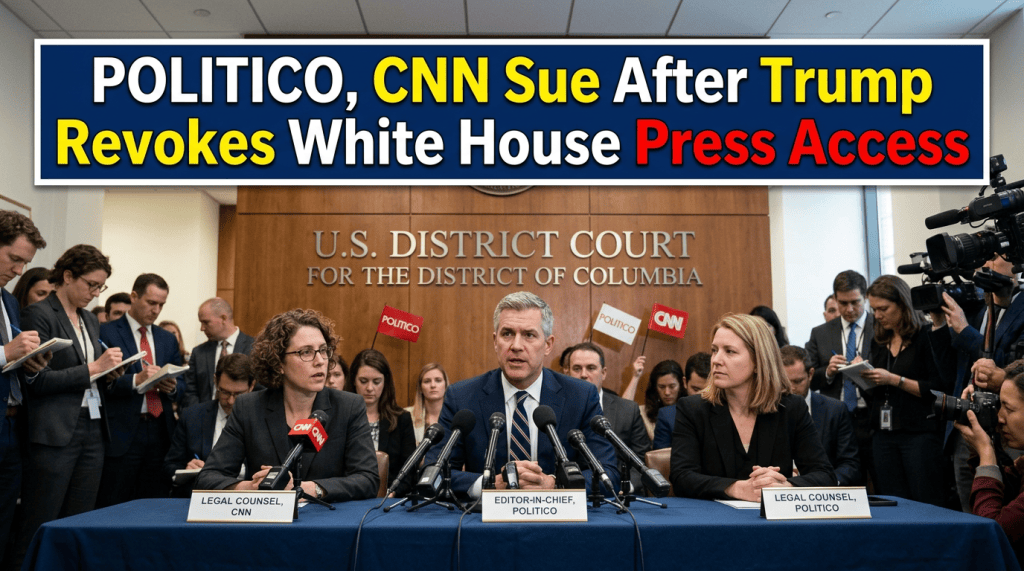
    Headline reads “POLITICO, CNN Sue After Trump Revokes White House Press Access”; U.S. District Court for the District of Columbia hearing with legal counsel for CNN, POLITICO editor-in-chief, and legal counsel for POLITICO.

    In a brief filed late Tuesday, the Justice Department said barring POLITICO, CNN and MS NOW from the White House complex was justified by how those outlets had reported on sensitive information.

    The administration told the courts that the president believed the plaintiffs had failed basic journalistic standards by revealing classified details and national security matters.

    Responding to an emergency injunction from the three media companies seeking immediate restoration of access, the government brief cited articles from each outlet about the conflict with Iran, US military reserve levels and a leak investigation into FBI Director Kash Patel. It also objected to POLITICO’s release of a Secret Service document originally given to Senate Republicans to help build a new presidential ballroom.

    The DOJ brief also included copies of letters supposedly sent to the organisations that day explaining the credential revocations and setting a Friday deadline for a response.

    But the documents had no signatures or letterhead and never explicitly said any cited example in the articles contained classified information. Several examples were also largely unrelated to national security; the letter to POLITICO objected to an article about internal tensions at a Texas Republican convention.

    Government attorneys conceded the retroactive letters do not meet the standard set by Sherrill v. Knight, a 49-year-old D.C. Circuit ruling holding that the state cannot arbitrarily exclude specific news organisations from White House press facilities based on its perceived coverage.

    Instead, the Justice Department is formally asking the courts to overturn the Sherrill precedent, dismantling the legal framework that ensures equal press access. The administration instead wants wider use of a different ruling from last year suggesting the president has discretion to restrict entry to high-security parts of the White House grounds, such as the Oval Office.

    POLITICO, CNN and MS NOW sued on Monday, arguing that revoking their press passes violates the First Amendment. They have also asked for a temporary restraining order forcing the administration to restore their credentials while the case is heard.

    U.S. District Judge Timothy Kelly, appointed by Trump, has set a hearing for Wednesday afternoon.

    Fediverse Reactions
  • Trump’s White House Press Ban Represents a Threat to the First Amendment and the Country Essay

    In an effort to continue his campaign of banning mainstream news sources, President Trump announced on Truth Social that he would ban CNN, MS NOW, and Politico from the White House. According to Trump, these news outlets were spreading “FAKE NEWS” for criticizing him, and he warned that more news organizations would be banned for speaking “critical” of his administration.

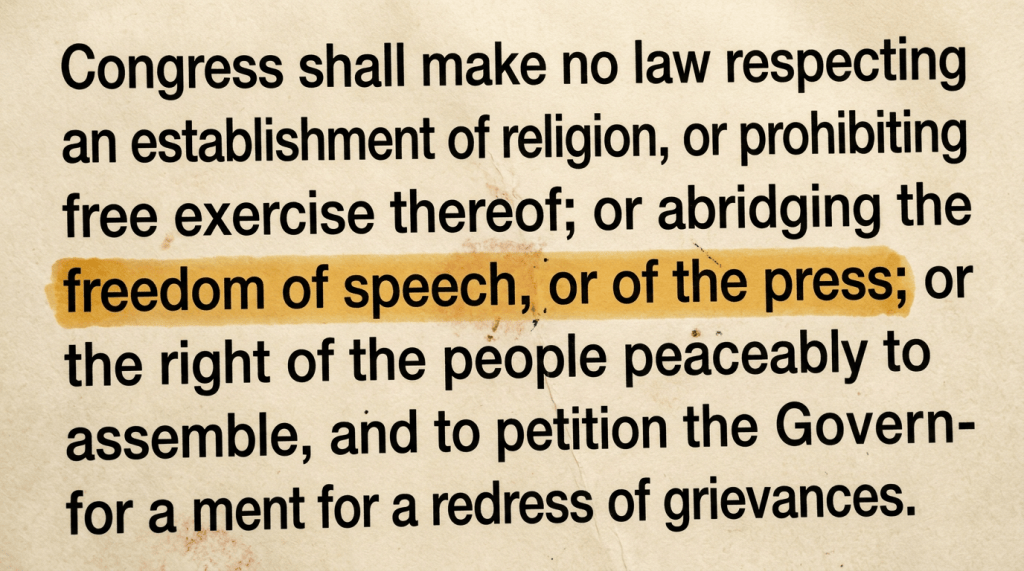
    Framed text beginning “Congress shall make no law respecting an establishment of religion...” and labeled “AMENDMENT I 1791.”

    At his daily press conference on Friday, Trump complained about the outlets being “very one-sided” and accused them of writing negatively about him and his administration. He also claimed that they do not reflect the opinion of the American people, who, according to him, have suffered due to his military actions against Iran. However, when Reuters reminded him that freedom of the press was a protected right and that the White House could not prevent them from asking questions, Trump reacted with disdain, stating, “Oh, thank you for reminding me.” When asked whether he was trying to intimidate the press, Trump responded, “No, I don’t like dishonest press. I think you are all horrible people.”

    In effect, what Trump was trying to do is interfere with the right of the American people to obtain reliable information about their president and his actions, which is a direct threat to the First Amendment.

    CNN strongly pushed back, claiming that “we have a right under the U.S. Constitution to do that reporting without hindrance or interference from the government.” Mark Schoeff, Jr., president of the National Press Club, expressed similar sentiments, stating that “[b]anning news organizations from the White House based on the administration’s disapproval of their coverage is a clear attempt to control which voices are allowed to witness and report on the exercise of presidential power.”

    A free press is one of the pillars of any democratic society, and by threatening it, Donald Trump is threatening the very foundation of the US political system.

  • Trump’s Oil‑Price Spin Masks a Growing Affordability Crisis and a Dangerous Iran War

    Trump’s Oil‑Price Spin Masks an Affordability Crisis and an Unnecessary Iran War

    Blue Press Journal – President Donald Trump tried to portray today’s surge in gasoline prices as a boon for U.S. producers, posting on TruthSocial that “the United States is the largest oil producer, so when oil prices go up, we make a lot of money.” But the reality, reported by Reuters and CNN, is that consumers are feeling the pinch of a “fuel shock” not seen since the 1970s, deepening an already‑severe affordability crisis for middle‑class families (Reuters). 

    Trump’s rhetoric also drifts into dangerous territory. He claims the war with Iran is necessary to stop a nuclear threat, yet The New York Times notes that diplomatic talks were nearing a mutually acceptable agreement and no credible evidence shows Tehran is building a bomb (NYT). Energy Secretary Chris Wright’s dismissal of a $200‑per‑barrel scenario as “unlikely” ignores Tehran’s explicit warning that regional destabilization will drive prices sky‑high (CNN). 

    Meanwhile, the president’s ongoing effort to suppress the Epstein files diverts attention from these urgent economic issues, raising questions about his priorities. As oil prices fluctuate, the real cost falls on American drivers, not on the Trump‑aligned oil lobby. 

  • Trump Administration and DOJ Stall Refunds After Supreme Court Nullifies Emergency Tariffs – Businesses Rush to Court

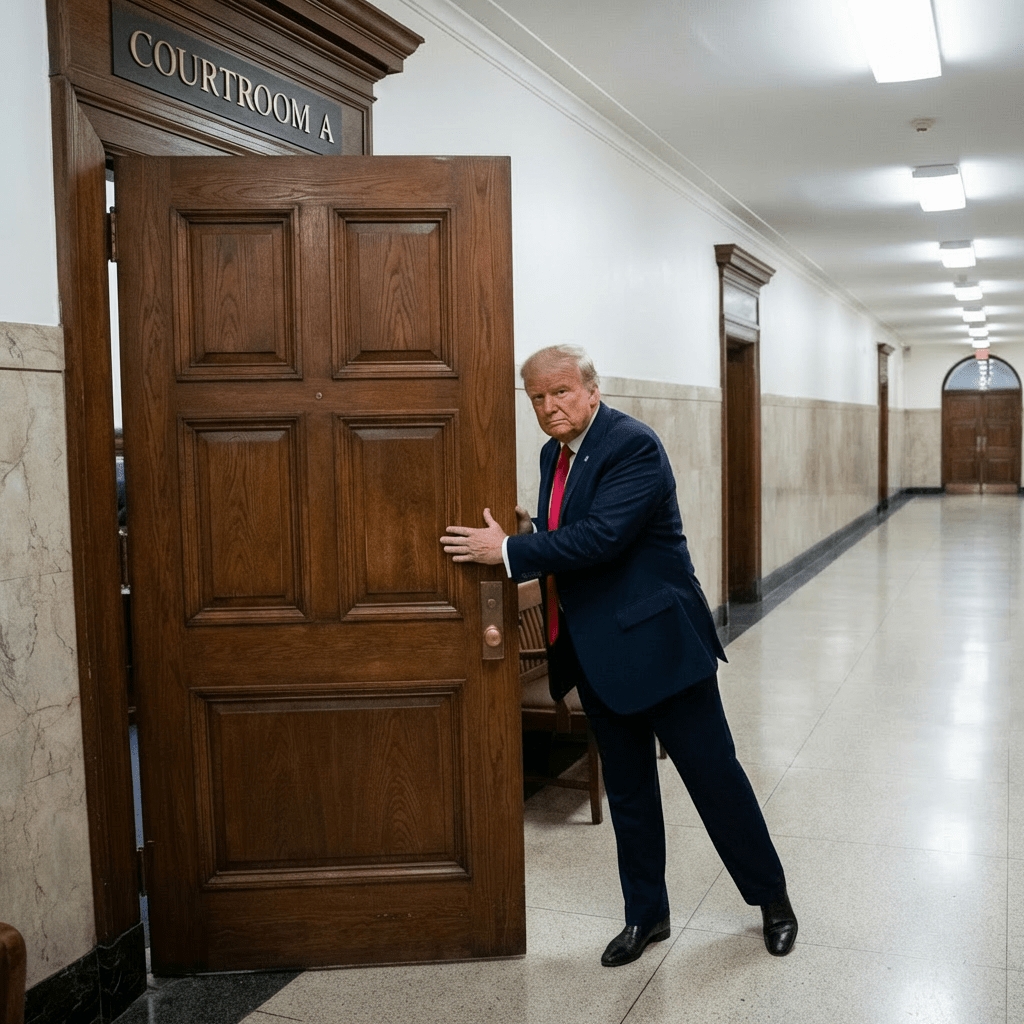
    Donald Trump peeking through the wooden doors of Courtroom A in a brightly lit hallway.

    BLUE PRESS JOURNAL – The Supreme Court’s decisive ruling that nullified President Donald Trump’s emergency tariffs ignited a frantic legal scramble. Hundreds of companies—from a New York wine importer to shipping giant FedEx—are now filing lawsuits to reclaim duties they allege were unlawfully collected. The fight has split into two competing jurisdictional tracks, while the Trump administration and the Department of Justice (DOJ) deliberately drag their feet.

    Two Front‑Line Challengers
    VOS Selections, a New York wine and spirits importer represented by the Liberty Justice Center, is pressing the U.S. Court of Appeals for an immediate mandate so lower courts can begin processing refunds. The importer previously secured a verbal guarantee from the administration that any successful claim would be reimbursed promptly. In contrast, AGS Company Automotive Solutions of Michigan, the lead docket in a consolidated case, is demanding a hearing to lift a December‑23 judicial stay, arguing that each day of delay deepens the prejudice to plaintiffs.

    DOJ’s 90‑Day Freeze: A Stalling Tactic
    Despite early assurances, the DOJ now argues for a 90‑day freeze to let “political branches consider options,” labeling rapid refunds as “ill‑conceived.”  President Trump, meanwhile, has suggested the process could take years and has urged the Supreme Court to rehear the case—a rarity not seen in nearly seven decades (Reuters).  Such postponements appear designed to protect the administration’s political capital rather than remedy wronged businesses.

    Political Backlash and Legislative Action
    Democratic governors from Illinois, New York, Maryland and California have issued invoices demanding billions in refunds for their residents.  Senators Ed Markey, Ron Wyden and Jeanne  Shaheen have introduced legislation compelling U.S. Customs and Border Protection to issue full refunds with interest within 180 days, prioritizing small‑business owners (Politico).

    A Call for Uniform, Court‑Supervised Relief
    The Liberty Justice Center warns that a “900‑case pileup” will overwhelm the courts if each company pursues separate suits. Yet the administration’s resistance to an expedited, uniform process leaves businesses in limbo, facing mounting legal costs and uncertain timelines.

    Bottom line: The Trump administration’s deliberate delays and the DOJ’s procedural roadblocks betray a disregard for fiscal justice, forcing American businesses to fight a protracted legal battle for money they are rightfully owed.