Tag: constitutional crisis

  • The Dimming Light: How Trump’s Presidency Is Eroding America’s Standing

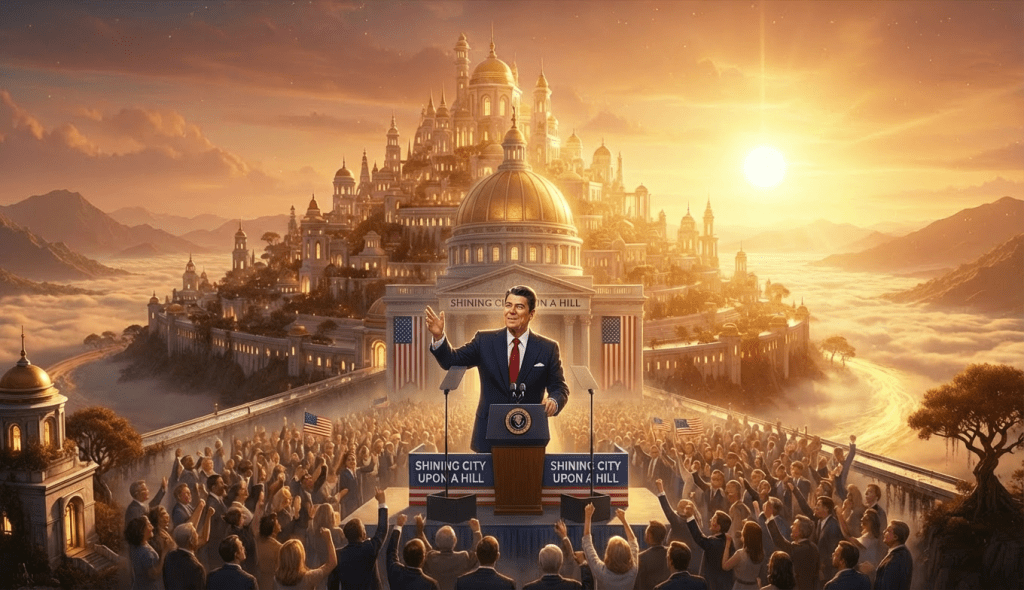
    A magnificent golden palace city built on a mountain peak surrounded by clouds.

    Blue Press Journal – There was a time when American presidents spoke of the nation as Ronald Reagan did: a “shining city on a hill,” a beacon of democracy and prosperity visible to the entire world. That imagery suggested permanence—a promise that no matter the challenges, the United States would remain the moral and economic anchor of the free world. Today, that light is flickering. Under President Donald Trump’s leadership, we are witnessing not the preservation of American greatness, but the deliberate dismantling of the very foundations that made it possible.

    The economic architecture of global cooperation has been shattered by a trade policy that treats allies as adversaries. Trump’s aggressive tariff regime has strained relations with virtually every major trading partner, transforming decades of diplomatic capital into resentment and retaliation. These are not the calculated negotiations of a nation securing its interests; they are the erratic maneuvers of an isolationist agenda that makes America poorer while promising prosperity. When the world’s largest economy retreats behind protectionist walls, the cost is borne not by abstract institutions, but by American consumers facing inflated prices and disrupted supply chains.

    Equally troubling is the administration’s incoherent approach to foreign policy, particularly regarding Ukraine and Russia. Trump’s hot-and-cold support for Kyiv—alternating between gestures of solidarity and open contempt—has left allies uncertain of American commitment. More alarming is his refusal to demand accountability from Moscow for its aggression, effectively absolving Russia of consequences while undermining Ukrainian sovereignty. This is not diplomacy; it is capitulation dressed in nationalist rhetoric, and it signals to the world that American security guarantees are negotiable commodities rather than sacred obligations.

    The recent escalation against Iran represents perhaps the most dangerous departure from presidential norms. Launching military actions without notifying allied democracies, only to later demand their support for a conflict that “makes no sense,” treats international partnerships as transactional burdens rather than strategic assets. The immediate consequence—rising gas prices—is already extracting pain from American households, translating geopolitical chaos into economic hardship at the pump. This is governance by impulse, not strategy, and the cost is measured in both dollars and diminishing American influence.

    Beneath these policy failures lies a more fundamental threat: the president’s apparent disregard for constitutional norms and his evident desire to function as a King rather than a servant of the republic. The separation of powers, the rule of law, and the peaceful transfer of authority—these are not inconveniences to be circumvented by executive fiat, but the essential guardrails of democratic governance. When a leader rejects these constraints, he does not merely damage his administration; he corrodes the public’s faith in the institutions that define American liberty.

    We are told we are entering a new golden age, but the reality is the end of the great American era that Trump and his MAGA movement have brought upon us. We are no longer the Reagan-esque “shining city on the hill”—that symbol of hope and ordered liberty. Instead, we have become an erratic power, rich in military might but increasingly impoverished in moral authority and economic stability. The policies of this administration are making America not greater, but smaller; not freer, but more constrained by the whims of authoritarian instinct.

    The city is still there, but the light is dimming. Whether it can be rekindled depends on whether we remember that true American greatness was never found in tariffs, isolationism, or the concentration of power in a single hand, but in our willingness to lead the world through principle rather than abandon it through pride
  • The Danger of “Nationalizing” U.S. Elections: A Constitutional Breakdown

     Donald Trump’s call to “nationalize the voting” is a direct assault on America’s state-run election system


    Blue Press Journal

    In a recent interview, President Donald Trump escalated his long-standing assault on U.S. election integrity by urging allies (Republicans) to “take over” the voting process in key states. His call for Republicans to “nationalize the voting” is not just inflammatory rhetoric; it is a direct challenge to the constitutional framework that has safeguarded American democracy for centuries.

    This proposition is fundamentally at odds with the U.S. Constitution and represents a dangerous path toward the partisan manipulation of elections.

    The Foundational Principle: State Control of Elections

    The U.S. electoral system is intentionally decentralized. The Constitution, through the Tenth Amendment, reserves all powers not explicitly granted to the federal government to the states. This includes the administration of elections.

    This state-level control is a feature, not a bug. It creates a robust system where a single point of failure or federal overreach cannot easily compromise a national election. As the Brennan Center for Justice, a non-partisan law and policy institute, notes, this diffusion of power is a critical bulwark against centralized election manipulation.

    Trump’s idea to “nationalize” this process would dismantle this structure, consolidating power in a way the Founders explicitly sought to avoid. It is an overt push for one political party to seize the machinery of democracy itself.

    Debunked Claims Undermining Public Trust

    This call to action is predicated on the repeatedly debunked “Big Lie” that the 2020 election was stolen. The facts are clear and overwhelming:

    • Election officials from both parties certified the results.
    • Dozens of judges, including many appointed by Trump, dismissed over 60 lawsuits due to a lack of evidence.
    • Trump’s own Attorney General, William Barr, stated the Justice Department found no evidence of widespread fraud that could have altered the outcome.

    Continuing to promote these falsehoods, as Trump does, severely erodes public trust. When a leader insists a system is rigged only when they lose, they lay the groundwork to justify seizing control of that system for their own benefit.

    A Chilling Precedent for Federal Overreach

    This is not a theoretical concern. The Trump administration previously tested the limits of federal power over state elections. In 2017, his Presidential Advisory Commission on Election Integrity attempted to compel states to turn over sensitive voter data. As reported by The New York Times, numerous states from both parties refused, citing significant privacy and federal overreach concerns.

    This history reveals a consistent pattern: an attempt to centralize election control under a partisan banner, justified by baseless claims of fraud.

    Why This is Bad for America

    A move to nationalize or partisanly “take over” election administration would have devastating consequences:

    1. Constitutional Crisis: It would ignite a legal battle between states and the federal government, destabilizing the very rule of law.
    2. Loss of Legitimacy: Elections perceived as controlled by one party lose their legitimacy in the eyes of the losing side, leading to increased political instability.
    3. Voter Suppression: Centralized, partisan control could lead to the systematic manipulation of voter rolls, polling place locations, and ballot counting to favor one party.

    The integrity of U.S. elections depends on their impartial administration. Abandoning this principle for partisan gain doesn’t just risk losing an election—it risks losing the democratic system itself. Defending the decentralized, state-run model is essential to preserving a government of, by, and for the people.