Tag: tariffs

  • Trump’s Tariff Legacy: American Families Face Staggering $330 Billion Burden While Businesses Get Refunds

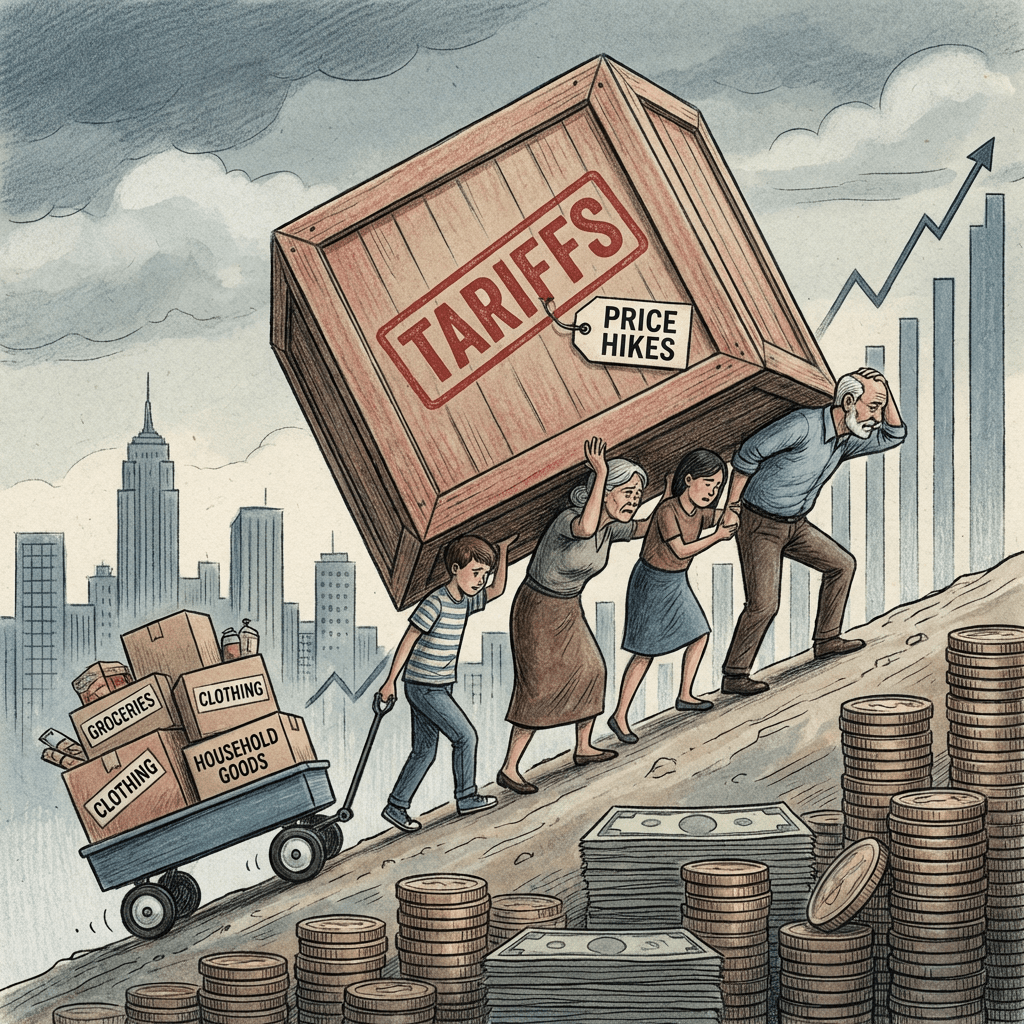
    Family carrying a heavy crate labeled TARIFFS and PRICE HIKES uphill past stacks of money.

    Blue Press Journal (DC) – American households are on track to endure an unprecedented financial hit this year, with combined costs from import duties totaling an estimated $330 billion. This colossal sum, translating to over $2,500 for the average family, underscores the severe economic strain inflicted by President Donald Trump’s aggressive trade policies. A recent report from the Democratic minority on the Joint Economic Committee (JEC) as reported by news outlets like Reuters, paints a stark picture of these escalating expenses, a considerable jump from the $1,700 Americans reportedly paid in 2025.

    Despite a Supreme Court ruling last month that invalidated Trump’s use of emergency powers for imposing widespread tariffs, the administration appears undeterred. US Treasury Secretary Scott Bessent has projected “virtually unchanged tariff revenue in 2026,” suggesting a continued reliance on these trade taxes through different legal avenues to circumvent the high court’s decision. This persistent strategy means continued pressure on consumer wallets.

    The burden of these customs charges falls disproportionately on everyday Americans. Independent analysis from the nonpartisan Congressional Budget Office (CBO) detailed in reports by organizations like the Associated Press, revealed that foreign entities bear only about 5% of tariff expenses. Domestic companies absorb roughly 30%, but a staggering 65% is ultimately shouldered by consumers through higher prices on goods and services.

    A Tale of Two Refunds: Businesses Get Relief, Families Don’t

    While American families grapple with surging costs, businesses impacted by what were deemed unlawful duties are poised for substantial relief. The US Court of International Trade (CIT) recently mandated that the Treasury Department and Customs and Border Protection must reimburse approximately 330,000 importers a staggering $166 billion for duties collected under the invalidated tariffs a development covered by outlets such as The Wall Street Journal. Customs officials indicate that a system for processing these refund requests for over 53 million entries could be operational as early as mid-April.

    However, a stark disparity remains for ordinary citizens. Senator Maggie Hassan (D-NH), a ranking member of the Joint Economic Committee, sharply criticized this imbalance. She lamented that while businesses are set to receive reimbursements with interest, “the Trump administration refuses to provide relief for families” and is instead “choosing to institute new tariffs that will push prices even higher.”

    Legislative Efforts to Aid Struggling Households

    In response to this growing economic strain, Senator Martin Heinrich (D-NM), also a committee member, has introduced a legislative proposal to directly assist those most affected. His “Working Families Refund” bill aims to provide a $600 tax rebate to individuals earning up to $90,000 annually, and to head-of-household filers making $120,000 or less. Joint filers under $180,000 would receive $1,200, with an additional $600 for each dependent child.

    Senator Heinrich emphasized the measure’s intent: “This is money that belongs to working families—not to CEOs of big corporations.” He criticized the administration’s rhetoric, stating, “The president may call the affordability crisis a ‘hoax,’ but working people feel it every time they pay for essentials. This bill will return the money lost to Trump’s tariffs back to those who paid the price.”

    Public sentiment reflects growing dissatisfaction with economic policies. An NBC News poll showed that 55% of voters believe trade taxes have harmed the economy, while only 33% view them as beneficial. With 62% disapproving of the administration’s handling of inflation and living costs, the financial strain on American families is clear. Heinrich’s bill includes a provision to prevent the president from labeling rebate checks with his name, acknowledging previous political optics around stimulus payments.
  • Trump Administration and DOJ Stall Refunds After Supreme Court Nullifies Emergency Tariffs – Businesses Rush to Court

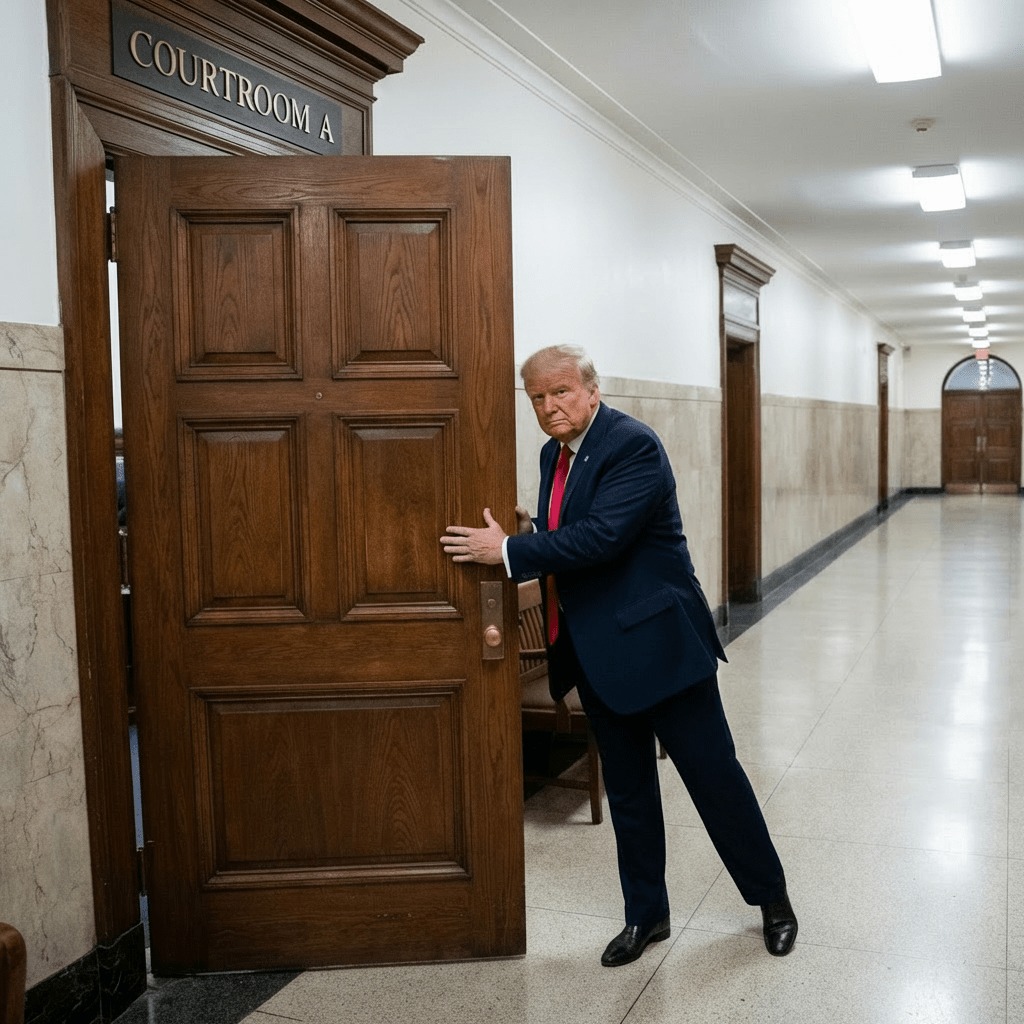
    Donald Trump peeking through the wooden doors of Courtroom A in a brightly lit hallway.

    BLUE PRESS JOURNAL – The Supreme Court’s decisive ruling that nullified President Donald Trump’s emergency tariffs ignited a frantic legal scramble. Hundreds of companies—from a New York wine importer to shipping giant FedEx—are now filing lawsuits to reclaim duties they allege were unlawfully collected. The fight has split into two competing jurisdictional tracks, while the Trump administration and the Department of Justice (DOJ) deliberately drag their feet.

    Two Front‑Line Challengers
    VOS Selections, a New York wine and spirits importer represented by the Liberty Justice Center, is pressing the U.S. Court of Appeals for an immediate mandate so lower courts can begin processing refunds. The importer previously secured a verbal guarantee from the administration that any successful claim would be reimbursed promptly. In contrast, AGS Company Automotive Solutions of Michigan, the lead docket in a consolidated case, is demanding a hearing to lift a December‑23 judicial stay, arguing that each day of delay deepens the prejudice to plaintiffs.

    DOJ’s 90‑Day Freeze: A Stalling Tactic
    Despite early assurances, the DOJ now argues for a 90‑day freeze to let “political branches consider options,” labeling rapid refunds as “ill‑conceived.”  President Trump, meanwhile, has suggested the process could take years and has urged the Supreme Court to rehear the case—a rarity not seen in nearly seven decades (Reuters).  Such postponements appear designed to protect the administration’s political capital rather than remedy wronged businesses.

    Political Backlash and Legislative Action
    Democratic governors from Illinois, New York, Maryland and California have issued invoices demanding billions in refunds for their residents.  Senators Ed Markey, Ron Wyden and Jeanne  Shaheen have introduced legislation compelling U.S. Customs and Border Protection to issue full refunds with interest within 180 days, prioritizing small‑business owners (Politico).

    A Call for Uniform, Court‑Supervised Relief
    The Liberty Justice Center warns that a “900‑case pileup” will overwhelm the courts if each company pursues separate suits. Yet the administration’s resistance to an expedited, uniform process leaves businesses in limbo, facing mounting legal costs and uncertain timelines.

    Bottom line: The Trump administration’s deliberate delays and the DOJ’s procedural roadblocks betray a disregard for fiscal justice, forcing American businesses to fight a protracted legal battle for money they are rightfully owed.


  • Trump’s New Tariffs: Another Costly Tax on American Families

    Blue Press Journal – In a move that has once again ignited concerns across the economic landscape, the Trump administration has announced a sweeping 10% tariff on goods imported to the U.S. from across the globe. This comes hot on the heels of a Supreme Court ruling on Friday, which deemed the administration’s previous use of the International Emergency Economic Powers Act (IEEPA) for issuing tariffs as unjustified. Despite this judicial setback, the President quickly pivoted, citing Section 122 of the 1974 Trade Act to impose these new levies, which are set to take effect on February 24th.

    While the administration touts these “import taxes” as a strategy to address “large and serious” trade deficits, the overwhelming consensus among economists and trade experts is clear: tariffs are not paid by foreign producers; they are a tax paid by American consumers and businesses.

    The Illusion of Protection: Who Really Pays?

    The notion that tariffs are a punitive measure exclusively against foreign nations is a dangerous misconception that has plagued Trump’s economic policy. In reality, when a tariff is imposed, it’s the American importer—a company, large or small, that brings goods into the country—who pays that tax to the U.S. Treasury. To recoup these costs, importers typically do one of two things:

    1. Raise Prices: They pass the increased cost directly onto consumers through higher retail prices.
    2. Absorb Costs: They absorb the cost, leading to reduced profits, which can translate into lower wages for employees, less investment in their businesses, or even job cuts.

    A comprehensive analysis by the National Bureau of Economic Research (NBER), for instance, found that “U.S. tariffs were almost entirely borne by U.S. domestic consumers and importers.” This sentiment is echoed by the Peterson Institute for International Economics (PIIE), which concluded that the burden of previous Trump administration tariffs fell “almost entirely on American consumers and firms.” These aren’t abstract economic theories; they are concrete realities felt in every American household.The Hidden Costs of Tariffs for American Households

    Impact CategoryDescription
    **Higher Consumer Prices**Increased costs for everyday goods, from clothing and electronics to household appliances, directly reducing purchasing power.
    **Reduced Business Investment**Companies face uncertainty and higher input costs, leading to less investment in expansion, innovation, and job creation.
    **Slower Wage Growth**As profits are squeezed, businesses have less capacity to offer competitive wages or bonuses.
    **Supply Chain Disruptions**Forced reshuffling of global supply chains can lead to inefficiencies, product shortages, and further price hikes.
    **Retaliatory Tariffs**Other countries often impose their own tariffs on U.S. exports, harming American farmers and manufacturers who rely on international markets.

    A Familiar, Flawed Playbook

    This latest round of tariffs, while excluding agricultural products, pharmaceuticals, electronics, certain vital minerals and metals, and goods from Canada and Mexico (due to a 2020 trade agreement), still casts a wide net over the global economy. It’s a return to the same protectionist policies that characterized the administration’s first term, often leading to costly “trade wars” that hurt American industries and consumers alike.

    The economic consequences of such policies are often multifaceted:

    • Inflationary Pressures: Tariffs contribute to rising prices across the board, fueling inflation and eroding the value of American wages.
    • Supply Chain Instability: Businesses struggle to plan and maintain efficient supply chains, leading to higher operational costs and potential product shortages.
    • Reduced Competitiveness: American companies that rely on imported components become less competitive globally.

    Facing Domestic Opposition

    Even within his own party, the President’s tariff strategy is facing significant pushback. Rep. Don Bacon (R-Neb.) was quick to signal that these tariffs will likely “be defeated” in Congress. As he told CNN in an interview, “It may not have a veto-proof majority, but it will have a majority that will go against that 10 percent global tariff, so I think the president is making a mistake here.”

    This confidence stems from the foundational principle that under the 16th Amendment, lawmakers hold broad authority over federal taxes, including tariffs. The legislative branch has the power to reject what many view as an economically damaging policy being unilaterally imposed.

    The True Cost of Protectionism

    The evidence is overwhelming: tariffs are a self-inflicted wound. They masquerade as a solution to trade imbalances but function as a regressive tax on hardworking American families and a burden on businesses. Instead of fostering economic growth, they invite retaliatory measures, disrupt supply chains, and ultimately make everyday life more expensive for millions.

    It’s time to move past the misleading rhetoric and embrace policies that truly strengthen the American economy through open markets, fair trade, and genuine competitiveness, rather than punishing our own citizens with higher taxes disguised as patriotism.


  • Supreme Court Strikes Down Trump’s Unilateral Tariffs, Upholds Congressional Taxing Power

    BREAKING NEWS

    BLUE PRESS JOURNAL (D.C) – In a landmark decision, the Supreme Court delivered a significant blow to President Donald Trump’s trade policies, ruling 6-3 on Friday to invalidate certain “emergency” tariffs imposed during his administration. The high court’s verdict decisively reasserts Congress’s constitutional authority over taxation, curtailing unchecked executive power in international trade.

    The ruling centered on the International Emergency Economic Powers Act (IEEPA), which the Court determined did not authorize the President to unilaterally impose tariffs. Chief Justice John Roberts, writing for the majority, critically observed that the expansive interpretation of IEEPA by the administration to levy broad tariffs was unsustainable. “Those words cannot bear such weight,” Roberts stated, referring to the Act’s language.

    This decision marks a rebuke of Trump’s trade war tactics, which often bypassed congressional oversight, and suggests a costly reckoning. A U.S. appeals court had previously ruled many “reciprocal” tariffs unlawful, pausing refund processes until the Supreme Court weighed in [Source: Reuters, “U.S. appeals court says Trump’s China tariffs unlawful,” e.g., August 2023 report]. While small businesses that sued stand to gain refunds, the path ahead for others seeking redress is still being clarified. This ruling underscores the critical importance of democratic checks and balances against executive overreach in economic policy, potentially paving the way for substantial financial implications for the government.


    Tags: Trump tariffs, Supreme Court, IEEPA, trade policy, executive power, congressional oversight, separation of powers, import duties, unlawful tariffs, economic impact, business refunds

  • Valentine’s Day Chocolate Shock: How Tariffs Increased Your Sweet Treat Costs

    Trump Tariffs Increase your Valentine’s Day Your Sweet Treat Costs

    Blue Press Journal – This Valentine’s Day, many are noticing that their beloved chocolates come with a higher price tag. Beyond general inflation, a specific economic policy is playing a significant role: import tariffs on cocoa and chocolate.

    During the Trump administration, the U.S. imposed substantial tariffs, impacting the global chocolate supply chain. Cocoa-producing countries faced average tariffs of 15% on their exports to the U.S., while finished chocolate products from the European Union saw duties as high as 20%. Given that the vast majority of cocoa used in American chocolate is imported, these tariffs directly escalated costs for manufacturers.

    When companies pay more to import essential ingredients or ready-made chocolate, these expenses inevitably trickle down, leading to higher prices at checkout. If your Valentine’s candy budget feels strained this year, these historical trade adjustments explain the extra cost. Trump promised to lower prices day one…he lied.

  • GOP Tariff Shield Crumbles: What This Means for Your Wallet

    Trump’s Tariff Gambit Backfires: GOP Revolt Exposes Rising Consumer Costs

    Blue Press Journal D.C. — A significant political maneuver on Capitol Hill this week has thrown President Trump’s favored trade weapon, tariffs, back into the spotlight, exposing deep divisions within the Republican Party and rekindling critical debate about their economic impact on American consumers. House Speaker Mike Johnson’s attempt to block future votes on Trump-era tariffs failed dramatically on Tuesday, signaling a growing bipartisan unease with protectionist trade policies.

    In a rare display of internal dissent, three Republican lawmakers – Thomas Massie of Kentucky, Kevin Kiley of California, and Don Bacon of Nebraska – joined forces with Democrats to defeat a crucial procedural measure by a slim 217-214 margin. This unexpected revolt clears the path for the House to consider resolutions disapproving of President Trump’s 25% duties on Canadian goods, and potentially others.

    For nearly a year, House Republican leadership had shielded its members from politically difficult votes on these tariffs, a strategy that crumbled on Tuesday. The procedural block, last extended in September, allowed members to avoid taking a stand on duties that have fomented uncertainty and drawn criticism from various economic sectors. Rep. Kiley, speaking after his “no” vote, emphasized the importance of institutional integrity, stating, “I don’t think that the House should be limiting the authority of members and enlarging the power of leadership at the expense of our members.”

    The Hidden Cost: Tariffs and Your Pocketbook

    While often framed as tools to protect domestic industries, economic analyses, including those from organizations like the Tax Foundation and reports cited by outlets such as The Wall Street Journal, have consistently demonstrated that tariffs act as a direct tax on American consumers and businesses. These import duties inevitably drive up costs for manufacturers and retailers, ultimately leading to higher prices on store shelves for everything from imported components to finished goods. Consumers, often unknowingly, bear the burden of these added expenses, seeing their purchasing power eroded.

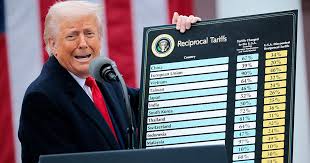
    Indeed, the long-term imposition of Trump’s “reciprocal” tariffs on a multitude of countries has generated economic headwinds, stifling competition and adding significant overhead for companies across various sectors.

    With the shield now gone, Democrats are poised to force votes, even if largely symbolic given potential presidential vetoes. Their goal is clear: to put House Republicans on record regarding their support for these controversial duties. As the Supreme Court weighs the legality of the President’s authority to impose such sweeping tariffs, the renewed congressional focus underscores a critical question: At what cost do these protectionist policies come, and who ultimately pays the price?

  • The Economic Crisis in Rural America: A Political Wake-Up Call for the GOP

    Trump Economic Policies Hurting Rural America

    Blue Press Journal – As the midterm elections approach, the deepening financial turmoil experienced by American farmers has morphed into a significant political dilemma for the Republican Party. According to former Republican strategist Rick Wilson, the fallout from President Donald Trump’s economic policies is manifesting in a way that could reshape the political landscape in rural America.

    In a recent Substack post, Wilson, co-founder of the anti-Trump organization The Lincoln Project, articulated a stark reality: many of Trump’s staunchest supporters are now grappling with a harsh economic truth. He stated, “Welcome to the ‘Find Out’ phase of the most expensive political experiment in American history. As we head into 2026, rural America is discovering that you can’t eat ‘owning the libs,’ and you can’t pay a mortgage with Facebook memes.”

    In the 2024 election, rural Americans did more than just support Trump; they made a perilous commitment to his policies. In the nation’s 444 farming-dependent counties, Trump garnered nearly 78% of the vote. Now, these areas are witnessing the catastrophic effects of what Wilson terms “MAGA-nomics,” as multi-generational family farms face unprecedented challenges. The metaphor of “Leopards Eating People’s Faces” epitomizes the irony of voters suffering from the very policies they championed.

    The Impact of Tariffs on Farmers

    The Trump administration’s imposition of sweeping tariffs has severely impacted farmers’ incomes. Wilson describes the consequences succinctly: “For farmers, this wasn’t ‘winning’—it was a state-sponsored execution.” China, which once accounted for half of all U.S. soybean exports, has largely ceased buying American agricultural products. By 2026, major crop revenues faced staggering declines: corn fell by $169 per acre, soybeans by $114, and cotton nearly $400. According to projections, net farm income is expected to plummet by $41 billion this year—a staggering 23% decrease, marking one of the sharpest declines seen in decades (U.S. Department of Agriculture, 2023).

    The Labor Crisis Intensified by Immigration Policies

    The plight of farmers has been further exacerbated by the Trump administration’s aggressive immigration policies. As Wilson aptly noted, “If tariffs were the heart attack, immigration policy was the stroke.” The push for mass deportations resulted in a labor crisis that farmers could not ignore. With roughly 70% of farmworkers being foreign-born, the labor force rapidly dwindled. In states like New Jersey and California, crops were left to rot in the fields, and one grower reported a staggering loss of $5 million due to a lack of available labor to harvest.

    Political Ramifications for the GOP

    The financial fallout from these policies has transformed into a political liability for the GOP. Wilson warns, “For Republicans running in 2026, this is a slow-motion catastrophe. They’re chained to an incumbent who is bankrupting his most loyal voters.” The irony is profound: the very individuals who rallied behind Trump’s trade wars and immigration policies are now suffering the consequences. Experts had predicted these outcomes, yet the farmers who built Trump’s support base are now paying the price.

    As rural America grapples with an economic crisis ignited by misguided policies, the political fallout for the GOP could be catastrophic. With the 2026 elections looming, uncertainty reigns over whether the party can extricate itself from the devastating consequences of Trump’s economic blunders or if they will be shackled to a disillusioned base that is growing ever more despondent.

  • Trump’s Tariff Threat Against Canada: Bad Economics, Worse for American Consumers

    President Trump’s latest 100% tariff threat against Canada will hurt American consumers, damage U.S. industries, and strain vital trade relationships. Learn why Trump’s trade war is bad economics and worse policy.


    Blue Press Journal – President Donald Trump’s recent threat Satruday to impose a 100% tariff on Canadian imports has sent shockwaves through North American trade circles. The move, aimed at punishing Canada for its newly negotiated trade concessions with China, reflects the same protectionist instincts that have defined Trump’s economic agenda since his first term. But beyond the political theater, tariffs like these come with a steep price — one paid directly by American consumers, businesses, and workers.


    The Canada-China Trade Context

    Earlier this month, Canadian Prime Minister Mark Carney announced a deal with China to lower tariffs on Chinese electric vehicles in exchange for reduced import taxes on Canadian agricultural products. While Canada maintains no free-trade agreement with China, the arrangement was crafted to support Canadian farmers and diversify trade relationships amid global tensions.

    Trump initially praised the deal, but quickly reversed course, accusing Canada of becoming a “drop-off port” for Chinese goods destined for the U.S. His retaliation? Threatening a 100% import tax on Canadian goods if Ottawa proceeds — a move that would affect everything from steel to agricultural products to critical minerals.


    Why Tariffs Hurt Americans More Than They Help

    Tariffs are often sold to voters as a way to protect domestic industries, but the reality is that tariffs operate as a hidden tax on U.S. consumers. When the U.S. imposes tariffs, importers pay higher costs, which are then passed along to businesses and consumers in the form of higher prices.

    According to a 2019 study by the Federal Reserve Bank of New York, U.S. tariffs during the Trump administration’s first trade war with China led to $1.4 billion in additional costs per month for American consumers. Similarly, research from the Peterson Institute for International Economics found that the average U.S. household paid $800 more per year due to tariff-driven price increases.

    For context:

    • Canada is the largest export destination for 36 U.S. states.
    • Nearly $2.7 billion USD in goods and services cross the Canada-U.S. border daily.
    • Canada supplies 60% of U.S. crude oil imports and 85% of U.S. electricity imports.
    • It is also a key supplier of steel, aluminum, uranium, and critical minerals essential for the auto industry, defense and technology.

    Imposing a 100% tariff on these imports would cause instant price spikes in energy, manufacturing, and consumer goods — directly hitting U.S. households and industries.


    Economic Fallout of Trump’s Tariff Threat

    If enacted, Trump’s proposed tariffs would:

    1. Raise Costs for Energy and Manufacturing – U.S. industries dependent on Canadian oil, electricity, and metals would face supply shortages and higher costs.
    2. Damage Cross-Border Supply Chains – The deeply integrated Canada-U.S. manufacturing sector, especially in automotive and aerospace, would be disrupted.
    3. Invite Retaliation from Canada – Ottawa could respond with its own tariffs on U.S. exports, hurting American farmers, particularly in states that rely on agricultural trade with Canada.
    4. Undermine NATO and Western Alliances – Trump’s antagonistic stance toward Canada, paired with his push to acquire Greenland and social media provocations, risks alienating a key ally.

    Political Theater vs. Economic Reality

    Trump’s rhetoric — including calling Carney “Governor Carney” and posting altered maps showing Canada as part of U.S. territory — may play well to a certain political base. But such antics undermine serious diplomatic relationships and erode trust among allies.

    Carney’s speech at the World Economic Forum in Davos, urging “middle powers” to unite against coercive tactics by great powers, clearly struck a nerve with Trump. As Carney’s popularity rises on the world stage, Trump’s trade threats appear less about protecting American workers and more about retaliating against political rivals.


    The Consumer’s Perspective

    For the average American, tariffs mean:

    • Higher grocery bills (due to increased costs on Canadian agricultural imports).
    • More expensive cars and electronics (Canadian manufacturing is a key part of U.S. supply chains).
    • Higher energy costs (Canadian oil, electricity, and uranium are essential to U.S. energy security).

    In short: Tariffs punish consumers first, industries second, and political rivals last.


    So What Does it Mean

    President Trump’s threat of a 100% tariff on Canadian goods is more than a diplomatic provocation — it’s an economic self-inflicted wound. Canada is one of America’s most important trading partners, and disrupting that relationship will raise prices, strain industries, and weaken alliances. 

    If history is any guide, Trump’s tariffs will not force Canada to change course with China. Instead, they will drive up costs for American families, hurt U.S. competitiveness, and isolate the United States in a world where cooperation — not coercion — is the key to economic success.


  • Trump’s Economic Policies Are Costing American Families Thousands – The Numbers Don’t Lie

    In Response to todays Trump News Conference

    Blue Press Journal – While former President Donald Trump made headlines with bizarre distractions like his public musings about buying Greenland, the real story for American households was happening in their wallets. A new congressional analysis reveals that under Trump’s leadership, U.S. families faced sharp increases in the cost of living, directly tied to his economic agenda and trade strategies. 

    According to a recent report from the Joint Economic Committee (JEC), the average U.S. household paid $1,625 more in 2025 for everyday essentials. These rising costs were not random — they were the result of Trump’s tariffs, housing market pressures, and broader economic mismanagement (Joint Economic Committee, 2025). 

    The Real Impact: Higher Prices for Housing, Transportation, and Groceries

    Breaking down the numbers, the JEC found that housing expenses rose by an average of $323 per family, transportation costs climbed by $241, and grocery bills surged across the country. For residents of states like Alaska, Connecticut, Massachusetts, and New York, the hit was even harder — more than $2,000 in additional annual costs. 

    The cause? Trump’s tariff-heavy trade policy, which he claimed would punish foreign exporters but in practice acted as a hidden tax on American consumers. Independent economic analyses, including research from the Center for American Progress, confirm that U.S. businesses and families bore nearly the entire cost of these tariffs (CAP, 2025). 

    The Inflation Reality Check

    Trump has repeatedly boasted that he “ended inflation” and claimed prices are falling. The data tells a different story. In December 2025, inflation was still running at 2.7% year-over-year, with prices continuing to climb month to month (CNN Fact Check). For working families, this meant that paychecks stretched less, and basic necessities became more expensive — despite the White House’s rosy rhetoric. 

    Economic Uncertainty Hurts Families

    Economists warn that tariffs not only raise consumer prices but also create uncertainty for businesses, slowing investment and job growth. This uncertainty compounds the financial strain on households, particularly in industries reliant on global supply chains. 

    Senator Maggie Hassan (D-NH) criticized the administration’s “reckless” economic approach, pointing out that tariffs, higher healthcare costs, and policy unpredictability have all contributed to the squeeze on American families. 

    The Takeaway: The “Greatest Economy” Myth

    Trump’s claims of delivering “the greatest first year in history” simply don’t match the lived reality of American families. The hard truth is that his economic policies functioned as a tax on the middle class, without delivering the promised benefits. 

  • Transatlantic Rift Deepens as Trump’s Greenland Tariffs Ignite Calls for EU ‘Trade Bazooka’

    Donald Trump’s punitive tariffs on European nations supporting Greenland security have sparked unprecedented EU retaliation talks, risking a historic breakdown in transatlantic relations.

    Blue Press Journal – The fragile fabric of transatlantic relations is fraying at an alarming pace, as U.S. President Donald Trump’s decision to impose tariffs on European nations involved in Greenland security exercises triggers outrage across the European Union. What began as a geopolitical skirmish over the Arctic has rapidly escalated into a confrontation that EU leaders say could fundamentally reshape the balance of power between Washington and Brussels. 

    At the heart of the crisis is Trump’s move to punish countries — including France, Germany, Sweden, Finland, Norway, and the Netherlands — that deployed troops to participate in a Danish-led military exercise in Greenland. The exercise, part of a broader European effort to secure the Arctic amid rising Russian and Chinese activity, was described by participating governments as entirely defensive and non-provocative. Yet Trump’s administration framed the deployments as a direct affront to U.S. interests, slapping punitive tariffs in a move critics say is both reckless and diplomatically corrosive. 

    Europe’s Retaliatory Options: From Restraint to Confrontation

    For months, EU leaders have tolerated Trump’s unpredictable foreign policy in the hope of preserving NATO unity. They have weathered his wavering support for Ukraine, his pressure for lopsided trade agreements, and his demands for massive defense spending increases. But the Greenland tariffs appear to have crossed a line. 

    French President Emmanuel Macron has emerged as one of the loudest voices demanding a robust response, calling for the activation of the EU’s Anti-Coercion Instrument — a powerful trade retaliation tool originally designed to counter China’s economic intimidation. Deploying it against the United States would be unprecedented, signaling a profound shift in the EU’s willingness to confront Washington head-on. 

    “The EU must resist humiliation and economic vassalization,” said Jérémie Gallon, a former French diplomat now based in Washington. His sentiment echoes a growing consensus among centrist and left-leaning EU lawmakers who argue that Europe must assert itself as a geopolitical actor rather than simply react to U.S. pressure. 

    Diplomatic Fallout and Strategic Calculations

    Even leaders with warmer ties to Trump, such as Italian Prime Minister Giorgia Meloni, have acknowledged the severity of the rift. While urging dialogue to avoid escalation, Meloni conceded that tariffs on NATO allies “are a mistake” and risk undermining shared security goals. 

    The European Parliament is already signaling its readiness to derail ratification of a recently negotiated EU-U.S. trade deal — a move that would have been unthinkable only months ago. Blocking the agreement would be a symbolic yet potent act, but triggering the Anti-Coercion Instrument would represent a direct economic counterstrike. 

    The Bigger Picture: Europe’s Geopolitical Awakening

    This crisis coincides with the EU’s broader push for strategic autonomy. European Commission President Ursula von der Leyen has announced a new security framework, while plans to bolster cybersecurity are set to be unveiled imminently. The Greenland standoff may accelerate this trajectory, forcing Europe to invest in defense and economic resilience without relying on U.S. goodwill. 

    The fact that Trump’s tariffs came just days after the EU signed a major trade deal with Latin America adds insult to injury, deepening perceptions that the U.S. is willing to use economic coercion to undermine Europe’s global aspirations. 

    As EU leaders return from Latin America to Brussels for emergency talks, the stakes could not be higher. The decision they face — whether to retaliate against their most powerful ally — may define Europe’s role on the world stage for decades.