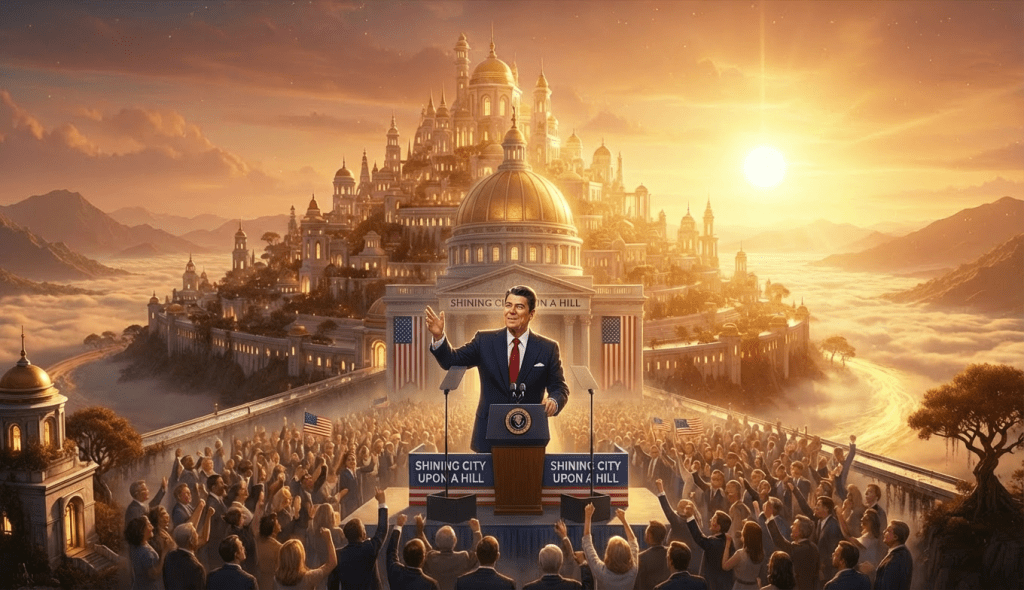
Blue Press Journal – There was a time when American presidents spoke of the nation as Ronald Reagan did: a “shining city on a hill,” a beacon of democracy and prosperity visible to the entire world. That imagery suggested permanence—a promise that no matter the challenges, the United States would remain the moral and economic anchor of the free world. Today, that light is flickering. Under President Donald Trump’s leadership, we are witnessing not the preservation of American greatness, but the deliberate dismantling of the very foundations that made it possible.
The economic architecture of global cooperation has been shattered by a trade policy that treats allies as adversaries. Trump’s aggressive tariff regime has strained relations with virtually every major trading partner, transforming decades of diplomatic capital into resentment and retaliation. These are not the calculated negotiations of a nation securing its interests; they are the erratic maneuvers of an isolationist agenda that makes America poorer while promising prosperity. When the world’s largest economy retreats behind protectionist walls, the cost is borne not by abstract institutions, but by American consumers facing inflated prices and disrupted supply chains.
Equally troubling is the administration’s incoherent approach to foreign policy, particularly regarding Ukraine and Russia. Trump’s hot-and-cold support for Kyiv—alternating between gestures of solidarity and open contempt—has left allies uncertain of American commitment. More alarming is his refusal to demand accountability from Moscow for its aggression, effectively absolving Russia of consequences while undermining Ukrainian sovereignty. This is not diplomacy; it is capitulation dressed in nationalist rhetoric, and it signals to the world that American security guarantees are negotiable commodities rather than sacred obligations.
The recent escalation against Iran represents perhaps the most dangerous departure from presidential norms. Launching military actions without notifying allied democracies, only to later demand their support for a conflict that “makes no sense,” treats international partnerships as transactional burdens rather than strategic assets. The immediate consequence—rising gas prices—is already extracting pain from American households, translating geopolitical chaos into economic hardship at the pump. This is governance by impulse, not strategy, and the cost is measured in both dollars and diminishing American influence.
Beneath these policy failures lies a more fundamental threat: the president’s apparent disregard for constitutional norms and his evident desire to function as a King rather than a servant of the republic. The separation of powers, the rule of law, and the peaceful transfer of authority—these are not inconveniences to be circumvented by executive fiat, but the essential guardrails of democratic governance. When a leader rejects these constraints, he does not merely damage his administration; he corrodes the public’s faith in the institutions that define American liberty.
We are told we are entering a new golden age, but the reality is the end of the great American era that Trump and his MAGA movement have brought upon us. We are no longer the Reagan-esque “shining city on the hill”—that symbol of hope and ordered liberty. Instead, we have become an erratic power, rich in military might but increasingly impoverished in moral authority and economic stability. The policies of this administration are making America not greater, but smaller; not freer, but more constrained by the whims of authoritarian instinct.
The city is still there, but the light is dimming. Whether it can be rekindled depends on whether we remember that true American greatness was never found in tariffs, isolationism, or the concentration of power in a single hand, but in our willingness to lead the world through principle rather than abandon it through pride
 Blue Press Journal