Tag: Operation Metro Surge

  • Minneapolis Pushes Back Against Trump’s Controversial Immigration Surge

    Minneapolis Mayor Jacob Frey condemns a federal court ruling allowing Trump-era immigration raids in Minnesota, calling it an invasion undermining safety and local authority.

    Blue Press Journal Minneapolis Mayor Jacob Frey condemns a federal court ruling allowing Trump-era immigration raids in Minnesota, calling it an invasion undermining safety and local authority.

    Minneapolis Mayor Jacob Frey and Minnesota officials are vowing to continue their fight against the Trump administration’s aggressive escalation of federal immigration enforcement in the Twin Cities — even after a federal judge rejected the state’s request to halt the operation. 

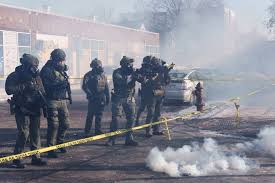
    The decision, handed down by U.S. District Judge Katherine Menendez, denied an injunction against what locals have described as an “invasion” of federal immigration officers under Operation Metro Surge. This initiative, launched during Trump’s presidency, has sent waves of heavily armed Immigration and Customs Enforcement (ICE) and Customs and Border Protection (CBP) agents into Minneapolis neighborhoods. 

    Mayor Frey: “This Has Brought Fear, Not Safety”

    Mayor Frey issued a strong rebuke following the ruling, stating that the surge has disrupted communities, instilled fear among residents, and undermined public safety. “This decision doesn’t change the lived reality here — fear, disruption, and harm caused by a federal operation that never belonged in Minneapolis in the first place,” Frey said. 

    He emphasized that Minneapolis’s sanctuary city policies are designed to protect immigrant communities, fostering trust between residents and local law enforcement. Critics argue that Trump’s immigration crackdowns — often targeting sanctuary jurisdictions — were politically motivated, aiming to punish cities that refused to cooperate with federal deportation efforts. 

    Tragic Consequences of Federal Overreach

    The lawsuit, filed by Minnesota Attorney General Keith Ellison and Twin Cities officials, gained urgency after two local residents — ICU nurse Alex Pretti and Renee Good — were killed in incidents tied to federal immigration actions. These deaths have intensified calls for accountability and raised questions about the safety and necessity of such operations in urban areas far from the border. 

    Researchers and immigration advocacy groups note that deploying militarized federal agents in sanctuary cities is not only legally contentious under the Tenth Amendment’s anti-commandeering doctrine, but also socially destabilizing. It can discourage crime victims from seeking help and erode trust in public institutions. 

    Sanctuary Cities Under Siege

    Under Trump’s leadership, sanctuary cities like Minneapolis, New York, and San Francisco repeatedly faced threats of funding cuts, public shaming, and targeted enforcement surges. The administration claimed such measures upheld federal law, but critics, including the American Civil Liberties Union (ACLU), warned they were designed to intimidate immigrant communities and score political points rather than improve safety. 

    Mayor Frey has made it clear that Minneapolis will not serve as an arm of federal immigration enforcement. “Undocumented residents should be able to call 911 without fearing deportation,” he said, reaffirming the city’s commitment to being a “welcoming, inclusive place for all.” 

    Despite the setback in court, Minneapolis officials are appealing the decision, determined to hold the Trump administration accountable. The broader legal battle touches on fundamental questions about states’ rights, local autonomy, and the limits of federal power in immigration enforcement. 

  • The Troubling Intersection of Election Denial and Federal Overreach in Minnesota

    The Dangerous Intersection of Election Denial and Federal Overreach: A Critical Look at Trump’s Actions in Minnesota

    Blue Press Journal – In an alarming display of federal overreach, former President Donald Trump has leveraged the power of Immigration and Customs Enforcement (ICE) to pursue his unfounded claims of election fraud in Minnesota. Critics argue that his obsession with the state stems from a desperate need to validate his belief that he won Minnesota in 2016, 2020, and 2024—claims that have been thoroughly dismissed by the courts and factual evidence.

    Norm Eisen, a former White House lawyer under Barack Obama, bluntly captures the chaos: “It’s almost unbelievable to think that election denial wasn’t a key factor driving his reckless animus, which in turn led to the ICE surge and the horrific fallout. This entire debacle reeks of a concoction built on nothing but lies.”

    The Trump administration’s recent tactics in Minnesota include a demand from Attorney General Pam Bondi for extensive voter data. This request arrives amid a backdrop of tragic incidents related to ICE operations, including the recent shooting of protester Alex Pretti. Bondi’s assertion that obtaining this data is essential for “free and fair elections” is seen by many as a thinly veiled attempt to intimidate voters and suppress legitimate electoral participation.

    In 2020, courts across the nation refuted Trump’s baseless allegations of widespread voter fraud, yet he continues to propagate these falsehoods. During a gathering in St. Paul in May 2024, Trump proclaimed, “I thought we won in 2016. I know we won it in 2020.” This starkly contrasts with the reality that he lost Minnesota in all three elections, including a 7.1-point defeat to Joe Biden in 2020—one of many losses that continue to fuel his unfounded claims.

    Democratic National Committee Chair Ken Martin, a Minnesota native, emphasized the absurdity of Trump’s fixation: “Minnesota voters rejected Donald Trump three times, a fact that he either willingly ignores or his addled, aging brain can’t remember.” Martin further noted that Trump’s obsession with Minnesota is intertwined with his administration’s unlawful ICE tactics aimed at instilling fear among voters.

    Marc Elias, a prominent election lawyer, pointed out that Bondi’s request for voter data is part of a broader strategy to suppress Democratic votes in upcoming elections. “He is punishing those states by sending in federal officers, federal officials to terrorize the population,” Elias stated. This alarming strategy underscores how Trump is willing to weaponize federal agencies to support his false narrative of election fraud.

    The troubling reality is that Trump’s historical pattern of claiming electoral theft dates back to his first political run. After losing the Iowa caucuses in 2016 to Ted Cruz, he immediately accused Cruz of cheating. Following his electoral victory, Trump continued to claim that he lost the popular vote to Hillary Clinton due to illegal immigrant voting—a conspiracy theory he later abandoned after a task force found no evidence to substantiate it.

    As recently as his speech in Davos, Switzerland, Trump reiterated his false claims, stating, “It was a rigged election. Everybody now knows that they found out. People will soon be prosecuted for what they did.” This rhetoric not only undermines democracy but also threatens the integrity of federal institutions, as Trump continues to blur the lines between political ambition and lawful governance.

    The situation in Minnesota serves as a critical reminder of the potential dangers posed by the abuse of federal power in the pursuit of unfounded claims. As federal agencies like ICE become entangled in Trump’s political vendettas, the safety and rights of citizens hang in the balance, raising urgent questions about the future of democracy in America.

  • High-Stakes Hearing Puts ICE Under Scrutiny in Minnesota Immigration Crackdown

    Blue Press Journal – A critical hearing scheduled for Friday is set to spotlight the escalating immigration enforcement operations in Minnesota, as the acting director of Immigration and Customs Enforcement (ICE), Todd Lyons, is summoned to testify. This unprecedented move comes in response to mounting legal challenges against ICE’s aggressive tactics amid a controversial crackdown.

    “The Court’s patience is at its limit,” stated Chief Judge Patrick Schiltz of Minnesota’s federal district court in a recent ruling. His remarks reflect the growing frustration within the judiciary as ICE’s operations face increasing scrutiny, particularly under the Trump administration’s policies which appear to shield the agency from accountability.

    Minnesota’s state government is actively pursuing legal action to limit ICE’s presence in the Twin Cities. Local prosecutors have petitioned for access to evidence related to a recent shooting incident involving ICE officers, while civil rights advocates are contesting the agency’s heavy-handed approach to protests. Additionally, numerous migrants affected by the ongoing enforcement surge have filed individual lawsuits challenging their detention conditions (Source: Minnesota District Court Records).

    The surge of enforcement actions has seen approximately 3,000 ICE and U.S. Customs and Border Protection (CBP) agents deployed in the Minneapolis area, as disclosed in recent court filings. Judge Schiltz noted that despite previous assurances from the government about complying with court directives, violations have persisted. 

    One notable case involves Juan Hugo Tobay Robles, who remains in custody despite a court ruling mandating a bond hearing or his release. His situation exemplifies the plight of many migrants who have filed habeas petitions—hundreds have inundated Minnesota courts since the initiation of Operation Metro Surge (The Gavel Analysis of Court Dockets).

    The immigration crackdown has ignited tensions between federal authorities and state officials, particularly following two tragic shootings. On January 7, Renee Good, a 37-year-old mother, was shot by an ICE officer during an encounter that escalated rapidly. Video evidence shows her vehicle surrounded by officers, with conflicting reports regarding the officer’s justification for the shooting (Eyewitness Accounts and Video Analysis).

    Just days later, ICU nurse Alex Pretti was fatally shot by a Border Patrol agent under similarly controversial circumstances. Initial claims from the Department of Homeland Security (DHS) suggested Pretti posed a threat; however, evidence from the incident challenges this narrative, raising questions about the use of lethal force by federal agents (Analysis of Surveillance Footage).

    In the wake of these incidents, Minnesota Attorney General Keith Ellison and Hennepin County Attorney Mary Moriarty swiftly filed a lawsuit aimed at preserving evidence, emphasizing the federal government’s unusual approach that appears to compromise standard investigative protocols (Emergency Motion Filed in Court).

    The situation is further complicated by ongoing litigation from the American Civil Liberties Union (ACLU), which is representing six Minnesota residents in a case challenging ICE’s alleged retaliatory tactics against peaceful protestors. U.S. District Judge Katherine Menendez has previously blocked the use of excessive force against demonstrators, though this decision was recently contested by the 8th U.S. Circuit Court of Appeals, marking a significant moment in the ongoing legal battle surrounding the operation (ACLU Press Release).


  • Minnesota Pushes Back Against Trump’s ICE Surge — Tenth Amendment at the Center of Legal Battle

    Blue Press JournalJanuary 26, 2026 – The ongoing clash between Minnesota state officials and the federal government over Immigration and Customs Enforcement (ICE) operations reached a critical juncture this week, as U.S. District Judge Kate Menendez weighed whether the Trump administration’s deployment of nearly 4,000 ICE agents to the state violates constitutional principles. 

    At the heart of the case is the Tenth Amendment, which reserves to the states or the people any powers not explicitly granted to the federal government. Minnesota’s legal team, led by Assistant Attorney General Brian Carter, argues that “Operation Metro Surge” — the mass influx of federal immigration agents — represents a coercive overreach that undermines state sovereignty and erodes public trust in the republic. 

    A Constitutional Flashpoint

    Judge Menendez acknowledged the “enormous evidentiary record” detailing the fallout from ICE’s aggressive tactics in Minnesota. This includes the fatal shootings of Renee Good and Alex Pretti, incidents that have intensified public outrage and raised urgent questions about accountability. 

    Carter underscored the gravity of the situation: 

    “If this is not stopped right here, right now, I don’t think anybody who is seriously looking at this problem can have much faith in how our republic is going to go in the future.” 

    According to the American Civil Liberties Union (ACLU) and investigative reports from ProPublica, ICE under the Trump administration frequently targeted individuals without serious criminal records, contradicting claims that enforcement is focused on “the worst of the worst.” 

    Accountability Gaps and Body Cameras

    The White House has refused to commit to releasing body camera footage from the federal agent killing of Alex Pretti. Press Secretary Karoline Leavitt sidestepped questions about whether ICE agents should be required to wear body cameras — a standard increasingly adopted by local police departments nationwide for transparency and public trust. 

    The Government Accountability Office (GAO) has repeatedly reported that ICE’s internal oversight mechanisms are inadequate, with insufficient transparency in use-of-force incidents. 

    Local Leaders Sound the Alarm

    Minneapolis City Attorney Sara Lathrop stressed that before the Trump administration’s escalation, Minnesota had just 80 ICE agents — who still managed thousands of arrests. The new surge, she argued, is unnecessary and producing “toxic and lifelong harms” to immigrant communities, where fear of detention now dictates daily life. 

    Lathrop urged Menendez to impose an immediate pause on ICE’s expanded operations, warning that without judicial intervention, constitutional rights will continue to be “trampled on.” 

    What’s at Stake

    This case is more than a dispute over immigration enforcement numbers — it’s a test of how far a presidential administration can push federal power into state jurisdictions without consent. If Judge Menendez sides with Minnesota, it could set a precedent limiting future federal overreach in immigration matters. 

    For now, the decision rests with the court. But one thing is clear: unchecked federal enforcement, lacking transparency and accountability, risks deepening mistrust between communities and the government — a danger to both constitutional balance and public safety.