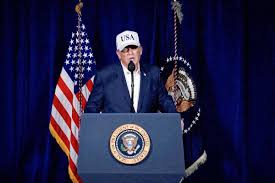
BLUE PRESS JOURNAL -When President Donald Trump authorized military strikes against Iranian targets, he did more than escalate regional tensions—he circumvented the constitutional requirement for congressional authorization, plunging the United States into a legally dubious conflict while viable diplomatic options remained on the table. The decision, executed without legislative approval and justified by rapidly shifting narratives, represents a dangerous expansion of executive war powers that demands immediate scrutiny.
Constitutional Erosion and Unilateral Warfare
Article I of the U.S. Constitution explicitly grants Congress—not the President—the power to declare war. Yet the administration proceeded without congressional debate or authorization, violating the War Powers Resolution’s mandate that the executive branch seek legislative consent for hostilities exceeding 60 days. Legal scholars at the Congressional Research Service note that unilateral strikes against sovereign nations traditionally require congressional backing unless responding to an imminent attack on U.S. territory—a threshold legal experts argue was not met. Senator Tim Kaine (D-VA) condemned the action as an “unconstitutional act of war,” filing a formal resolution to restrict further hostilities and force a floor debate on the engagement’s legality.
Diplomatic Arson Amid Negotiations
The timing proves particularly egregious. Even as Iranian and American diplomats reportedly engaged in back-channel discussions regarding nuclear non-proliferation and regional stability, the administration opted for kinetic force. Arms Control Association analysts confirmed that Tehran had remained technically compliant with the JCPOA’s uranium enrichment limits until the strike shattered the diplomatic framework. The attack effectively torpedoed negotiations, replacing dialogue with missile fire and ensuring a cycle of retaliation that endangered regional civilian populations.
Shifting Sands, Shattering Credibility
Complicating matters further, the administration offered contradictory justifications: initially citing “imminent threats” to U.S. personnel—a claim intelligence assessments later contradicted—while simultaneously floating regime-change aspirations reminiscent of 1953 CIA operations. A Washington Post analysis revealed that within hours of the assault, messaging pivoted from deterrence to “installing” compliant governance, revealing motivations divorced from national security necessity.
Without congressional authorization, strategic coherence, or respect for diplomatic alternatives, this military intervention establishes a troubling precedent: the imperial presidency unchecked, risking American lives and international law for undefined objectives.
 Blue Press Journal