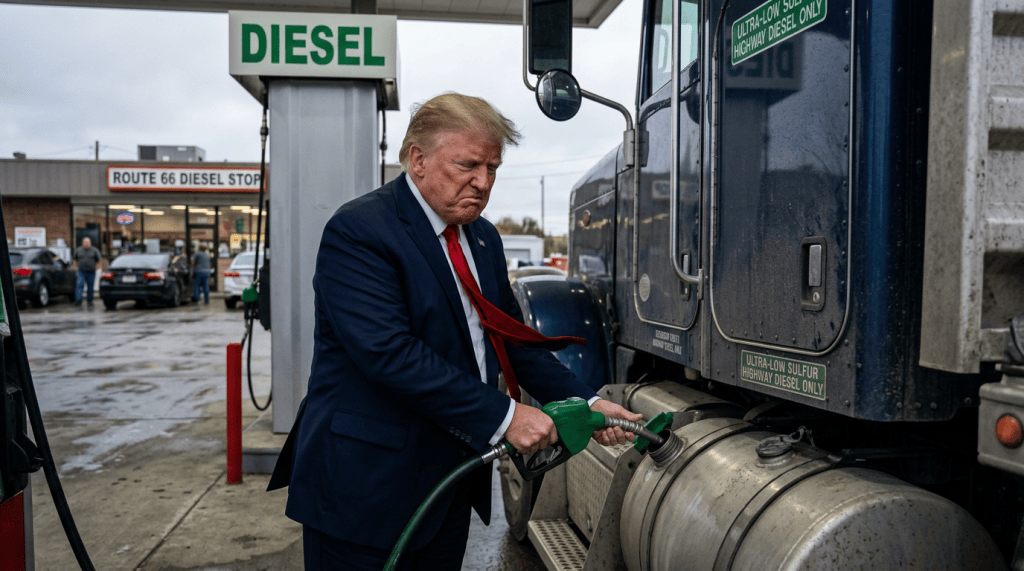
The reality of Donald Trump’s doomed war with Iran is catching up with the general American population. A seemingly quick and easy military mission that was supposed to stabilize the region has blown up in the troubled president’s face, causing the price of diesel to skyrocket to $6.32 per gallon today, as reported on October 6, 2026. The situation with the fuel price is a typical example of how Trump’s policy has affected everyday Americans.
Diesel fuel is an essential part of the American economy because it powers most trucks, tractors, and ships. Nevertheless, the Trump administration seemed to care little about the potential chaos that the conflict in the Mideast could bring. The US Energy Information Administration states that prices at the pump “are determined by crude oil prices, refining costs and profits, and taxes and duties in the country of destination, with the freight rates on crude oil also being a factor.” Additionally, the EIA warns that geopolitical issues could “result in the restriction of crude oil trade routes and petroleum product shipments,” which are already restricted by the Mideast conflict.
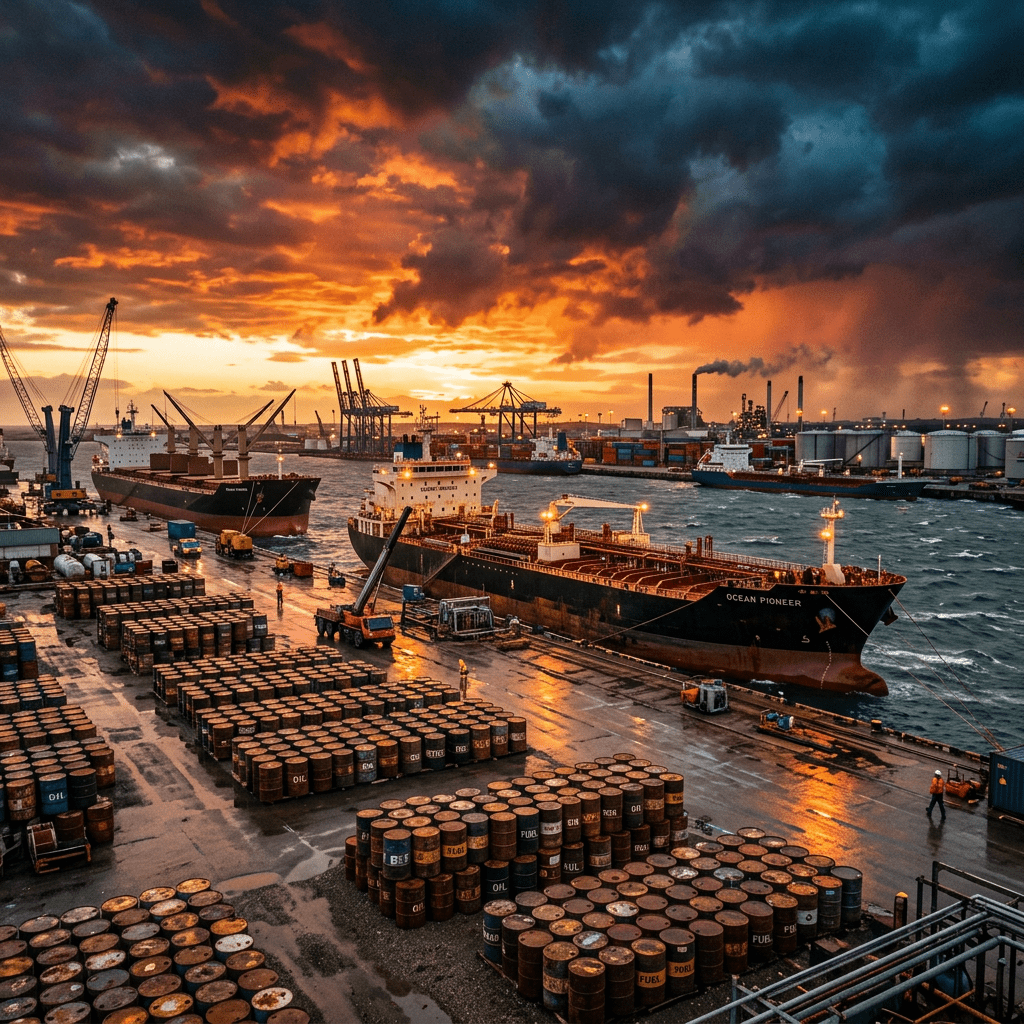
It is evident that the Trump administration’s involvement in the Mideast affair was the cause of the diesel price increase. The American president’s disdain for Iran resulted in the latter being blockaded or heavily militarized in essential trade ports such as the Strait of Hormuz. With the disruption of oil transportation routes, the already high prices of fuel increased as oil became more expensive due to restricted trade.
It is possible to state that Donald Trump’s adventurism in the Mideast led to the supply chain malfunction, which pushed the prices of diesel to unprecedented levels. The Trump administration cared little about the potential economic fallout of the war, or even planed for it.
It is the middle class who suffer the most from the diesel price increases. They represent a significant part of the population that uses this type of fuel for commuting and other daily activities. As a result, ordinary Americans pay for the war with Iran through higher prices at the pump and an overall higher cost of living, with supply chains disrupted and prices inflated.
How Trump’s “Bold” Moves Turned a Working Iran Deal Into a Self-Inflicted Crisis
by Winston Wendell
Wars don’t always begin with explosions. Sometimes you lose before a single shot—when your rivals grow stronger, your network of allies weakens, and your own choices hurt more than help. That’s what happened after Trump tore up the Iran nuclear deal, the JCPOA, and started his so-called “maximum pressure” campaign. Looking back now, it’s clear: all that posturing did more harm than good.
Let’s break down how we got here—how the tough talk just made things messier, gas prices spiked, markets stumbled, and even America’s best friends started doubting us.
Grandstanding Isn’t the Same as Getting Results
Trump loved making a scene. He’d throw out fiery tweets, trash the Iran deal at every rally, and promise something “better.” He called the JCPOA weak, claiming it caved to Tehran and left America empty-handed.
But reality didn’t match the rhetoric. The facts were plain: the JCPOA was working. Iran cut its enriched uranium stockpile by 98%, dismantled thousands of centrifuges, and opened up its nuclear sites to unprecedented inspections from the IAEA. The deal put hard limits in place.
Still, the Trump administration never came up with a better alternative. All “maximum pressure” really meant was punishing sanctions, hoping Iran would fold and come crawling back. Of course, that didn’t happen. Instead, Iran held its ground, which is pretty much what history teaches us about relying on pressure without a backup plan.
Walking Away From Progress
The Decision
In May 2018, Trump yanked America out of the JCPOA and hit Iran with sanctions again. I remember thinking: why break something that’s actually working? The real answer wasn’t about better policy. It was politics.
Immediate Fallout
Iran didn’t just shrug and take it. They cranked up uranium enrichment, ignoring the deal’s strict limits. Suddenly, the path to building a bomb got a lot shorter.
Diplomatic ties started unraveling. The negotiating group shrank, with the U.S. out and Europe struggling to shield Iran from American sanctions. Everyone’s bargaining power sagged without U.S. support.
America’s allies noticed. When one country tears up a major deal, trust dries up fast. It’s not easy earning that back.
Leaving the JCPOA handed Iran a whole new set of advantages: the freedom to enrich more uranium, the chance to play the victim, and a divided bunch of opponents.
The Economic Domino Effect: Oil, Markets, Wallets
Oil Prices Spike
Sanctions knocked 2–3 million barrels of Iranian oil a day off the world market. Saudi Arabia and Russia tried to cover the slack, but oil prices still jumped from $70 a barrel to nearly $85 in a few months.
We felt it, our weekly gas bill jumped about 15%. Drivers everywhere noticed, along with businesses shipping goods or running trucks.
Markets Wobble
Investors hate not knowing what’s next. Trump’s moves spread uncertainty all over:
Stock markets bounced around, especially for energy companies and businesses with a Middle East footprint. Countries like India, China, and South Korea scrambled to find new oil suppliers. Their budgets felt the hit and so did the cost of goods at home.
These numbers weren’t just for headlines. Groceries cost more, energy bills crept up, and even retirement savings got dinged if they were tied to the markets. Decisions in Washington rippled straight to regular people.
Leaving Allies Out to Dry
Europe on the Spot
Europe tried to save the JCPOA with a workaround, INSTEX, but without U.S. backing, European companies ran for cover. I remember German and French leaders sounding pretty frustrated, caught between supporting the deal and avoiding U.S. penalties.
Asia’s Dilemma
Japan and South Korea got a few short-term waivers to keep buying Iranian oil. But every few months, diplomats scrambled to figure out what Washington would do next. It was exhausting for everyone involved.
Trust Gets Shaky
When the rules keep changing, allies grow suspicious. NATO wasn’t thrilled. Neither were old partners, watching America toss aside another agreement. Doubt crept into military exercises, intelligence sharing, and every future negotiation. And that kind of mistrust is hard to reverse.
Why “Maximum Pressure” Missed the Mark
The biggest mistake? Betting it all on sanctions without leaving room for real negotiation. Iran’s leaders just doubled down, ramped up their nuclear work, and kept stirring up trouble in the region. More pressure just meant less cooperation, not more.
So what did the U.S. get? A dead inspection program, an Iran with more nuclear options, shaky world markets, and cooler alliances all around. Everyday Americans ended up paying for it.
Honestly, a smarter move would’ve been to stick with JCPOA inspections and use them as leverage to fix the deal’s flaws on missiles, on regional actions. Not trashing the whole thing.
Lessons for Next Time
Here’s what I take away:
If something’s working, don’t destroy it, improve it. Check if it’s actually hitting its goals, then build on that. Sanctions only work if there’s an exit. Just squeezing harder makes the other side push back.
Stay tight with partners. America’s strongest when its friends trust and cooperate. Go it alone, and you end up isolated and less effective.
When Showmanship Wins, Everyone Pays
I watched the fallout from one attention-grabbing decision echo all the way from the UN to my local pump. Trump’s bold moves made for good TV but wrecked progress and ordinary people picked up the bill.
The Iran deal wasn’t perfect, but it did the job. Scrapping it gave Iran new momentum, touched off economic pain, strained alliances, and made life harder for regular folks.
If we want to avoid repeating this, we need to stick with what works, trust the facts, and focus on steady, smart partnerships. Real strength isn’t just about big talk. It’s about reliable leadership that others (and the world) can count on.
If this breakdown made sense to you, pass it on or subscribe for more straight-shooting analysis on politics, economics, and global security.
In a move that has stunned Washington and the broader defense community, U.S. Secretary of Defense Pete Hegseth has ordered roughly 800 of the nation’s top military officers—generals, admirals, and their senior enlisted partners—from around the world to return to the United States next week for an unplanned meeting. The orders, first reported by The Washington Post, require every senior officer at the one-star general or rear admiral level and above to gather at Marine Corps University in Quantico, Virginia, on Tuesday.
What makes the summons so alarming is its secrecy. No agenda has been provided, no explanation offered. Officers and analysts alike are left questioning why nearly the entire top tier of U.S. military leadership is being pulled into one room. In an era when global crises can flare at any moment, taking commanders away from their posts without a clear reason feels not just unusual, but potentially reckless.
Whispered Concerns of a Loyalty Oath
Speculation erupted almost immediately. Some worry the Secretary’s intent may have little to do with operational readiness or external adversaries. Instead, they fear this is about reshaping the loyalty of the military itself.
“July 1935 German generals were called to a surprise assembly in Berlin and informed that their previous oath to the Weimar constitution was void and that they would be required to swear a personal oath to the Führer,” wrote retired U.S. Army Lieutenant General Ben Hodges on social media. “Most generals took the new oath to keep their positions.”
The chilling historical parallel was not lost on readers. While no evidence has yet surfaced that an oath of loyalty to the President—or to Hegseth personally—will be demanded, simply invoking that possibility has raised the stakes considerably.
Critics See Recklessness and Ego
Several senior veterans were quick to voice their outrage at what appears to be, at best, a costly and distracting exercise. Fred Wellman, a West Point graduate, Harvard Kennedy School alumnus, and 22-year combat veteran, did not mince words:
“You are pathetic,” Wellman declared in response to Hegseth’s public barbs directed at retired generals. “Supposed to be leading the largest department of our government with millions of troops and civilians and you are trolling retired generals who served honorably longer and more heroically than you could. You’re not even a good squad leader.”
Marc Polymeropoulos, a retired senior officer from the CIA’s clandestine service, echoed concerns about both the practicality and optics of such a meeting. “So it’s a juvenile Rah Rah high school football speech, that cost[s] a ton of money, takes leaders out of positions in where they [are] managing crises, and puts a massive target on Quantico,” he warned. “Plus they all gonna get stuck when govt shuts down. Genius all around.”
Warrior Ethos or Political Theater?
According to The Washington Post, the meeting is expected to feature Hegseth speaking at length about his personal beliefs and vision for what the U.S. military should be—a framework he calls his “warrior ethos.” While a defense secretary is entitled to articulate philosophy and direction, doing so with the nation’s entire top brass in a single, closed-door session comes across as both unorthodox and troublingly opaque.
At a time when U.S. forces face simultaneous challenges on multiple fronts—Ukraine, Israel-Gaza, Taiwan, cyber threats—removing senior leaders from their commands for what critics are characterizing as a motivational sermon seems difficult to justify.
A Dangerous Precedent?
The principle that the U.S. military serves the Constitution, not any individual, has been one of the Republic’s most foundational guardrails. Even the appearance of undermining that norm can carry dangerous consequences, not only for civil-military relations but for international confidence in American stability.
Is this extraordinary recall a prelude to something significant, or just an ill-conceived attempt at motivational theater? Until Tuesday, the defense world—and the nation—are left with only speculation and the unsettling feeling that transparency has once again fallen victim to politics.