Tag: Big Beautiful Bill

  • The Gutless Party: How Republicans Abandoned Their Principles to Appease Donald Trump

    The Republican Party has long been known for its values of fiscal responsibility and limited government intervention. However, recent events have exposed a stark reality: the party has lost all credibility and has become a mere puppet of Donald Trump. The latest example of this is the passage of the, “Big Beautiful Bill”, that increases the national debt and cuts vital social programs, despite numerous Republican lawmakers expressing strong opposition to it beforehand.

    In the days leading up to the vote, several prominent Republicans spoke out against the bill, citing concerns over its impact on the nation’s finances and vulnerable populations. Senator Ron Johnson (R-Wis.) warned that the bill would “steal from our children and grandchildren” by adding to the $37 trillion national debt. Senator Josh Hawley (R-Mo.) vowed not to support the bill due to its “real Medicaid benefit cuts,” which he deemed unacceptable for any Republican. Representatives Chip Roy (R-Texas) and Keith Self (R-Texas) also expressed strong reservations, with Roy calling the bill a “travesty” and Self emphasizing the need to avoid saddling future generations with an exploding national debt.

    Moreover, Representative Ralph Norman (R-S.C.) was adamant in his opposition, stating that he would vote against the bill on the floor. These statements suggest that many Republicans were deeply troubled by the bill’s provisions and were willing to take a stand against it.

    However, when it came time to cast their votes, many of these same lawmakers caved to pressure and supported the bill. The most notable example is Senator Lisa Murkowski (R-Alaska), who provided the tie-breaking vote in favor of the bill. This is particularly egregious given that Alaska is one of the most rural states in the country, and the cuts to Medicaid, Medicare, and SNAP (Supplemental Nutrition Assistance Program) will disproportionately harm its residents.

    So, why did Murkowski and other Republicans who had previously spoken out against the bill ultimately vote for it? The answer is simple: gutlessness. They prioritized their loyalty to Donald Trump and the party leadership over their principles and the well-being of their constituents.

    This lack of backbone is not limited to Murkowski. The fact that so many Republicans who had expressed strong reservations about the bill ultimately voted for it suggests that the party has become beholden to Trump’s demands, rather than standing up for their own values and constituents.

    The implications of this are far-reaching. If Republicans are willing to abandon their principles and ignore the needs of their constituents to appease Trump, then they have lost all credibility as a party. They can no longer claim to be the champions of fiscal responsibility, limited government, and social conservatism. Instead, they have become a party of sycophants, willing to do whatever it takes to maintain power and appease their leader.

    As the country moves forward, it is essential to recognize the Republican Party for what it has become: a gutless party that prioritizes loyalty to Trump over all else. The American people deserve better than a party that is willing to sacrifice its principles and values for the sake of political expediency. It is time for Republicans to take a stand and reclaim their party from the grip of Trump’s authoritarianism. Until then, they will remain a party without credibility or conscience.
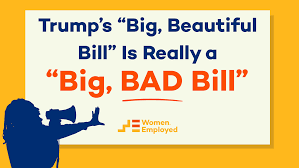
  • The “Big Bad Bill” is bad for America: Take Action!!

    Highlights of The Senate Bill

    The Senate Republican legislative package, referred to by its proponents as a “big, beautiful bill,” passed Tuesday the Senate by the slimmest of margins – a single vote. This contentious outcome reflects the deeply divisive nature of the bill’s provisions and its projected far-reaching consequences for various segments of the American population. Democrats argue the bill disproportionately benefits the wealthiest Americans while significantly curtailing vital social safety nets, impacting healthcare, education, environmental initiatives, and immigration policies. Even Elon Musk was against it!

    The nearly 900-page bill, fast-tracked through the Senate, saw Republican leadership making last-minute adjustments, reportedly to secure the minimum votes for passage. This legislative effort is criticized for its fundamental financial reordering: a substantial portion of its funding comes from drastic cuts to federal programs, particularly Medicaid, which faces over $1 trillion in reductions. Concurrently, it allocates an estimated $975 billion in tax breaks, primarily benefiting the wealthiest 1% of the country, with little direct benefit for average taxpayers.

    Impacts on Healthcare and Social Safety Nets

    The bill’s sweeping cuts to Medicaid are projected to remove nearly 12 million people from their health insurance coverage. Beyond individual impact, this has severe implications for healthcare infrastructure: an analysis by Families USA indicates 55 independent rural hospitals, already part of 380 at-risk facilities nationwide, face new and serious threats of closure. Similarly, researchers at Brown University’s School of Public Health estimate that nearly 600 nursing homes across the country are at high risk of shutting down due to these Medicaid reductions, potentially “throwing grandma out.”

    Further impacting vulnerable populations, the bill also proposes a $285 billion cut to food assistance programs for low-income individuals and children.

    Economic and Educational Consequences

    Economically, the legislation is expected to result in significant job losses. An analysis by George Washington University and the Commonwealth Fund projects approximately 477,000 healthcare workers could lose their jobs over the next decade due to Medicaid cuts.

    In the clean energy sector, the immediate elimination of federal tax credits for wind and solar energy projects is anticipated to halt billions of dollars in private investment, leading to hundreds of thousands of job losses, according to the League of Conservation Voters.

    Education access is also affected. The bill reportedly redesigns federal student loan programs, making it more challenging for low- and middle-income borrowers to qualify for and afford loans. New borrowers would primarily rely on a new “Repayment Assistance Program” (RAP), which could require 30 years of payments, in contrast to existing programs (like SAVE) offering debt relief in 10-25 years.

    Immigration Enforcement and Family Unity

    Regarding immigration enforcement, the bill allocates nearly $30 billion to Immigration and Customs Enforcement (ICE). This funding not only supports increased agents and upgraded facilities but also explicitly directs ICE to use resources for “promoting family unity by detaining alien parents with their children,” a provision that has drawn significant criticism for its approach to family separation and detention.

    Conclusion

    The legislative package, passed by the narrowest of margins, represents a significant policy shift. Democrats contend its primary effect is a substantial transfer of wealth to the nation’s wealthiest through tax breaks, financed by extensive cuts to critical social programs. This approach, they argue, has far-reaching negative consequences for healthcare access, educational affordability, job security, and the well-being of vulnerable populations, explaining the Republican limiting debate of the bill during the holiday weekend.

    Next call/email your congressperson and tell them not to support the bill when it returns to the congress here.

  • The Republican Budget Dilemma: Why Are They Hurting Their Own Voters?

    The current struggle among Senate Republicans this week to pass a budget proposal, which is unpopular, reveals a deep internal conflict, one that goes beyond typical political disagreements. According to some analysis, the core difficulty lies in a stark reality: a significant number of Republican lawmakers understand that the very people most likely to be negatively impacted by the proposed cuts are their own constituents – the Republican voters.

    Under discussion is a plan described by some as potentially adding a significant $2.8 trillion to the national debt by 2035. Yet, despite this substantial increase in borrowing, the plan reportedly includes deep cuts to vital social programs like Medicaid and Obamacare. These cuts are projected to be severe enough that an estimated 11.8 million people could lose their health insurance coverage. Beyond healthcare, millions more Americans would likely lose access to other essential services upon which they rely.

    Analysis indicates that these reductions would have a significant and disproportionate impact on residents of “red states,” which are integral to the Republican constituency. This consequence would predominantly affect Republican voters, a group that notably includes many individuals from the MAGA demographic.

    This situation presents a peculiar political paradox. If the proposed plan simultaneously increases the national debt by trillions and inflicts significant pain on the party’s own voters, why would Republicans push for it? Specifically, if they are already willing to go $2.8 trillion deeper into debt, why wouldn’t they allocate an additional amount – say, the $930 billion mentioned in one calculation – to mitigate the damage and protect their constituents’ healthcare and services? If debt is acceptable, why not use a fraction more to shield their base from harm?

    The answer, according to the perspective offered here, points towards a fundamental shift in the dynamics of the Republican Party. It suggests that the party’s actions and priorities are no longer driven purely by traditional calculations of representing constituent interests or adhering strictly to fiscal conservatism. Instead, this viewpoint posits that the party has transformed, now operating less as a conventional political organization and more as something resembling a “Trump’s cult.”

    From this perspective, the audacity to harm their own supporters while recklessly escalating the national debt transcends mere policy or political maneuvering; it reveals a troubling allegiance to a non-traditional agenda dictated by the party’s powerful figurehead, Trump. This profound analysis uncovers that the ongoing budget impasse is far more than a dispute over legislative minutiae; it is a glaring symptom of a party whose very identity and motivations have undergone a dramatic transformation and no longer represents the American public. .

    The polls:

    Fox News poll found that 38% of registered voters support the “One Big Beautiful Bill” based on what they know about it, while 59% oppose it.

    The survey found that the legislation is unpopular across demographic, age and income groups. It is opposed 22%-73% by independents, and 43%-53% among white men without a college degree, the heart of Trump’s base.

    Quinnipiac University poll found that 27% of registered voters support the bill, while 53% oppose it. Another 20% had no opinion. Among independents, 20% said they support it and 57% said they oppose it.

    KFF poll found that 35% of adults have a favorable view when asked about the “One Big Beautiful Bill Act,” while 64% have an unfavorable view. Just 27% of independents said they hold a favorable view of it.

    A survey from Pew Research Center found that 29% of adults favor the bill, while 49% oppose it. (Another 21% said they weren’t sure.) Asked what impact it would have on the country, 54% said “a mostly negative effect,” 30% said “a mostly positive effect” and 12% said “not much of an effect.”

    A poll by The Washington Post and Ipsos found that 23% of adults support “the budget bill changing tax, spending and Medicaid policies,” while 42% oppose it. Another 34% had no opinion.

  • GOP’s ‘Big Beautiful Bill’ Favoring Wealthy, Adding Trillions to Debt Amidst Budget Gimmick

    A Republican Senate legislative effort, reportedly dubbed the “Big Beautiful Bill,” is facing significant criticism for its potential impact on the national debt and the distribution of its benefits. Democrats argue the bill is heavily skewed towards the wealthy, providing significant tax cuts for that millionairs and billionaires while offering little benefit for the average American, simultaneously adding trillions to the national debt.

    Official budget scorekeepers for Congress, the Congressional Budget Office (CBO) and the Joint Committee on Taxation (JCT), estimate the cost of President Trump’s tax and spending bill at $4.5 trillion. This figure is reportedly $500 billion more than the House version of the proposed legislation. Concerns are further amplified by projections that the cost could rise to nearly $5 trillion if temporary business tax cuts included in the bill are made permanent.

    Adding to the ongoing controversy, Republicans have shockingly resorted to a new budget gimmick designed to conceal the true cost of the bill! This audacious maneuver unfolds against the backdrop of heated debates over the Senate’s filibuster rules, with critics passionately framing it as a blatant assault on democratic principles!

    Procedural maneuvers in the Senate have also drawn scrutiny. To avoid a potentially adverse opinion from the parliamentarian on a specific matter related to the bill’s passage, Republicans reportedly blocked the parliamentarian from ruling on it. This tactic seemingly allowed them to bypass the need to overrule the parliamentarian on the Senate floor – a move they had reportedly vowed never to do and for which they likely lacked sufficient votes. Instead, senators voted to support Senator Graham’s authority, as Chairman of the Budget committee, to use “current policy” within the reconciliation process.

    Details emerging from the bill’s components include a proposed amendment by GOP senators that aims to shrink the Medicaid program by another $313 billion, adding another layer of criticism regarding the bill’s priorities and impact on social programs.

    Democrats contend that the bill represents a significant shift of wealth towards the top while placing a substantial burden on future generations through increased national debt, with questions remaining about its fiscal impact and the methods used for its potential passage.