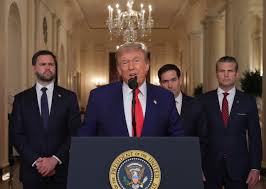
President Trump’s address last night regarding the decision to join Israel’s military action against Iran was remarkably brief – under four minutes – and offered virtually no strategic rationale. This lack of explanation is particularly perplexing given his recent claims of making progress in talks with Iran. Why, then, was this attack launched?
The strategic thinking articulated by Trump appears to contradict the views of most experts. The overwhelming consensus is that Iran will now retaliate and that prospects for a future agreement with the U.S. have significantly worsened. Adding to the concern, his short speech included explicit threats of further military action.
For what is arguably the most consequential foreign policy decision of his second term, the American public received virtually no justification or strategic insight of why he has dragged us into this conflict. While suggesting a path toward de-escalation, he provided no clarity on how this could possibly be achieved immediately after initiating an attack, or how it would encourage Iran to negotiate. His remarks at times seemed confused, weak and contradictory. The action is almost certain to provoke substantial, escalatory retaliation, not just symbolic gestures. Many states have now heightened their readiness for potential threats here in the United States.
Trump’s decision comes amidst considerable domestic disagreement over Iran policy, even fracturing his own political base. Critics warn that this approach risks entangling the United States in an unpredictable and costly regional conflict.
The question now is: what comes next? It is almost certain that Iran will leverage its resources to retaliate against the United States, initiating a conflict widely seen as lacking both strategic logic and clear necessity.

 Blue Press Journal