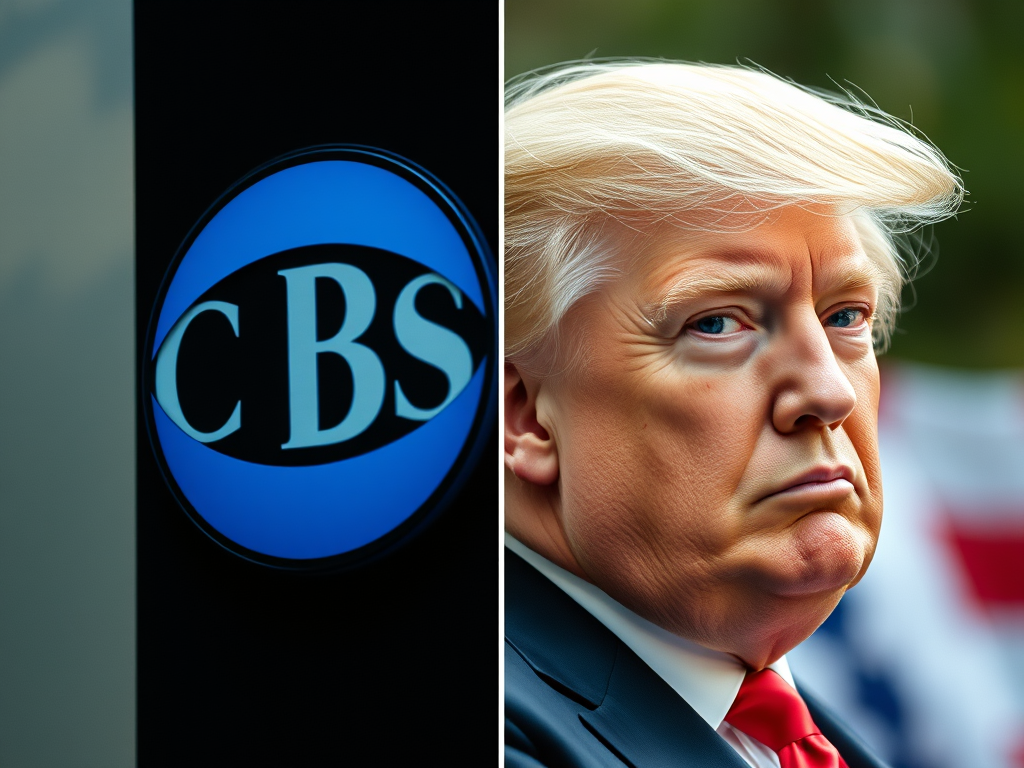
The Battle for Public Perception
Blue Press Journal – In the chaotic aftermath of the shooting death of Renee Good by ICE agent Jonathan Ross, the Trump administration has struggled to maintain control of the public narrative. After initial attempts to label Good as a “domestic terrorist” failed to resonate with the American public, the White House appears to be shifting tactics. The new strategy relies on drip-feeding carefully curated information to a seemingly sympathetic media landscape.
The latest chapter in this unfolding saga involves a report from CBS News, citing anonymous sources regarding the physical state of the ICE agent involved. For observers of both media ethics and political accountability, this incident raises troubling questions about the integrity of news reporting and the influence of political appointees within legacy media institutions.
The “Sympathetic” Leak: Anatomy of the CBS Report
Yesterday, CBS News published a report that immediately rippled through conservative media circles. The article claimed that Jonathan Ross, the ICE agent who shot and killed Renee Good, “suffered internal bleeding to the torso following the incident.” The report attributed this information to “two U.S. officials.”
While the headline-grabbing claim of “internal bleeding” suggests a violent, life-threatening struggle, a closer look at the reporting reveals significant gaps:
- Vague Terminology: “Internal bleeding to the torso” is a broad medical description. Without hospital records, diagnostic imaging, or independent medical verification, the phrase remains unsubstantiated.
- Anonymous Sourcing: The officials who provided the tip have not been named, nor have they responded to follow-up inquiries, according to CBS’s own reporting.
- Timing Ambiguity: The phrase “following the incident” is temporally vague. It could imply an injury sustained during the encounter, or a medical condition that arose hours or days later.
Visual Evidence vs. Official Claims
One of the most significant contradictions in this narrative lies in the available visual evidence. Video footage taken moments after the shooting depicts Agent Ross walking unassisted, handling his equipment with precision, and appearing notably composed.
Critics have pointed out that an individual suffering from severe internal bleeding—a life-threatening condition involving hemorrhage within the abdominal cavity—would likely exhibit signs of shock, distress, or physical incapacitation. Yet, footage shows Ross drawing his weapon, maintaining his balance, and inspecting Good’s vehicle without any visible signs of distress.
This discrepancy between the visual record and the anonymous leaks suggests that the administration’s narrative may be more about public relations than forensic fact-finding.
The Role of the New CBS News Leadership
To understand how such a thinly sourced story made it to air, one must look at the recent leadership changes at CBS News. In a move that critics view as an attempt to align the network’s editorial stance with the administration’s interests, the Trump administration has installed a new director widely perceived as a political loyalist.
This appointment marks a significant shift in CBS’s editorial independence. Under this new leadership, the network’s standards for vetting information appear to have changed abruptly. While a rigorous, months-long investigation into torture at CECOT (the Terrorism Confinement Center in El Salvador) was reportedly suppressed—allegedly due to the administration’s refusal to provide an on-camera response—a dubious, anonymously sourced claim about an ICE agent’s health was published with minimal verification.
This “two-tiered” approach to journalism—strict scrutiny for administration critics and leniency for administration allies—undermines the network’s credibility. It suggests that the new director may be functioning effectively as a “plant” for the administration, facilitating the flow of propaganda rather than independent news.
Political Reaction: Weaponizing the Leak
The leaked report to CBS quickly became a tool for political messaging. Vice President JD Vance took to social media to mock the public’s skepticism, stating, “While much of left has lied about this case, it turns out ramming a law enforcement officer with a car causes injuries. Who knew!”
This reaction highlights the administration’s strategy: utilizing media leaks as “smoking gun” evidence to shut down debate. By framing the discussion around an unverified medical claim, the administration diverts attention from the central issue—the use of lethal force by a federal agent against a civilian.
Demand Transparency and Accountability
The reporting on Renee Good’s death has become a case study in modern information warfare. The Trump administration’s manipulation of the narrative, combined with the willingness of a compromised CBS News to act as a conduit for unverified leaks, distorts the public’s understanding of the event.
By reporting an unverified claim from anonymous sources that aligns perfectly with the White House’s preferred narrative, Bari Weiss, as the editor-in-chief of CBS News, is not acting as a watchdog but as a stenographer. This erodes public trust and creates an environment where official narratives—no matter how thin—can be presented as fact.
 Blue Press Journal