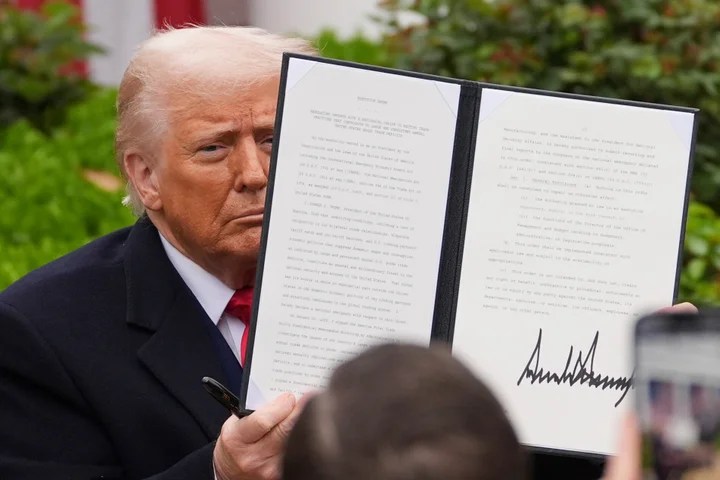
The absurd tale that inspired Trump’s tariffs plan is truly a masterpiece of deception and delusion. In a stroke of genius, Peter Navarro, a key adviser to President Trump, conjured up a fictional character named Ron Vara to bolster his arguments about the economic threat posed by China. This phantom figure, with his fake memo and fake email address, managed to convince Trump to embrace the idea of tariffs as a solution to all of America’s problems.
Now, as we witness the havoc wreaked by Trump’s tariffs on the U.S. economy, we can only shake our heads in disbelief. Who knew that all it would take to bring about economic ruin was a president with “great ideas” and a penchant for imaginary experts? The sheer audacity of it all is truly mind-boggling.
So, here we are, in the midst of economic chaos, all thanks to the brilliant mind of Donald Trump. Who needs real experts and sound economic policy when you have a fictional character like Ron Vara to guide the way? It’s a tale for the ages, a cautionary fable about the dangers of putting your faith in fake news and fake experts and Donald Trump!
Few Republicans are willing to defend the president’s tariffs, leaving the party vulnerable for the first time in Trump’s new term. The implementation of these tariffs marks a significant shift from the global trend of decreasing trade barriers, with economists warning that Americans could face thousands of dollars in increased prices each year, while the U.S. economy is expected to slow sharply.
The impact of these tariffs will be particularly harsh on Asian countries, with duties on Vietnamese imports rising to 46% and on Indonesia to 32%. Some Chinese imports could face tariffs as high as 79%, affecting major U.S. import sources for shoes like Nike, which produced half of its shoes and one-third of its clothing in Vietnam last year.
Best Buy’s stock plummeted by a staggering 17.8%, a devastating blow attributed to the global production of its electronics. United Airlines also suffered a significant loss of 15.6%, as fears of a weakening global economy deterred customers from traveling for business or leisure. Target, too, experienced a sharp decline of 10.9%, with concerns mounting over the financial strain on its customers amidst persistent inflation. The once thriving giants of the retail and travel industries now find themselves teetering on the edge of uncertainty, as the world grapples with economic turmoil.
The report, which cited two U.S. officials, has raised eyebrows, especially considering Musk’s business interests in China, a major U.S. adversary, as the country plays a significant role in Tesla manufacturing.
Elon Musk, now a so-called defense expert, is strangely entangled in slashing federal jobs and undermining our veterans. Can we genuinely afford to have a South African immigrant privy to such sensitive and classified information? It feels like there’s a far more sinister agenda at work, aimed at dismantling our federal agencies and eroding crucial services. This scenario reads like a chilling plot from a dystopian novel, where a foreign power infiltrates and takes control of the United States from the inside! And let’s not overlook Trump’s cozy relationship with Russia and his alarming shift in stance on Ukraine.
The plans to brief Musk on the top-secret preparations have been independently confirmed by several news outlets. However, it remains unclear if the briefing will proceed following these reports.
Musk is reportedly planning to cut up to 60,000 civilians from the Defense Department, according to a senior defense official. It does not sound like Trump and Musk are truly serious about protecting the United States. Once again, it reads like a plot of a takeover of the United States.
For years, the debate around tariffs has raged, often framed as a tool to protect domestic industries and bring jobs back home. However, a closer look reveals a less palatable truth: tariffs, ultimately, hit the pockets of American consumers hard. While the intention might be noble, the reality is that these taxes on imported goods often translate into higher prices, reduced choices, and a weakened economy for everyone.
So, how do tariffs negatively impact the average American? Here’s a breakdown:
1. Higher Prices for Everyday Goods: This is perhaps the most immediate and noticeable effect. When a tariff is placed on imported goods like clothing, electronics, or even ingredients for our favorite foods, the cost of importing those goods increases. Businesses, often with tight margins, are left with two choices: absorb the cost (which can be unsustainable) or pass it on to the consumer in the form of higher prices.
Think about that imported washing machine you were looking to buy. A tariff on imported steel, for example, increases the cost of the materials used to make it, driving up the retail price. Suddenly, that washing machine isn’t so affordable anymore. This applies to countless products we use daily, from smartphones to coffee beans.
2. Less Choice and Reduced Competition: Tariffs protect domestic industries by making imported goods less competitive. While this sounds good on paper, it can stifle innovation and lead to complacency. Without the pressure of foreign competition, domestic companies may become less motivated to improve their products, offer competitive pricing, or explore new innovations.
This translates to fewer choices for consumers. Instead of having a range of products to choose from, consumers might be stuck with fewer, potentially more expensive, options offered by a shrinking pool of domestic suppliers. This lack of competition ultimately limits consumer power and pushes prices higher.
3. Supply Chain Disruptions and Increased Uncertainty: Modern supply chains are incredibly complex and interconnected. Tariffs disrupt these carefully orchestrated systems, forcing businesses to scramble for alternative suppliers, which can be time-consuming and costly. This disruption can also lead to shortages of certain goods, further driving up prices.
Moreover, the uncertainty surrounding tariffs can scare businesses from investing and expanding. The threat of new tariffs or changes to existing ones makes it difficult for companies to plan for the future, leading them to delay investments, cut back on hiring, and ultimately hindering economic growth.
4. Retaliatory Tariffs and Trade Wars: Tariffs rarely happen in isolation. When one country imposes tariffs on another, the affected country often retaliates with its own tariffs. This tit-for-tat escalation, known as a trade war, can severely disrupt global trade and damage economies on both sides.
American farmers, for instance, have been significantly impacted by retaliatory tariffs on agricultural products. Reduced demand for their goods leads to lower prices and financial hardship, demonstrating the widespread impact of trade wars that ultimately impact consumers through higher grocery bills.
5. Reduced Purchasing Power: Ultimately, the combined effect of higher prices, reduced choices, and economic uncertainty translates to a reduced purchasing power for American consumers. Every dollar spent on higher-priced goods is a dollar less that can be used for other necessities, savings, or investments. This can have a significant impact on household budgets, particularly for low- and middle-income families.
While Trump often argues for their benefits in protecting domestic industries, the evidence suggests that the costs far outweigh the benefits, particularly for US consumers. Tariffs act as a hidden tax, eroding purchasing power, limiting choices, and disrupting the economy. A focus on free trade, fair competition, and policies that foster innovation will ultimately benefit American consumers far more than protectionist measures that leave us all paying the price.
Here we go again with new tariffs! The stock market took a hit last week, and now some of our closest security partners in the European Union are retaliating with their own trade actions. They are imposing new duties on U.S. industrial and farm products in response to the Trump administration’s decision to increase tariffs on steel and aluminum imports to 25%.
The EU’s measures will affect goods from the United States worth a staggering 26 billion euros ($28 billion). These tariffs won’t just target steel and aluminum products, but also textiles, home appliances, and agricultural goods. Specifically, they are aimed at products made in Republican-held states, such as beef and poultry from Kansas and Nebraska, and wood products from Alabama and Georgia. So, MAGA world, get ready to pay the price for your misguided support of Trump.
The new tariffs will cost companies billions of dollars and increase uncertainty in two of the world’s major trade partnerships. Companies will either absorb the losses and see reduced profits, or more likely, pass the costs on to consumers in the form of higher prices. This will lead to increased prices in both Europe and the United States, putting jobs at risk.
Is this really what voters expected? It’s time to rethink our trade policies and work towards mutually beneficial agreements. Let’s prioritize job creation, economic growth, and stability for all parties involved.
Maybe tell Trump to retake Economics 101 because he really has not got a clue.
We have become accustomed to President Trump’s falsehoods, but some may attribute his inaccuracies to his age and forgetfulness. One such instance is the dairy agreement he supposedly made with Canada during his last term in office.
These high tariffs only apply after the US surpasses a specific quantity of tariff-free dairy sales negotiated by (in his first term) Trump each year. The US dairy industry itself acknowledges that the US has not reached its allowed zero-tariff maximum in any dairy product category, including milk!
Furthermore, President Trump falsely asserted that Canadian dairy tariffs increased under President Biden’s administration. In reality, official Canadian documents and industry groups on both sides of the border confirm that Canada did not raise its dairy tariffs under President Biden. The tariffs Trump criticized were actually maintained by the United States-Mexico-Canada Agreement (USMCA), a trade deal negotiated and signed by Trump in 2018.
The US Department of Agriculture website notes that under the previous North American Free Trade Agreement (NAFTA), almost all US agricultural exports to Canada faced no tariffs or quotas. The USMCA preserved this zero-tariff, zero-quota trade while providing greater US access to select Canadian markets governed by supply management.
Canada is the second-largest export market for US dairy products, with approximately $1.1 billion in sales in 2024. Trump seems to forget or maybe it’s just he can’t remember?
Trump inherited a thriving economy, with wages, consumer spending, and corporate profits all on the rise. Unemployment was at record lows. However, just over a month into his term, the outlook has taken a dark turn. The stock market is in turmoil, layoffs are increasing, and forecasters are slashing their growth estimates. Some even predict a potential shrink in the U.S. gross domestic product in the first quarter.
Under Trump’s current policies, we are on the brink of a recession. His decisions have created uncertainty, with tariffs and trade wars threatening to raise prices and slow growth. Federal job cuts are looming, which could lead to higher unemployment rates and decreased spending. Deportations may drive up costs for industries reliant on immigrant labor.
The chaos surrounding Trump’s economic policies is evident. Tariffs are announced and then delayed, government workers are hired and fired in a never-ending cycle. This lack of planning is detrimental to the economy.
Trump’s policies will hinder economic growth, take money out of people’s pockets, and increase unemployment rates. Veterans and regions heavily reliant on federal jobs will be hit the hardest. Trump’s track record of bankruptcies and dishonesty about his net worth only adds to the uncertainty.
Trump’s policies are detrimental to America and its citizens. His lack of understanding and chaotic decision-making are leading us towards an economic downturn. The future looks bleak under his leadership.
The Trump administration decided to spice things up this morning by slapping 25 percent tariffs on imports from Canada and Mexico, and throwing in a new 10 percent tariff on imports from China just for fun.
In response, Canada retaliated by hitting the U.S. with 25 percent tariffs on $30 billion worth of goods. Canadian Prime Minister Justin Trudeau made it clear that these tariffs are here to stay until the U.S. decides to play nice. If not, Canada is ready to whip out some non-tariff measures that will surely make Trump think twice. China also joined the party by imposing tariffs on a variety of American goods, leaving farmers shaking in their boots – Trump’s usual strong supporters.
The stock market took a hit, with the S&P 500 dropping by 1.76 percent, the Dow Jones falling by nearly 650 points, and the Nasdaq Composite down by 2.64 percent. That really great for those retirement accounts. Ontario Premier Doug Ford even threatened to cut off electricity exports to the U.S. if Trump’s tariffs go through, leaving 1.5 million Americans in the dark.
States like Louisiana, Pennsylvania, Florida, and Ohio, which helped Trump get into power, are now facing the consequences of his tariff tantrum. But hey, who needs affordable goods when you can have tariffs, right?
These tariffs are like a gift that keeps on giving – adding thousands of dollars to the price of a new car and overall expenses for consumers. And let’s not forget about
Nearly a century ago, a disastrous law played a significant role in triggering the Wall Street crash of 1929 and plunging the world into a devastating depression. The Smoot-Hawley Tariff, which covered approximately one-quarter of all imports, ignited tensions with U.S. trading partners and led to a drastic reduction in American imports and exports. This painful lesson taught Americans the high cost of trade wars, and serves as a stark reminder that we must carefully consider our trade relationships.
During the previous Trump administration, retaliatory tariffs from trade partners sparked a widespread trade war that negatively impacted various sectors of American industry, including agriculture, manufacturing, aerospace, motor vehicles, and distilled spirits. Canada has already announced retaliatory measures targeting Kentucky products such as peanut butter and whiskey, which will ultimately result in increased costs for American consumers. Senate McConnell emphasized the importance of maintaining strong alliances with our trading partners to ensure the long-term prosperity of American industry and workers, stating that trade wars with allies disproportionately harm working people.
It is imperative that we approach trade policies with caution and foresight, prioritizing collaboration with our allies rather than engaging in harmful disputes. Let us learn from the mistakes of the past and work towards fostering mutually beneficial trade relationships for the benefit of all.
President Donald Trump has implemented a 25% tax on foreign steel and aluminum, which has had significant implications. In the past, tariffs have strained U.S. relations with key allies and led to increased costs for downstream industries.
The steel and aluminum tariffs are particularly impactful on U.S. allies, with Canada being the largest supplier of foreign steel and aluminum to the United States. Research conducted in 2020 by Harvard University and the University of California, Davis, revealed that while the tariffs did create 1,000 jobs, they also resulted in a loss of 75,000 jobs in other sectors.
A study conducted by the U.S. International Trade Commission in 2023 found that in 2021, production at downstream companies decreased by nearly $3.5 billion due to the tariffs. This offset the $2.3 billion increase in production by aluminum producers and steelmakers that year.
To put this into perspective, a typical car contains approximately 1,000 pounds of steel, costing around $6,000 to $7,000 per vehicle. Therefore, a 25% tariff will raise the cost of a car by $1,000 to $1,500. These tariffs have far-reaching consequences that impact various industries and the economy as a whole.






 Blue Press Journal