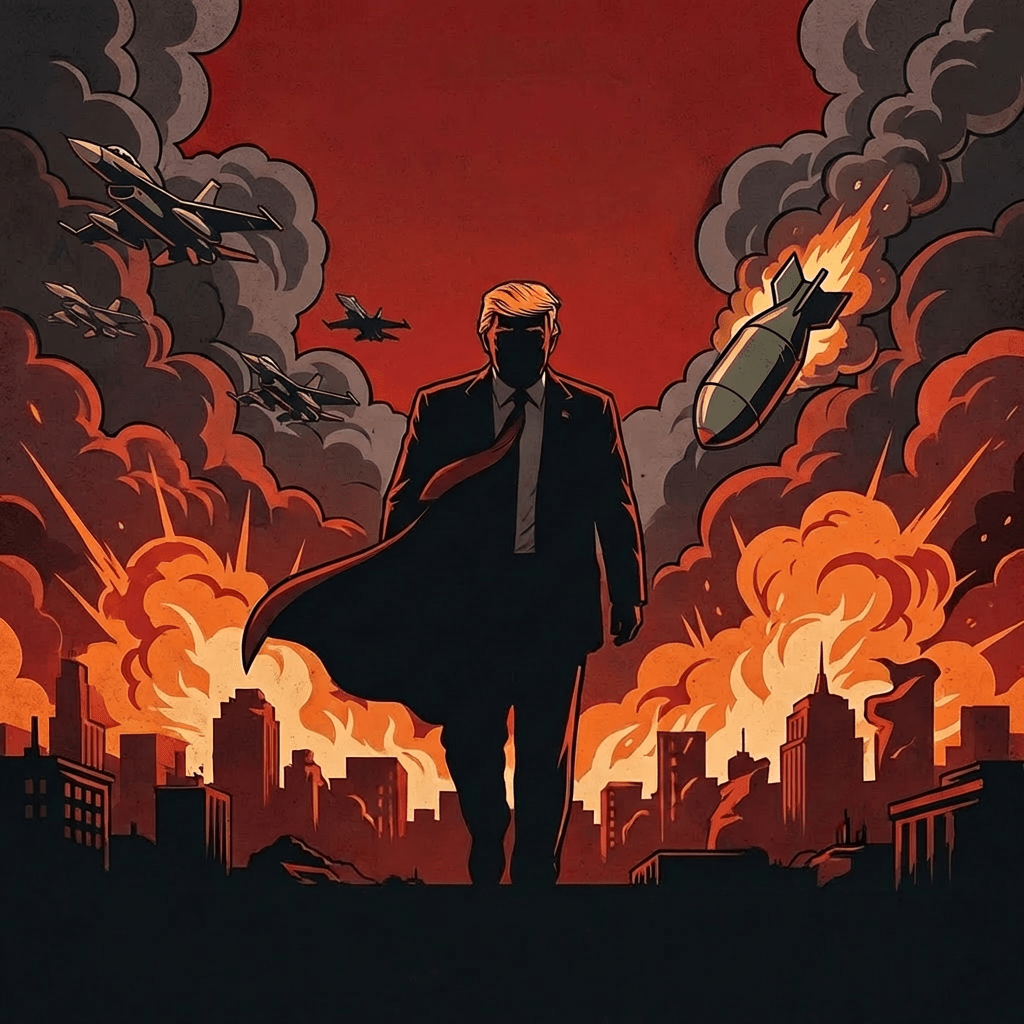
Trump’s Bombs and Bluster
Blue Press Journal – In a scathing rebuke that cuts to the heart of constitutional governance, Senator Tim Kaine (D-Va.) has publicly questioned whether President Donald Trump possesses the mental acuity to recognize that his own foreign policy decisions catalyzed the current crisis with Tehran. Following the launch of “Operation Epic Fury”—a massive aerial bombardment targeting Iranian nuclear and governmental facilities—Kaine asked whether Trump is “too mentally incapacitated to realize that we had a diplomatic agreement with Iran that was keeping its nuclear program in check, until he ripped it up during his first term” (The Hill).
The Virginia senator’s critique centers on the 2015 Joint Comprehensive Plan of Action (JCPOA), the multilateral agreement that had effectively severed Iran’s pathway to nuclear weaponization before Trump unilaterally withdrew the United States in 2018. By abandoning diplomacy for military escalation, critics argue, the administration has not only reignited a dormant nuclear threat but potentially violated Article I of the Constitution, which reserves the power to declare war exclusively for Congress.
Constitutional Crisis and Unauthorized War
The strikes, which commenced early Saturday morning following the breakdown of Geneva negotiations mediated by Oman, represent a dramatic expansion of American military involvement in the Middle East. Unlike the limited June 2024 attacks that Trump falsely claimed had “obliterated” Iran’s nuclear infrastructure, Operation Epic Fury reportedly targets governmental centers in Tehran, including areas proximate to the presidential palace and National Security Council (The Hill).
Legal scholars and lawmakers immediately challenged the administration’s justification—that the attacks were necessary to neutralize “imminent threats” to the American people. “For months, I have raised hell about the fact that Americans want lower prices, not more wars – especially wars that aren’t authorized by Congress, as required by the Constitution,” Kaine stated, echoing bipartisan demands for a War Powers Resolution vote to terminate unauthorized hostilities.
The constitutional violation appears stark: Article I, Section 8 explicitly grants Congress alone the authority to declare war, a constraint the War Powers Resolution of 1973 reinforces by requiring presidential notification and congressional approval within 60 days of introducing armed forces into hostilities. By launching regime-change operations—including Trump’s explicit call for Iranians to “take over your government” following bombardment—without legislative authorization, the administration risks embroiling the nation in an open-ended conflict with catastrophic regional implications (New York Times).
Motivations and Conservative Backlash
Complicating the legal and strategic picture are indications that Trump’s motivations may extend beyond immediate national security concerns. According to Drop Site News, the President posted on Truth Social attempting to justify the strikes by alleging Iranian interference in the 2020 and 2024 U.S. elections—a rationale that shifted abruptly from the “imminent threat” narrative deployed in his official video address.
The dissonance between Trump’s isolationist campaign promises and his current bellicosity has triggered significant backlash within conservative circles. Meghan McCain, conservative commentator and daughter of the late Senator John McCain, noted the irony that MAGA personalities who previously denounced her family as “blood thirsty neocon warmongers” now silent as Trump pursues explicit regime change in Tehran. Meanwhile, Gateway Pundit writer Cassandra MacDonald amplified warnings from Turning Point USA’s Charlie Kirk, who cautioned that “regime change will result in a bloody civil war, killing hundreds of thousands and creating another massive Muslim refugee crisis.”
Escalation Risks and Diplomatic Fallout
As regional tensions metastasize, The New York Times reports that Iranian forces have retaliated by targeting U.S. military installations across the Persian Gulf, including facilities in the United Arab Emirates and Qatar—nations now placed under shelter-in-place orders for American citizens. With Israeli Defense Minister Israel Katz declaring a national state of emergency and F-35s, F-22s, and dual aircraft carriers positioned for sustained operations, the region teeters on the precipice of a wider war that Congress never authorized.
Senator Kaine’s assessment encapsulates the growing alarm: “These strikes are a colossal mistake, and I pray they do not cost our sons and daughters in uniform and at our embassies throughout the region their life.” Whether the judiciary or legislature can restrain an executive branch determined to reshape the Middle East through force—while potentially obscuring strategic failures behind claims of electoral interference—remains the pressing constitutional question of the moment.
 Blue Press Journal