Tag: Cost of Living

  • The Empty Promises at the Pump Essay

    How a Needless Conflict Is Crushing American Family Budgets

    By Winston Wendell

    Gas prices in America have once again reached a breaking point. For many families, the prospect of filling up their cars is an unbearable prospect. Energy prices directly impact the global economy, and its repercussions are being felt by ordinary families. As an essential good, increases in its price effectively act as a tax on all other goods and services.

    The devastating impact of this development is felt most strongly by middle-class families. Yet, what many people fail to understand is that this crisis is a direct result of an avoidable conflict engineered by Donald Trump.
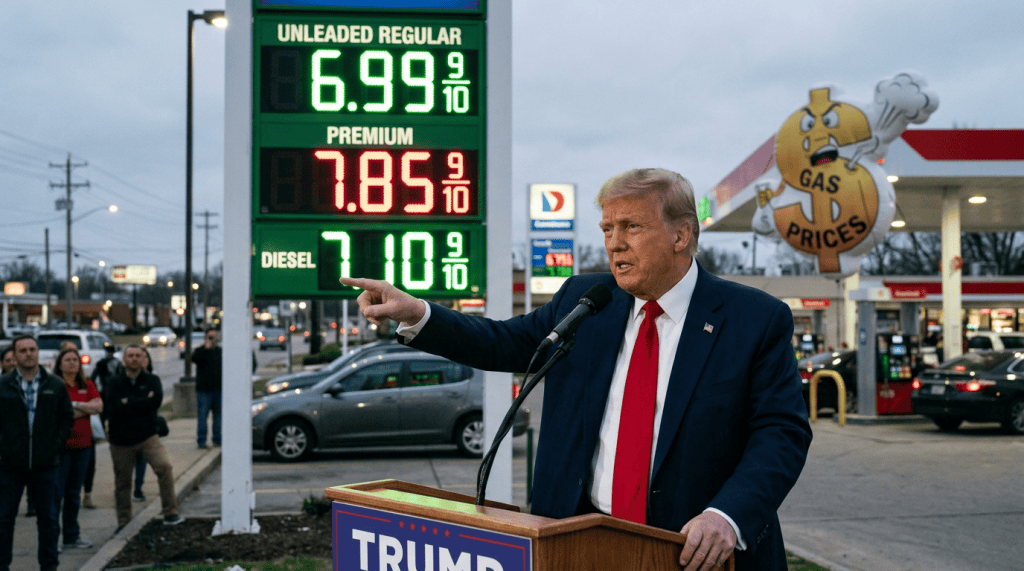
    Donald Trump points while speaking beside gas prices and a TRUMP podium

    During the 2024 election campaign, US president Donald Trump courted working-class voters by promising to ease the rising costs of living. Voters were promised that a Trump administration would be good for the economy and energy prices would plummet. Many were drawn to his populist rhetoric and pledged their vote to the former president, hoping that he would deliver on his promises.

    They delivered their votes, but not much else.

    With little provocation, the President decided to embark on a geopolitical and military adventure in Iran. By fueling a senseless war, Trump pushed global oil prices to a record high, devastating families that trusted him to restore stability to the economy.

    This development is an unforgivable betrayal of the middle-class voters that placed their trust in him. Ordinary Americans that believed in his populism are now faced with the ugly reality of Trump’s presidency. With every visit to a gas station and a grocery store, they are reminded that their president is responsible for their financial struggles.

    These people know that they were misled and their trust betrayed. They understand that the America First rhetoric masked Trump’s recklessness and irresponsibility as a leader.

    For the American middle class, there is no justice. For everyone else, there is at least some form of redemption.

    During the 2024 campaign, commentators, economists, and analysts warned of the potential economic ramifications of Trump’s presidency. They spoke of skyrocketing energy prices and a possible inflation crisis. Throughout the election race, they were dismissed as irresponsible and unworthy of attention.

    Now, as the damage is being tallied, these commentators can finally take a deep breath and say: “we told you so”.

    American families deserve better leadership than what they have been offered during the 2024 campaign. They deserve better than a foreign policy fueled by ego and a domestic policy of perpetual war and division.

    The price for Trump’s vanity and incompetence will be paid in higher gas prices and unbearable costs of living. It is only fitting that those that promoted this vision of America, MAGA, are held accountable. Voters must understand that a vote for a Trump and Republicans are a vote for higher taxes and budget deficits. The electorate needs to hold the president and his Republican Party enablers in Congress responsible for the manufactured crisis at home and abroad.

  • April Inflation Rate Surpasses Predictions: Impacts on Households

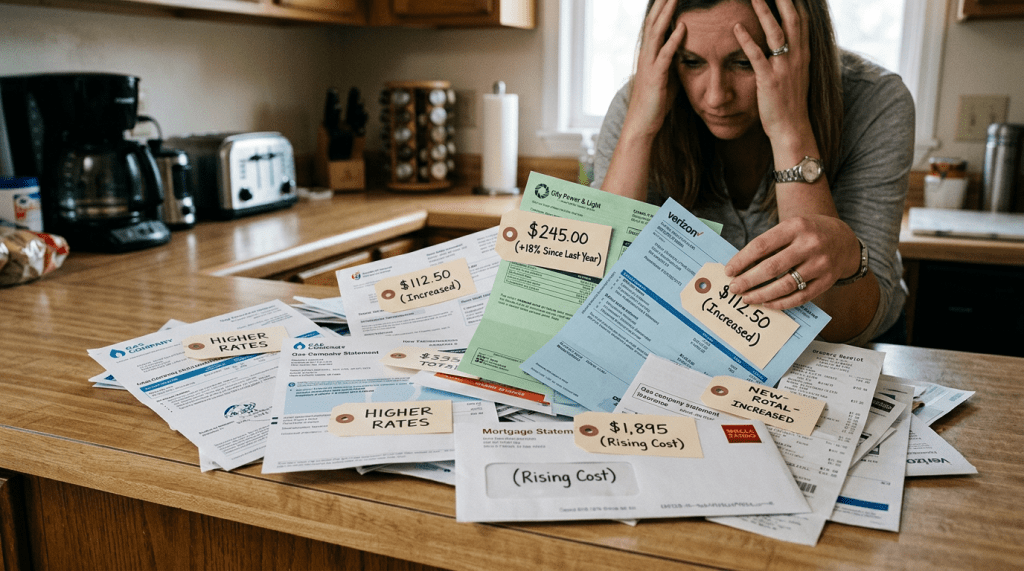
    Woman reviewing various bills showing increased and rising costs for utilities and mortgage
    .

    Increased costs to American households

    by Winston Wendell

    The today’s Consumer Price Index report makes it quite clear: April’s inflation rate climbed by 3.8% compared to the previous year, surpassing Wall Street’s 3.7% prediction. For American households already struggling with rising prices at the grocery store, these figures simply confirm their everyday experience that living expenses continue to increase under Donald Trumps administration.

    Separately today, before heading to a meeting in China, Donald Trump discussed the significant financial burdens associated with his ongoing military actions in Iran. He stated that monetary considerations were not his primary concern when weighed against achieving his military objectives, whatever those are.

    Energy prices led the way, soaring nearly 18% since April 2025. In a country still tethered to unpredictable oil markets, that’s meant higher gas and utility bills for everyone. Grocery shopping hasn’t brought much comfort either. Five out of six major food categories went up, beef’s 2.7% higher, fruits and vegetables bumped up 1.8%. Families just trying to make dinner now face real challenges.

    Economists are no longer tiptoeing around the connection between Washington’s choices and what happens at people’s kitchen tables. Joseph Brusuelas at RSM came right out and said it … the U.S. economy is locked in a higher-inflation mode, and median-income households face tough adjustments for the rest of the year.

    The University of Michigan’s Survey of Consumers reported record-low consumer confidence due to concerns over price hikes from the Iran conflict. Economist Justin Wolfers noted that economic uncertainty arises from “empty promises,” trade disputes, and military actions, leading to a shifting market cycle.

    The public’s just as frustrated as the experts. A recent CNN poll found 70% unhappy with how the administration’s handled the economy, and 75% said the war with Iran has hit their finances personally.

    Alex Jacquez from the Groundwork Collaborative didn’t hold back. He called the situation “Trump’s illegal and reckless war in Iran” and said it “reignited inflation,” and there’s just no clear end in sight.

    April’s CPI report presents a critical question: Will Trump comprehend that his international decisions significantly impact American citizens at the gas station and grocery store? It is evident that voters are continuously forced to shoulder the financial burden of decisions they did not endorse.

  • The Hidden Tax: How Global Conflict is Quietly Draining Our Bank Accounts

    Editorial

    Man in denim jacket refueling black car with gas pump at gas station

    Blue Press Journal – I was standing at the pump this Sunday morning, watching the numbers tick upward on the digital display, and I couldn’t help but feel that familiar, sinking pit in my stomach. Like millions of Americans, I’m constantly balancing the household budget, but lately, that balance feels more like a tightrope walk. 

    With tensions escalating in the Middle East—specifically the war with Iran, which many experts claim was unnecessary, have caused the global oil markets to spike. When crude prices jump in response to the war in Iran, the ripple effect isn’t just felt at the pump; it’s felt at the grocery store, the pharmacy, and every single time we make a decision about our daily commute.

    The Immediate Pain at the Pump

    Energy markets are inherently reactive. According to the U.S. Energy Information Administration (EIA), even a minor disruption in supply chains or a mere risk will cause a push to national averages. When gas prices spike, they act as a “hidden tax” on every American worker.

    Mark Zandi, Chief Economist at Moody’s Analytics, and other economic analysts, have pointed to the regressive nature of high energy prices, noting that they act as a hidden tax that disproportionately impacts low- and middle-income households. When you spend a larger percentage of your income on fuel, you have significantly less discretionary capital left for housing, food, or savings.

    The “Follow-On” Cost: Our Grocery Bill

    What many of us don’t immediately account for is the logistical cost of getting goods to market. Almost everything we buy—from fresh produce in California to electronics in New York—traveled on a truck or train to get to our shelves. As diesel prices climb alongside gasoline, those transportation costs are passed directly to the consumer.

    Consider a hypothetical breakdown of how these costs impact our monthly spending:

    Expenditure CategoryEstimated Weekly Impact of High Gas Prices
    Commuting+$15 – $25 per week
    Grocery/Food Staples+$10 – $20 per week (transportation surcharges)
    Family Activities+$10 – $15 per week (sports/errands)
    Total Estimated Hit$35 – $60 per week

    Tough Choices for Our American Families

    For the average family, an extra $50 a week isn’t just “pocket change.” It’s the difference between a savings account contribution and a credit card balance. I’ve found myself cutting back on non-essential trips, consolidating errands to save on mileage, and—regrettably—choosing generic brands at the grocery store to offset the rising cost of “transported” goods.

    We are entering a season of adaptation. Americans are experts at tightening their belts, but it’s becoming increasingly difficult to find more “slack” in the rope under the Trump administration. We are choosing between the kid’s soccer tournament and an extra trip to the grocery store; we are opting for home-cooked meals over dining out; and we are delaying major purchases while we wait for the economic and political smoke to clear.

    Our Bottom Line

    As of today, analysts from sources like Bloomberg and The Wall Street Journal suggest that while the U.S. is more energy-independent than it was a decade ago, we are still beholden to the global price of oil. Until stability returns to the Middle East, volatility will remain the “new normal.”

    For those of us at the pump this weekend, my advice is simple: track your expenses, prioritize your essential travel, and keep a close watch on your budget. We may not be able to control the price of a barrel of oil or the war in Iran, but we can manage how we navigate the political choices at home. It’s clear the Trump administration has made bad choices so let’s not compound them with ours. The midterms should be where we make a clear choice for change.