by Winston Wendell
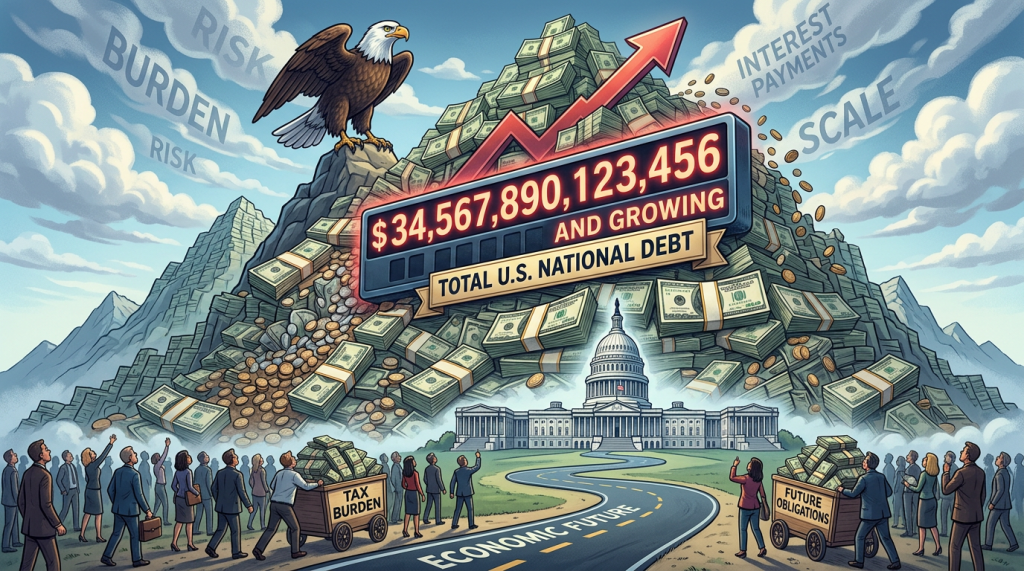
I’ve covered the messy space where politics and economics meet for years, and honestly, fiscal benchmarks usually come and go without much press coverage. This week’s news hits differently and it’s troubling, to say the least. The latest government numbers show that, for the first time since the aftermath of World War II, our national debt has officially blown past 100% of the country’s Gross Domestic Product. The debt now sits at $31.265 trillion, just nudging past our GDP of $31.216 trillion.
Sure, it sounds like a dry statistic that the average American would find unimportant. But look beneath the surface, and you’ll find a story about deep fiscal irresponsibility, a story that traces straight back to choices made by the Donald Tump’s administration and the current Republican Party.
It has not always been this way, two Democrats actually balanced the budget. President Bill Clinton balanced the federal budget, achieving consecutive budget surpluses between fiscal years 1998 and 2001 and President Lyndon B. Johnson achieved a balanced budget in 1969.
Let’s not kid ourselves: This didn’t happen suddenly, and it didn’t happen by chance. Every recent administration has added to the debt, but one deliberate shift in policy put us on fast-forward. I point directly to the Republican 2017 Tax Cuts and Jobs Act. This was the centerpiece of Trump’s economic playbook. It sold itself as a “middle-class miracle,” but honestly, it was a massive giveaway to the wealthy where the average American saw little longterm advantage.
The Center for American Progress, a non-partisan think tank, crunched the numbers on the law. They found that the top 1 percent got an average tax cut of $61,090, while the bottom 80 percent saw about $870. We were told growth would explode and pay for everything. That didn’t happen. The Congressional Budget Office backs that up, showing the law pumped the deficit and added about $1.9 trillion to national debt over ten years. Now we’re staring at the fallout and it’s clear what caused this.
And circumstances are on the brink of worsening dramatically. The “Big Beautiful Bill” of 2025, the darling of Republican Congressional leaders and Trump’s staunch backers, threatens to deepen our deficit yet again, pushing through reckless tax cuts for corporations and the wealthy elite. This initiative disregards fiscal responsibility; it paves a perilous path toward financial disaster. In essence, it’s a lavish tax giveaway to the affluent, leaving the hardworking American taxpayer to bear the brunt of the costs.
There’s another piece we can’t ignore: the cost of war. Trump’s reckless and unconstitutional conflict with Iran on shaky intelligence opened a new financial black hole. The Associated Press covered the mounting costs: Pentagon estimates put price tag for military operations in the Persian Gulf at over $1 billion a month on borrowed money, supporting a war that didn’t have to happen. These figures are backed up by recent congressional hearings.
The Wall Street Journal points out that these massive deficits aren’t going away anytime soon. But they leave out, like most major news media, the real reason: revenue took a hit from tax cuts favoring the wealthy, while spending spiked everywhere except where it would actually help the middle class.
That headline number of 100.2% isn’t just a statistic—it’s judgment. It stands as proof of a political mindset that threw fiscal responsibility out the window, favoring the rich and fueling pointless, expensive adventures overseas. Now, the bill for years of parties thrown for millionaires and billionaires has landed and the rest of us are left to pay it.


