Tag: democratic integrity

  • The Corruption of the Presidency

    by Winston Wendell

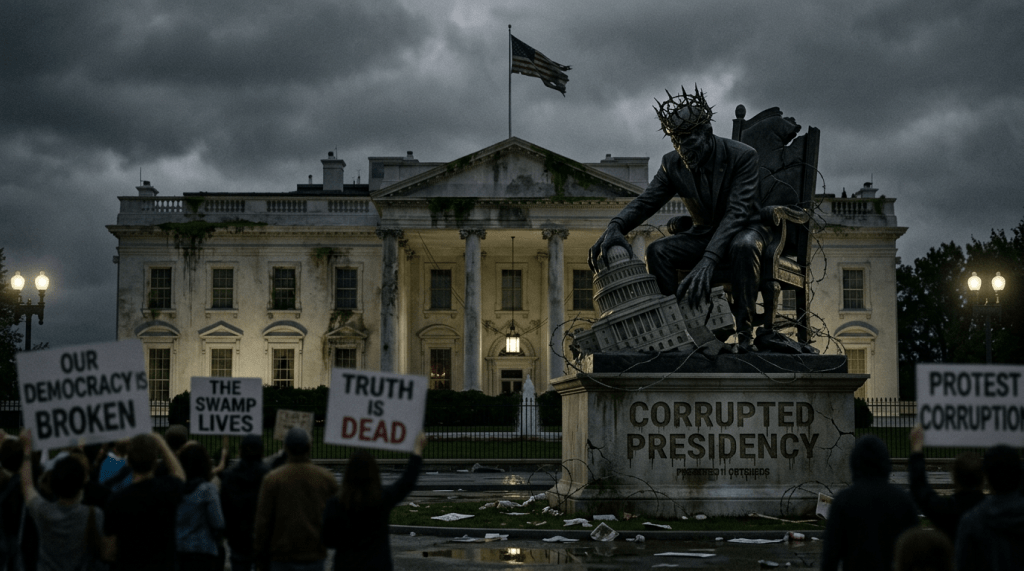
    Statue of a man wearing a crown of thorns holding a toppled Capitol building with cracked pedestal labeled 'Corrupted Presidency' outside the White House, surrounded by protesters with signs

    As I look at the current administration’s recent direction, something troubling stands out: the line between running the country and personal financial gain keeps getting harder to see. This isn’t just ordinary governing, it looks like President Tump is linking his decisions to his own investments.

    It’s hard to ignore the evidence. Again and again, Donald Trump’s stock moves seem to either predict or closely follow moves by his administration that help those same holdings. There’s the Nvidia stock purchase right before the Department of Commerce green-lit chip exports to China, buying Dell shares just ahead of public praise for the brand, and glowing statements about Apple soon after investing in the company, these moments keep lining up almost too well.

    When you put it all together, it looks like the presidency itself is being used to grow personal wealth. Maybe it’s no surprise that Forbes recently pointed out a $1 billion jump in the president’s net worth in the last year. If this happened when Biden or Obama were president, congress would be having nonstop investigators over it. Yet, inside this administration, it’s just accepted as business as usual. Main Street media’s response, second page news.

    However, the financial controversy extends beyond the realm of stocks. There exists a new $1.7 billion “anti-weaponization fund” allocated within the Department of Justice, established following a settlement from a $10 billion lawsuit the president’s own litigation against his own government a legal strategy that detractors deem devoid of merit.

    Here’s the real worry: what happens with that money? A lot of people are concerned those taxpayer dollars will support individuals convicted for their roles in the January 6 Capitol riot. Using public funds to help people who tried to disrupt democracy isn’t just a budget issue, it’s a serious ethical breach. For many, this turns the U.S. treasury into a reward of cash for a group of convicted criminals. That’s before the president pardoned them, but the ethics and legality of that is for another article.

    This isn’t just partisan drama. It cuts right into the heart of what the presidency is supposed to mean. When public trust becomes just another asset and government policy gets treated like a tool for personal profit, the foundations of government start crumbling and we are seeing it now. Voters are noticing: New York Times/Siena College polls now show the president’s approval rating slipping to new lows for his second term. People aren’t just worried about gas prices or groceries, they’re anxious about the future of the country itself.

    A president’s job is to look out for the public, not cash in on power. When personal gain and shielding friends take priority over the common good, it’s Americans who end up paying the price, 1.7 billion to be exact. We all have to ask, is this what we want from our leaders, or is it time to demand better ethics and transparency? No matter where you stand politically, the signs of deep corruption should make anyone who cares about democracy sit up and take notice.

  • Unprecedented Federal Raids and Election Conspiracy Theories Undermine Democratic Trust

    A new federal raid on Georgia’s Fulton County offices, linked to debunked election fraud claims, has intensified concerns about political interference and the erosion of democratic norms.

    Blue Press Journal – In January 2026, a controversial report by the Election Oversight Group (EOG) reignited baseless allegations of fraud in Georgia’s 2020 presidential election, claiming “irregularities” in Fulton County’s ballot counts. Just weeks later, FBI agents executed a high-profile raid, seizing 700 boxes of election records from the county’s offices. This unprecedented action has sparked a firestorm of speculation about broader attempts to destabilize U.S. electoral processes, with critics warning of a dangerous pattern of executive overreach. 

    The EOG, a self-proclaimed watchdog group, has a history of peddling conspiracy theories that were previously cited in former President Trump’s legal battles. According to The Political Machine (TPM), the group’s 2026 report, released on January 6th—symbolically mirroring the Capitol attack—was shared with Trump’s legal team. The report’s findings, which include debunked claims about “unsigned ballots,” were amplified by Trump allies, including 2024 campaign spokesperson Liz Harrington, who promoted the allegations on social media platforms. 

    The raid aligns with a growing strategy within the Trump administration to challenge state election outcomes, despite overwhelming legal and electoral confirmations of Georgia’s 2020 results. Independent recounts, overseen by Republican officials, and judicial rulings have consistently dismissed fraud claims due to a lack of credible evidence. Yet, figures like EOG associate Kevin Moncla, who reportedly discussed the report with U.S. Attorney Thomas Albus, continue to push the narrative, framing their efforts as a mission to “protect election integrity.” 

    The Department of Justice (DOJ), now led by Attorney General Pam Bondi, has embraced this agenda, with Albus overseeing the Fulton County operation. This has raised alarms among constitutional scholars and civil liberties groups, who argue that such actions risk politicizing federal agencies and eroding public trust in democratic institutions. “When law enforcement tools are weaponized to service a partisan agenda, the very foundations of democracy are threatened,” warned Dr. Maria Delgado, a political scientist at Harvard University. 

    White House officials, including Director of National Intelligence Tulsi Gabbard, have defended the raids as necessary to “secure America’s elections.” However, critics highlight the absence of transparency and the disproportionate focus on blue states. Former attorney general Eric Holder, in an op-ed for The Washington Post, condemned the move as an “attack on legitimate election procedures” that could normalize authoritarian tactics. 

    Notably, far-right figures like Alex Jones and Stewart Rhodes have celebrated the raid, further entrenching a climate of distrust. Rhodes, founder of the Oath Keepers, praised Gabbard’s involvement during a recent InfoWars broadcast, framing the operation as a “battle for America’s soul.” Such rhetoric, absent factual grounding, risks polarizing the electorate and legitimizing fringe theories. 

    As the administration intensifies its fervent campaign for “election reform,” experts passionately implore vigilance against the insidious creep of anti-democratic practices. “History is littered with regimes that have wielded such pretexts to stifle dissent and manipulate outcomes,” passionately cautioned political commentator David Cole in The New York Times. The upcoming months will be a crucible that tests whether the U.S. will staunchly defend the integrity of its democratic process—or fall prey to the seductive, yet treacherous, allure of conspiracy-laden governance.