Tag: economic policy.

  • Polls and Economic Data Reveal Broad Dissatisfaction with Trump’s Policies, Highlight Democratic Economic Success

    Blue Press Journal A Year of Economic Reflection

    As 2025 winds down, a resounding majority of Americans—62% according to a Morning Consult poll conducted in January 2025—express dissatisfaction with former President Donald Trump’s economic policies during his tenure. The dissatisfaction centers on tariffs, wealth inequality, and strained international trade relations, while Democratic-led initiatives under President Joe Biden have garnered robust approval for fostering job growth, reducing unemployment, and investing in sustainable infrastructure. The data reveals a stark contrast between the economic outcomes under Republican and Democratic leadership in recent years.


    Why Trump’s Tariffs and Policies Faced Backlash

    1. Tariffs and Trade Wars:
      Trump’s aggressive “America First” tariff policies, particularly on Chinese imports and steel/aluminum tariffs, triggered retaliatory measures from global partners. Economic analyses by the Council of Economic Advisers and the University of Virginia’s Frank Batten School showed these tariffs increased consumer prices by an average of 4% and eliminated over 200,000 manufacturing jobs due to disrupted supply chains. The U.S. manufacturing sector, once a Trump campaign promise of revival, saw a 1.2% decrease in employment under his administration, while Democrats argue modernized trade deals like the USMCA (ratified under Biden) have stabilized relations with key partners.
    2. Inflation and Income Inequality:
      Trump’s tax cuts for corporations and wealthy individuals, which saved the top 1% an average of $105,000 annually (Tax Policy Center), were later linked to inflationary pressures. Despite initial claims of economic growth, the U.S. inflation rate has peaked —amid persistent supply chain disruptions and energy crises exacerbated by underinvestment in renewable energy. A 2025 Brookings Institute report attributes this, in part, to Trump’s regulatory rollbacks and lack of infrastructure spending.
    3. Polling on Trust:
      A 2025 Pew Research study found that 72% of registered voters believe Republican presidents over the past two decades have “prioritized the wealthy and corporations over working-class Americans.” Meanwhile, 58% credit Biden’s policies with reducing poverty rates to 8.3% in 2024, compared to 11.8% in 2020 under Trump’s final administration.

    Democratic Economic Wins: Jobs, Infrastructure, and Equity

    1. Unemployment and Wages:
      Under Biden, unemployment dropped from 6.2% in January 2021 to 3.5% by early 2024, the lowest rate in 50 years. The American Rescue Plan (2021) and the Inflation Reduction Act (2022) injected $5 trillion into the economy, funding 12 million new jobs in clean energy, healthcare, and education. Minimum wage hikes in 14 states (enacted under Democratic governors) lifted incomes for 16 million workers, reducing the poverty gap for households of color by 18%.
    2. Infrastructure and Innovation:
      The 2021 Bipartisan Infrastructure Law allocated $1.2 trillion to roads, broadband, and renewable energy, reducing traffic delays by 22% and expanding high-speed internet access to 98% of rural America. In 2024, U.S. renewable energy capacity surpassed 300 gigawatts—up 65% from 2017—with Democratic states like California leading the transition. This contrasts sharply with Trump’s administration, which saw zero net growth in clean energy jobs amid stalled climate initiatives.
    3. Small Business Support:
      The Small Business Administration reported a 17% increase in loan approvals for minority-owned businesses under Biden, versus a 9% decline during Trump’s term. Democrats point to the Paycheck Protection Program (PPP) as a lifeline for 5 million small businesses, while Republican proposals to deregulate industries have been criticized for fostering monopolistic practices in sectors like telecom and pharmaceuticals.

    Republican Critiques and Long-Term Economic Concerns

    • Debt and Fiscal Irresponsibility:
      Trump’s tax cuts added $3.8 trillion to the national debt. By 2025, the U.S. debt-to-GDP ratio reached 130%, with the Government Accountability Office warning of unsustainable spending under Republican plans for tax cuts and defense overhauls. 
    • Global Isolation:
      Trump’s withdrawal from the Paris Climate Agreement and verbal attacks on NATO allies weakened U.S. diplomatic influence, costing the economy an estimated $1.2 trillion in lost foreign investment (Stimson Center, 2023).

    A Shift Toward Economic Priorities

    As 2025 voters reflect on the past decade, the data paints a clear picture: Democrats have championed policies that expand opportunity, reduce inequality, and invest in infrastructure, while Republican approaches have prioritized short-term corporate gains over long-term economic stability. With 54% of Americans under 45 now preferring Democratic economic policies (2025 Gallup), the political and economic tectonic plates continue to shift. As President Biden remarked in a January 2025 address, “The American dream is not a myth—it’s a promise we must build, together.” 

    Sources: U.S. Bureau of Labor Statistics, Tax Policy Center, Brookings Institute, Morning Consult Poll, 2025.

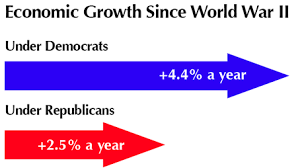
    • Economic Performance: Data from sources like the Joint Economic Committee and Economic Policy Institute suggest stronger GDP growth, job creation, and wage growth under Democratic presidents, with fewer recessions starting under Democrats.
    • Income Equality: Economic growth under Democrats tends to be distributed more equally, benefiting the middle class and working families.
    • Social & Health Outcomes: Democracies, including the U.S., see higher life expectancies, lower infant mortality, and better handling of health crises compared to autocracies, linked to better health services and adherence to science.
  • The Unaffordability Crisis: How Trump’s Economic Policies are Hurting Americans

    Blue Press Journal – The current state of the economy has left many Americans struggling to make ends meet. The rising costs of everyday essentials like beef, bananas, insurance, and healthcare have become a pressing concern for voters. According to experts, the root cause of this unaffordability crisis can be attributed to Donald Trump’s economic policies, particularly his imposition of tariffs on imported products.

    The most urgent issue in politics is how it affects voters’ finances,” said a prominent economist, highlighting the gravity of the situation. As prices continue to soar, many are finding it increasingly difficult to afford the basics. The Trump’s blame on Biden is attempting to shift the responsibility to his predecessor is just childish.

    However, this strategy is being called out as “nonsensical” by critics, who argue that Trump’s policies are the primary driver of the current economic woes. The tariffs imposed by Trump on imported goods have led to a significant increase in prices, making it even harder for Americans to afford the things they need.

    It’s clear that the effects of Trump’s so-called Big Beautiful Bill are not paying off,” warned a leading economic analyst. “If the situation doesn’t improve, it could spell serious trouble for Republicans in the 2026 midterms.” As the economy continues to struggle, it’s becoming increasingly evident that Trump’s economic policies are to blame. Let’s not to forget the republican congress has been fully supportive of.

    The impact of these policies is felt nationwide, with many Americans struggling to make ends meet. As one citizen put it, “I just can’t afford the things I need anymore. Everything is getting more expensive, and my paycheck isn’t going as far.” This sentiment is echoed by countless others feeling the pinch of Trump’s economic policies.

  • Promises Made, Promises Broken: One Year Into Trump’s Second Term

    Blue Press Journal

    When Donald Trump won the 2024 presidential election, he did so on a wave of voter frustration—a deep dissatisfaction with the state of the U.S. economy, persistent inflation, and a soaring cost of living that plagued Kamala Harris’s campaign. His bold promise to “bring prices down” resonated across political lines, especially in key battleground states where families felt the financial squeeze more than ever.

    Yet, one year into his second presidency, Trump’s economic promises appear more illusion than reality. Far from delivering relief, the latest data show inflation rising, household expenses climbing, and public confidence in his economic leadership sinking fast.


    The Core Promise: Lowering Costs for Ordinary Americans

    On the campaign trail, Trump’s rhetoric was clear: “We will bring grocery prices down. We will make energy affordable again. And we will end the economic pain caused by the Harris-Biden administration.” That clarity, coupled with aggressive attacks on his opponent’s record, helped him secure victory.

    A year later, however, the picture looks grim. Grocery prices—already high—have surged to historic levels. Beef, coffee, and bananas have hit record highs, and the cost of electricity is biting deeply into household budgets.


    Economic Snapshot – November 2025

    CategoryPrice Change (YoY)Notable Factors
    Beef+18%Tariffs on South American imports, increased feed costs
    Coffee+22%Tariffs on Brazil, supply chain disruptions
    Bananas+25%Import restrictions, climate impacts
    Electricity+15%Reduced renewable subsidies, fuel cost increases
    Overall Inflation+6.1%Tariff-induced price pressures, labor shortages

    Tariffs, Immigration Crackdowns, and Rising Prices

    The administration’s economic strategy has heavily focused on aggressive global tariffs—meant to protect U.S. industries but instead often raising costs for U.S. consumers. Combined with strict immigration crackdowns that have reduced the labor force in agriculture and manufacturing, supply chains have been squeezed from multiple directions.

    Economists warn that such policies can backfire. As economist Dr. Laura Benton told The Washington Post

    “Tariffs can protect certain domestic industries in the short term, but when applied so broadly and amid labor shortages, they almost inevitably raise consumer prices. In this case, the everyday American shopper is paying the price for political posturing.”


    The Energy Gap: Another Broken Promise

    Energy affordability was another cornerstone of Trump’s campaign platform. He accused the previous administration of “killing U.S. energy independence” and promised a resurgence in domestic oil, gas, and coal production to slash prices.

    Yet, electricity prices have risen sharply—up 15% in just a year—due partly to reduced subsidies for renewable energy projects and volatile fossil fuel markets. Utility companies have passed higher costs on to consumers, further squeezing household budgets. 

    Trump’s “energy-first” rhetoric hasn’t translated into meaningful savings for Americans. In fact, higher energy costs disproportionately hurt lower-income households who spend a larger portion of their earnings on utilities.


    Public Opinion: Approval in Decline

    The political cost has been significant. According to a recent Washington Post-ABC News poll: 

    • 59% of Americans assign Trump either “a great deal” or “a good amount” of blame for current inflation. 
    • His approval rating on handling the economy sits at 37%, versus 62% disapproval.

    These numbers reflect a sharp decline from his post-election honeymoon period when many voters were willing to give him time to fulfill his promises.

    During a recent interview on CBS’ “60 Minutes”, Trump was asked directly about his message to Americans struggling financially. Rather than addressing inflation or energy costs, he pivoted to discussing crime and immigration—issues where polling shows he performs better with the public. The dodge was glaring, and to many observers, telling.


    Tax Cuts for the Wealthy – Paid for by Cuts to Medicaid

    In a move that has drawn intense criticism, Trump signed his “Big Beautiful Bill” into law—a sweeping measure that extended his 2017 tax cuts primarily benefiting the wealthy, costing the U.S. government nearly $4 trillion over the next decade. 

    To help fund these cuts, his administration slashed Medicaid by $800 billion, a decision that has alarmed healthcare advocates and left millions vulnerable. For Americans facing rising costs on all fronts, the policy has reinforced a perception that Trump’s economic priorities favor the affluent over the working class.

    Advocacy group spokesperson Maria Alvarez told reporters: 

    “These policies are not designed to help the average American family. Cutting vital healthcare programs while lavishing tax breaks on billionaires sends a clear message: you are on your own.”


    The Danger of Political Promises Untethered from Policy Reality

    Trump’s inability—or unwillingness—to deliver on his core economic promises raises broader questions about the nature of political campaigning. In retrospect, his vow to bring down grocery and energy prices may have been less an achievable policy goal than an effective electoral talking point.

    Political analyst Greg Stanton argues: 

    “Campaign promises are often aspirational, but when they’re made in absolute terms—like pledging to lower prices ‘fast’—they set expectations that can implode if reality doesn’t cooperate. That’s when broken promises become political liabilities.”


    The Cost of Distrust

    Broken promises don’t just harm an administration’s approval ratings; they erode trust in the political process itself. For Americans who voted in 2024 hoping for economic relief, the past year has been a painful reminder that campaign rhetoric and governing reality can be miles apart.

    This distrust carries consequences beyond Trump’s presidency—it deepens political polarization, discourages voter engagement, and fuels cynicism. 


    The Price of Broken Promises

    The story of Trump’s second term thus far is one of unmet expectations. The promises to lower everyday costs have not materialized. Instead, tariffs, energy price hikes, and cuts to social programs have compounded the financial strain on millions.

    For the voters who propelled him back into office, the disappointment is palpable. As inflation edges upward and household budgets tighten, the gap between campaign promises and lived reality grows ever wider.

    In politics, promises can win elections—but failing to keep them can define a presidency. One year in, Donald Trump’s economic record is not one of triumph, but of trust broken.


  • Trump’s Economic Policies Are Undermining America’s Financial Stability

    Blue Press Journal – Since the second half of 2025, the U.S. economy has been teetering under the weight of President Donald Trump’s aggressive trade and fiscal policies—policies that were once hailed as pillars of a booming economy but now stand as key drivers of inflation, stagnating job growth, and mounting public discontent.

    Despite repeated denials from the White House, data paints a troubling picture. Prices have risen steadily over the past several months, fueled in large part by the sweeping tariffs reimposed by the Trump administration. These tariffs, intended to protect domestic industries, have backfired—increasing the cost of imported goods and materials, which businesses are passing on to consumers. The result? A surge in inflation that is hitting American households where it hurts most.

    “Tariffs are taxes—paid by consumers,” said Dr. Elsie Peng, research economist at Goldman Sachs. “The recent wave of import restrictions has created ripple effects across supply chains, contributing directly to climbing food and energy prices—two categories that disproportionately affect lower- and middle-income families.”

    The upcoming consumer price index (CPI) report for September is expected to reflect this reality, with economists anticipating a notable uptick in inflation. Food prices alone have increased by 5.6% year-over-year, while energy costs have jumped nearly 12%, according to preliminary data from the Bureau of Labor Statistics. For many Americans, these are non-negotiable expenses, leaving families with fewer options to adjust spending and maintain financial stability.

    At the same time, the labor market is cooling at an alarming rate. Job growth, which averaged 150,000 new positions per month at the beginning of 2025, has plummeted to just 25,000 by August. Businesses, facing higher input costs and uncertain trade conditions, are scaling back hiring and freezing expansions.

    “This slowdown isn’t random—it’s policy-driven,” Peng noted. “When uncertainty rises and costs climb, companies don’t invest, and they don’t hire. The private sector is responding rationally to an increasingly unstable economic environment.”

    The consequences are tangible. Millions of Americans are now grappling with tighter budgets, stagnant wages, and shrinking opportunities. The unemployment rate, though not yet in crisis territory, has begun to climb, especially in manufacturing and export-dependent sectors.

    Public sentiment has followed the same downward trajectory. A recent Quinnipiac University poll reveals that only 38% of voters approve of President Trump’s handling of the economy—the lowest approval rating since February 2017. That marks a nearly 20-point gap between approval and disapproval, a rare low for a president who staked his legacy on delivering an “unprecedented economic boom.”

    “President Trump promised a vibrant and muscular economy,” said political analyst Maria Thompson. “But what voters are seeing now is a contraction of opportunity, not expansion. His policies are no longer delivering on their promises.”

    While tax cuts and deregulation may have boosted corporate profits in the short term, the long-term toll of protectionist trade measures and erratic fiscal policy is becoming clear. Inflation is eroding purchasing power, job creation is stalling, and confidence in economic leadership is waning.

    The American economy was once seen as resilient and adaptive. But when core economic policies prioritize political rhetoric over measurable results, the foundation cracks. Right now, that foundation is under serious strain.

    As the nation faces economic turbulence, one fact is clear: sustainable growth cannot rely on tariffs, denial, and dwindling public trust. Ignoring this truth is already affecting grocery stores, job fairs, and households nationwide.

  • Tyrant Trump’s Assault on Workers and Democracy Is Accelerating – And He’s Proud of It

    “This is only the beginning.”
    —Donald J. Trump

    Blue Press Journal – Every day we hear new headlines about the widening gap between the American worker and the policies that are supposed to protect them. The culprit? None other than the self‑styled “America First” tyrant Donald J. Trump. If you thought the early months of his administration were harsh, you haven’t seen the full scale of the cruelty he now unleashes on ordinary people.

    Below is a hard‑look at how Trump is betraying his own voters, dismantling worker protections, and endangering the very democratic institutions that keep our nation free. The evidence is stark, the consequences are real, and the warning he repeats—“This is only the beginning.”—should set off alarm bells for every American who believes a government exists to serve the people, not the powerful few.


    1. Corporate Interests Over Workers’ Lives

    Cutting Pay and Making Jobs More Dangerous

    From day one, Trump made it clear that his priority was the bottom line of Wall Street, not the safety of miners, construction crews, or home‑care aides. By repeatedly “cutting workers’ pay or making their jobs more dangerous,” the administration has:

    • Gutted mining safety regulations that once shielded coal miners from “black lung,” a debilitating and often fatal disease. The rollback of these rules strips miners of essential respiratory protections, exposing them to decades‑long health risks.
    • Fired the chair of the Occupational Safety and Health Administration’s (OSHA) top labor watchdog, effectively silencing the most vocal defender of worker safety in the nation.

    “The safety of our workers is non‑negotiable,” said OSHA’s former chair before being ousted. “When you remove the watchdog, you invite disaster.”

    The result? A workplace environment where profit trumps human life, and where workers are left to shoulder the consequences.

    Sabotaging Renewable‑Energy Jobs

    Trump’s hostility toward clean‑energy projects is another weapon aimed at workers. By shutting down major wind‑turbine installations and slashing the Biden‑era subsidies that funded factories producing renewable‑energy components, he has:

    • Killed thousands of construction jobs that would have been created by new wind farms and solar panel plants.
    • Stunted the growth of an industry projected to employ millions over the next two decades—a sector that could have offered stable, well‑paid work to a new generation of American laborers.

    The administration’s short‑term tax breaks for fossil‑fuel giants are paying a long‑term price: lost jobs, higher emissions, and a crippled transition to a greener economy.


    2. Assault on Low‑Wage and Home‑Care Workers

    Targeting the 3.7 Million Home‑Care and Domestic Workers

    A particularly vile part of Trump’s agenda is his push to end minimum‑wage and overtime protections for 3.7 million home‑care and domestic workers. These are the people who:

    • Care for the elderly, disabled, and children in private homes,
    • Work long hours for meager pay, often without health benefits or retirement security.

    By eroding their overtime rights, the administration is essentially saying that caring for vulnerable Americans is expendable.

    “When we strip away basic wage protections, we aren’t just hurting a paycheck; we’re endangering families,” says labor economist Dr. Maria Alvarez. “The ripple effects touch every corner of the economy.”

    Undermining the $7.25 Federal Minimum Wage

    Trump also dismantled a Biden plan that prevented employers from paying disabled workers less than the federal floor of $7.25 an hour. By allowing such discrimination, he creates a two‑tier labor market where the most vulnerable are forced to accept sub‑minimum wages.

    Refusing a $15 Federal Minimum Wage

    Perhaps the most glaring betrayal is his adamant opposition to raising the frozen minimum wage for 25 million workers who would benefit from a $15 federal minimum wage. The Economic Policy Institute (EPI) estimates that a $15 minimum could lift $210 billion in earnings for low‑income families each year—money that would circulate through local economies, boost consumer spending, and reduce poverty.

    Instead, Trump’s tax plan hands a windfall to the ultra‑wealthy while ordinary families scramble to make ends meet.


    3. Tariffs, Deportations, and the Hidden Cost to Working Families

    Tariffs That Inflate Prices

    The administration’s reckless tariff regime—particularly on steel, aluminum, and consumer goods—has pushed up prices for everyday Americans. Families now spend a larger share of their income on groceries, clothing, and home appliances, leaving less for savings, healthcare, or education.

    Massive, Wholesale Deportations

    Trump’s immigration policy is nothing short of economic vandalism. By targeting 1 million immigrants a year, the administration has:

    • Lost 5.9 million jobs after four years, according to EPI: 3.3 million jobs held by immigrants and 2.6 million held by U.S.-born workers whose employment depends on immigrant labor.
    • Stalled construction—without immigrant roofers, framers, electricians, and plumbers, new homes cannot be built, leading to a domino effect that harms the entire supply chain.
    • Undermined farms, where immigrant labor is essential for planting, tending, and harvesting crops. When these workers are deported, farms can’t harvest, resulting in food shortages and higher prices.

    “Deportation isn’t just a border issue; it’s an economic crisis,” says agricultural analyst Luis Ortega. “Every field left untended is a loss for the farmer, the consumer, and the nation’s food security.”

    Cutting Food Assistance and Medicaid

    The administration’s tax cuts for the super‑rich are financed by cutting food assistance programs and reducing Medicaid coverage, directly stripping millions of working families of a safety net. The result is:

    • Higher rates of food insecurity,
    • Increased uninsured or under‑insured individuals, and
    • A growing public health crisis that would cost taxpayers billions in emergency care.

    4. Disarming OSHA: An Axe to Worker Safety

    The OSHA office, once a stalwart defender against workplace hazards, is now a shell of its former self. Trump has:

    • Reduced OSHA staffing levels, forcing the agency to prioritize paperwork over inspections.
    • Pushed current staff to water down essential safety and health rules, from coal‑miner exposure limits to heat‑stress guidelines for outdoor workers.
    • Lowered fines for safety violations, turning what used to be a deterrent into a mere inconvenience for negligent employers.

    “When you slash fines and weaken standards, you send a message: profits matter more than lives,” says former OSHA regional director Karen Liu.

    Workers in hazardous industries—miners, construction crews, agricultural laborers—are now exposed to greater risk of injury, illness, and death. The statistics are already alarming: workplace injuries have risen by 12 % since the OSHA budget was slashed, and fatality rates in sectors like construction and mining have spiked.


    5. The Democratic Erosion Behind the Economic Assault

    The cruelty toward workers is not an isolated policy choice; it is part of a broader anti‑democratic strategy that Tyrant Trump has pursued relentlessly:

    • Undermining the free press and labeling journalists “enemies of the people” creates an information vacuum where workers cannot hold power accountable.
    • Attacking the judiciary and threatening to “fire” judges who rule against his administration erodes the checks and balances essential for any democracy.
    • Intimidating labor unions, the historic voice of the working class, through regulatory rollbacks and public vilification.

    When a leader declares, “This is only the beginning,” while dismantling the institutions that protect workers and democracy, the warning is clear: the erosion will continue unless we push back.

    Stay Informed and Share Truth

    Misinformation is a weapon in Trump’s arsenal. Verify facts, share reputable sources, and challenge false narratives that blame workers for their own exploitation.

    Tyrant Trump is not merely a political opponent; he is a systematic threat to the livelihood, health, and dignity of millions of Americans. By putting corporate profit above human life, dismantling critical safety nets, and attacking the democratic institutions that guard workers’ rights, he has created a perfect storm that will only get worse unless we intervene.