Tag: economics

  • It’s Time for California to Seize the Tax Leverage

    Blue Press Journal (Opinion) – As the fifth-largest economy in the world, California is an economic powerhouse and a leader in national policy. However, despite its significant contribution to the nation’s wealth, the state receives only a fraction of its tax dollars back in funding for essential priorities such as healthcare, housing, climate resilience, and infrastructure. It’s time for California to take a bold step and establish the California Federal Tax Administration (CFTA) to collect and remit federal taxes, thereby gaining control over its own wealth and leveraging its economic power.

    CategoryAmount
    Annual Tax Revenue$400 billion
    Federal Funding Received$30 billion
    Net Outflow$370 billion

    The CFTA would be a new state agency responsible for collecting all federal personal and corporate income taxes from California residents and businesses and then remitting the funds to the federal government. This move would not only simplify the tax collection process but also provide California with a level of autonomy and bargaining power in its dealings with Washington. As noted by Governor Gavin Newsom, “California is not just a state, it’s an economic engine that drives the nation. It’s time we take control of our own destiny and ensure that our tax dollars are being used to benefit our own citizens.

    By instituting the CFTA, California would be able to highlight the significant outflow of its wealth to the federal government, making it clear that the state is subsidizing the rest of the nation. This would be a powerful statement, as Kamala Harris has noted, “California is a donor state, meaning we give more to the federal government than we receive in return. It’s time we change that dynamic and ensure that our tax dollars are being used to benefit our own state and its residents.”

    The benefits of establishing the CFTA extend beyond political leverage. The state would have a system to ensure government continuity and preserve revenue, offering an advantage during economic downturns or funding uncertainties. As former Governor Jerry Brown stated, “California has always been a leader in innovation and progressive policy. Establishing the CFTA would be a bold step toward controlling our economic destiny and ensuring our state’s long-term prosperity.

    It’s time for California to seize the tax leverage and establish the CFTA. This move would empower the state to negotiate with Washington from a position of strength. Californians must unite to demand that their elected officials take action, ensuring our state’s wealth benefits our citizens instead of subsidizing underperforming RED STATES. As Governor Newsom has said, “It’s time for California to take control of its own destiny and become the economic powerhouse it was meant to be.”

  • The Importance of an Independent Federal Reserve: Why Trump’s Politicization is a Recipe for Disaster

    Blue Press Journal – The Federal Reserve Bank, the central bank of the United States, has long been a bastion of independence, making decisions based on economic data and expertise rather than political considerations. However, with recent attempts by President Donald Trump to politicize the Fed, there are growing concerns about the potential consequences of such a move. In this blog post, we will explore the dangers of politicizing the Federal Reserve and why other countries that have taken this path have faced significant economic challenges.

    The Risks of Politicization

    Politicizing the Federal Reserve would undermine its independence and potentially lead to a range of negative consequences, including increased inflation and economic instability. As former Federal Reserve Chairman, Ben Bernanke, once stated, “The independence of the Federal Reserve is essential to its ability to make decisions based on its mandate to promote maximum employment and price stability, rather than based on short-term political considerations.”

    CountryCentral BankOutcome
    TurkeyCentral Bank of the Republic of TurkeyHigh inflation, economic instability
    ArgentinaCentral Bank of ArgentinaHyperinflation, economic crisis
    VenezuelaCentral Bank of VenezuelaHyperinflation, economic collapse

    As the table above illustrates, countries that have politicized their central banks have faced significant economic challenges. In Turkey, for example, the government’s interference in the central bank’s decisions led to a sharp increase in inflation and economic instability. Similarly, in Argentina and Venezuela, the politicization of their central banks resulted in hyperinflation and economic crisis.

    Why Trump’s Plan is Flawed

    President Trump’s desire to politicize the Federal Reserve is particularly concerning given his own history of financial mismanagement. As a businessman, Trump has filed for bankruptcy multiple times, raising questions about his ability to make sound economic decisions. As Nobel Prize-winning economist, Joseph Stiglitz, noted, “The idea of putting the Federal Reserve under political control, particularly with someone like Donald Trump who has a history of bankruptcy, is a recipe for disaster.”

    The Federal Reserve’s politicization would risk far-reaching consequences for the US economy. Its independence is crucial for decisions based on economic data rather than political pressures. History shows that politicizing central banks can lead to inflation, instability, and crisis. We must protect the Fed’s independence from political interference.

    As former Federal Reserve Chairman, Alan Greenspan, once stated, “The Federal Reserve’s independence is a cornerstone of its ability to maintain price stability and promote economic growth.” Let us hope that policymakers will heed this warning and reject any attempts to politicize the Federal Reserve. The future of the US economy depends on it.

  • Trump’s Firing of BLS Commissioner Unravels as White House Tries to Manipulate Economic Data

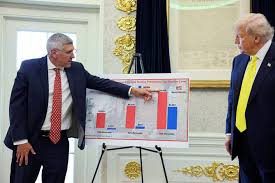
    Blue Press Journal: In a bizarre and embarrassing turn of events, President Donald Trump’s firing of the Bureau of Labor Statistics (BLS) commissioner has been exposed as a blatant attempt to prioritize politics over accurate information. The latest development in this ongoing trainwreck came on Thursday, when right-wing economist Stephen Moore visited the Oval Office, armed with charts that purportedly showed fake job numbers during Joe Biden’s presidency.

    However, the irony was not lost on observers, as Moore’s argument relied heavily on the very same BLS numbers he was trying to discredit. The economist used the BLS data to make a case against the agency, which had previously released a bad jobs report that led to the commissioner’s firing. This move has been widely criticized as a transparent attempt to bend reality to fit Trump’s preferences for economic data.

    The White House’s actions have been likened to Trump’s infamous insistence in 2017 that over a million people attended his inauguration, despite overwhelming evidence to the contrary. This latest outburst over a bad jobs report has raised concerns that the President is more interested in promoting his own delusional worldview than in accepting factual information.

    The process of collecting and releasing economic data is designed to be decentralized and transparent, with built-in checks to prevent interference. The BLS uses a proven and reliable methodology to produce estimates every month, revising prior estimates to reflect more accurate information. A group of statisticians, including two former BLS commissioners, one of whom was appointed by Trump himself, has spoken out against the President’s actions, stating that the BLS’s process is “transparent, reliable, and free from interference.”

    The firing of the BLS commissioner has been widely condemned as a politicization of economic data, with many arguing that it undermines the integrity of the agency and the accuracy of its reports. As one observer noted, “Downward revisions released during Biden’s presidency cannot possibly be part of a plot to hurt Trump.” The White House’s attempts to justify the commissioner’s firing have only served to further erode trust in the administration’s handling of economic data.

    Trump’s actions have revealed a disturbing disregard for facts and numbers, and a willingness to manipulate reality to suit his own interests.

  • Why the Bureau of Labor Statistics Must Remain Above Trump Politics

    What it Mean to You!

    Blue Press Journal: Often operating behind the scenes, the U.S. Bureau of Labor Statistics (BLS) is one of the most vital yet least understood agencies in the federal government. Its name might sound dry, but its work is anything but. The data it collects and publishes—from unemployment rates to inflation figures and wage growth—forms the bedrock of economic understanding and directly impacts the financial well-being of every American. For this very reason, its independence from political influence is not merely a bureaucratic ideal but a cornerstone of economic stability and individual financial well-being.

    The Power of the Numbers: What the BLS Determines

    The BLS is the nation’s premier source for labor market data, meticulously gathering and analyzing information that shapes our understanding of the economy. Here are just a few critical areas it directly influences:

    • Social Security Cost-of-Living Adjustments (COLA): The annual increase in Social Security benefits, which millions of retirees and beneficiaries rely on, is directly tied to the Consumer Price Index (CPI) as determined by the BLS. This ensures that benefits keep pace, at least partially, with the rising cost of living.
    • Job Numbers and Unemployment Rate: The monthly jobs report, including the unemployment rate, is a critical indicator of economic health. It informs businesses about labor market conditions, guides policymakers on employment strategies, and impacts public sentiment about the economy.
    • Inflation Percentages: The CPI, a measure of inflation, is a key economic barometer produced by the BLS. It helps us understand the purchasing power of our dollar, influencing everything from wage negotiations to the pricing of goods and services.

    The Peril of Political Interference: A House of Cards

    Now, imagine a scenario where these critical figures could be manipulated or slanted to serve a political agenda. The consequences would be devastating and widespread, directly disadvantaging citizens in profound ways:

    1. Undermining Social Security and Retirement Security: If inflation rates were artificially suppressed to make the economy “look better,” the annual Social Security COLA would be understated. This would mean retirees and beneficiaries receive smaller increases than they are truly entitled to, effectively eroding their purchasing power and forcing them into greater financial hardship.
    2. Distorting Economic Policy and Interest Rates: A politically skewed unemployment rate or inflation figure could lead the Federal Reserve to make misguided decisions on interest rates. If the economy is falsely portrayed as stronger or weaker than it is, the Fed might raise rates too quickly, stifling growth, or keep them too low, risking inflation. Both scenarios would ripple through the economy, impacting everything from mortgage rates and credit card interest to the returns on savings accounts.
    3. Misleading Investment Decisions: For individuals and institutional investors, accurate, unbiased data is essential for making sound financial decisions. If job numbers or economic growth figures are inflated for political gain, investors might pour money into markets based on false premises, leading to potential bubbles and significant losses when the true picture emerges. Conversely, underreported positive trends could lead to missed opportunities.
    4. Eroding Public Trust and Accountability: When economic numbers are perceived as politically motivated, public trust in government institutions shatters. Citizens lose faith in official reports, making it harder for policymakers to implement effective solutions and for the public to hold leaders accountable. A democracy cannot function effectively when its citizens cannot trust the fundamental data about their own economic reality.
    5. Building on False Premises: Every major economic policy decision—from government spending on infrastructure to tax cuts or adjustments to social programs—is built upon the foundation of BLS data. If that foundation is rotten with political bias, the policies built upon it will be flawed, ineffective, and potentially harmful, leading to misallocation of resources and unintended negative consequences.

    Protecting the Integrity of Data

    The BLS’s strength lies in its non-partisan, professional approach to data collection and analysis. Its credibility is built on decades of rigorous methodology, free from the pressures of electoral cycles or partisan narratives. While administrations change and political winds shift, the BLS must remain a beacon of objective truth, committed solely to presenting the most accurate picture of the American labor market and economy.

    Allowing politicians, regardless of their party, to control or influence the BLS would be akin to letting the fox guard the hen house, but with far graver consequences for every American citizen.

  • Tariff-Induced Inflation Begins to Take Hold: Economists Expect Further Price Increases

    The latest Consumer Price Index (CPI) report from the Labor Department’s Bureau of Labor Statistics has shown the first signs of tariff pass-through, with inflation rising 0.3% in June. This increase, the largest since January, is likely to be the starting point of a long-anticipated uptick in inflation driven by the sweeping import duties announced by President Donald Trump in April.

    Economists have been warning that the effects of the tariffs would take time to materialize, and the June CPI report appears to confirm this expectation. Businesses had been selling merchandise accumulated before the tariffs were announced, which helped to keep prices stable in the short term. However, as these inventories are depleted, the full impact of the tariffs is expected to become more evident in the July and August CPI reports.

    The experience with tariffs on washing machines in 2018 provides a precedent for this delayed effect. At that time, it took several months for the duties to show up in the inflation data, and economists are expecting a similar pattern to emerge this time around.

    The June CPI report showed increases in various categories, including food prices, which rose 0.3% to match the increase in May. Grocery store prices also advanced 0.3%, driven by a 1.4% increase in the costs of nonalcoholic beverages and a 2.2% jump in coffee prices. These price increases are likely due to higher import duties, which are being passed on to consumers.

    Other categories that saw significant price increases include fruits and vegetables, which cost 0.9% more, and beef prices, which jumped 2.0%. The cost of food consumed away from home rose 0.4%, while gasoline prices rebounded 1.0% after four straight monthly declines.

    Rental costs also contributed to the overall increase in inflation, with the cost of shelter rising 0.3%. This reflects the ongoing trend of rising housing costs, which has been driven by a combination of factors, including limited supply and strong demand.

    The tariff-exposed goods, which saw significant price increases in June, are likely to be the first of greater price pressures to come. As the effects of the tariffs continue to ripple through the economy, economists expect to see further increases in inflation, which could have implications for consumer spending and economic growth.

  • Impact of GOP Budget Bill on U.S. Debt: A $3.8 Trillion Concern

    The recent passage of the Republican budget bill vote, passed under cover of a late night vote, has raised significant concerns about the future of U.S. debt levels, with several analyses suggesting a troubling trajectory. Over the next decade, this GOP bill could potentially cost the nation a staggering $3.8 trillion, as highlighted in a report earlier this month by the Joint Committee on Taxation. This report meticulously examined the implications of the proposed tax measures in comparison to spending cuts.

    Wall Street is already feeling the tremors of these risks. On Friday, Moody’s Ratings downgraded the nation’s debt, citing the likelihood that the new bill could add an alarming $4 trillion to the federal primary deficit—excluding interest payments—over the next ten years. Economists and policy experts alike warn that this surge in debt could ultimately constrain federal spending, as the U.S. would likely face escalating interest payments. Such a scenario could jeopardize funding for essential programs like Social Security, which is already under strain as baby boomers reach retirement age. Additionally, it could hinder investments in critical infrastructure initiatives that are vital for stimulating economic growth.

    While the bill does propose some spending cuts, recent analyses indicate that these reductions are insufficient to counterbalance the extensive tax breaks. The nonpartisan Bipartisan Policy Center estimated in a May 14 analysis that the tax cuts would amount to a staggering $7.7 trillion over the next decade, while the proposed spending cuts would only offset $3.9 trillion during the same period. This results in a significant shortfall of $3.8 trillion—an arithmetic reality that prompted Moody’s to downgrade its rating on U.S. debt from the highest tier of Aaa to Aa1.

    Moreover, the implications of the proposed GOP bill raise significant concerns for the lowest-income Americans. According to a May 19 analysis from the Penn Wharton Budget Model, a research group at the University of Pennsylvania that evaluates the fiscal impact of public policies, the bottom 20% of earners—despite potential savings from tax cuts—will face a $1,035 reduction in 2026 when the cuts to Medicaid and other programs are taken into account, affecting middle class earners.

    Just remember, Trump has sent a wave of bankruptcy crashing through several of his businesses, and now, against all odds, MAGA has handed over the country’s checkbook to him. God help us all!