The Dangerous Intersection of Election Denial and Federal Overreach: A Critical Look at Trump’s Actions in Minnesota
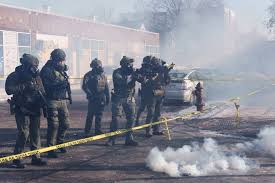
Blue Press Journal – In an alarming display of federal overreach, former President Donald Trump has leveraged the power of Immigration and Customs Enforcement (ICE) to pursue his unfounded claims of election fraud in Minnesota. Critics argue that his obsession with the state stems from a desperate need to validate his belief that he won Minnesota in 2016, 2020, and 2024—claims that have been thoroughly dismissed by the courts and factual evidence.
Norm Eisen, a former White House lawyer under Barack Obama, bluntly captures the chaos: “It’s almost unbelievable to think that election denial wasn’t a key factor driving his reckless animus, which in turn led to the ICE surge and the horrific fallout. This entire debacle reeks of a concoction built on nothing but lies.”
The Trump administration’s recent tactics in Minnesota include a demand from Attorney General Pam Bondi for extensive voter data. This request arrives amid a backdrop of tragic incidents related to ICE operations, including the recent shooting of protester Alex Pretti. Bondi’s assertion that obtaining this data is essential for “free and fair elections” is seen by many as a thinly veiled attempt to intimidate voters and suppress legitimate electoral participation.
In 2020, courts across the nation refuted Trump’s baseless allegations of widespread voter fraud, yet he continues to propagate these falsehoods. During a gathering in St. Paul in May 2024, Trump proclaimed, “I thought we won in 2016. I know we won it in 2020.” This starkly contrasts with the reality that he lost Minnesota in all three elections, including a 7.1-point defeat to Joe Biden in 2020—one of many losses that continue to fuel his unfounded claims.
Democratic National Committee Chair Ken Martin, a Minnesota native, emphasized the absurdity of Trump’s fixation: “Minnesota voters rejected Donald Trump three times, a fact that he either willingly ignores or his addled, aging brain can’t remember.” Martin further noted that Trump’s obsession with Minnesota is intertwined with his administration’s unlawful ICE tactics aimed at instilling fear among voters.
Marc Elias, a prominent election lawyer, pointed out that Bondi’s request for voter data is part of a broader strategy to suppress Democratic votes in upcoming elections. “He is punishing those states by sending in federal officers, federal officials to terrorize the population,” Elias stated. This alarming strategy underscores how Trump is willing to weaponize federal agencies to support his false narrative of election fraud.
The troubling reality is that Trump’s historical pattern of claiming electoral theft dates back to his first political run. After losing the Iowa caucuses in 2016 to Ted Cruz, he immediately accused Cruz of cheating. Following his electoral victory, Trump continued to claim that he lost the popular vote to Hillary Clinton due to illegal immigrant voting—a conspiracy theory he later abandoned after a task force found no evidence to substantiate it.
As recently as his speech in Davos, Switzerland, Trump reiterated his false claims, stating, “It was a rigged election. Everybody now knows that they found out. People will soon be prosecuted for what they did.” This rhetoric not only undermines democracy but also threatens the integrity of federal institutions, as Trump continues to blur the lines between political ambition and lawful governance.
The situation in Minnesota serves as a critical reminder of the potential dangers posed by the abuse of federal power in the pursuit of unfounded claims. As federal agencies like ICE become entangled in Trump’s political vendettas, the safety and rights of citizens hang in the balance, raising urgent questions about the future of democracy in America.
 Blue Press Journal