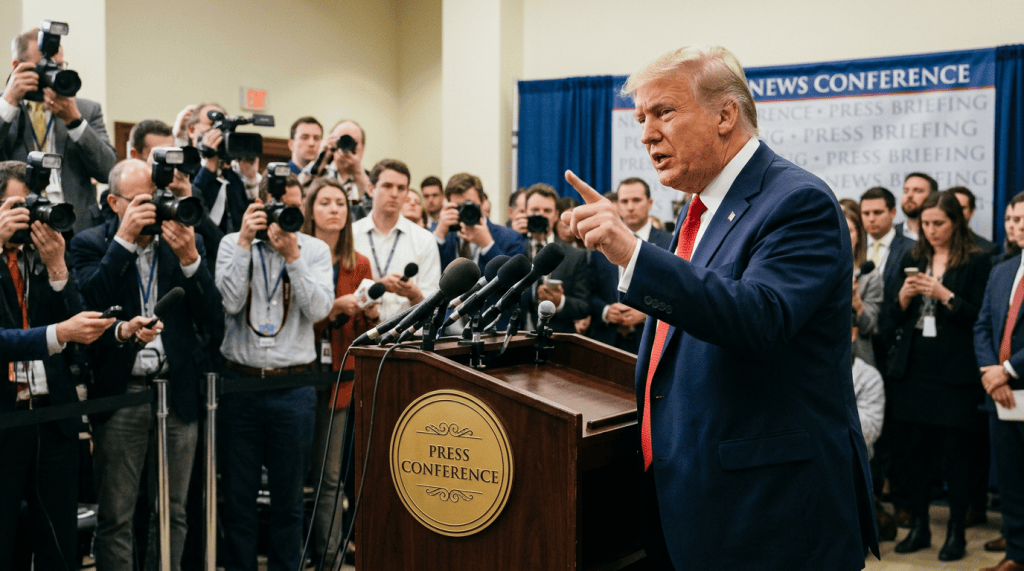
A first‑person look at the administration’s wave of bans, lawsuits, and intimidation tactics that aim to silence the media.
by Winston Wendell
I have observed the Trump administration’s efforts to censor the news media carefully throughout the year, and I believe that the current situation may be the most extreme in recent times. Last week, Trump prohibited CNN, MSNBC and Politico from entering the White House, which caused a press boycott, with Fox News announcing the cancellation of all coverage, and other outlets refusing to print photographs of the president. The president’s Monday ribbon-cutting ceremony did not have its audio available to the public.
President Trump has a history of attacking journalists who criticize him, and using the Federal Communications Commission to threaten broadcasters who air unfavorable news. In April, after ABC late-night host Jimmy Kimmel joked about the president’s wife, the head of the FCC, Brendan Carr, a Trump loyalist, ordered an investigation into all of ABC’s broadcasting licenses. ABC filed a lawsuit against the FCC, claiming that it was retaliating for Kimmel’s comments.
He has also targeted individual female journalists with insults. I am sure many people were surprised when, after Kaitlin Collins of CNN was awarded the White House Correspondents’ Dinner honor, the president tweeted a computer-generated video of himself tossing the young woman into a dumpster.
Phone records of New York Times reporters were sought by Trump through a subpoena, but the president later withdrew the request. The FTC is investigating Media Matters for America, which was previously named in a defamation lawsuit by the president. Most notable are the numerous multi-billion-pound libel lawsuits that Trump has initiated against the Wall Street Journal and the BBC, among others, seeking $10 billion, The New York Times for $15 billion and $10 billion respectively in damages, both of which were dismissed as “megaphone cases.” A judge even stated that he filed the lawsuit to deflect negative news coverage.
Despite the ongoing ban, press freedom is flourishing in the United States. While the recent boycott was a frightening reminder of what could happen to America’s news outlets, it was also a brilliant publicity stunt for the companies that participated. As I watch the drama unfold, I am trying to determine whether it will affect news outlets’ ability to report objectively on the president, or if the president’s disinformation efforts will ultimately harm him.
For years, I studied the relationship between information and society. But the latest policy changes in Washington are deeply troubling. This week, the Federal Communications Commission, in a 2-1 vote, overturned a key media ownership rule protecting the diversity of viewpoints in our news and entertainment. This decision, which has been made by a Republican majority, allows bigger corporations to acquire a significantly greater share of local news.
If this is to be achieved, local news outlets will no longer be truly local. As someone who has fought for years for a better environment for local news to survive, I believe this development to be an existential threat to it. This is why I am raising this alarm bell about the end of local news.
What Just Happened? (The 39 Percent Cap Was Lifted)
For more than two decades, companies have been restricted to 39 percent of all television households as a result of a certain law. It was designed to prevent a single entity from dominating the news and information space.
The chairman of the FCC, Brendan Carr, a Trump appointee, argued that this decision was made to “restore fairness” to the system, giving local news a better chance to compete with big tech conglomerates.
Many, however, do not share this point of view. During the debate in the FCC, democrat commissioner Anna Gomez said, “This is not local broadcasting; it is Big Media muscling in to replace Big Tech as the gatekeeper – neither of which is in the public interest.”
Who Wins from This?
In this tug of war, there are always winners and losers, but the main beneficiaries of this policy shift were already predicted by its supporters. With this FCC decision, Nexstar, for example, will be able to merge with Tegna, so that around 80 percent of all households in the USA will receive their local news from one company. Such concentration of power in one media holding threatens the diversity of views in society.
Another media conglomerate that wins from this is Sinclair Broadcasting Group. This company has a reputation for forcing “must run” news stories on its affiliated local TV stations, so that the news coming out of them reflects a particular point of view selected by the company’s bosses. With the repeal of the 39 percent rule, Sinclair will be able to disseminate its political narratives even more widely through dozens of local news outlets.
Not Entirely Legal either (Challenges to the FCC Decision are Being Considered)
In addition to being “unfair,” this FCC decision may also be illegal. This is what the court in Washington will have to decide in one of the lawsuits challenging the new FCC rules. This case, brought by the media watchdog group Free Press, claims that Brendan Carr does not have the authority to repeal the 39 percent rule.
According to the complaint, the FCC’s move violates the Communications Act of 2004, which was adopted by a decision of Congress. Moreover, this law prevented the FCC from overturning the 39 percent cap unless Congress voted to repeal it. According to Matt Wood of Free Press, Carr’s initiative is an attempt to help Trump allies grab local news markets by any means.
How Does This Affect the Local News?
The importance of this decision for the future of local news can’t be overestimated. When a large national media company buys a popular local news outlet, it rarely means that it will begin to provide more comprehensive coverage of local events. Such mergers usually lead to the opposite: cuts in the number of local news shows, journalists’ salaries, and much more remote management decisions.
In other words, the audience will have less information about what is happening around them and about their region in general, since coverage of local events will be controlled by people who speak for themselves. John Bergmayer of Public Knowledge said, “News consolidation leads to less local news, fewer journalists, and more top-down management.”
The FCC as an Agency that Makes Politically Motivated Decisions
Perhaps the most annoying aspect of all this is that the FCC itself seems to serve primarily as an instrument for advancing the policy preferences of the current administration.
By promoting his candidates to the post of FCC chairman, Trump has ensured that the FCC will be willing to loosen regulations whenever they see fit. This week, commissioner Brendan Carr, for example, accused ABC and CBS of “anti-conservative bias” in the coverage of certain news. In essence, it is a call for these federal networks to change their narratives in favor of the Trump administration. By politicizing the FCC, Trump has turned it into an auxiliary instrument for pursuing his policy in Congress.
From my point of view
This decision to repeal the 39 percent rule is another step toward greater corporate control of the news, which is why I am raising this alarm bell about the end of local news. This is because it allows companies to buy more local news outlets and cover fewer local issues than before. In addition, the coverage of news will be subject to the control and management of officials from these companies, which will have an even greater impact on the polarization of opinions in society.
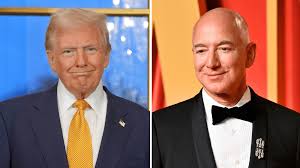
Washington Post layoffs and Jeff Bezos’s role in dismantling the newsroom, and how this aligns with the erosion of the First Amendment and appeasement of Donald Trump
The news industry this week witnessed a seismic shift that threatens the very foundation of American democracy. The Washington Post, a nearly 150-year-old institution and a pillar of the democratic system, began a fresh wave of mass layoffs. Under the ownership of billionaire Jeff Bezos and the stewardship of publisher Will Lewis, the paper is closing its Sports department, gutting its International and Metro desks, and ending its signature podcast.
While management frames these cuts as a necessary business realignment, a closer examination reveals a more troubling narrative. These layoffs represent a systematic dismantling of the Fourth Estate’s ability to hold power accountable. When viewed alongside Bezos’s history of appeasing Donald Trump and his interference in editorial independence, it becomes clear that these cuts are not just financial—they are a direct threat to the First Amendment.
The Erosion of Institutional Integrity
The Washington Post has long been synonymous with investigative journalism, most famously exposing the Watergate scandal. However, under Jeff Bezos’s ownership, the paper has pivoted away from its role as a public watchdog toward a model that prioritizes business interests over journalistic missions.
According to a statement released by the Washington Post Guild, “Continuing to eliminate workers only stands to weaken the newspaper, drive away readers and undercut The Post’s mission.” This is not hyperbole; it is a factual assessment of the current trajectory. By decimating the Metro desk and closing the Books section, the Post is severing its connection to the local community and intellectual discourse—areas essential for a well-informed citizenry.
The human cost of these decisions is staggering. As reported by The Guardian, laid-off journalists took to social media to voice their anger. The former Cairo bureau chief revealed she was laid off alongside the “entire roster” of Middle East correspondents, while a Ukraine-based correspondent lamented losing her job “in the middle of a warzone.” When a major news outlet abandons on-the-ground reporting in conflict zones, it creates an information vacuum that authoritarianism thrives in.
Bezos, Trump, and the Politics of Appeasement
To understand the First Amendment implications of these layoffs, one must look at the broader context of Jeff Bezos’s behavior over the last two years. There is a growing trend in American media, as identified by media critics, where “media companies and other key institutions of civil society responding to Donald Trump’s efforts to bully and intimidate them by knuckling under, sucking up, and appeasing him.”
Jeff Bezos has emerged as a chief practitioner of this appeasement.
In a move that broke with decades of tradition, the Post announced it would not endorse a presidential candidate for the 2024 election—a decision made directly by Bezos. As noted by NPR, this decision resulted in the swift loss of tens of thousands of subscribers. This was not a neutral act; it was a strategic maneuver to protect Bezos’s vast business empire, including Amazon and Blue Origin, from potential retribution should Donald Trump return to power.
Furthermore, Bezos’s interference extends to the editorial pages. He previously forced the opinion section to pivot toward “personal liberties and free markets,” a move that prompted the section’s editor to resign. This editorial meddling signals to readers that the paper’s content is subject to the whims of a billionaire rather than the principles of journalistic integrity.
The Financial Fallacy and the “Puff Piece” Paradox
Critics argue that the layoffs are a response to financial struggles, yet the Post’s decline in subscribers correlates directly with Bezos’s political decisions, not a lack of demand for news. In fact, competitors like The New York Times have thrived. As reported by The New York Times itself, the paper added approximately 450,000 digital-only subscribers in the last quarter of 2025 alone. The difference? The Times continues to invest in its newsroom while the Post is slashing it.
The contradiction in Bezos’s strategy is glaring. While he cuts essential reporting staff, reports have surfaced regarding massive spending on non-journalistic projects. Critics point to the investment of tens of millions in a documentary about the First Lady—a project that serves as a “puff piece” rather than hard news. This allocation of resources suggests that Bezos is more interested in curating a favorable public image than in funding the investigative reporting that defines the Washington Post.
The First Amendment in Peril
The First Amendment guarantees freedom of the press, but that freedom is meaningless without the infrastructure to support it. A free press requires funding, staff, and the independence to report without fear of billionaire reprisal.
By gutting the International and Metro departments, Bezos is effectively shrinking the scope of information available to the American public. A democracy relies on a press that can cover local city hall meetings just as much as it covers international conflicts. When those layers of coverage are stripped away, the public is left with a superficial understanding of the world, making them more susceptible to disinformation and authoritarian rhetoric.
As former Washington Post executive editor Marcus Brauchli once noted, the paper’s value lies in its ability to provide “indispensable” coverage. If Bezos continues to view the Post solely as a financial asset to be liquidated for parts rather than a civic institution, the paper may not survive the decade.
A Call for Responsible Stewardship
The layoffs at The Washington Post are not merely a business restructuring; they are a symptom of a larger disease in American media—the consolidation of power in the hands of billionaires who prioritize self-preservation over public service.
Jeff Bezos has the wealth to sustain the Washington Post for decades, investing in the next generation of reporters and expanding coverage. Instead, he has chosen a path of austerity that weakens the paper’s ability to function as a check on power. By silencing foreign correspondents and dismantling local desks, he is aiding the efforts of those who wish to diminish the free press.
If Bezos is unwilling to be a steward of this beloved institution, he should heed the advice of critics and consider selling the Washington Post to owners who value the First Amendment over personal gain. Until then, the slow death of the Washington Post serves as a chilling warning: the freedom of the press is only as strong as the will of those who own it.