Tag: gao

  • The GAO Finds That DOGE Budget Reports Were Misleading

    NEWS REPORT by Winston Wendell

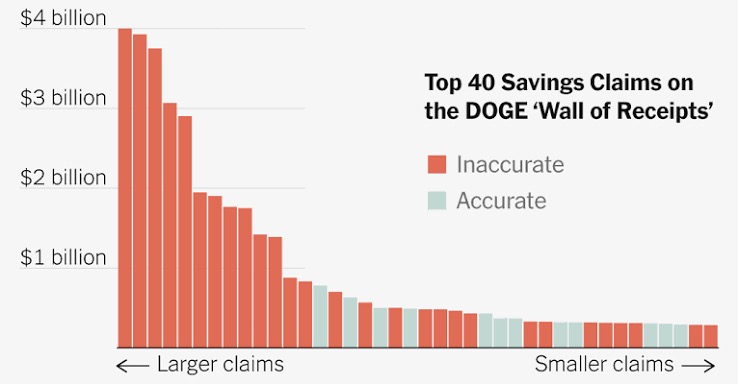
    According to a report released on Thursday, the Department of Government Efficiency, better known as DOGE, led by Elon Musk himself, was making up figures about the amount of money it was saving the country. The report was requested by Democratic senators Gary Peters of Michigan and Richard Blumenthal of Connecticut and was conducted by the Government Accountability Office.

    DOGE was found to have used “misleading practices” when it came to canceled leases and active government contracts. Additionally, the audit found that the department provided insufficient evidence for the methods used in 96 percent of the canceled grants.

    The Department of Government Efficiency was also found to have failed to follow their own formulas when it came to calculating figures for canceled leases and contracts, and in the cases where they did follow their formulas, they either missed out on the details or did not disclose them when they should have. When they did follow their own procedures, the Government Accountability Office found that they overlooked the complexities of government contracts, including liabilities and penalties that come with breaking a contract before the due date.

    “The report shows that the Trump administration’s cost-saving mission was conducted in a misleading fashion, achieving little apart from putting at risk taxpayer data and key programs,” said Senator Peters.

    “President Trump and his allies in the Senate and House have been using DOGE as a fig leaf to hide tax-cut giveaways to the wealthy and large corporations while pretending to save the deficit,” said Senator Blumenthal.

    Many people have responded to the report, including Jessica Tillipman, associate dean of the GWU School of Law, who specializes in government procurement. Tillipman cited several errors she found on the social media accounts of DOGE, one of which being a claim that the department had saved $28 million reduction in expenditures for an Air Force agreement, whereas the actual financial relief amounted to roughly $600,000 from a canceled lease. “That figure doesn’t account for the present value of future lease payments, which would reduce the supposed $3.7 million savings,” Tillipman said.

    “DOGE’s fiscal wins were mostly fictional,” write Reason editor-in-chief Eric Boehm, who covered the story for the libertarian magazine. “According to a new report from the Government Accountability Office, the Trump administration’s claims about savings from slashing federal spending were often based on faulty math.”

    “DOGE may soon start spending more taxpayer money, but at least the government watchdogs are forcing Musk’s agency to be more open about how it spends our money when it comes to cutting back federal services,” concluded Senator Blumenthal.

    Fediverse Reactions
  • Republicans are Undermining Government Accountability in Pursuit of Tax Cuts for the Wealthy

    Congressional Republicans have consistently voiced their commitment to a more efficient, cost-effective, and accountable federal government. However, a closer look at their proposed budget cuts reveals a potential contradiction that could ultimately harm American taxpayers. 

    As part of the FY2026 Legislative Branch funding bill, Republicans are pushing for a dramatic $396 million cut to the Government Accountability Office (GAO), the independent investigative arm of Congress. This represents a staggering 49% reduction in the GAO’s budget, potentially leading to the elimination of over 2,200 of its roughly 3,500 employees.

    This proposed cut raises serious questions about the true intent behind Republican rhetoric on government accountability. The GAO plays a crucial role in identifying waste, fraud, and abuse within federal agencies. By conducting rigorous, non-partisan audits and investigations, the GAO helps Congress and the public understand how taxpayer dollars are being spent and identify areas for improvement.

    Democrats argue that decimating the GAO’s workforce would leave only “skeletal staffing,” severely hindering its ability to effectively monitor government spending. This could result in federal taxpayers losing out on potentially tens or hundreds of billions of dollars in savings, which the GAO routinely identifies through its investigations.

    The proposed cuts have sparked accusations that Republicans are prioritizing tax cuts for wealthy individuals at the expense of average American taxpayers. By weakening the GAO, they argue, Republicans are essentially removing a key watchdog that helps ensure responsible use of taxpayer money. This lack of oversight could lead to increased waste and mismanagement, ultimately burdening American families with higher costs and fewer essential services.

    It remains to be seen whether these proposed cuts will ultimately be enacted. However, the debate surrounding the GAO’s funding highlights a fundamental tension between Republican promises of fiscal responsibility and their willingness to potentially undermine a crucial institution dedicated to promoting government accountability. As the budget process moves forward, it is vital for lawmakers to carefully consider the potential consequences of these cuts and prioritize the responsible stewardship of taxpayer dollars.