Tag: gerrymandering

  • Justice Kagan Warns Supreme Court Ruling on Texas Map Could Erode Voter Rights 


    Blue Press Journal (DC) – In a sharply worded dissent, U.S. Supreme Court Justice Elena Kagan has cautioned that the Court’s recent decision to greenlight Texas’s new congressional map could undermine constitutional protections for voters—particularly those from racial minority communities. Earlier this week, the Court’s conservative majority allowed Texas to implement its redrawn districts for upcoming elections, despite a lower court’s finding that the map was likely drawn with impermissible racial considerations. 

    The lower court had determined that the map—crafted by the Republican-controlled state legislature—split communities along racial lines in ways that could diminish the political power of Black and Latino voters. Such a move, the court said, potentially violates both the 14th Amendment’s guarantee of equal protection and the 15th Amendment’s prohibition against racial discrimination in voting. 

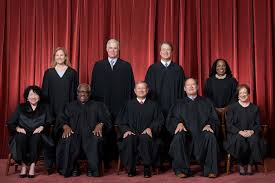
    Justice Kagan, joined by Justices Sonia Sotomayor and Ketanji Brown Jackson, accused the majority of rushing to judgment without fully grappling with the evidence. “Today’s decision,” Kagan wrote, “disregards the careful, thorough analysis conducted by the district court and replaces it with a hasty greenlight for a map that may well be unconstitutional.” She emphasized that the lower court’s examination had been not only extensive but grounded in testimony, demographic data, and a deep review of the legislative process. 

    Kagan also warned that the Court’s intervention sends a troubling message about how voting rights cases will be handled going forward. “When this Court short-circuits lower court processes,” she noted, “it risks both the constitutional rights at stake and the public’s trust in the judiciary’s commitment to protecting them.” 

    The ruling is expected to have ripple effects beyond Texas. Redistricting battles are already underway in several states, including California, where a newly approved map is projected to favor Democrats. Some legal analysts believe the Texas decision could embolden partisan mapmakers elsewhere, knowing they may face fewer judicial roadblocks. 

    Critics of the ruling argue that it diminishes the role of trial courts in independently scrutinizing maps for racial bias and weakens long-standing protections designed to ensure fair representation.  

    The timing of the decision—so close to upcoming elections—adds to the controversy. Historically, the Supreme Court has been cautious about altering election rules too near a vote, citing the potential for confusion. In this case, however, the majority opted to leave the disputed map in place. For voters in Texas’s affected districts, the consequence is immediate: they will cast ballots in districts whose boundaries remain hotly contested. 

    As the 2026 election cycle intensifies, the Supreme Court’s posture on redistricting and voter rights will be under even closer scrutiny. Justice Kagan’s dissent underscores the stakes: “Our Constitution promises equal political voice to all citizens, regardless of race. Today’s decision risks breaking that promise.” 

  • The Texas Test: Will Republicans Uphold Their Own Gerrymandering Rules?

    A question that challenges the very essence of democracy itself, as it stands before the Supreme Court.

    Blue Press Journal – The Republican Party’s commitment to integrity is about to be put to the test once again, this time in Texas. A federal district court has blocked the state’s redrawn congressional map from taking effect, leaving the GOP majority with a difficult decision: will they uphold the gerrymandering rules they created, or will they turn a blind eye to Texas’ racial gerrymandering?

    The controversy surrounding Texas’ congressional map is not new. In 2021, the state’s Republican-led legislature redrew the map to favor their party, sparking allegations of racial gerrymandering. The new map was challenged in court, and on Tuesday, a federal district court ruled that it was likely unconstitutional, blocking its implementation.

    This development is significant, coming on the heels of several Supreme Court decisions that have made it easier for state legislatures to gerrymander their congressional maps. In 2019, Chief Justice John Roberts ruled in Rucho v. Common Cause that partisan gerrymandering claims are non-justiciable, effectively allowing state legislatures to rig their maps to protect their own party. As Roberts himself wrote, “The federal courts have no power to resolve” partisan gerrymandering claims.

    However, this decision, combined with last year’s ruling in Alexander v. South Carolina State Conference of the NAACP, has created a worrying precedent. In Alexander, Justice Samuel Alito wrote that if a redrawn map hurts minority voters but legislators can plausibly claim it was drawn for partisan gain, courts must presume that “the legislature acted in good faith” and rule in their favor. This has effectively created a roadmap for state legislatures to bypass the Constitution’s prohibition on racial gerrymandering.

    As Elora Mukherjee, a law professor at Columbia University, noted, “The Supreme Court’s decisions have made it increasingly difficult to challenge gerrymandered maps in court.” She added, “The Texas case is a test of whether the Republican Party will uphold their own rules and ensure that their gerrymandering does not harm minority voters.”

    The Texas case is particularly egregious, as the state’s redrawn map appears to have been designed to disenfranchise minority voters. The map would have reduced the number of majority-minority districts, making it harder for minority communities to elect representatives of their choice.

    As the Republican Party grapples with this issue, they must confront the consequences of their own actions. By creating a framework that allows for partisan gerrymandering, they have opened the door to racial gerrymandering. Now, they must decide whether to uphold their own rules or turn a blind eye to Texas’ racial gerrymandering.

    As The New York Times editorial board wrote, “The Supreme Court’s decisions have emboldened state legislatures to push the boundaries of gerrymandering.” The Texas case is a stark reminder that the fight against gerrymandering is far from over.

    In a statement, the NAACP Legal Defense Fund said, “The Texas case is a critical test of the Supreme Court’s commitment to ensuring that voting rights are protected.” The organization’s president, Janai Nelson, added, “We will continue to fight against gerrymandering in all its forms, and we will not back down in the face of attempts to disenfranchise minority voters.”

    As the Texas case makes its way through the courts, one thing is clear: the integrity of the Republican Party will be on full display. Will they uphold their own gerrymandering rules, or will they allow Texas’ racial gerrymandering to slide? The answer will have significant implications for the future of democracy in America.

    In the words of Rucho v. Common Cause dissenting Justice Elena Kagan, “The Court’s decision today will have disastrous consequences for representative democracy.” The Texas case is a stark reminder that the consequences of gerrymandering are very real, and that the fight for fair representation is far from over.