Tag: global stability

  • The Golden Idol vs. The Gospel: Why Trump’s Attack on the Pope Is a Moral Line Crossed

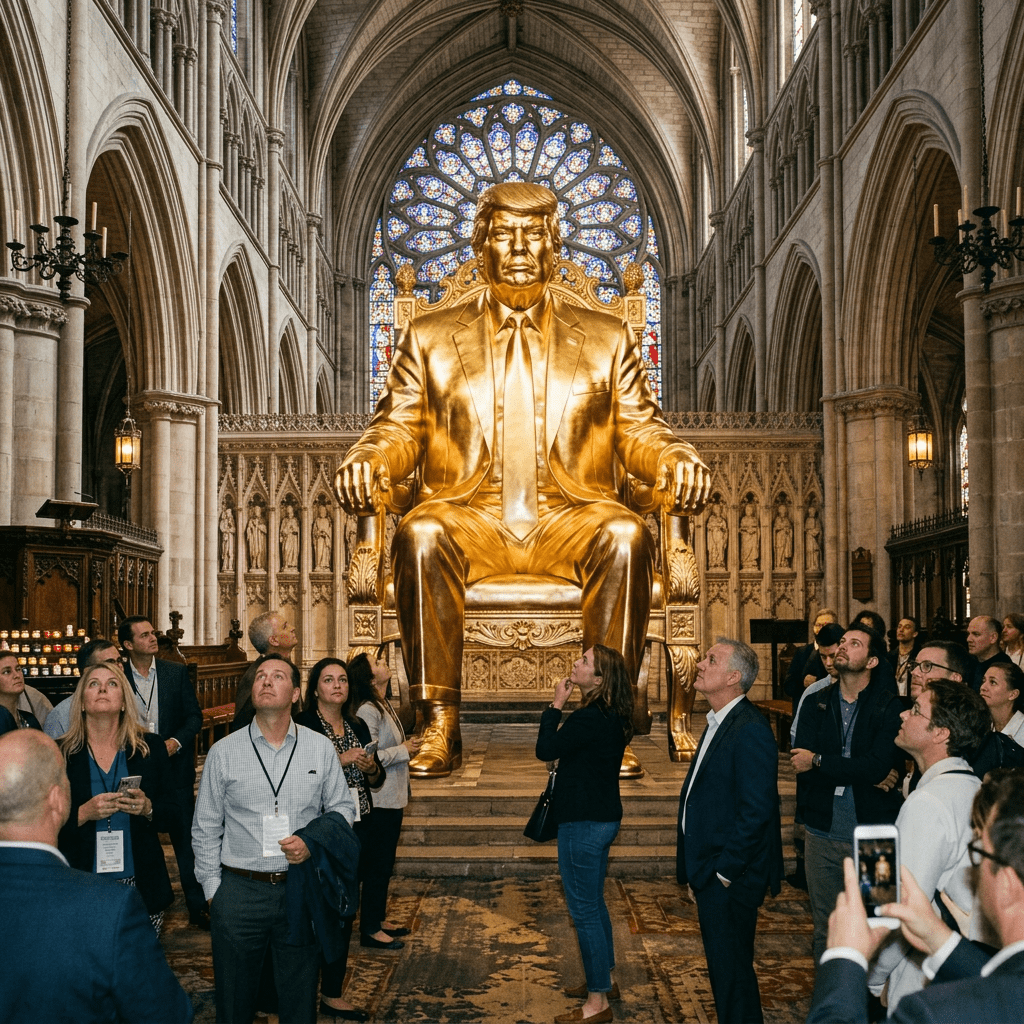
    Large golden statue of a man sitting on an ornate throne surrounded by people looking up

    Blue Press Journal – In the landscape of modern politics, Trump politics, we have become accustomed to the daily barrage of inflammatory rhetoric from Donald Trump. However, Sundays unhinged tirade against Pope Leo XIV—the first American-born pontiff—marks a chilling departure from political discourse and signals a complete detachment from reality. 

    When the president decided to attack the head of the planet’s biggest religious group, debate over decisions and policies fades away. Instead comes a breakdown in basic thinking. It is a fundamental collapse of cognitive reasoning and a direct affront to the core tenets of the Christian faith.

    The Tirade: A Distortion of Reality

    The attack, posted to Truth Social, was as erratic as it was vitriolic. Trump took issue with the Pope’s calls for global peace—calls that were not directed at any specific individual, but were instead a broader warning against the “delusion of omnipotence” that threatens international stability. 

    Instead of measured responses, Trump responded with sharp criticism, calling the Pope ineffective regarding crime and poorly suited for international affairs. Not stopping there, he suggested his own influence shaped events, insisting the cardinals chose the pontiff as a calculated effort against his administration.

    “I don’t want a Pope who criticizes the President of the United States because I’m doing exactly what I was elected, IN A LANDSLIDE, to do,” Trump griped.

    The Conflict: Omnipotence vs. Peace

    The Pope’s message was a clarion call for de-escalation, particularly regarding the growing tensions with Iran. Throughout history, the Papacy has stood as a bastion for peace, preaching the message of brotherly love and the sanctity of human life. 

    What stands out is how a plea for worldwide calm was taken as an offense to Donald Trump. Only a narcissist would view the Popes remarks as against himself.  Trump targeted the Catholic Church’s head over messages favoring peace, it went beyond criticism of an individual. Instead, it became defiance of principles rooted deeply in Christian doctrine.

    A Choice for Christians: The Mirror Test

    For millions of American Christians, this moment serves as an urgent, defining mirror test. We must ask ourselves: Has the political movement surrounding Donald Trump become a golden idol that demands the sacrifice of our spiritual integrity? 

    The Bible is clear. It calls for humility, mercy, and the pursuit of peace. It does not call for the idolization of political figures who view spiritual leaders as enemies simply because they speak truth to power. If we claim to follow the teachings of Christ, we cannot remain silent while those same teachings are mocked and maligned by a leader who values his own ego above the sanctity of the faith.

    Christians and Followers of Christ

    Donald Trump’s descent into attacking the Pope is more than just another news cycle; it is a warning. It reveals a worldview where there is no room for moral authority, no room for spiritual guidance, and no room for peace if it does not serve Donald Trump’s narrative. 

    Future directions require clarity on priorities. One path follows a leader whose authority rests on unquestioned devotion. In contrast, another reflects quiet principles long professed within spiritual tradition. These are not compatible routes. Commitment to one weakens alignment with the other. Choice becomes unavoidable when values diverge so fully. The time has come to choose.
  • Beyond Generosity: Why Robust U.S. Support for Ukraine is Critical for American National & Economic Security

    The security of Kyiv directly impacts the security of Main Street.

    Blue Press Journal – Ukraine’s ongoing struggle for sovereignty is often framed as a moral imperative or an act of generosity from its allies. However, a closer look reveals that sustained U.S. support for Ukraine is not just altruistic; it is a strategic investment in American national and economic security. This pivotal moment demands that U.S. policymakers and the public understand the profound implications for their own prosperity and global stability.

    Ukraine’s Unwavering European Path & Enduring American Partnership

    At its core, Ukraine is irrevocably committed to a future intertwined with Europe. This profound aspiration, coupled with a deep appreciation for American partnership, shapes their daily decisions, from energy infrastructure to military planning and economic recovery. Despite fluctuating political signals from Washington (Donald Trump), Ukrainians continue to view the United States with remarkable gratitude. Their primary concern isn’t outright abandonment, but rather the destabilizing inconsistency that could undermine long-term planning and deterrence.

    American Support: A Nuanced Reality

    A persistent misconception in Washington suggests a waning of public support for Ukraine. Yet, the data tells a more reassuring story. Polling from organizations like the Atlantic Council, utilizing data from HarrisX, consistently demonstrates that a majority of Americans – approximately six in ten – continue to support U.S. assistance to Ukraine, including vital military aid. [Source: Atlantic Council via HarrisX polling data, often cited in their analyses of public opinion, e.g., “The Resilience of American Support for Ukraine”]. Americans largely view Russia as the aggressor, express deep distrust of the Russian government, and oppose territorial concessions that would reward aggression.

    The challenge isn’t public opposition, but rather a lack of sustained attention. Domestic concerns like inflation, housing costs, and electoral politics understandably dominate daily discourse. Ukraine often doesn’t top these lists, not because Americans oppose assistance, but because they assume the issue is being competently managed. The public is distracted, not hostile, highlighting a crucial communication gap that U.S. advocates must bridge.

    The Economic Stakes: Why Global Stability Benefits Every American

    The most critical aspect often overlooked is how Ukraine’s fight directly safeguards the foundational principles of the international order that underpin American prosperity. For decades, the U.S. economy has thrived within a predictable global framework: secure trade routes, stable borders, enforceable rules, and alliances that deter major conflicts. This stability reduces risk, lowers costs, stimulates investment, creates American jobs, and allows the U.S. to shape global standards for trade, technology, and finance.

    The immediate aftermath of Russia’s full-scale invasion in 2022 offered a stark preview of these economic vulnerabilities. Energy prices surged globally, food costs climbed due to disrupted grain and fertilizer markets, and shipping and insurance rates increased, fueling inflation across the economy. [Source: International Monetary Fund (IMF) analysis on the economic impact of the war in Ukraine, e.g., “Global Economic Outlook: A Rocky Road Ahead” – specific chapter on Ukraine impacts]. These ripple effects led to higher interest rates, impacting mortgages, auto loans, credit cards, and small businesses – hitting American pocketbooks directly.

    If Russian aggression goes unchecked, the economic consequences will only deepen. A world where aggression is rewarded leads to structural risk, higher costs for everything, and diminished confidence for investment. This means slower growth, fragile supply chains, and greater volatility in retirement savings. Governments would spend more reacting to crises and less investing in domestic priorities. As the Council on Foreign Relations notes, “allowing Russia to dictate terms… would set a dangerous precedent for revisionist powers globally, destabilizing key trade routes and investment climates.” [Source: Council on Foreign Relations, e.g., “The Global Economic Impact of the War in Ukraine”].

    A Clear-Eyed National Security Imperative

    Beyond economics, supporting Ukraine is vital for U.S. national security. Ukraine is not asking the United States to fight its war, but to recognize that American security and prosperity are inextricably linked to its outcome. A failure to deter Russian aggression in Ukraine would signal weakness, inviting further challenges to the post-World War II international order. This would directly impact the credibility of NATO, the cornerstone of European security and a vital alliance for the U.S. [Source: NATO Official Statements, e.g., “NATO’s Response to Russia’s War in Ukraine”].

    If the United States desires a world governed by rules, predictability, and sovereign choice rather than coercion and chaos, it cannot afford to waver now. The cost of inaction – both economic and strategic – will far outweigh the investment required to ensure Ukraine’s success and uphold a stable global environment. Supporting Ukraine isn’t just about Ukraine; it’s about safeguarding America’s own power, prosperity, and the principles upon which its security rests.