Tag: global trade

  • Belarus Potash Debacle: Trump’s “Massive Deal” Proves to be a Hot Air

    by Winston Wendell

    In a surprising development, Belarussian President Alexander Lukashenko refuted the reports of a major potash deal between the US and Belarus. Lukashenko asserted that there were no such volumes of potash for sale to make such a deal, despite Trump’s insistence that a significant discount on Belarusian potash would benefit the American farmers.

    President Trump announced the deal on his social media platform called Truth Social, claiming that the US is “working on a massive Deal with respect to the purchase of Potash from Belarus” at a price lower than the current Canadian rate. However, President Lukashenko of Belarus spoiled the deal by telling Trump that all of their available potash has already been ordered and that they do not have any for sale.

    Trump’s long-running dispute between Canada and the United States has upended the potash market and has had a clear outcome: American farmers supply has decreased and costs have increased. Canada is the world’s largest producer of potash, and about 53% of its output is exported to the United States. Overall, roughly 80% of the potash used on American farms comes from Canada, while Belarus supplies only about 2%.

    As the dust is settling on the Belarus potash debacle, it is hard to say with a degree of certainty whether Trump was being truthful about the purported deal or he was just engaging in some self-promotion from the outset. The American farmers are left scratching their heads in bewilderment over the actual state of affairs with respect to their fertilizers. The bottom line is Trump is solely to blame for the critical shortage!
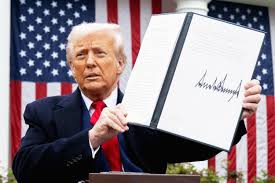
  • Trump’s Tariff Recalibration: Legal Setback Ignored, Consumers Still Face the Bill

    Blue Press Journal – A recent Supreme Court decision has delivered a significant legal setback to former President Donald Trump’s trade agenda, curtailing his ability to unilaterally impose tariffs under the International Emergency Economic Powers Act (IEEPA). However, this judicial review appears to be little more than a momentary speed bump for an administration determined to reconstitute its protectionist apparatus, with grave implications for American consumers and businesses.

    The 6-3 ruling, issued Friday, clarified that while IEEPA grants the president power to regulate trade for national security in emergencies, it does not extend to levying tariffs – a power reserved exclusively for Congress. This decision validates the concerns of thousands of businesses, potentially opening avenues for tariff refunds. Yet, Trump, undeterred, quickly announced his intent to employ alternative legal frameworks, vowing “much higher” tariffs for any nation perceived to be challenging his trade policies.

    Economists like Diane Swonk of KPMG suggest the White House anticipated this outcome, noting the administration has been “preparing for this” by identifying other levers. Trump’s immediate response included moving to impose a 10 percent universal tariff via Section 122 of the Trade Act of 1974, ostensibly to address balance of payments issues – a justification many experts find dubious. More enduringly, the administration is now pivoting towards Section 301 of the Trade Act of 1974 and Section 232 of the Trade Expansion Act of 1962.

    Section 301 empowers the president to impose tariffs in response to a foreign country’s unfair trade practices. This provision has a lengthy history, notably used by Trump against China during his first term. Its established precedent makes it a formidable tool, with experts like Edward Alden of the Council on Foreign Relations believing courts are unlikely to second-guess executive judgment under this authority.

    Meanwhile, Section 232 grants expansive power to impose tariffs on products deemed a threat to national security. Trump previously applied this to steel and aluminum imports, later extending it to goods like autos, lumber, and even furniture, often with questionable national security justifications. While some applications of Section 232 appear tenuous, courts historically defer to presidential assessments of national security, making challenges difficult.

    Crucially, regardless of the legal mechanism, tariffs are not paid by foreign governments or producers; they are a tax levied on domestic importers, which is then passed directly to American consumers in the form of higher prices. This hidden tax reduces purchasing power and stifles economic growth. As Goldman Sachs analysts Alec Phillips, Elsie Peng, and David Mericle warn, this constant recalibration of trade policy introduces significant volatility, disrupting global supply chains and creating uncertainty for businesses. The Supreme Court may have pruned one branch of Trump’s tariff strategy, but the root system remains deeply entrenched, promising continued turbulence and higher costs for ordinary Americans.