Tag: GOP budget cuts

  • Why Trump’s Healthcare Plan Fails Americans: A Critique of Vagueness, Risk, and Political Strategy

    Trump’s Healthcare Plan He Released Today Fails Americans

    Blue Press Journal (DC) – Donald Trump’s “affordability framework” for healthcare, touted as a solution to soaring drug prices and insurance premiums, has sparked significant criticism from experts, advocacy groups, and even within Congress. While the plan aims to address a pressing issue—healthcare costs for millions of Americans—the lack of concrete details, its potential risks, and its divergence from existing safeguards under the Affordable Care Act (ACA) render it inadequate, if not outright counterproductive. 

    Vagueness and Exclusion of Preexisting Conditions

    Trump’s proposal calls for allowing individuals to use government subsidies to purchase insurance plans of their choice. However, the plan conspicuously avoids specifying whether these plans would adhere to ACA mandates, including coverage for preexisting conditions. This omission has raised alarm among healthcare advocates, who argue that without such protections, people with chronic illnesses could face discrimination, unaffordable premiums, or outright denial of coverage. 

    The advocacy group Protect Our Care, among others, has lambasted the plan as a “joke” and a “gimmick,” emphasizing that Trump’s past policies have already weakened consumer protections. For instance, Trump’s administration rolled back the ACA’s community rating rules, allowing insurers to charge older Americans up to three times more than younger counterparts. Critics warn that his latest plan could exacerbate this problem by enabling insurers to offer cheaper, watered-down policies with minimal coverage, leaving vulnerable populations unprotected. 

    Failure to Address Expired ACA Subsidies

    One of the most urgent issues facing healthcare affordability today is the expiration of enhanced ACA premium subsidies, which led to a dramatic spike in costs for millions of Americans. The House passed a bipartisan three-year extension of these subsidies, which the Congressional Budget Office (CBO) estimates would add 3 million insured Americans by 2027 and 4 million by 2028. Yet Trump and Senate Republicans have stalled action on the extension, with Senate Majority Leader John Thune refusing to bring it to a vote. 

    Instead of supporting the proven solution, Trump advocates for subsidies to go directly to individuals rather than insurers—a shift that lacks a clear implementation strategy or funding mechanism. Protect Our Care accused the administration of “gaslighting” Americans by ignoring the root cause of the crisis: Trump’s own cuts to Medicaid and his refusal to reauthorize subsidies, which have left 22 million Americans in a coverage gap. “The solution isn’t rocket science,” the group stated. “It’s a clean extension of the ACA credits that passed the House.” 

    Vague Funding and No Concrete Cost-Containment Strategies

    Trump’s framework offers a broad outline but provides no specifics on how it would be funded or how it would lower drug prices—a central promise of the proposal. While Trump has long railed against pharmaceutical companies, his administration has failed to implement aggressive price negotiations that could reduce costs. Meanwhile, critics argue that his plan’s focus on subsidizing individuals rather than regulating insurers or drug manufacturers ignores systemic issues like hospital consolidation and insurance company profiteering. 

    The White House called the plan “comprehensive,” but the absence of legislative text or cost projections has led experts to question its feasibility. Without clear mechanisms to hold insurers and pharmaceutical companies accountable, the plan risks merely shifting costs rather than addressing them. 

    Undermining the ACA’s Infrastructure

    Rather than building on the ACA’s success in expanding coverage to 20 million Americans, Trump’s proposal risks destabilizing the existing healthcare market. By bypassing the ACA’s insurance marketplace rules, the plan could disrupt the system that subsidizes coverage for low- and middle-income families. Furthermore, Trump’s past attempts to repeal the ACA—and his cuts to Medicaid funding—have already eroded trust in his commitment to healthcare access. 

    Senators who blocked the House’s subsidy extension (via a unanimous consent agreement) underscored the political nature of the stalemate. Protect Our Care accused Trump of prioritizing “tax breaks for billionaires” over the needs of working families, noting that his administration’s policies have “taken a hammer to American healthcare.” 

    The Need for a Proven, Bipartisan Solution

    Trump’s healthcare plan lacks the substance, protections, and funding to meaningfully lower costs or expand access. Its omissions—particularly regarding preexisting conditions and expired subsidies—highlight its reliance on vague promises rather than tangible reforms. In contrast, the House’s three-year ACA subsidy extension, supported by bipartisan majorities and backed by the CBO, offers a clear, data-driven path forward. 

    As the midterm elections loom, Americans are sick of empty political theater and demand genuine solutions. Congress better wake up and prioritize the House’s critical extension to stabilize insurance markets or risks a public outcry as premiums spiral out of control. Meanwhile, Trump’s so-called plan is nothing more than a hollow shell, fixated on fleeting optics instead of ensuring real healthcare stability for the long haul. As Protect Our Care rightly asserts, “The American people deserve real solutions, not gimmicks.”


  • GOP Blocks Health Care Rescue Bill as Millions Face Soaring Premiums

    Blue Press Journal (DC) 12/11/25 – A critical bipartisan opportunity to prevent massive health insurance premium spikes has collapsed in the Senate, as Republicans overwhelmingly rejected a Democratic proposal to extend life-saving Affordable Care Act (ACA) subsidies. Despite growing alarm over the financial fallout for American families, the GOP’s refusal to support a clean, three-year extension has left millions at risk of unaffordable coverage just as enrollment for next year begins.

    The Democratic-backed bill, which aimed to continue enhanced subsidies introduced during the pandemic, received 51 votes—just enough to pass under a simple majority if not for the 60-vote threshold required under current Senate rules. Four Republican senators—Susan Collins (R-ME), Lisa Murkowski and Dan Sullivan (R-AK), and Josh Hawley (R-MO)—broke with their party to support the measure. But their bipartisan effort was not enough to overcome unified GOP opposition.

    These subsidies have been instrumental in making health insurance affordable for low- and middle-income Americans. Since their expansion, enrollment in ACA plans has surged to record levels, and average premiums have dropped significantly. Without action, those gains are poised to vanish overnight. Experts project that monthly premiums could increase by hundreds of dollars for millions of Americans, particularly those earning just above the poverty line.

    The consequences are not hypothetical. For a family of four in a mid-sized city, the loss of subsidies could mean paying an extra $5,000 or more annually for coverage. For many, that burden will force impossible choices: pay for health insurance or afford rent, groceries, or prescription medications.

    And yet, the Republican response has been marked by inaction and disarray. While Senate Republicans blocked the Democratic bill, House Republicans remain deeply divided on any alternative solution. There is no unified GOP plan—no proposal with policy details, no cost estimates, no pathway to enactment. Their silence speaks volumes: rather than crafting a solution, the party has chosen political obstruction over human consequence.

    This isn’t just about policy disagreements. It’s about priorities. At a moment when Americans are still grappling with the economic aftermath of a pandemic and enduring high costs for essentials like food, gas, and housing, the Republican leadership has decided that protecting working families from skyrocketing health care costs is not worth their support. Their refusal to act, again and again, underscores a broader abandonment of the very constituents they claim to serve.

    Make no mistake: the bottom line is clear. Republicans—and Donald Trump, whose influence over the party remains profound—have repeatedly demonstrated that they do not care about the affordability and accessibility of health care for ordinary Americans. They have rejected pragmatic, bipartisan compromise not because of policy concerns, but because of political calculation.

  • Rural Hospitals Face Uncertain Future and Closures After Trump Signs Budget Bill into Law

    Blue Press Journal: In a move that has left many in the healthcare community reeling, President Donald Trump signed a budget bill into law on July 4 that is expected to have devastating consequences for rural hospitals across the country. The legislation, which includes significant cuts to Medicaid, is estimated to put 380 independent rural hospitals “at serious risk of closure nationwide,” according to Families USA, a non-partisan consumer health care nonprofit.

    The impact of these cuts will be felt disproportionately in rural areas, where residents rely heavily on Medicaid for their healthcare needs. In an effort to mitigate the damage, GOP lawmakers included a $50 billion “Rural Health Transformation Fund” in the bill, ostensibly to support struggling rural health facilities. However, public health experts argue that this amount is woefully insufficient to offset the estimated $137 billion in losses that rural health facilities are expected to incur under the legislation.

    Furthermore, the distribution methods for the $50 billion fund have been criticized as opaque and seemingly partisan. This lack of transparency has raised concerns that the funds may not be allocated in a way that effectively addresses the needs of rural hospitals and the communities they serve.

    The situation is further complicated by the fact that rural hospitals will be forced to absorb the estimated 16 million uninsured patients that the Medicaid cuts are likely to create. This will put an unsustainable strain on already-overburdened healthcare systems, exacerbating existing shortages of health professionals in rural areas.

    The potential consequences of these cuts are dire, with many rural hospitals facing the very real possibility of closure. This would not only deprive communities of essential healthcare services but also have a devastating impact on local economies. As the full effects of the budget bill begin to unfold, it remains to be seen whether the $50 billion Rural Health Transformation Fund will be enough to stem the tide of hospital closures and ensure that rural communities continue to have access to quality healthcare.

  • Rural America Bears the Brunt of Trump’s Medicaid Cuts, But Supporters Remain in Denial

    A health clinic in McCook, Nebraska, a small town with a population of 7,446, has become the latest casualty of President Donald Trump’s budget cuts to Medicaid. The clinic’s closure has sent shockwaves through the community, leaving many without access to vital healthcare services. However, despite the devastating impact on rural America, many of Trump’s fervent supporters continue to refuse to accept the reality of the situation.

    The Medicaid cuts, championed by Trump and the Republican Party, have been sold to rural white voters as a necessary measure to prevent benefits from being squandered on “undeserving” individuals, such as immigrants, city dwellers, and people of color. This narrative has been perpetuated despite being thoroughly debunked, and has proven to be a potent tool in rallying support for the cuts.

    However, the consequences of these cuts are now being felt in communities like McCook, where the health clinic’s closure will leave a significant gap in healthcare services. The clinic’s demise is a stark reminder that the Medicaid cuts are not just affecting “illegals” or “freeloaders,” as some right-wing message boards would have you believe, but are instead harming hard-working, rural Americans who are in dire need of healthcare services.

    Despite the evidence, many of Trump’s supporters remain in denial, insisting that the cuts are only affecting those who do not deserve healthcare. Social media platforms are filled with comments from individuals who claim that the cuts are necessary to prevent abuse of the system, and that the only people being hurt are those who are not truly in need.

    The stark reality on the ground unveils a grave predicament. Rural America, long besieged by a lack of adequate healthcare services, is facing a devastating blow from the recent Medicaid cuts. Alarmingly, experts predict that these drastic reductions to Medicaid will resonate throughout nearly every state, with the terrifying forecast showing that more than 25% of hospitals could face closure. In 11 states, the situation is even more dire, as up to 50% or more of hospitals stand on the brink of shutting down, leaving vulnerable communities in a perilous state.

    The shutdown of the health clinic in McCook serves as a stark reminder of the human cost of the Medicaid cuts, and the need for republicans to reconsider the impact of their decisions on rural America.

  • The Republican Debt Bomb: How Trump and the GOP are Adding Trillions to the National Debt

    Despite their oft-expressed outrage over the country’s borrowing habits, Republicans appear to be adding another massive, multi-trillion-dollar slab onto the national debt. President Donald Trump and Republican majorities in both chambers of Congress have voted to erode the tax base even further, increasing annual deficits and sending the federal debt to historic highs.

    When Trump took office in 2017, he inherited a robust economy with low unemployment. However, his decision to implement a big tax cut has generated $1 trillion-a-year budget deficits. According to the non-partisan Congressional Budget Office, the anticipated new debt already projected by the time Trump began his second term in January totaled some $7 trillion. This was before his new legislation added an additional $3.4 trillion to the debt over the coming decade.

    By the time Trump is constitutionally required to leave office in 2029, the national debt will likely be a staggering $45 trillion, with Trump himself having contributed $18 trillion of it over two terms. This is a far cry from the fiscal responsibility that Republicans often claim to champion.

    It’s worth noting that Trump’s tax cuts, which he and his followers claim are the largest in history, are actually smaller than those implemented by Ronald Reagan in 1981. Reagan’s tax cuts totaled 2.9% of the nation’s GDP at the time, while Trump’s 2017 cuts were about 0.7% of GDP. George W. Bush’s 2001 and 2003 cuts fell somewhere in between, at 1.3% of GDP.

    What’s more, while Reagan is often remembered for cutting taxes, he also raised them repeatedly during his time in office. In fact, he raised taxes a total of 11 times over his two terms, including the Tax Equity and Fiscal Responsibility Act of 1982, which was among the largest tax increases in U.S. history.

    The consequences of the Republican debt bomb are stark. In the final years of Clinton’s second term, the debt-to-GDP ratio was shrinking, and actually paying off the national debt seemed within reach. However, the GOP’s addiction to tax cuts and spending increases has put those days behind us. The national debt is now projected to balloon to unprecedented levels, threatening the country’s economic stability and leaving future generations to foot the bill.

    .

  • GOP Tax Cut Legislation Threatens to Upend America’s Healthcare System

    The recent passage of massive tax cut legislation by the House and Senate has sent shockwaves through the American healthcare system. While the bill’s proponents claim it will boost economic growth, the reality is that it poses a significant threat to the stability of rural and safety-net hospitals, and ultimately, the patients who rely on them.

    At the heart of the issue is a provision that alters state-levied provider taxes, resulting in a substantial reduction in spending – to the tune of nearly $191 billion over the next decade, according to estimates from the Congressional Budget Office (CBO). An analysis by the National Rural Health Association and Manatt Health found that an earlier version of the bill introduced in the Senate would have resulted in a staggering $58 billion in Medicaid cuts over the next 10 years for rural hospitals.

    The final bill that passed includes a five-year, $50 billion rural health relief fund, but provider groups argue that this is merely a Band-Aid solution compared to the overall cost of the cuts. In reality, this temporary fix is unlikely to mitigate the long-term damage caused by the legislation.

    As a direct consequence of the bill’s provisions, hospitals are poised to experience an alarming surge in uncompensated care and an overwhelming influx of patients flooding emergency rooms. This crisis will unfold as millions of American families are pushed to the brink, losing their essential healthcare coverage due to the draconian Medicaid work requirements and the heartless eligibility alterations embedded in this legislation. The repercussions will be catastrophic, leaving our hospitals grappling desperately to provide the care that every patient and community so profoundly deserves.

    “We are in a crisis,” said Bruce Siegel, president and CEO of America’s Essential Hospitals, a group that represents hospitals serving primarily low-income patients. “Widespread coverage losses plus weakened hospitals is a recipe for disaster, and patients will pay the price.”

    The impact on rural hospitals will be particularly severe, as they are often the lifeline for communities with limited access to healthcare services. The loss of funding will exacerbate existing challenges, such as staffing shortages and outdated infrastructure, making it even more difficult for these hospitals to provide essential care to their patients.

    While the tax cut legislation may have been touted as a economic stimulus, its true impact will be felt in the healthcare sector, where it threatens to destabilize rural and safety-net hospitals.

  • Republicans Push Through Tax Cut Bill, Leaving Millions to Suffer the Consequences

    In a move that has been widely criticized, the Republican-controlled House of Representatives passed a massive bill on Thursday that cuts taxes and slashes Medicaid funding, sending the legislation to President Donald Trump’s desk for signature. The bill, which passed by a narrow margin of 218-214, is expected to have far-reaching and devastating consequences for millions of Americans.

    The bill’s passage was made possible by Republican lawmakers who, despite previously expressing concerns about the legislation, ultimately caved to pressure from the Trump administration and party leadership. All Democrats and two Republicans, Reps. Brian Fitzpatrick (R-Pa.) and Thomas Massie (R-Ky.), voted against the bill.

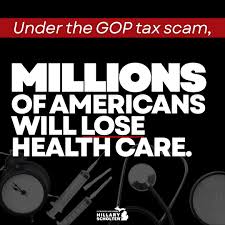
    The legislation threatens to strip millions of Americans of their health insurance, as devastating cuts to Medicaid funding will leave hospitals, especially those in rural areas, teetering on the brink of financial collapse. Moreover, the harsh reductions to SNAP, which provides crucial nourishment for countless children, are simply inexcusable. To add insult to injury, the bill’s tax cuts, which primarily benefit the wealthiest households, will only serve to deepen the national debt, inflating it by an astronomical $3.4 trillion.

    The $4.5 trillion price tag of the tax cuts is only partially offset by $1 trillion in cuts to federal food and health programs, a move that will have serious consequences for vulnerable populations. The bill’s fiscal irresponsibility and slapdash legislative process are hallmarks of Republican governance in the Trump era, where ideology and party loyalty have taken precedence over responsible policymaking.

    The bill’s passage is also expected to supercharge Trump’s efforts to round up, detain, and deport millions of immigrants who lack legal authorization to remain in the country, further exacerbating an already fraught immigration system.

    In a stark illustration of the bill’s priorities, the tax cuts will largely benefit wealthy households, while the Medicaid cuts and other reductions in federal health and food programs will harm low- and middle-income Americans. The bill’s supporters have touted it as a “big, beautiful bill,” but the reality is that it is a deeply flawed piece of legislation that will have serious and long-lasting consequences for the country.

    When President Trump signs the bill into law, it is clear that the Republican Party has chosen to prioritize the interests of the wealthy and large corporations over those of ordinary Americans. The bill’s passage is a stark reminder of the deep partisan divisions in Washington and the need to elect a Democratic Majority in 2026!

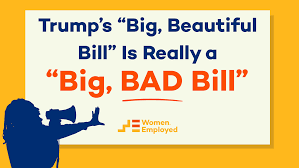
  • The “Big Bad Bill” is bad for America: Take Action!!

    Highlights of The Senate Bill

    The Senate Republican legislative package, referred to by its proponents as a “big, beautiful bill,” passed Tuesday the Senate by the slimmest of margins – a single vote. This contentious outcome reflects the deeply divisive nature of the bill’s provisions and its projected far-reaching consequences for various segments of the American population. Democrats argue the bill disproportionately benefits the wealthiest Americans while significantly curtailing vital social safety nets, impacting healthcare, education, environmental initiatives, and immigration policies. Even Elon Musk was against it!

    The nearly 900-page bill, fast-tracked through the Senate, saw Republican leadership making last-minute adjustments, reportedly to secure the minimum votes for passage. This legislative effort is criticized for its fundamental financial reordering: a substantial portion of its funding comes from drastic cuts to federal programs, particularly Medicaid, which faces over $1 trillion in reductions. Concurrently, it allocates an estimated $975 billion in tax breaks, primarily benefiting the wealthiest 1% of the country, with little direct benefit for average taxpayers.

    Impacts on Healthcare and Social Safety Nets

    The bill’s sweeping cuts to Medicaid are projected to remove nearly 12 million people from their health insurance coverage. Beyond individual impact, this has severe implications for healthcare infrastructure: an analysis by Families USA indicates 55 independent rural hospitals, already part of 380 at-risk facilities nationwide, face new and serious threats of closure. Similarly, researchers at Brown University’s School of Public Health estimate that nearly 600 nursing homes across the country are at high risk of shutting down due to these Medicaid reductions, potentially “throwing grandma out.”

    Further impacting vulnerable populations, the bill also proposes a $285 billion cut to food assistance programs for low-income individuals and children.

    Economic and Educational Consequences

    Economically, the legislation is expected to result in significant job losses. An analysis by George Washington University and the Commonwealth Fund projects approximately 477,000 healthcare workers could lose their jobs over the next decade due to Medicaid cuts.

    In the clean energy sector, the immediate elimination of federal tax credits for wind and solar energy projects is anticipated to halt billions of dollars in private investment, leading to hundreds of thousands of job losses, according to the League of Conservation Voters.

    Education access is also affected. The bill reportedly redesigns federal student loan programs, making it more challenging for low- and middle-income borrowers to qualify for and afford loans. New borrowers would primarily rely on a new “Repayment Assistance Program” (RAP), which could require 30 years of payments, in contrast to existing programs (like SAVE) offering debt relief in 10-25 years.

    Immigration Enforcement and Family Unity

    Regarding immigration enforcement, the bill allocates nearly $30 billion to Immigration and Customs Enforcement (ICE). This funding not only supports increased agents and upgraded facilities but also explicitly directs ICE to use resources for “promoting family unity by detaining alien parents with their children,” a provision that has drawn significant criticism for its approach to family separation and detention.

    Conclusion

    The legislative package, passed by the narrowest of margins, represents a significant policy shift. Democrats contend its primary effect is a substantial transfer of wealth to the nation’s wealthiest through tax breaks, financed by extensive cuts to critical social programs. This approach, they argue, has far-reaching negative consequences for healthcare access, educational affordability, job security, and the well-being of vulnerable populations, explaining the Republican limiting debate of the bill during the holiday weekend.

    Next call/email your congressperson and tell them not to support the bill when it returns to the congress here.

  • GOP’s ‘Big Beautiful Bill’ Favoring Wealthy, Adding Trillions to Debt Amidst Budget Gimmick

    A Republican Senate legislative effort, reportedly dubbed the “Big Beautiful Bill,” is facing significant criticism for its potential impact on the national debt and the distribution of its benefits. Democrats argue the bill is heavily skewed towards the wealthy, providing significant tax cuts for that millionairs and billionaires while offering little benefit for the average American, simultaneously adding trillions to the national debt.

    Official budget scorekeepers for Congress, the Congressional Budget Office (CBO) and the Joint Committee on Taxation (JCT), estimate the cost of President Trump’s tax and spending bill at $4.5 trillion. This figure is reportedly $500 billion more than the House version of the proposed legislation. Concerns are further amplified by projections that the cost could rise to nearly $5 trillion if temporary business tax cuts included in the bill are made permanent.

    Adding to the ongoing controversy, Republicans have shockingly resorted to a new budget gimmick designed to conceal the true cost of the bill! This audacious maneuver unfolds against the backdrop of heated debates over the Senate’s filibuster rules, with critics passionately framing it as a blatant assault on democratic principles!

    Procedural maneuvers in the Senate have also drawn scrutiny. To avoid a potentially adverse opinion from the parliamentarian on a specific matter related to the bill’s passage, Republicans reportedly blocked the parliamentarian from ruling on it. This tactic seemingly allowed them to bypass the need to overrule the parliamentarian on the Senate floor – a move they had reportedly vowed never to do and for which they likely lacked sufficient votes. Instead, senators voted to support Senator Graham’s authority, as Chairman of the Budget committee, to use “current policy” within the reconciliation process.

    Details emerging from the bill’s components include a proposed amendment by GOP senators that aims to shrink the Medicaid program by another $313 billion, adding another layer of criticism regarding the bill’s priorities and impact on social programs.

    Democrats contend that the bill represents a significant shift of wealth towards the top while placing a substantial burden on future generations through increased national debt, with questions remaining about its fiscal impact and the methods used for its potential passage.

  • Trump’s ‘One Big Beautiful Bill’: Unmasking the Truth That Even Republicans Find Ugly

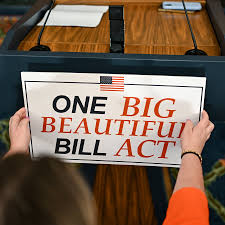
    President Donald Trump often champions his legislative initiatives with grand, optimistic titles. Among them, the “One Big Beautiful Bill” stands out – a flagship package of proposed tax and spending cuts currently being debated by his party in the Senate. Yet, beneath the veneer of its aspirational name, a stark reality is emerging: when ordinary Republican voters are given the unvarnished details of what this bill entails, they often find it anything but beautiful.

    In its current form, this monumental legislative proposal aims to slash spending on vital social safety net programs like Medicaid and food stamps. Simultaneously, it projects an estimated addition of a staggering $2.8 trillion to the national deficit. The stated goal for proponents is to streamline government and stimulate the economy. However, the anticipated impact on American families paints a very different picture.

    The “One Big Beautiful Bill” is designed to be passed without Democratic input, leveraging a parliamentary manoeuvre known as “reconciliation” to bypass the filibuster threat. Despite this strategic legislative pathway, the bill has been consistently polling poorly. As noted by political scientists Jacob Hacker and Paul Pierson in a recent op-ed, “Americans have yet to fully understand the special alchemy of inegalitarianism that defines it.”

    This “alchemy” refers to the bill’s profound redistribution of wealth. While proponents often speak in broad strokes about economic growth, a closer examination reveals that the proposed cuts and changes would disproportionately benefit the nation’s wealthiest households, potentially at the significant expense of the poor and middle class.

    And this is where the disconnect truly becomes apparent. When Trump’s die-hard supporters are presented with a clear, factual breakdown of how the bill’s provisions would affect the finances of the nation’s richest and poorest households – including their own potential loss of critical services or increased economic strain – their initial enthusiasm often dissolves into apprehension, if not outright dismay. The vision of a universally beneficial “beautiful bill” quickly gives way to the unsettling truth of its highly partisan and unequal consequences.

    This shift in sentiment among the Republican base highlights a critical information gap. While the bill is debated in the halls of power, and its merits are extolled on certain media platforms, the specific, granular details of its impact often remain obscured. For many of Trump’s most fervent supporters, the full scope of the bill’s “inegalitarian” nature – the way it could exacerbate economic disparities – is simply not part of the narrative they typically encounter, particularly not through sources like Fox News, which often provides a carefully curated perspective on the administration’s policies.

    The “One Big Beautiful Bill” thus serves as a potent example of the chasm that can exist between political rhetoric and tangible reality. When the lofty promises are stripped away, and the specific financial implications for ordinary families are laid bare, even those within the President’s core constituency are forced to confront an uncomfortable truth: beauty, in this case, truly is in the eye of the informed beholder, and for many, that informed glance reveals very little to admire.