A complaint against the Trump administration was filed on Tuesday with the Federal Communications Commission (FCC) and the Federal Trade Commission (FTC). It claims that the Trump’s recent government-funded television advertisements are illegal because they violate federal laws banning public funding of political propaganda.
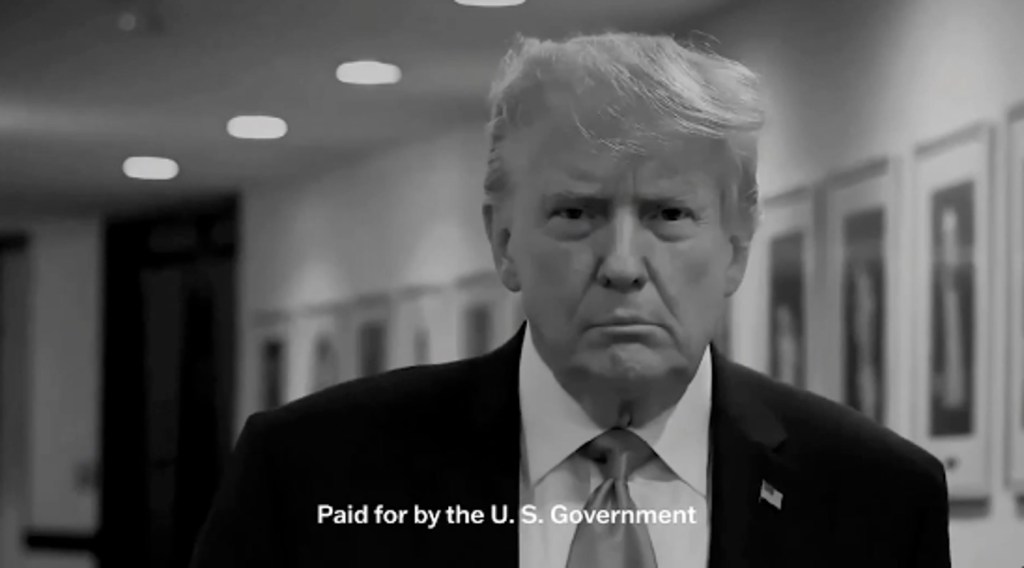
The petition asks the FCC and the FTC to demand that television channels stop broadcasting these commercials and warns that continuing to do so will make the stations “liable for playing ads that violate federal law.” According to Lisa Gilbert, co-president of the Public Citizen, “It’s stunning that the administration not only ignored last week’s anti-American ad but doubled down by running a second taxpayer-funded piece during the heavily watched Sunday football games. These illegal ads should be taken off the air immediately and the White House’s many violations should be investigated.”
Besides the FCC and the FTC, the organization asked the Government Accountability Office and the Office of Special Counsel to review whether the administration violated the Hatch Act and other laws.
What do the ads say and how are they paid for?
Three different advertisements, all of which include the disclaimer “Paid for by the U.S. Government,” started to air last week. They began airing on Fox News and later started to appear during NFL and college football games and on Newsmax, a conservative-leaning cable channel. In total, the government spent over $1 million on the ads, according to the Wall Street Journal. The money was allocated from the Customs and Border Protection budget, which does not have any apparent connection to the content of the advertisements.
One of the ads includes the voice of former President Trump, who claims that “America will never become a communist country,” and a commentary by UFC President Dana White, who calls Trump “the toughest, most resilient person I’ve ever met,” set to the rhythm of the song “Love me.” Another ad is similar to the campaign’s video depicting Trump for the 2024 presidential election. It includes Trump’s speech: “We’re gonna liberate our country from these villains,” referring to “sick political class that hates our nation” and “fake news media.”
The third video, which includes a narration by Trump, juxtaposes scenes of Mount Rushmore and claims that “Our administration marks the beginning of America’s golden age.” The White House’s argument counters the allegations that the ads are illegal. The White House argues that these are public service announcements similar to those used by other presidents to encourage citizens to enroll in the Affordable Care Act.
According to the White House, the ads are justified since they “inform the public about important government services and programs.” However, According to Public Citizen, the ads “contain no legitimate government message; are aimed at influencing the presidential election; and therefore violate numerous statutes, including the prohibition on using federal funds for campaign propaganda and the Hatch Act.”
Representatives from both sides agree that the ads carry a message that favors the president and his party and can damage the reputation of the government in the eyes of the public. At the same time, according to the complaint, “None of the ads mention any government program or attempt to explain how government works. Each ad seeks to promote the private interests of Donald Trump and advance the political interests of the Republican Party by manipulating the electorate ahead of the 2026 mid-term elections.”
A bipartisan opinion on the issue
Apart from progressive organizations, even some Republicans were concerned about the ads. Senator Thom Tillis, a Republican from North Carolina, was apparently surprised by the videos. “I hate it. It reminds me of Viktor Orbán and the people in Hungary. There’s no way to do that here.” Senator John Thune, a Republican from South Dakota, stated, “The message is fine. Pity it is paid for by the taxpayers.”
Can the complaint against Trump’s ads lead to any changes?
Probably not, considering that the heads of both the FCC and the FTC are Trump appointees, and the President himself has repeatedly accused these agencies of being out of control. On the other hand, the Supreme Court has upheld presidential authority to remove officials from government positions for refusing to carry out presidential orders. All of this suggests that there is a real danger that the budget funds allocated to the advertisers will be reallocated to propaganda.