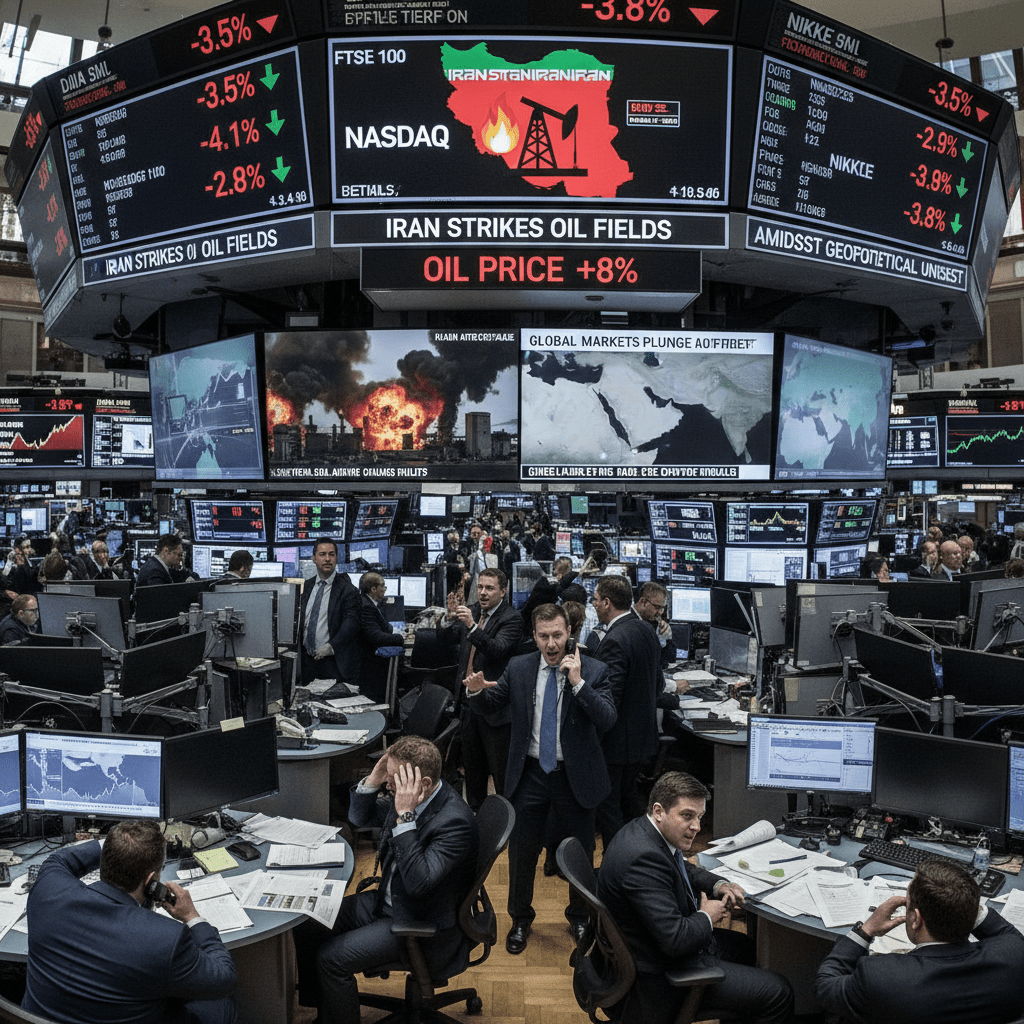
Blue Press Journal – The global energy landscape is currently facing a catastrophic destabilization. Following targeted Iranian strikes on critical energy infrastructure in the Gulf—specifically two major refineries in Kuwait and Qatar’s vital Ras Laffan natural gas terminal—Brent crude has surged toward the $115 mark. As Tehran’s offensive disrupts the flow of approximately 20% of the world’s liquefied natural gas (LNG), the specter of a “macro wrecking ball” hanging over the global economy has become a grim reality.
A Manufactured Crisis and the Trump Administration
While the physical damage to the Strait of Hormuz and surrounding facilities is undeniable, financial analysts and geopolitical experts are increasingly pointing the finger at the White House. Critics argue that the Trump administration’s decision to initiate this conflict was a strategic blunder of historic proportions. According to reports from The New York Times, high-level security officials previously indicated there was no immediate or imminent security threat from Iran that warranted a full-scale kinetic engagement.
By prioritizing a hawkish foreign policy over regional stability, the administration has arguably invited the very energy crisis it claimed to prevent. This “war of choice” has now pushed the national average price of gas to a staggering $3.88 per gallon as of March 19, 2026, placing an immense burden on American households.
Global Market Contagion
The economic repercussions are being felt far beyond U.S. borders. On Thursday, Brent crude jumped 6% to $113.77 per barrel, a massive leap from the sub-$73 levels seen prior to the commencement of hostilities. The Financial Times reports that European natural gas benchmarks have doubled in just thirty days, threatening a wave of “debilitating inflation” across the continent.
Global indices are reflecting this instability:
Japan’s Nikkei 225 plummeted 3.4% as the Bank of Japan froze interest rates.
Germany’s DAX and London’s FTSE 100 both saw losses exceeding 2%.
Wall Street futures remain in the red as the Federal Reserve warns that persistent inflation, fueled by the war, limits their ability to provide further interest rate relief.
As the Strait of Hormuz remains effectively shuttered to tanker traffic, the question remains: was the pursuit of this conflict worth the systematic dismantling of global economic stability? For now, the world pays the price at the pump and in the markets for a war that many intelligence experts claim was entirely avoidable.
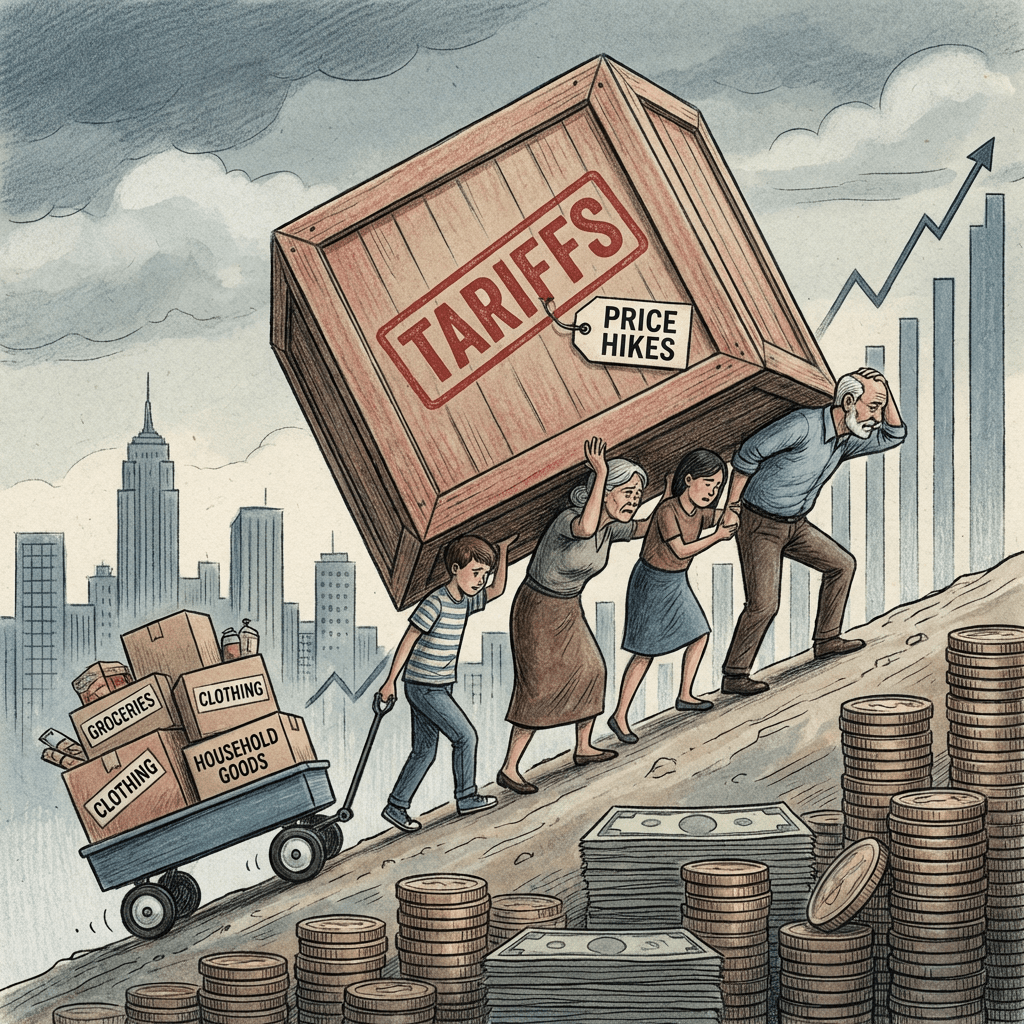
Blue Press Journal (DC) – American households are on track to endure an unprecedented financial hit this year, with combined costs from import duties totaling an estimated $330 billion. This colossal sum, translating to over $2,500 for the average family, underscores the severe economic strain inflicted by President Donald Trump’s aggressive trade policies. A recent report from the Democratic minority on the Joint Economic Committee (JEC) as reported by news outlets like Reuters, paints a stark picture of these escalating expenses, a considerable jump from the $1,700 Americans reportedly paid in 2025.
Despite a Supreme Court ruling last month that invalidated Trump’s use of emergency powers for imposing widespread tariffs, the administration appears undeterred. US Treasury Secretary Scott Bessent has projected “virtually unchanged tariff revenue in 2026,” suggesting a continued reliance on these trade taxes through different legal avenues to circumvent the high court’s decision. This persistent strategy means continued pressure on consumer wallets.
The burden of these customs charges falls disproportionately on everyday Americans. Independent analysis from the nonpartisan Congressional Budget Office (CBO) detailed in reports by organizations like the Associated Press, revealed that foreign entities bear only about 5% of tariff expenses. Domestic companies absorb roughly 30%, but a staggering 65% is ultimately shouldered by consumers through higher prices on goods and services.
A Tale of Two Refunds: Businesses Get Relief, Families Don’t
While American families grapple with surging costs, businesses impacted by what were deemed unlawful duties are poised for substantial relief. The US Court of International Trade (CIT) recently mandated that the Treasury Department and Customs and Border Protection must reimburse approximately 330,000 importers a staggering $166 billion for duties collected under the invalidated tariffs a development covered by outlets such as The Wall Street Journal. Customs officials indicate that a system for processing these refund requests for over 53 million entries could be operational as early as mid-April.
However, a stark disparity remains for ordinary citizens. Senator Maggie Hassan (D-NH), a ranking member of the Joint Economic Committee, sharply criticized this imbalance. She lamented that while businesses are set to receive reimbursements with interest, “the Trump administration refuses to provide relief for families” and is instead “choosing to institute new tariffs that will push prices even higher.”
Senator Heinrich emphasized the measure’s intent: “This is money that belongs to working families—not to CEOs of big corporations.” He criticized the administration’s rhetoric, stating, “The president may call the affordability crisis a ‘hoax,’ but working people feel it every time they pay for essentials. This bill will return the money lost to Trump’s tariffs back to those who paid the price.”
Public sentiment reflects growing dissatisfaction with economic policies. An NBC News poll showed that 55% of voters believe trade taxes have harmed the economy, while only 33% view them as beneficial. With 62% disapproving of the administration’s handling of inflation and living costs, the financial strain on American families is clear. Heinrich’s bill includes a provision to prevent the president from labeling rebate checks with his name, acknowledging previous political optics around stimulus payments.
Blue Press Journal – The past week has laid bare the consequences of President Trump’s overreach—a mix of policy missteps and self‑inflicted damage that is tanking his poll numbers and eroding congressional support. A stagnant labor market, combined with skyrocketing gas prices tied to the Iran‑U.S. conflict, is pushing the U.S. economy toward stagflation, a scenario Wall Street analysts now warn could become a reality (Reuters, March 5).
Trump’s immigration agenda, already unpopular, hit a new low with the abrupt removal of DHS Secretary Kristi Noem. Critics argue the move was less about policy competence and more about political retaliation, exposing the administration’s chaotic leadership style (The New York Times, March 4). The fallout has amplified voter frustration, as households grapple with higher gasoline costs that directly counter the president’s “America First” promises to ease living expenses.
Meanwhile, the labor market shows little sign of recovery. The Bureau of Labor Statistics reported a flat employment growth rate for the second consecutive month, while wages remain stagnant (BLS, March 2). This paradox of weak job creation and rising inflation undermines the administration’s narrative that its tax cuts and deregulation are revitalizing the economy.
Polls reflect the shifting tide. A recent Quinnipiac survey placed Trump’s approval at a historic low, with many Republicans citing “economic anxiety” as the primary concern (Quinnipiac, March 3). As the GOP struggles to keep voters focused on its agenda, the cascade of bad news threatens to derail any attempt to regain momentum before the midterm elections.
Blue Press Journal – In a move that has once again ignited concerns across the economic landscape, the Trump administration has announced a sweeping 10% tariff on goods imported to the U.S. from across the globe. This comes hot on the heels of a Supreme Court ruling on Friday, which deemed the administration’s previous use of the International Emergency Economic Powers Act (IEEPA) for issuing tariffs as unjustified. Despite this judicial setback, the President quickly pivoted, citing Section 122 of the 1974 Trade Act to impose these new levies, which are set to take effect on February 24th.
While the administration touts these “import taxes” as a strategy to address “large and serious” trade deficits, the overwhelming consensus among economists and trade experts is clear: tariffs are not paid by foreign producers; they are a tax paid by American consumers and businesses.
The Illusion of Protection: Who Really Pays?
The notion that tariffs are a punitive measure exclusively against foreign nations is a dangerous misconception that has plagued Trump’s economic policy. In reality, when a tariff is imposed, it’s the American importer—a company, large or small, that brings goods into the country—who pays that tax to the U.S. Treasury. To recoup these costs, importers typically do one of two things:
Raise Prices: They pass the increased cost directly onto consumers through higher retail prices.
Absorb Costs: They absorb the cost, leading to reduced profits, which can translate into lower wages for employees, less investment in their businesses, or even job cuts.
A comprehensive analysis by the National Bureau of Economic Research (NBER), for instance, found that “U.S. tariffs were almost entirely borne by U.S. domestic consumers and importers.” This sentiment is echoed by the Peterson Institute for International Economics (PIIE), which concluded that the burden of previous Trump administration tariffs fell “almost entirely on American consumers and firms.” These aren’t abstract economic theories; they are concrete realities felt in every American household.The Hidden Costs of Tariffs for American Households
Impact Category
Description
**Higher Consumer Prices**
Increased costs for everyday goods, from clothing and electronics to household appliances, directly reducing purchasing power.
**Reduced Business Investment**
Companies face uncertainty and higher input costs, leading to less investment in expansion, innovation, and job creation.
**Slower Wage Growth**
As profits are squeezed, businesses have less capacity to offer competitive wages or bonuses.
**Supply Chain Disruptions**
Forced reshuffling of global supply chains can lead to inefficiencies, product shortages, and further price hikes.
**Retaliatory Tariffs**
Other countries often impose their own tariffs on U.S. exports, harming American farmers and manufacturers who rely on international markets.
A Familiar, Flawed Playbook
This latest round of tariffs, while excluding agricultural products, pharmaceuticals, electronics, certain vital minerals and metals, and goods from Canada and Mexico (due to a 2020 trade agreement), still casts a wide net over the global economy. It’s a return to the same protectionist policies that characterized the administration’s first term, often leading to costly “trade wars” that hurt American industries and consumers alike.
The economic consequences of such policies are often multifaceted:
Inflationary Pressures: Tariffs contribute to rising prices across the board, fueling inflation and eroding the value of American wages.
Supply Chain Instability: Businesses struggle to plan and maintain efficient supply chains, leading to higher operational costs and potential product shortages.
Reduced Competitiveness: American companies that rely on imported components become less competitive globally.
Facing Domestic Opposition
Even within his own party, the President’s tariff strategy is facing significant pushback. Rep. Don Bacon (R-Neb.) was quick to signal that these tariffs will likely “be defeated” in Congress. As he told CNN in an interview, “It may not have a veto-proof majority, but it will have a majority that will go against that 10 percent global tariff, so I think the president is making a mistake here.”
This confidence stems from the foundational principle that under the 16th Amendment, lawmakers hold broad authority over federal taxes, including tariffs. The legislative branch has the power to reject what many view as an economically damaging policy being unilaterally imposed.
The True Cost of Protectionism
The evidence is overwhelming: tariffs are a self-inflicted wound. They masquerade as a solution to trade imbalances but function as a regressive tax on hardworking American families and a burden on businesses. Instead of fostering economic growth, they invite retaliatory measures, disrupt supply chains, and ultimately make everyday life more expensive for millions.
It’s time to move past the misleading rhetoric and embrace policies that truly strengthen the American economy through open markets, fair trade, and genuine competitiveness, rather than punishing our own citizens with higher taxes disguised as patriotism.
Blue Press Journal – The U.S. economy experienced a stark slowdown in the final quarter of 2025, with GDP growth reaching only 1.4%—significantly below the anticipated 3% and casting a long shadow over market optimism. This disappointing performance, coupled with a slightly higher-than-expected inflation rate (PCE up 2.9%), paints a challenging picture for American households.
Economic analysts widely agree, including Heather Long, chief economist at Navy Federal Credit Union, that the prolonged 43-day government shutdown was a major culprit, significantly eroding year-end growth and impacting federal workers’ incomes. Leading financial publications like The Wall Street Journal and Bloomberg similarly highlighted the shutdown’s disruptive effect on economic indicators, validating the Bureau of Economic Analysis’s findings.
Curiously, President Donald Trump took to Truth Social to declare the “Democrat Shutdown” cost the U.S. “at least two points in GDP,” while also attacking Federal Reserve Chair Powell. Such statements are not only legally problematic—federal law prohibits executive branch officials from discussing sensitive economic data pre-release—but are fundamentally false. His administration’s own political brinkmanship and demands often precipitated these very shutdowns, making his blame on Democrats a misleading deflection from policies that directly contribute to economic instability. His repeated calls for “LOWER INTEREST RATES,” while appealing, often disregard the complex factors the Federal Reserve must balance, and could exacerbate inflationary pressures.
The economic headwinds of Q4 2025, therefore, are less an external conspiracy and more a consequence of Trump’s erratic governance and political tactics that undermine economic predictability and consumer confidence.
The security of Kyiv directly impacts the security of Main Street.
Blue Press Journal – Ukraine’s ongoing struggle for sovereignty is often framed as a moral imperative or an act of generosity from its allies. However, a closer look reveals that sustained U.S. support for Ukraine is not just altruistic; it is a strategic investment in American national and economic security. This pivotal moment demands that U.S. policymakers and the public understand the profound implications for their own prosperity and global stability.
Ukraine’s Unwavering European Path & Enduring American Partnership
At its core, Ukraine is irrevocably committed to a future intertwined with Europe. This profound aspiration, coupled with a deep appreciation for American partnership, shapes their daily decisions, from energy infrastructure to military planning and economic recovery. Despite fluctuating political signals from Washington (Donald Trump), Ukrainians continue to view the United States with remarkable gratitude. Their primary concern isn’t outright abandonment, but rather the destabilizing inconsistency that could undermine long-term planning and deterrence.
American Support: A Nuanced Reality
A persistent misconception in Washington suggests a waning of public support for Ukraine. Yet, the data tells a more reassuring story. Polling from organizations like the Atlantic Council, utilizing data from HarrisX, consistently demonstrates that a majority of Americans – approximately six in ten – continue to support U.S. assistance to Ukraine, including vital military aid. [Source: Atlantic Council via HarrisX polling data, often cited in their analyses of public opinion, e.g., “The Resilience of American Support for Ukraine”]. Americans largely view Russia as the aggressor, express deep distrust of the Russian government, and oppose territorial concessions that would reward aggression.
The challenge isn’t public opposition, but rather a lack of sustained attention. Domestic concerns like inflation, housing costs, and electoral politics understandably dominate daily discourse. Ukraine often doesn’t top these lists, not because Americans oppose assistance, but because they assume the issue is being competently managed. The public is distracted, not hostile, highlighting a crucial communication gap that U.S. advocates must bridge.
The Economic Stakes: Why Global Stability Benefits Every American
The most critical aspect often overlooked is how Ukraine’s fight directly safeguards the foundational principles of the international order that underpin American prosperity. For decades, the U.S. economy has thrived within a predictable global framework: secure trade routes, stable borders, enforceable rules, and alliances that deter major conflicts. This stability reduces risk, lowers costs, stimulates investment, creates American jobs, and allows the U.S. to shape global standards for trade, technology, and finance.
The immediate aftermath of Russia’s full-scale invasion in 2022 offered a stark preview of these economic vulnerabilities. Energy prices surged globally, food costs climbed due to disrupted grain and fertilizer markets, and shipping and insurance rates increased, fueling inflation across the economy. [Source: International Monetary Fund (IMF) analysis on the economic impact of the war in Ukraine, e.g., “Global Economic Outlook: A Rocky Road Ahead” – specific chapter on Ukraine impacts]. These ripple effects led to higher interest rates, impacting mortgages, auto loans, credit cards, and small businesses – hitting American pocketbooks directly.
If Russian aggression goes unchecked, the economic consequences will only deepen. A world where aggression is rewarded leads to structural risk, higher costs for everything, and diminished confidence for investment. This means slower growth, fragile supply chains, and greater volatility in retirement savings. Governments would spend more reacting to crises and less investing in domestic priorities. As the Council on Foreign Relations notes, “allowing Russia to dictate terms… would set a dangerous precedent for revisionist powers globally, destabilizing key trade routes and investment climates.” [Source: Council on Foreign Relations, e.g., “The Global Economic Impact of the War in Ukraine”].
A Clear-Eyed National Security Imperative
Beyond economics, supporting Ukraine is vital for U.S. national security. Ukraine is not asking the United States to fight its war, but to recognize that American security and prosperity are inextricably linked to its outcome. A failure to deter Russian aggression in Ukraine would signal weakness, inviting further challenges to the post-World War II international order. This would directly impact the credibility of NATO, the cornerstone of European security and a vital alliance for the U.S. [Source: NATO Official Statements, e.g., “NATO’s Response to Russia’s War in Ukraine”].
If the United States desires a world governed by rules, predictability, and sovereign choice rather than coercion and chaos, it cannot afford to waver now. The cost of inaction – both economic and strategic – will far outweigh the investment required to ensure Ukraine’s success and uphold a stable global environment. Supporting Ukraine isn’t just about Ukraine; it’s about safeguarding America’s own power, prosperity, and the principles upon which its security rests.
Blue Press Journal – The Federal Reserve Bank, the central bank of the United States, has long been a bastion of independence, making decisions based on economic data and expertise rather than political considerations. However, with recent attempts by President Donald Trump to politicize the Fed, there are growing concerns about the potential consequences of such a move. In this blog post, we will explore the dangers of politicizing the Federal Reserve and why other countries that have taken this path have faced significant economic challenges.
The Risks of Politicization
Politicizing the Federal Reserve would undermine its independence and potentially lead to a range of negative consequences, including increased inflation and economic instability. As former Federal Reserve Chairman, Ben Bernanke, once stated, “The independence of the Federal Reserve is essential to its ability to make decisions based on its mandate to promote maximum employment and price stability, rather than based on short-term political considerations.”
Country
Central Bank
Outcome
Turkey
Central Bank of the Republic of Turkey
High inflation, economic instability
Argentina
Central Bank of Argentina
Hyperinflation, economic crisis
Venezuela
Central Bank of Venezuela
Hyperinflation, economic collapse
As the table above illustrates, countries that have politicized their central banks have faced significant economic challenges. In Turkey, for example, the government’s interference in the central bank’s decisions led to a sharp increase in inflation and economic instability. Similarly, in Argentina and Venezuela, the politicization of their central banks resulted in hyperinflation and economic crisis.
Why Trump’s Plan is Flawed
President Trump’s desire to politicize the Federal Reserve is particularly concerning given his own history of financial mismanagement. As a businessman, Trump has filed for bankruptcy multiple times, raising questions about his ability to make sound economic decisions. As Nobel Prize-winning economist, Joseph Stiglitz, noted, “The idea of putting the Federal Reserve under political control, particularly with someone like Donald Trump who has a history of bankruptcy, is a recipe for disaster.”
The Federal Reserve’s politicization would risk far-reaching consequences for the US economy. Its independence is crucial for decisions based on economic data rather than political pressures. History shows that politicizing central banks can lead to inflation, instability, and crisis. We must protect the Fed’s independence from political interference.
As former Federal Reserve Chairman, Alan Greenspan, once stated, “The Federal Reserve’s independence is a cornerstone of its ability to maintain price stability and promote economic growth.” Let us hope that policymakers will heed this warning and reject any attempts to politicize the Federal Reserve. The future of the US economy depends on it.
Blue Press Journal: In a move that has sent shockwaves through the economic community, President Trump has nominated E.J. Antoni, chief economist at the conservative Heritage Foundation, to be the next commissioner at the Labor Department’s Bureau of Labor Statistics (BLS). The nomination has been met with a chorus of criticism from economists across the political spectrum, who argue that Antoni’s appointment would bring a new level of politicization to the traditionally nonpartisan agency.
As head of the BLS, Antoni would oversee the release of the consumer price index, which is used to adjust Social Security payments for inflation. Critics argue that his views on Social Security and his apparent willingness to manipulate data to favor the Trump administration make him unqualified for the position.
“There’s just nothing in his writing or his resume to suggest that he’s qualified for the position, besides that he is always manipulating the data to favor Trump in some way,” said Brian Albrecht, chief economist at the International Center for Law and Economics.
Democratic lawmakers have also weighed in on the nomination, with Sen. Patty Murray of Washington calling Antoni “an unqualified right-wing extremist” and demanding that the Senate Health, Education, Labor and Pensions Committee hold a confirmation hearing for him.
The nomination has sparked fears that the BLS, which has long been respected for its impartial and reliable data, may become increasingly politicized under Antoni’s leadership. The agency’s independence and nonpartisanship have been crucial in providing accurate and unbiased information about the nation’s economic health.
Blue Press Journal: Often operating behind the scenes, the U.S. Bureau of Labor Statistics (BLS) is one of the most vital yet least understood agencies in the federal government. Its name might sound dry, but its work is anything but. The data it collects and publishes—from unemployment rates to inflation figures and wage growth—forms the bedrock of economic understanding and directly impacts the financial well-being of every American. For this very reason, its independence from political influence is not merely a bureaucratic ideal but a cornerstone of economic stability and individual financial well-being.
The Power of the Numbers: What the BLS Determines
The BLS is the nation’s premier source for labor market data, meticulously gathering and analyzing information that shapes our understanding of the economy. Here are just a few critical areas it directly influences:
Social Security Cost-of-Living Adjustments (COLA): The annual increase in Social Security benefits, which millions of retirees and beneficiaries rely on, is directly tied to the Consumer Price Index (CPI) as determined by the BLS. This ensures that benefits keep pace, at least partially, with the rising cost of living.
Job Numbers and Unemployment Rate: The monthly jobs report, including the unemployment rate, is a critical indicator of economic health. It informs businesses about labor market conditions, guides policymakers on employment strategies, and impacts public sentiment about the economy.
Inflation Percentages: The CPI, a measure of inflation, is a key economic barometer produced by the BLS. It helps us understand the purchasing power of our dollar, influencing everything from wage negotiations to the pricing of goods and services.
The Peril of Political Interference: A House of Cards
Now, imagine a scenario where these critical figures could be manipulated or slanted to serve a political agenda. The consequences would be devastating and widespread, directly disadvantaging citizens in profound ways:
Undermining Social Security and Retirement Security: If inflation rates were artificially suppressed to make the economy “look better,” the annual Social Security COLA would be understated. This would mean retirees and beneficiaries receive smaller increases than they are truly entitled to, effectively eroding their purchasing power and forcing them into greater financial hardship.
Distorting Economic Policy and Interest Rates: A politically skewed unemployment rate or inflation figure could lead the Federal Reserve to make misguided decisions on interest rates. If the economy is falsely portrayed as stronger or weaker than it is, the Fed might raise rates too quickly, stifling growth, or keep them too low, risking inflation. Both scenarios would ripple through the economy, impacting everything from mortgage rates and credit card interest to the returns on savings accounts.
Misleading Investment Decisions: For individuals and institutional investors, accurate, unbiased data is essential for making sound financial decisions. If job numbers or economic growth figures are inflated for political gain, investors might pour money into markets based on false premises, leading to potential bubbles and significant losses when the true picture emerges. Conversely, underreported positive trends could lead to missed opportunities.
Eroding Public Trust and Accountability: When economic numbers are perceived as politically motivated, public trust in government institutions shatters. Citizens lose faith in official reports, making it harder for policymakers to implement effective solutions and for the public to hold leaders accountable. A democracy cannot function effectively when its citizens cannot trust the fundamental data about their own economic reality.
Building on False Premises: Every major economic policy decision—from government spending on infrastructure to tax cuts or adjustments to social programs—is built upon the foundation of BLS data. If that foundation is rotten with political bias, the policies built upon it will be flawed, ineffective, and potentially harmful, leading to misallocation of resources and unintended negative consequences.
Protecting the Integrity of Data
The BLS’s strength lies in its non-partisan, professional approach to data collection and analysis. Its credibility is built on decades of rigorous methodology, free from the pressures of electoral cycles or partisan narratives. While administrations change and political winds shift, the BLS must remain a beacon of objective truth, committed solely to presenting the most accurate picture of the American labor market and economy.
Allowing politicians, regardless of their party, to control or influence the BLS would be akin to letting the fox guard the hen house, but with far graver consequences for every American citizen.
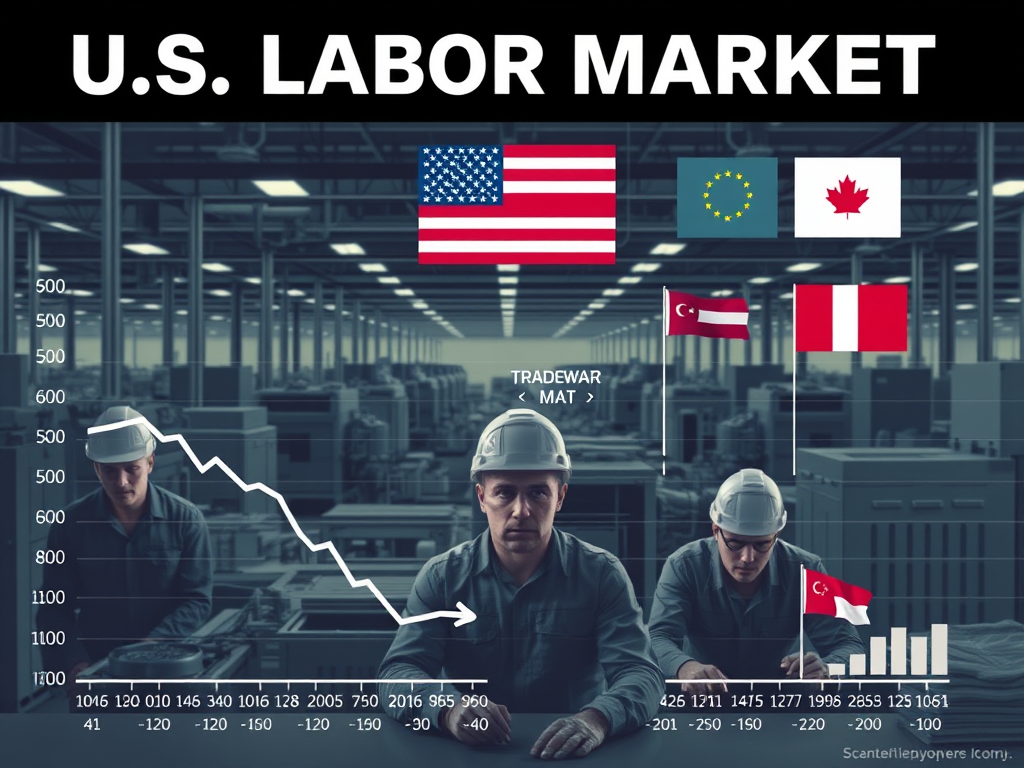
The US labor market showed signs of weakness in June, with employers adding a mere 73,000 jobs last month, according to the latest report from the Labor Department. This unexpected slowdown has raised concerns about the health of the job market and the economy, as President Donald Trump continues to push forward with his radical trade policies, imposing hefty tariffs on imports from almost every country.
The unemployment rate ticked up to 4.2% in June, a slight increase from 4.1% the previous month. Furthermore, revisions to previous reports revealed that hiring was much weaker than initially thought in May and June, painting a gloomier picture of the labor market.
The current situation is a stark reversal of the job market’s previous trajectory, and experts warn that the uncertainty surrounding Trump’s trade policies is paralyzing businesses and stifling growth. The imposition of tariffs on imports from almost every country has created a climate of uncertainty, making it difficult for companies to make informed decisions about hiring and investment.
As the trade wars escalate, concerns are growing that the US economy may be headed for a slowdown, or even a recession. The weak job report has raised questions about the wisdom of Trump’s trade policies and their impact on American businesses and workers.
The Labor Department’s report has sparked widespread concern among economists and policymakers, who are urging the administration to reassess its trade strategy and work towards a more stable and predictable economic environment. As the US economy navigates these uncertain times, one thing is clear: the labor market is sending a warning signal that cannot be ignored.



 Blue Press Journal