Tag: investing

  • The Billion-Dollar Gap: Analyzing Trump’s 2025 Financial Disclosure

    by Winston Wendell

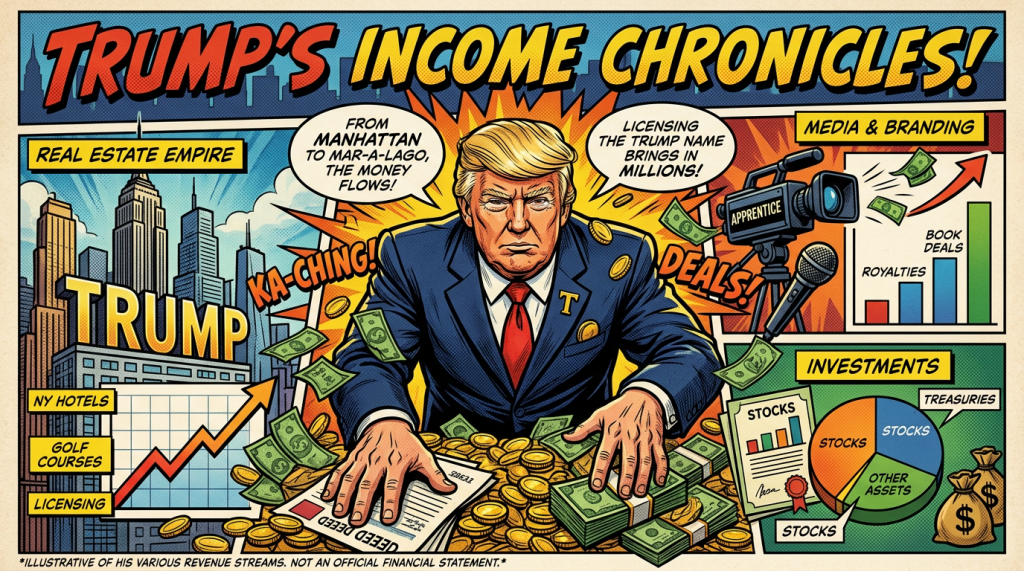
    Comic illustration of Donald Trump with money, charts, and labels showing income from real estate, media, and investments.

    As I sifted through the 927 pages of President Donald Trump’s 2025 financial disclosure, I was struck by a central narrative the President continues to push: that his staggering two-billion-dollar fortune increase is merely a byproduct of a rising broader market. During a July 1 press conference, Trump dismissed concerns about presidential profiteering with a wave of his hand, pivoting to the universal language of the 401(k). “We’re all gaining,” he insisted. 

    However, as I examined the granular data buried within the document, the math simply does not align with the narrative of passive market growth. While Trump credits the bull market for his windfall, his own filing paints a different picture—one where speculative digital assets and aggressive revenue streams play a far more significant role than his equity portfolio.

    The most glaring departure from the “market rally” explanation is the $1.4 billion generated by his cryptocurrency ventures. Projects like World Liberty Financial and the TRUMP meme token have proven to be gold mines for the President, even as they have proven disastrous for his followers. Blockchain-analytics firm Nansen reports that nearly a million everyday investors lost over $3.8 billion collectively in those meme tokens by mid-year. It is a sobering realization: while the President’s balance sheet surged, the capital of his supporters was effectively hollowed out.

    Beyond the digital frontier, the filing details $400 million in non-equity income. This includes approximately $196 million from his real estate empire, $88.5 million in legal settlements from media and tech entities, and $65 million from overseas licensing deals spanning from the Middle East to Southeast Asia. When I weigh these figures against the total growth, it becomes clear that the stock market is, at best, a secondary player in this financial explosion.

    Critics like Kedric Payne of the Campaign Legal Center argue that the “lion’s share” of this wealth growth is independent of the market. Even when looking at the most charitable estimates, non-stock gains account for between 67% and 81% of his increase. 

    The White House maintains that this is simply the result of a “wildly successful business career,” yet the sheer velocity of these earnings—particularly from speculative crypto assets—raises inevitable questions about the intersection of governance and private gain. When a sitting president derives the majority of his annual wealth increase from sources far removed from traditional index funds, it is no longer just a case of “everyone benefiting.” It is a financial ecosystem unto itself, one that thrives on volatility and branding in ways that leave the average 401(k) holder behind.

    Fediverse Reactions
  • Tariff Uncertainty Proves Fatal for New York North Country Chocolate Company

    Blue Press Journal Apothecary Chocolates, a specialty chocolate company based in Colton, NY, has closed its doors due to the uncertainty surrounding tariffs and their impact on the global cocoa market. The company’s owner, Shelby Connelly, cited the fear of impending tariffs as a major factor in her decision to shutter the business.

    Connelly founded Apothecary Chocolates in 2017, using European chocolate product Callebaut to create unique chocolate bars and truffles. However, the cost of Callebaut skyrocketed from $90 per 22-pound bag in 2017 to $250 per bag this spring, following President Trump’s announcement of tariffs on cocoa-bean producing countries. Despite efforts to find alternative suppliers, Connelly was unable to mitigate the price increases, which ultimately made it impossible for the business to operate.

    The price hikes were not only caused by tariffs, but also by market uncertainty and fear. Suppliers hesitated to produce and distribute cocoa beans, leading to shortages and price increases, which were too much for the small business to overcome.

    Connelly is quick to acknowledge that other factors, such as COVID-19-related price hikes and increasing packaging costs, also contributed to the company’s demise. However, the tariff-induced panic was the final nail in the coffin. The fact that the issue was not related to cocoa bean production, but rather a global trade situation, made it particularly difficult for Connelly to accept.

    The closure of Apothecary Chocolates has not only affected Connelly but also her three full-time chocolatiers, who have lost their jobs. Connelly, who also works as an acupuncturist, is particularly concerned about the impact on her former employees, who relied on the company as their sole source of income.

  • Tariff-Induced Inflation Begins to Take Hold: Economists Expect Further Price Increases

    The latest Consumer Price Index (CPI) report from the Labor Department’s Bureau of Labor Statistics has shown the first signs of tariff pass-through, with inflation rising 0.3% in June. This increase, the largest since January, is likely to be the starting point of a long-anticipated uptick in inflation driven by the sweeping import duties announced by President Donald Trump in April.

    Economists have been warning that the effects of the tariffs would take time to materialize, and the June CPI report appears to confirm this expectation. Businesses had been selling merchandise accumulated before the tariffs were announced, which helped to keep prices stable in the short term. However, as these inventories are depleted, the full impact of the tariffs is expected to become more evident in the July and August CPI reports.

    The experience with tariffs on washing machines in 2018 provides a precedent for this delayed effect. At that time, it took several months for the duties to show up in the inflation data, and economists are expecting a similar pattern to emerge this time around.

    The June CPI report showed increases in various categories, including food prices, which rose 0.3% to match the increase in May. Grocery store prices also advanced 0.3%, driven by a 1.4% increase in the costs of nonalcoholic beverages and a 2.2% jump in coffee prices. These price increases are likely due to higher import duties, which are being passed on to consumers.

    Other categories that saw significant price increases include fruits and vegetables, which cost 0.9% more, and beef prices, which jumped 2.0%. The cost of food consumed away from home rose 0.4%, while gasoline prices rebounded 1.0% after four straight monthly declines.

    Rental costs also contributed to the overall increase in inflation, with the cost of shelter rising 0.3%. This reflects the ongoing trend of rising housing costs, which has been driven by a combination of factors, including limited supply and strong demand.

    The tariff-exposed goods, which saw significant price increases in June, are likely to be the first of greater price pressures to come. As the effects of the tariffs continue to ripple through the economy, economists expect to see further increases in inflation, which could have implications for consumer spending and economic growth.