Tag: Marco Rubio

  • Rubio Clashes with EU’s Kallas at G7 as Trump Foreign Policy Alienates Allies and Shifts to Iran

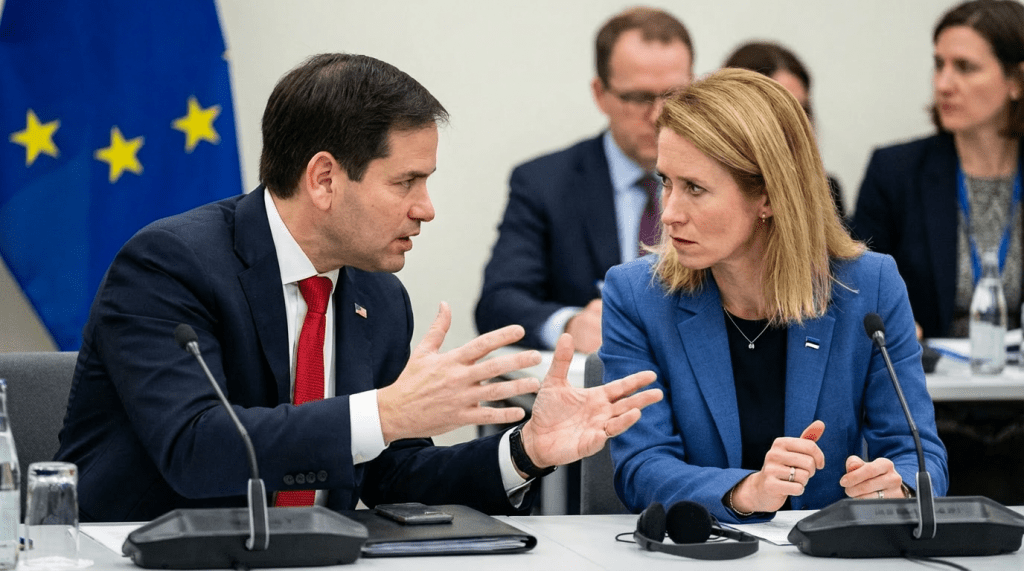
    Marco Rubio and Kaja Kallas confer behind swapped ESTONIA and USA nameplates.

    Trump’s administration refusal not keep word to escalate sanctions on Russia creates flash point at meeting

    Blue Press Journal – At a recent G7 foreign ministers meeting in Canada, a heated exchange between U.S. Secretary of State Marco Rubio and EU foreign policy chief Kaja Kallas laid bare the growing transatlantic fracture over the Trump administration’s contradictory approach to global security, according to Axios.

    The confrontation erupted when Kallas, a vocal Kremlin critic and former Estonian prime minister, challenged Rubio’s wavering commitment to pressuring Moscow. Citing Rubio’s own pledge from the previous year that Washington would escalate sanctions if Russia obstructed peace efforts, Kallas pointedly asked, “When is your patience going to run out?” Sources present told Reuters that Rubio visibly bristled at the interrogation, snapping back that if European powers believed they could negotiate a better settlement, America would simply “step aside.”

    The remark, witnessed by stunned allied ministers, reflects mounting desperation within Donald Trump’s foreign policy team as they face scrutiny over shifting strategic priorities. Critics argue the administration’s escalating focus on Middle East conflicts—particularly the expanding Iran War—has come at the direct expense of coherent Russia policy.

    According to The Guardian, Ukrainian officials recently departed Miami talks with Trump envoys Jared Kushner and Steve Witkoff without concessions, confirming that Washington’s diplomatic energy has pivoted entirely toward Tehran. Concurrently, Bloomberg reported that the administration has quietly permitted Russian oil sales to continue, effectively undermining the economic isolation previously promised to Kyiv.

    Trump’s reckless bifurcated strategy—coddling the Kremlin while posturing aggressively in Tehran—doesn’t just jeopardize global stability; it outright fuels authoritarian regimes and throws our democratic allies under the bus exactly when we need strong American leadership the most.
  • Sen. Chris Murphy Accuses Trump Officials of Misleading Congress Over Venezuela Operation

    Blue Press Journal – In a sharp rebuke of Trump administration officials, Senator Chris Murphy (D-Conn.) accused Defense Secretary Pete Hegseth and Secretary of State Marco Rubio of deceiving both Congress and the American public regarding the U.S. military’s recent actions in Venezuela. The senator’s remarks come in response to U.S.-led operation that resulted in the capture of Venezuelan President Nicolás Maduro and his wife, Cilia Flores—an event that has sparked serious debate about the scope of executive authority in foreign interventions. 

    According to Murphy, administration officials “literally lied to our face” before the Venezuelan operation, insisting that the mission was a limited counternarcotics effort and not an attempt at regime change. “They aren’t being straight with the American people,” Murphy stated, emphasizing the absence of any formal briefing for Congress to clarify the operation’s objectives or strategy moving forward. 

    Questions Over War Powers and Executive Authority

    Murphy’s criticism also reignites discussion about the War Powers Act of 1973, a law designed to ensure that Congress maintains oversight over the deployment of U.S. armed forces. Under the Act, the president must notify Congress within 48 hours of committing military forces to action and withdraw them within 60 days unless Congress authorizes the use of force. 

    By bypassing this process, Murphy argues, the administration has undermined constitutional checks and balances. “Even if there are dictators around the world, that does not give any president unilateral power to invade another nation,” he said, cautioning that such actions erode the legitimacy of U.S. foreign policy and set a dangerous precedent for future administrations. 

    The Broader Implications for U.S. Foreign Policy

    The controversy underscores a recurring tension between the executive branch and Congress over control of military operations abroad. Critics contend that the lack of transparency not only damages America’s global credibility but also risks dragging the nation into unwarranted conflicts.