Tag: misinformation

  • Trump’s Electronic Voting Machine Claims: The Real Security Risks Explained

    by Winston Wendell

    Voting Machines and Election Security

    Watching election security evolve has been a strange ride, especially when high-profile politicians start making claims that shake people’s confidence in the whole system. Lately, Donald Trump has been all over the idea that America’s electronic voting machines are just waiting to be hacked. That’s got a lot of election officials and cybersecurity pros on edge. But if you really dig into what he’s saying, his claims do more damage than they highlight any real problem.
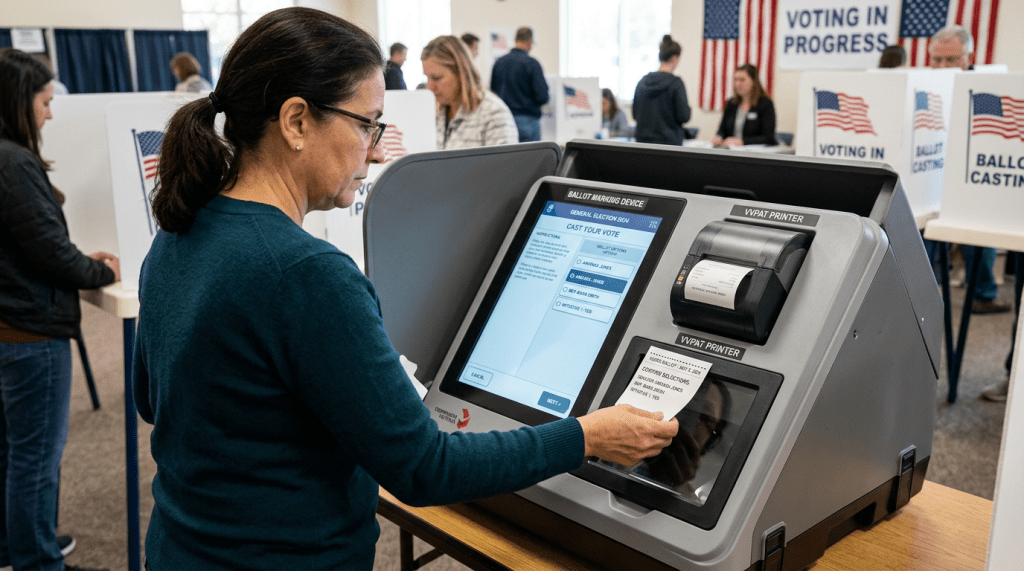
    Woman printing a ballot with a ballot marking device at a voting station

    Trump went on TV and basically told Americans that everything they’ve heard about secure elections is a lie, and that electronic machines are easy targets for anyone wanting to mess with results. It’s true, researchers have found weak spots—DEFCON’s Voting Village loves demonstrating just that. But here’s the part everyone keeps missing: nobody’s shown real evidence of these flaws getting used to change an election’s outcome. That’s what matters.

    Remember when Russian hackers went after our elections in 2016? That was a wake-up call. Now, we’re seeing way more states using paper ballots or machines that spit out a paper record. Most voters today leave behind something you can physically check. Plus, elections aren’t managed from a single office—they’re split across every state and county. That makes a giant, coordinated hack pretty far-fetched.

    Election experts keep saying that these kinds of claims just eat away at trust. Colorado Secretary of State Jena Griswold put it simply: Trump’s story isn’t new, and it’s not about some overlooked threat. Yeah, there’s probably an audience for this stuff, but spinning these tales just pushes people away from voting or sets them up to question any results they don’t like.

    Government records released Thursday didn’t back up Trump’s claims of widespread voting machine hacking. The National Intelligence Council checked for proof of foreign tampering as recently as 2020 and came up empty. Cybersecurity and Infrastructure Security Agency—CISA—admitted there are always risks, but said they haven’t seen any evidence of actual votes being changed.

    That doesn’t mean the job’s done. Local officials are still squeezed for cash and can’t always upgrade equipment or boost cybersecurity training. Congress has dropped about $1 billion since 2018, but just $45 million was set aside last year—barely enough to keep things running.

    Benjamin Hovland, former commissioner at the Election Assistance Commission, keeps calling for more funding. He’s not shy about it: if we’re serious about protecting elections, we need to pay for better tools and train the people who use them. States hear a lot of talk, but the actual resources just aren’t reaching them.

    So where does that leave us? Election security is messy, but it’s getting better, not worse. The people running our elections and the experts backing them up are working on real fixes, not just trading in outrage.

    Instead of fanning the flames, it’s time for everyone—politicians, tech companies, and regular voters—to sit down and talk about how to keep improving things. That’s going to mean real investment, honesty, and showing our work so everyone can see the system doing its job.

    The future of our democracy depends on facts and clear policy-making, not scare tactics. Let’s argue about solutions, not sow distrust.

    Fediverse Reactions
  • The Iran Nuclear Deal Fallout: Trump’s Misguided Perspective

    A Critical Look at the Deal’s Shortcomings

    “Trump’s” Iran nuclear deal was supposed to stop Iran from chasing nuclear weapons. Honestly, that promise looks flimsier every time I dig into the details. Just look at a recent piece from a major Iranian publication connected to the military. They straight up said Iran will go for nuclear arms, no matter what the deal says. That’s jarring. It makes you wonder if Iran ever took this agreement seriously. It also leaves me asking what the U.S. actually hopes to gain by insisting on upholding rules that Tehran seems ready to ignore. 

    The Strait of Hormuz: Troubling Signs

    Now, if you shift your attention to the Strait of Hormuz, things get even more tense. The U.S. signed a Memorandum of Understanding with Iran, basically promising safe passage for commercial ships crossing the waterway—no fees for 60 days out of the Persian Gulf. Just 60 days? What about going forward? On paper, it’s neat. But you have to ask yourself: what’s Iran’s real game? Whoever controls the Strait controls a key route for global oil. That’s real power, and I don’t buy that Tehran plans to just hand that over in 60 days. 

    Trump’s Real Reasons for the So Called Deal

    From the jump, Trump’s angle on Iran and its nuclear program has sparked debate. He said he wanted to lower oil prices and give Americans a break at the pump—by strong-arming Iran, apparently. But spend even a few minutes listening to him and the logic gets twisted pretty quickly. Trump’s version of the truth barely reflects the actual deal, or how much leverage the U.S. really has. Before his war, the Strait of Hormuz was open to international trade without any fees.

    Trump’s Bluster Versus Reality

    Take a closer look at what Trump’s been saying lately and the disconnect is impossible to miss. Just this Monday he claimed, “We have total control of the Strait of Hormuz.” Meanwhile, drone strikes and missiles keep targeting U.S. allies and troops near the strait. The facts on the ground clash completely with his bravado. Instead of showing strength, his words just reveal a growing gap between what the administration claims and what’s actually happening.

    More Wishful Thinking

    But he doesn’t stop there. Trump keeps insisting the U.S. got big concessions and forced Iran to comply. The truth says otherwise. Iran hasn’t backed down—if anything, it’s doubled down. And the U.S. has ended up giving Iran even more leverage and 300 billion. 

    Looking at all this, two things really crippled the Iran nuclear deal: Iran openly dismissing its own promises and Trump misreading the whole situation. The Strait of Hormuz is still a powder keg, with Iran’s influence making everything feel increasingly fragile. The path forward for the U.S. isn’t obvious. Should it keep pushing for enforcement? Accept that the deal came up short? Either way, American’s need to face the facts instead of hiding behind empty talk. The risks in this situation are just too high for anything else.

    Fediverse Reactions
  • How AI Is Changing American Politics

    by Winston Wendell

    I watched the Thomas Massie primary unfold with a growing sense of dread. Here was a sitting congressman, one who’d actually voted against Trump on occasion, finding himself on the receiving end of something entirely new in American politics. A pro-Trump super PAC dropped an AI-generated video depicting Massie in a fake, scandalous romance with members of the progressive “Squad.” Massie called it out for what it was, a sleazy, desperate lie. It didn’t matter. He lost anyway. Welcome to the future of American democracy, where fabricated, synthetic disinformation can take down a sitting congressman and barely raise an eyebrow.

    The Weaponization of Synthetic Reality

    Living through the Trump era means living in a constant state of reality vertigo. You see AI-generated images of Trump playing savior, then viciously doctored shots of his opponents and frankly, the ridiculousness never lets up. Psychiatrist Robert Jay Lifton has a name for this: “malignant normality,” where people become numb to ceaseless distortion because there’s simply too much of it to process. I feel this numbness creep in sometimes, and I think many Americans do too.

    Philosophers have started calling these synthetic attacks “slopaganda,” and the term fits perfectly. Slopaganda doesn’t need to be true. It doesn’t even need to be convincing. It just needs to get under your skin and stir up emotions like paranoia or tribal rage. The goal isn’t persuasion, it’s chaos. When nothing can be proven, these games don’t just spread misinformation; they systematically undermine society’s trust in anything at all.

    Democratized Destruction

    The Republican Party has become remarkably efficient at deploying these tools. The RNC pumps out AI-generated scare ads depicting American collapse under Democratic leadership. Trump himself shares bogus clips showing journalists in fictional scenarios. The bar for political discourse has dropped so far it’s practically subterranean.

    What terrifies me most is the accessibility of this technology. Researchers at places like Brookings have been warning us: these tools let anyone do what used to require professional troll farms and significant resources. Deepfakes are cheap, fast, and everywhere now. Spreading dangerous fake information barely costs a thing, while the resources needed to combat it, fact-checking, verification, education struggle to keep pace.

    State attempts to regulate this, like California’s new laws, run into the familiar obstacles: free speech debates, technology racing far ahead of lawmakers, and plain political inertia. I keep waiting for a comprehensive response, but Washington moves while AI moves faster.

    The Death of Shared Truth

    This digital arms race isn’t just messy, it’s potentially devastating. When people can’t agree on basic facts, participation in civic life collapses. We slide toward “hypernormalization,” a term borrowed from Soviet-era analysis: official stories and reality drift so far apart that nobody believes anything anymore.

    I see this happening in real-time. Voters get lost in the fog, so they cling to strongmen and simple answers for complicated problems. As AI continues pouring into our political system, the collapse of our shared truth feels less like slow decay and more like an active demolition. The real question isn’t whether individual citizens can tell what’s real, it’s whether democracy can survive at all once the distinction between real and fake dissolves entirely.

    At what point do we stop being citizens and start being passengers in a simulation we didn’t choose? I’m not sure we’re far from that line.

  • Trump’s Delusional Canada Rant: The Gordie Howe Bridge, Hockey, and Diplomatic Mayhem

    Trump’s Detachment From Reality

    Blue Press Journal – President Donald Trump has once again ignited controversy with an astonishingly erratic diatribe, this time targeting Canada, a steadfast U.S. ally. His recent pronouncements, characterized by their detachment from reality, have intensified long-standing concerns about his judgment and grasp of international relations, prompting critics to openly question his mental fitness for public office.

    In a bizarre 296-word screed posted on his Truth Social platform, Trump not only accused Canada of treating the United States “very unfairly” but went on to issue an astonishing threat: he vowed to keep the vital new Gordie Howe International Bridge closed unless Canada ceded “at least one half of this asset” to the U.S. This demand ignores a crucial, widely reported fact: Canada is solely responsible for the construction costs of the bridge, a project essential for cross-border trade and economic growth. This blatant disregard for established facts echoes previous instances of his administration’s contentious approach to trade agreements with Ottawa, as documented by reputable outlets like The New York Times and The Washington Post.

    The President’s tangent then veered wildly into geopolitics and sports, specifically an imagined scenario involving China. He alleged that a trade deal with China would lead to the end of “ALL Ice Hockey being played in Canada” and the permanent elimination of the Stanley Cup. This fantastical assertion, which Trump has reportedly made before, defies all logic and understanding of international trade and cultural sovereignty. Such hyperbolic claims, reminiscent of baseless conspiracy theories, further underscore a troubling disconnect from reality.

    While the Stanley Cup is a revered symbol, the idea that China could dictate Canada’s national sport is absurd. Such claims from the president are not just comical; they raise questions about his leadership and ability to navigate international relationships. Dismissing an ally’s investment and spreading unfounded claims threaten vital partnerships and undermine America’s diplomatic standing.

  • Trump Repeats Debunked Claim That Protesters Were “Paid” Amid Rising Opposition to U.S. Actions in Venezuela

    BLUE PRESS JOURNAL (DC) – In yet another display of misinformation, President Donald Trump has revived a long-debunked conspiracy theory — that Americans protesting his policies are “paid” to do so. Speaking today to a group of Republicans at the Kennedy Center, Trump claimed that thousands who demonstrated against his administration’s recent military action in Venezuela were compensated for their activism. 

    “They will pay people, most of these people are paid,” Trump falsely asserted, pointing to the quality of protesters’ signs as supposed evidence. The comments came after widespread demonstrations erupted across the country, including a thousand-strong march in New York City where citizens chanted, “No more coups, no more wars, Venezuela’s not yours!” 

    Trump’s remarks not only dismiss the genuine outrage many Americans feel over reckless foreign interventions, but also insult the civic spirit behind peaceful protest. Suggesting that dissent can only exist if someone funds it reflects a profound misunderstanding — or rejection — of democratic values. 

    Critics argue that by repeating baseless claims, Trump seeks to delegitimize public opposition and distract from the real issues surrounding U.S. involvement abroad. Instead of addressing concerns about military overreach, he fixates on the “beautiful” printed signs, joking that he’d like their creator to work for his campaign. 

    Americans not only have the right but also the imperative to unleash their dissent against actions done in their name. To dismiss protests as mere “paid” efforts is to blatantly attack that right and tear away the very fabric of trust needed for genuine democratic dialogue. In a landscape saturated with misinformation that distorts political discourse, it’s crucial for citizens to be fiercely vigilant, armed with facts, and bold enough to challenge power head-on.