Tag: news

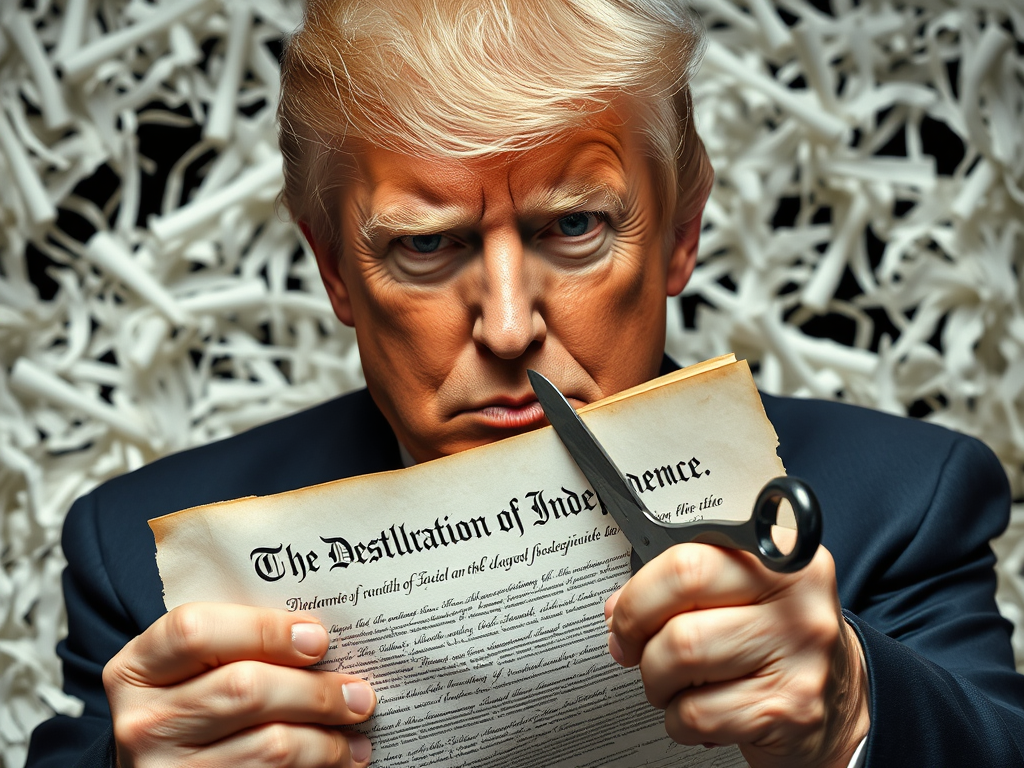
  • Declaration of Independence: Historical Grievances and Trump’s Presidency

    As we commemorate the anniversary of our country’s independence, it is fitting to reflect on the reasons behind our decision to separate from England and the grievances that led to this historic split. In the weeks leading up to July 4, 1776, the Declaration of Independence was crafted, and its authors sought to justify the case for separation from Great Britain by citing specific examples of the King’s abuses of power.

    The Declaration of Independence lists 27 grievances against the King and his regime, many of which are eerily relevant to the presidency of Donald Trump. Two hundred and forty-nine years later, it is striking to see how many of these grievances apply to Trump’s actions and policies.

    Let us examine a few examples. The King was accused of refusing to assent to laws that were wholesome and necessary for the public good. Similarly, Trump has shown disregard for Congress by ignoring existing laws and using his executive power to unilaterally impose his will. For instance, he launched a military attack on Iran without consulting Congress, and he has impounded funds approved by Congress.

    The King was also accused of forbidding his governors to pass laws of immediate and pressing importance unless they were suspended until he gave his assent. Trump has attempted to do something similar by introducing a provision in his tax and spending bill that would ban states from enacting measures to regulate artificial intelligence and withhold federal funds from states that do not comply with his policies.

    Furthermore, the King was accused of refusing to pass laws that would accommodate large districts of people unless they relinquished their right to representation in the legislature. Trump has threatened to deny disaster relief to California unless it abandons its legislative independence and changes its water policies to his liking. He has also threatened to cut off federal funding to New York City if it enacts laws or policies that he opposes.

    The King was also accused of calling together legislative bodies at unusual and distant locations to fatigue them into compliance with his measures. Trump’s administration has moved to relocate federal agencies and repurpose their office buildings, making life uncomfortable for employees and officials.

    In addition, the King was accused of dissolving representative houses repeatedly for opposing his invasions on the rights of the people. Trump’s Department of Homeland Security has sent Marines and National Guard troops to Los Angeles, allegedly to “liberate” the city from its elected representatives.

    The King was also accused of endeavoring to prevent the population of the states by obstructing laws for naturalization and refusing to pass laws to encourage migration. Trump has revealed a plan to denaturalize certain American citizens, imposed a ban on migration from many nations, and undone the immigration status of hundreds of thousands of people living in the United States. He has also taken steps to block foreign students from attending American colleges and universities.

    The King was accused of obstructing the administration of justice by refusing to establish judiciary powers. Trump has been accused of obstructing justice during the Russia investigation, and his administration has faced contempt proceedings for not abiding by court orders.

    Moreover, the King was accused of keeping standing armies in times of peace without the consent of the legislature. Trump ordered Marines and National Guard troops into Los Angeles without the consent of the state legislature or the governor, and over the objection of local officials.

    The King was also accused of cutting off trade with all parts of the world. Trump has proposed draconian global tariffs that would bring trade to a halt, claiming that trade deficits with countries such as Lesotho are a national emergency.

    Finally, the King was accused of depriving citizens of the benefits of trial by jury. The Trump administration has rounded up Venezuelan migrants and sent them to an infamous Salvadoran prison without affording them due process or court hearings.

    As we reflect on the grievances listed in the Declaration of Independence, it is striking to see how many of them are relevant to the presidency of Donald Trump. It is a sobering reminder of the importance of holding our leaders accountable and protecting the rights and freedoms that our founding fathers fought so hard to establish.

  • Republicans Push Through Tax Cut Bill, Leaving Millions to Suffer the Consequences

    In a move that has been widely criticized, the Republican-controlled House of Representatives passed a massive bill on Thursday that cuts taxes and slashes Medicaid funding, sending the legislation to President Donald Trump’s desk for signature. The bill, which passed by a narrow margin of 218-214, is expected to have far-reaching and devastating consequences for millions of Americans.

    The bill’s passage was made possible by Republican lawmakers who, despite previously expressing concerns about the legislation, ultimately caved to pressure from the Trump administration and party leadership. All Democrats and two Republicans, Reps. Brian Fitzpatrick (R-Pa.) and Thomas Massie (R-Ky.), voted against the bill.

    The legislation threatens to strip millions of Americans of their health insurance, as devastating cuts to Medicaid funding will leave hospitals, especially those in rural areas, teetering on the brink of financial collapse. Moreover, the harsh reductions to SNAP, which provides crucial nourishment for countless children, are simply inexcusable. To add insult to injury, the bill’s tax cuts, which primarily benefit the wealthiest households, will only serve to deepen the national debt, inflating it by an astronomical $3.4 trillion.

    The $4.5 trillion price tag of the tax cuts is only partially offset by $1 trillion in cuts to federal food and health programs, a move that will have serious consequences for vulnerable populations. The bill’s fiscal irresponsibility and slapdash legislative process are hallmarks of Republican governance in the Trump era, where ideology and party loyalty have taken precedence over responsible policymaking.

    The bill’s passage is also expected to supercharge Trump’s efforts to round up, detain, and deport millions of immigrants who lack legal authorization to remain in the country, further exacerbating an already fraught immigration system.

    In a stark illustration of the bill’s priorities, the tax cuts will largely benefit wealthy households, while the Medicaid cuts and other reductions in federal health and food programs will harm low- and middle-income Americans. The bill’s supporters have touted it as a “big, beautiful bill,” but the reality is that it is a deeply flawed piece of legislation that will have serious and long-lasting consequences for the country.

    When President Trump signs the bill into law, it is clear that the Republican Party has chosen to prioritize the interests of the wealthy and large corporations over those of ordinary Americans. The bill’s passage is a stark reminder of the deep partisan divisions in Washington and the need to elect a Democratic Majority in 2026!

  • Trump Is Lying Through his Teeth: On Gas Prices

    Donald Trump has once again misrepresented the truth about fuel prices in the United States. In a recent statement, he claimed that gasoline had reached a price of $1.99 in five states, with prices as low as $1.98 in some areas. He also asserted that this low price was spreading to other states, stating, “Now we have no inflation. Gasoline just hit $1.99 in five states: $1.99, isn’t that a nice sound?” He even went so far as to claim that prices had previously reached as high as $7.70 in California, but were now decreasing.

    However, this claim is entirely false. At the time of Trump’s statement, the average gas price in the United States was actually $3.17 per gallon, according to AAA. Even in the state with the lowest average gas price, Mississippi, the price was still $2.71 per gallon. This is a far cry from the $1.99 and $1.98 prices that Trump claimed.

    It is unclear whether Trump is intentionally lying or if his cognitive decline is becoming more apparent. Regardless, his desperation to tout an improved economy has led him to stoop to a new low of deceiving the American public about prices that they experience every day. Fortunately, it is easy to fact-check Trump’s claims by simply checking the prices at a local gas station. The evidence is clear: Trump is lying about gas prices, and it is essential to hold him accountable for his dishonesty.

    It is worth noting that Trump’s claim of low gas prices is not only false but also misleading. Gas prices have actually increased since he took office, with the national average price rising by 5 cents per gallon. This is a stark contrast to Trump’s claims of decreasing prices and no inflation. The American public deserves accurate and truthful information, and it is essential to call out Trump’s lies and hold him accountable for his words.

  • Paramount’s Settlement with Trump: A Threat to Press Freedom

    In a disturbing development, Paramount Global, the parent company of CBS News, has agreed to pay former US President Donald Trump $16 million to settle a widely criticized lawsuit. The lawsuit, which was deemed entirely meritless by legal experts, concerned the media organization’s handling of a pre-election “60 Minutes” interview with Kamala Harris. This settlement sets a troubling precedent for free speech, as it appears to reward Trump’s attacks on the media and undermines the principles of a free press.

    As Paramount engaged in negotiations with Trump’s legal team, press freedom advocates and members of Congress urged the company not to settle, warning that doing so would embolden Trump’s ongoing efforts to intimidate and silence media outlets that he perceives as his political enemies. Unfortunately, their warnings were ignored, and the settlement was finalized. This decision has been condemned as “shameful” and a blow to the integrity of the media.

    It has been reported that Paramount’s controlling shareholder, Shari Redstone, supported the settlement in the hopes that it would facilitate federal approval of the company’s merger with Skydance, an entertainment company. However, this reasoning has been criticized by the Freedom of the Press Foundation, a Paramount shareholder, which argued that the settlement could be seen as a bribe to the Trump administration in exchange for approval of the merger. The advocacy group had threatened to sue Paramount if the company gave in to Trump’s demands.

    The implications of this settlement are far-reaching and alarming. At a time when the Trump administration’s authoritarian tendencies are becoming increasingly pronounced, the need for a free and independent press has never been more urgent. By settling this lawsuit, Paramount has sent a chilling message that the media can be intimidated and silenced by those in power. This undermines the fundamental principles of democracy and sets a dangerous precedent for the future of journalism. As the Trump administration continues to pose a threat to press freedom, it is more important than ever that we defend the right to a free and unfettered press, un beholden to the whims of those in power.

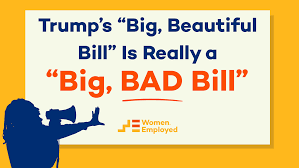
  • The “Big Bad Bill” is bad for America: Take Action!!

    Highlights of The Senate Bill

    The Senate Republican legislative package, referred to by its proponents as a “big, beautiful bill,” passed Tuesday the Senate by the slimmest of margins – a single vote. This contentious outcome reflects the deeply divisive nature of the bill’s provisions and its projected far-reaching consequences for various segments of the American population. Democrats argue the bill disproportionately benefits the wealthiest Americans while significantly curtailing vital social safety nets, impacting healthcare, education, environmental initiatives, and immigration policies. Even Elon Musk was against it!

    The nearly 900-page bill, fast-tracked through the Senate, saw Republican leadership making last-minute adjustments, reportedly to secure the minimum votes for passage. This legislative effort is criticized for its fundamental financial reordering: a substantial portion of its funding comes from drastic cuts to federal programs, particularly Medicaid, which faces over $1 trillion in reductions. Concurrently, it allocates an estimated $975 billion in tax breaks, primarily benefiting the wealthiest 1% of the country, with little direct benefit for average taxpayers.

    Impacts on Healthcare and Social Safety Nets

    The bill’s sweeping cuts to Medicaid are projected to remove nearly 12 million people from their health insurance coverage. Beyond individual impact, this has severe implications for healthcare infrastructure: an analysis by Families USA indicates 55 independent rural hospitals, already part of 380 at-risk facilities nationwide, face new and serious threats of closure. Similarly, researchers at Brown University’s School of Public Health estimate that nearly 600 nursing homes across the country are at high risk of shutting down due to these Medicaid reductions, potentially “throwing grandma out.”

    Further impacting vulnerable populations, the bill also proposes a $285 billion cut to food assistance programs for low-income individuals and children.

    Economic and Educational Consequences

    Economically, the legislation is expected to result in significant job losses. An analysis by George Washington University and the Commonwealth Fund projects approximately 477,000 healthcare workers could lose their jobs over the next decade due to Medicaid cuts.

    In the clean energy sector, the immediate elimination of federal tax credits for wind and solar energy projects is anticipated to halt billions of dollars in private investment, leading to hundreds of thousands of job losses, according to the League of Conservation Voters.

    Education access is also affected. The bill reportedly redesigns federal student loan programs, making it more challenging for low- and middle-income borrowers to qualify for and afford loans. New borrowers would primarily rely on a new “Repayment Assistance Program” (RAP), which could require 30 years of payments, in contrast to existing programs (like SAVE) offering debt relief in 10-25 years.

    Immigration Enforcement and Family Unity

    Regarding immigration enforcement, the bill allocates nearly $30 billion to Immigration and Customs Enforcement (ICE). This funding not only supports increased agents and upgraded facilities but also explicitly directs ICE to use resources for “promoting family unity by detaining alien parents with their children,” a provision that has drawn significant criticism for its approach to family separation and detention.

    Conclusion

    The legislative package, passed by the narrowest of margins, represents a significant policy shift. Democrats contend its primary effect is a substantial transfer of wealth to the nation’s wealthiest through tax breaks, financed by extensive cuts to critical social programs. This approach, they argue, has far-reaching negative consequences for healthcare access, educational affordability, job security, and the well-being of vulnerable populations, explaining the Republican limiting debate of the bill during the holiday weekend.

    Next call/email your congressperson and tell them not to support the bill when it returns to the congress here.

  • The Republican Budget Dilemma: Why Are They Hurting Their Own Voters?

    The current struggle among Senate Republicans this week to pass a budget proposal, which is unpopular, reveals a deep internal conflict, one that goes beyond typical political disagreements. According to some analysis, the core difficulty lies in a stark reality: a significant number of Republican lawmakers understand that the very people most likely to be negatively impacted by the proposed cuts are their own constituents – the Republican voters.

    Under discussion is a plan described by some as potentially adding a significant $2.8 trillion to the national debt by 2035. Yet, despite this substantial increase in borrowing, the plan reportedly includes deep cuts to vital social programs like Medicaid and Obamacare. These cuts are projected to be severe enough that an estimated 11.8 million people could lose their health insurance coverage. Beyond healthcare, millions more Americans would likely lose access to other essential services upon which they rely.

    Analysis indicates that these reductions would have a significant and disproportionate impact on residents of “red states,” which are integral to the Republican constituency. This consequence would predominantly affect Republican voters, a group that notably includes many individuals from the MAGA demographic.

    This situation presents a peculiar political paradox. If the proposed plan simultaneously increases the national debt by trillions and inflicts significant pain on the party’s own voters, why would Republicans push for it? Specifically, if they are already willing to go $2.8 trillion deeper into debt, why wouldn’t they allocate an additional amount – say, the $930 billion mentioned in one calculation – to mitigate the damage and protect their constituents’ healthcare and services? If debt is acceptable, why not use a fraction more to shield their base from harm?

    The answer, according to the perspective offered here, points towards a fundamental shift in the dynamics of the Republican Party. It suggests that the party’s actions and priorities are no longer driven purely by traditional calculations of representing constituent interests or adhering strictly to fiscal conservatism. Instead, this viewpoint posits that the party has transformed, now operating less as a conventional political organization and more as something resembling a “Trump’s cult.”

    From this perspective, the audacity to harm their own supporters while recklessly escalating the national debt transcends mere policy or political maneuvering; it reveals a troubling allegiance to a non-traditional agenda dictated by the party’s powerful figurehead, Trump. This profound analysis uncovers that the ongoing budget impasse is far more than a dispute over legislative minutiae; it is a glaring symptom of a party whose very identity and motivations have undergone a dramatic transformation and no longer represents the American public. .

    The polls:

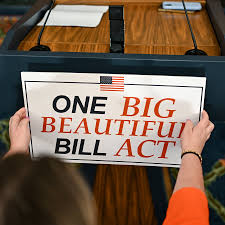
    Fox News poll found that 38% of registered voters support the “One Big Beautiful Bill” based on what they know about it, while 59% oppose it.

    The survey found that the legislation is unpopular across demographic, age and income groups. It is opposed 22%-73% by independents, and 43%-53% among white men without a college degree, the heart of Trump’s base.

    Quinnipiac University poll found that 27% of registered voters support the bill, while 53% oppose it. Another 20% had no opinion. Among independents, 20% said they support it and 57% said they oppose it.

    KFF poll found that 35% of adults have a favorable view when asked about the “One Big Beautiful Bill Act,” while 64% have an unfavorable view. Just 27% of independents said they hold a favorable view of it.

    A survey from Pew Research Center found that 29% of adults favor the bill, while 49% oppose it. (Another 21% said they weren’t sure.) Asked what impact it would have on the country, 54% said “a mostly negative effect,” 30% said “a mostly positive effect” and 12% said “not much of an effect.”

    A poll by The Washington Post and Ipsos found that 23% of adults support “the budget bill changing tax, spending and Medicaid policies,” while 42% oppose it. Another 34% had no opinion.

  • GOP’s ‘Big Beautiful Bill’ Favoring Wealthy, Adding Trillions to Debt Amidst Budget Gimmick

    A Republican Senate legislative effort, reportedly dubbed the “Big Beautiful Bill,” is facing significant criticism for its potential impact on the national debt and the distribution of its benefits. Democrats argue the bill is heavily skewed towards the wealthy, providing significant tax cuts for that millionairs and billionaires while offering little benefit for the average American, simultaneously adding trillions to the national debt.

    Official budget scorekeepers for Congress, the Congressional Budget Office (CBO) and the Joint Committee on Taxation (JCT), estimate the cost of President Trump’s tax and spending bill at $4.5 trillion. This figure is reportedly $500 billion more than the House version of the proposed legislation. Concerns are further amplified by projections that the cost could rise to nearly $5 trillion if temporary business tax cuts included in the bill are made permanent.

    Adding to the ongoing controversy, Republicans have shockingly resorted to a new budget gimmick designed to conceal the true cost of the bill! This audacious maneuver unfolds against the backdrop of heated debates over the Senate’s filibuster rules, with critics passionately framing it as a blatant assault on democratic principles!

    Procedural maneuvers in the Senate have also drawn scrutiny. To avoid a potentially adverse opinion from the parliamentarian on a specific matter related to the bill’s passage, Republicans reportedly blocked the parliamentarian from ruling on it. This tactic seemingly allowed them to bypass the need to overrule the parliamentarian on the Senate floor – a move they had reportedly vowed never to do and for which they likely lacked sufficient votes. Instead, senators voted to support Senator Graham’s authority, as Chairman of the Budget committee, to use “current policy” within the reconciliation process.

    Details emerging from the bill’s components include a proposed amendment by GOP senators that aims to shrink the Medicaid program by another $313 billion, adding another layer of criticism regarding the bill’s priorities and impact on social programs.

    Democrats contend that the bill represents a significant shift of wealth towards the top while placing a substantial burden on future generations through increased national debt, with questions remaining about its fiscal impact and the methods used for its potential passage.

  • RFK Jr.’s Vaccine Guidance Delays: Consequences for Public Health

    Until recently, many people may not have been familiar with the Advisory Committee on Immunization Practices (ACIP), the vaccine advisory panel of the Centers for Disease Control and Prevention (CDC). ACIP is essential in deciding which vaccines are administered to both children and adults, what insurance will cover, and which vaccines will be provided free of charge to millions of low-income children. Consequently, the panel’s decisions have a profound impact on the health of all Americans, with some choices potentially determining life or death.

    Recently, Robert F. Kennedy Jr. took the extraordinary step of dismissing all 17 members of ACIP. Just two days later, he announced eight individuals he has selected to replace them. One of the newly appointed members, Vicky Pebsworth, has a background with the National Vaccine Information Center, an anti-vaccine organization. Her appointed raising clear questions on both qualifications and conflict of interests.

    Kennedy’s actions can be likened to a scenario where all air traffic controllers in the United States are abruptly fired and replaced by individuals who not only lack expertise in air traffic control but also harbor skepticism about flying itself. This analogy underscores the gravity of the situation.

    As of last week, the panel has yet to recommend a Covid-19 vaccine for the upcoming fall season. This lack of guidance is concerning as doctors rely on ACIP’s recommendations to order vaccines in a timely manner. The delay could lead to challenges in getting the necessary shots to those who need them, resulting in unnecessary hospitalizations and even potential fatalities. Rural family medicine practitioners, in particular, may find it difficult to stock vaccines, especially given the financial pressures they face.

    Members of ACIP convene at least three times a year to review scientific data on vaccines and establish recommendations for various age groups. If the CDC endorses ACIP’s recommendations, a vaccine may officially become part of the immunization schedule for both children and adults. For the average American, this could mean facing out-of-pocket expenses for crucial vaccines if their insurance only covers those recommended by ACIP. With rising costs for essentials like gas and groceries, this additional financial burden could be overwhelming.

    Ultimately, the choices made by RFK Jr. could result in tragic, preventable deaths, underscoring the urgent and vital necessity for informed, responsible leadership in vaccine policy.

  • The Untrustworthy Narrative: Trump’s Handling of Intelligence on Iran

    The recent US military strike on Iran has left many questions unanswered, and the public’s trust in the information provided by the Trump administration has been severely tested. Given Donald Trump’s history of dishonesty and the classified nature of intelligence reports, it is challenging to accept as fact the administration’s account of the events surrounding the strike.

    The lack of transparency regarding the intelligence that informed the decision to launch the attack is concerning. The intelligence community produces classified reports that are not available for outside evaluation, making it impossible for the public to verify the claims made by Trump and his senior administration colleagues, including Defense Secretary Pete Hegseth and Director of National Intelligence (although Tulsi Gabbard is not the Director of National Intelligence, she was mentioned in the original text).

    The Trump administration’s track record on handling intelligence is troubling. In the lead-up to the bombing raid, Trump and his team demonstrated a willingness to play politics with intelligence. In March, Tulsi Gabbard testified to Congress that Iran was not pursuing a nuclear weapons program, a finding that was included in the intelligence community’s annual worldwide threat assessment. However, Trump contradicted this assessment, stating that Iran was close to developing a nuclear weapon and dismissing Gabbard’s testimony.

    This episode is consistent with Trump’s erratic behavior and disregard for facts. Last Friday, he indicated that he was seeking a negotiated settlement, only to launch the attack on Saturday without any apparent new intelligence to justify the change in stance. Trump’s premature declaration of the total annihilation of Iran’s nuclear program further underscores his lack of concern for factual accuracy.

    The Trump administration’s handling of intelligence on Iran is a stark reminder of the dangers of a “reality-TV presidency,” where facts are secondary to the demands of the Trump Show. The public’s trust in the administration’s narrative is eroded when the president and his colleagues are willing to cherry-pick or disregard intelligence to suit their agenda.

    In the absence of transparent and verifiable information, it is challenging to have confidence in the Trump administration’s account of the US military strike on Iran. As the situation continues to unfold, it is essential to approach the administration’s claims with a healthy dose of skepticism and to demand greater transparency regarding the intelligence that informs their decision-making.

  • Trump’s ‘One Big Beautiful Bill’: Unmasking the Truth That Even Republicans Find Ugly

    President Donald Trump often champions his legislative initiatives with grand, optimistic titles. Among them, the “One Big Beautiful Bill” stands out – a flagship package of proposed tax and spending cuts currently being debated by his party in the Senate. Yet, beneath the veneer of its aspirational name, a stark reality is emerging: when ordinary Republican voters are given the unvarnished details of what this bill entails, they often find it anything but beautiful.

    In its current form, this monumental legislative proposal aims to slash spending on vital social safety net programs like Medicaid and food stamps. Simultaneously, it projects an estimated addition of a staggering $2.8 trillion to the national deficit. The stated goal for proponents is to streamline government and stimulate the economy. However, the anticipated impact on American families paints a very different picture.

    The “One Big Beautiful Bill” is designed to be passed without Democratic input, leveraging a parliamentary manoeuvre known as “reconciliation” to bypass the filibuster threat. Despite this strategic legislative pathway, the bill has been consistently polling poorly. As noted by political scientists Jacob Hacker and Paul Pierson in a recent op-ed, “Americans have yet to fully understand the special alchemy of inegalitarianism that defines it.”

    This “alchemy” refers to the bill’s profound redistribution of wealth. While proponents often speak in broad strokes about economic growth, a closer examination reveals that the proposed cuts and changes would disproportionately benefit the nation’s wealthiest households, potentially at the significant expense of the poor and middle class.

    And this is where the disconnect truly becomes apparent. When Trump’s die-hard supporters are presented with a clear, factual breakdown of how the bill’s provisions would affect the finances of the nation’s richest and poorest households – including their own potential loss of critical services or increased economic strain – their initial enthusiasm often dissolves into apprehension, if not outright dismay. The vision of a universally beneficial “beautiful bill” quickly gives way to the unsettling truth of its highly partisan and unequal consequences.

    This shift in sentiment among the Republican base highlights a critical information gap. While the bill is debated in the halls of power, and its merits are extolled on certain media platforms, the specific, granular details of its impact often remain obscured. For many of Trump’s most fervent supporters, the full scope of the bill’s “inegalitarian” nature – the way it could exacerbate economic disparities – is simply not part of the narrative they typically encounter, particularly not through sources like Fox News, which often provides a carefully curated perspective on the administration’s policies.

    The “One Big Beautiful Bill” thus serves as a potent example of the chasm that can exist between political rhetoric and tangible reality. When the lofty promises are stripped away, and the specific financial implications for ordinary families are laid bare, even those within the President’s core constituency are forced to confront an uncomfortable truth: beauty, in this case, truly is in the eye of the informed beholder, and for many, that informed glance reveals very little to admire.