by Winston Wendell
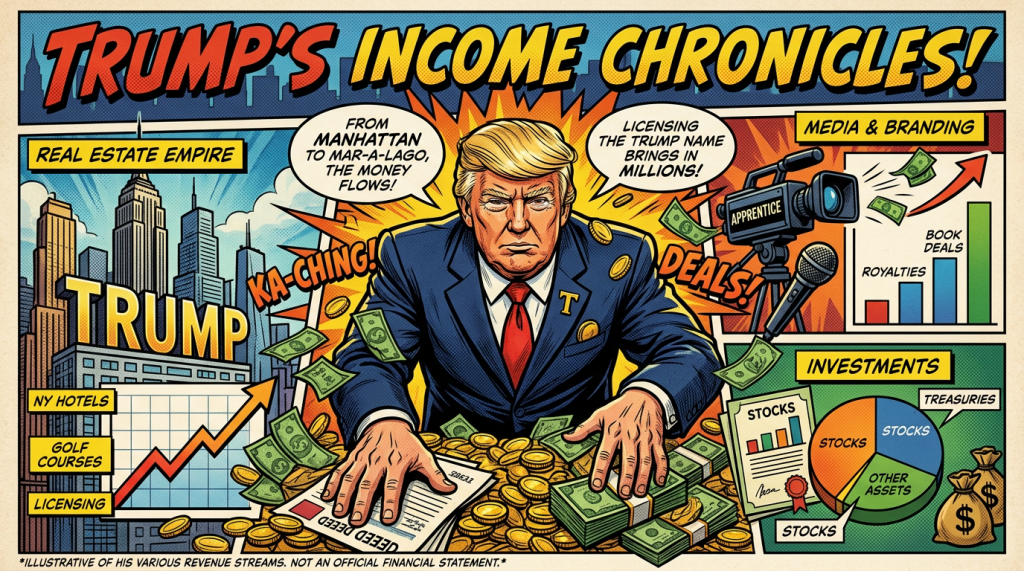
As I sifted through the 927 pages of President Donald Trump’s 2025 financial disclosure, I was struck by a central narrative the President continues to push: that his staggering two-billion-dollar fortune increase is merely a byproduct of a rising broader market. During a July 1 press conference, Trump dismissed concerns about presidential profiteering with a wave of his hand, pivoting to the universal language of the 401(k). “We’re all gaining,” he insisted.
However, as I examined the granular data buried within the document, the math simply does not align with the narrative of passive market growth. While Trump credits the bull market for his windfall, his own filing paints a different picture—one where speculative digital assets and aggressive revenue streams play a far more significant role than his equity portfolio.
The most glaring departure from the “market rally” explanation is the $1.4 billion generated by his cryptocurrency ventures. Projects like World Liberty Financial and the TRUMP meme token have proven to be gold mines for the President, even as they have proven disastrous for his followers. Blockchain-analytics firm Nansen reports that nearly a million everyday investors lost over $3.8 billion collectively in those meme tokens by mid-year. It is a sobering realization: while the President’s balance sheet surged, the capital of his supporters was effectively hollowed out.
Beyond the digital frontier, the filing details $400 million in non-equity income. This includes approximately $196 million from his real estate empire, $88.5 million in legal settlements from media and tech entities, and $65 million from overseas licensing deals spanning from the Middle East to Southeast Asia. When I weigh these figures against the total growth, it becomes clear that the stock market is, at best, a secondary player in this financial explosion.
Critics like Kedric Payne of the Campaign Legal Center argue that the “lion’s share” of this wealth growth is independent of the market. Even when looking at the most charitable estimates, non-stock gains account for between 67% and 81% of his increase.
The White House maintains that this is simply the result of a “wildly successful business career,” yet the sheer velocity of these earnings—particularly from speculative crypto assets—raises inevitable questions about the intersection of governance and private gain. When a sitting president derives the majority of his annual wealth increase from sources far removed from traditional index funds, it is no longer just a case of “everyone benefiting.” It is a financial ecosystem unto itself, one that thrives on volatility and branding in ways that leave the average 401(k) holder behind.


 Blue Press Journal